

Article Sidebar
Downloads
Main Article Content
Abstract
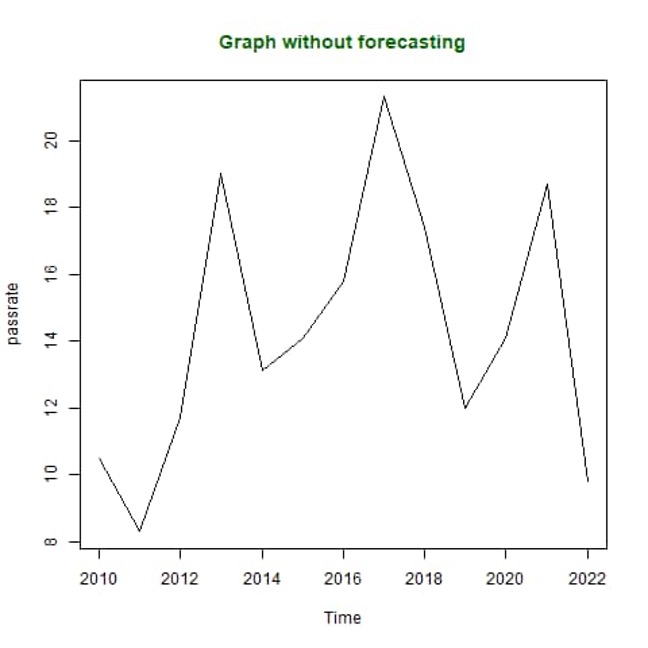
This study applies time series analysis and ARIMA forecasting to the Ordinary Level Mathematics results of one high school in Bulawayo, Zimbabwe, for the period 2010 to 2022—a period following the 2008–2009 emigration of qualified teachers that was anticipated to disrupt mathematics performance. Secondary results data were smoothed and analyzed in R Studio to identify the underlying trend through regression analysis, and an ARIMA model was fitted to forecast the school's future pass rate. To explain the observed pattern face-to-face interviews were conducted with all ten qualified mathematics teachers at the school. The pass rate followed a repeating cycle of a fall in one year being usually followed by an improvement in the next two years and both the fitted ARIMA (1,1,1) model and trend line suggested a small improvement by the sixteenth year of the series, 2025. Interview evidence linked this cycle chiefly to the rotation of teachers between examination and non-examination classes. The study recommends that the school deploy teachers with a demonstrated record of improving pass rates to examination classes, allocate more revision time, and introduce performance-based incentives while extending this line of research to the district and provincial level.
Keywords
Article Details
Copyright (c) 2026 Edward Nsingo, Silvanos Chirume

This work is licensed under a Creative Commons Attribution 4.0 International License.
References
- Aljandali, A. (2017). The Box-Jenkins Methodology. In A. Aljandali, Multivariate Methods and Forecasting with IBM® SPSS® Statistics (pp. 59–79). Springer International Publishing. https://doi.org/10.1007/978-3-319-56481-4_3
- Anderson, O. D., Box, G. E. P., & Jenkins, G. M. (1978). Time Series Analysis: Forecasting and Control. The Statistician, 27(3/4), 265. https://doi.org/10.2307/2988198
- Anyigulile, B. (2026). Time Series Forecasting of Students’ Mathematics Performance in Certificate of Secondary Education Examinations in Tanzania: Evidence from Mbeya Region Using ARIMA Models. Journal of Policy and Development Studies, 20(2), 192–207. https://doi.org/10.4314/jpds.v20i2.14
- Deogratias, E., Hezron, M., & Lupeja, T. (2025). Examining Ordinary Level Secondary Students’ Connections Between Classroom-Learned Mathematics With Their Real-Life Experiences. International Journal of Research in Mathematics Education, 3(2), 191–202. https://doi.org/10.24090/ijrme.v3i2.15203
- Fuller, S. C., & Ladd, H. F. (2013). School-Based Accountability and the Distribution of Teacher Quality Across Grades in Elementary School. Education Finance and Policy, 8(4), 528–559. https://doi.org/10.1162/EDFP_a_00112
- George, K., Harish, M., Rao, S., & Murali, K. (2017). Comparison of neural-network learning algorithms for time-series prediction. 2017 International Conference on Advances in Computing, Communications and Informatics (ICACCI), 7–13. https://doi.org/10.1109/ICACCI.2017.8125808
- Hanushek, E. A., Machin, S. J., & Woessmann, L. (2011). Handbook of the Economics of Education (Vol. 3). Elsevier. https://unesdoc.unesco.org/ark:/48223/pf0000260617
- Hyndman, R. J. (2018). Forecasting: Principles & Practice. OTexts. https://otexts.com/fpp3/
- Kolambe, M., & Arora, S. (2024). Forecasting the Future: A Comprehensive Review of Time Series Prediction Techniques. Journal of Electrical Systems, 20(2s), 575–586. https://doi.org/10.52783/jes.1478
- Kwiatkowski, D., Phillips, P. C. B., Schmidt, P., & Shin, Y. (1992). Testing the null hypothesis of stationarity against the alternative of a unit root. Journal of Econometrics, 54(1–3), 159–178. https://doi.org/10.1016/0304-4076(92)90104-Y
- Machimbidza, T., & Mutula, S. (2020). Investigating disciplinary differences in the use of electronic journals by academics in Zimbabwean state universities. The Journal of Academic Librarianship, 46(2), 102132. https://doi.org/10.1016/j.acalib.2020.102132
- Makonye, J. P. (2017). Migrant Teachers’ Perceptions of the South African Mathematics Curriculum and Their Experiences in Teaching in the Host Country. Sage Open, 7(2), 2158244017706713. https://doi.org/10.1177/2158244017706713
- Marongedza, L., Hlungwani, P. M., & Hove, P. (2023). Institutional constraints affecting secondary school student performance: A case study of rural communities in Zimbabwe. Cogent Education, 10(1), 2163552. https://doi.org/10.1080/2331186X.2022.2163552
- Mastellos, N., Tran, T., Dharmayat, K., Cecil, E., Lee, H. Y., Wong, C. C. P., Mkandawire, W., Ngalande, E., Wu, J. T. S., Hardy, V., Chirambo, B. G., & O’Donoghue, J. M. (2018). Training community healthcare workers on the use of information and communication technologies: A randomised controlled trial of traditional versus blended learning in Malawi, Africa. BMC Medical Education, 18(1), 1–13. https://doi.org/10.1186/s12909-018-1175-5
- McCarville, D. J. (2026). Modern Benford’s Law: State of the Art Techniques for Audit and Compliance Professionals (1st ed.). CRC Press. https://doi.org/10.1201/9781003562238
- Mema, B., & Zela, K. (2024). Predictive Analysis of Educational Trends: A Time Series Approach to State Matriculation Exam Performance. Journal of Educational and Social Research, 14(5), 371. https://doi.org/10.36941/jesr-2024-0145
- Mills, T. C. (2015). Non-stationary Time Series: Differencing and ARIMA Modelling. In T. C. Mills, Time Series Econometrics (pp. 41–57). Palgrave Macmillan UK. https://doi.org/10.1057/9781137525338_3
- Oluniyi, A. S., & Oluwatoyin, A. J. (2020). Mathematics as a prerequisite for admission into universities in Nigeria: A call for awareness creation and attitudinal change. The African Journal of Behavioural and Scale Development Research, 2(2), 151–158. https://doi.org/10.58579/AJB-SDR/2.2.2020.151
- Piepho, H. (2019). A coefficient of determination ( R2 ) for generalized linear mixed models. Biometrical Journal, 61(4), 860–872. https://doi.org/10.1002/bimj.201800270
- Piepho, H. (2023). An adjusted coefficient of determination ( R2 ) for generalized linear mixed models in one go. Biometrical Journal, 65(7), 2200290. https://doi.org/10.1002/bimj.202200290
- Ramos, F., Costa, A., & Mendes, D. (2017). Forecasting financial time series: A comparative study. https://doi.org/10.13140/RG.2.2.11548.41606
- Rizvi, M. F. (2024). ARIMA Model Time Series Forecasting. International Journal for Research in Applied Science and Engineering Technology, 12(5), 3782–3785. https://doi.org/10.22214/ijraset.2024.62416
- Rosman, P. A. S., Rahman, N. H. A., Nunkaw, O., & Fabregas, A. C. (2025). Milestones and developments in classical statistical time series forecasting: A comprehensive review. Data Analytics and Applied Mathematics (DAAM), 9–22. https://doi.org/10.15282/daam.v6i1.12113
- Sahlaoui, H., Alaoui, E. A. A., Nayyar, A., Agoujil, S., & Jaber, M. M. (2021). Predicting and Interpreting Student Performance Using Ensemble Models and Shapley Additive Explanations. IEEE Access, 9, 152688–152703. https://doi.org/10.1109/ACCESS.2021.3124270
- Shepard, L. A. (2000). The Role of Assessment in a Learning Culture. Educational Researcher, 29(7), 4–14. https://doi.org/10.3102/0013189X029007004
- Siami-Namini, S., Tavakoli, N., & Siami Namin, A. (2018). A Comparison of ARIMA and LSTM in Forecasting Time Series. 2018 17th IEEE International Conference on Machine Learning and Applications (ICMLA), 1394–1401. https://doi.org/10.1109/ICMLA.2018.00227
- Suleiman, I. B., Okunade, O. A., Dada, E. G., & Ezeanya, U. C. (2024). Key factors influencing students’ academic performance. Journal of Electrical Systems and Information Technology, 11(1), 41. https://doi.org/10.1186/s43067-024-00166-w
- Surur, A. M., Pujilestari, S., & Ridwanulloh, M. U. (2026). Pedagogical Anchors Amid Pedagogical Dilemmas: The Myth of Innovation and Unsustainable Expectations within Mathematics Education Research. International Journal of Review in Mathematics Education, 108–123. https://doi.org/10.23917/ijrime.15736
- Taylor, J. W. (2003). Exponential smoothing with a damped multiplicative trend. International Journal of Forecasting, 19(4), 715–725. https://doi.org/10.1016/S0169-2070(03)00003-7
- Zareie, B., Poorolajal, J., Roshani, A., Menbari, A., & Karami, M. (2024). Outbreak detector: A web application to boost disease surveillance systems and timely detection of infectious disease epidemics. BMC Research Notes, 17(1), 229. https://doi.org/10.1186/s13104-024-06892-8
References
Aljandali, A. (2017). The Box-Jenkins Methodology. In A. Aljandali, Multivariate Methods and Forecasting with IBM® SPSS® Statistics (pp. 59–79). Springer International Publishing. https://doi.org/10.1007/978-3-319-56481-4_3
Anderson, O. D., Box, G. E. P., & Jenkins, G. M. (1978). Time Series Analysis: Forecasting and Control. The Statistician, 27(3/4), 265. https://doi.org/10.2307/2988198
Anyigulile, B. (2026). Time Series Forecasting of Students’ Mathematics Performance in Certificate of Secondary Education Examinations in Tanzania: Evidence from Mbeya Region Using ARIMA Models. Journal of Policy and Development Studies, 20(2), 192–207. https://doi.org/10.4314/jpds.v20i2.14
Deogratias, E., Hezron, M., & Lupeja, T. (2025). Examining Ordinary Level Secondary Students’ Connections Between Classroom-Learned Mathematics With Their Real-Life Experiences. International Journal of Research in Mathematics Education, 3(2), 191–202. https://doi.org/10.24090/ijrme.v3i2.15203
Fuller, S. C., & Ladd, H. F. (2013). School-Based Accountability and the Distribution of Teacher Quality Across Grades in Elementary School. Education Finance and Policy, 8(4), 528–559. https://doi.org/10.1162/EDFP_a_00112
George, K., Harish, M., Rao, S., & Murali, K. (2017). Comparison of neural-network learning algorithms for time-series prediction. 2017 International Conference on Advances in Computing, Communications and Informatics (ICACCI), 7–13. https://doi.org/10.1109/ICACCI.2017.8125808
Hanushek, E. A., Machin, S. J., & Woessmann, L. (2011). Handbook of the Economics of Education (Vol. 3). Elsevier. https://unesdoc.unesco.org/ark:/48223/pf0000260617
Hyndman, R. J. (2018). Forecasting: Principles & Practice. OTexts. https://otexts.com/fpp3/
Kolambe, M., & Arora, S. (2024). Forecasting the Future: A Comprehensive Review of Time Series Prediction Techniques. Journal of Electrical Systems, 20(2s), 575–586. https://doi.org/10.52783/jes.1478
Kwiatkowski, D., Phillips, P. C. B., Schmidt, P., & Shin, Y. (1992). Testing the null hypothesis of stationarity against the alternative of a unit root. Journal of Econometrics, 54(1–3), 159–178. https://doi.org/10.1016/0304-4076(92)90104-Y
Machimbidza, T., & Mutula, S. (2020). Investigating disciplinary differences in the use of electronic journals by academics in Zimbabwean state universities. The Journal of Academic Librarianship, 46(2), 102132. https://doi.org/10.1016/j.acalib.2020.102132
Makonye, J. P. (2017). Migrant Teachers’ Perceptions of the South African Mathematics Curriculum and Their Experiences in Teaching in the Host Country. Sage Open, 7(2), 2158244017706713. https://doi.org/10.1177/2158244017706713
Marongedza, L., Hlungwani, P. M., & Hove, P. (2023). Institutional constraints affecting secondary school student performance: A case study of rural communities in Zimbabwe. Cogent Education, 10(1), 2163552. https://doi.org/10.1080/2331186X.2022.2163552
Mastellos, N., Tran, T., Dharmayat, K., Cecil, E., Lee, H. Y., Wong, C. C. P., Mkandawire, W., Ngalande, E., Wu, J. T. S., Hardy, V., Chirambo, B. G., & O’Donoghue, J. M. (2018). Training community healthcare workers on the use of information and communication technologies: A randomised controlled trial of traditional versus blended learning in Malawi, Africa. BMC Medical Education, 18(1), 1–13. https://doi.org/10.1186/s12909-018-1175-5
McCarville, D. J. (2026). Modern Benford’s Law: State of the Art Techniques for Audit and Compliance Professionals (1st ed.). CRC Press. https://doi.org/10.1201/9781003562238
Mema, B., & Zela, K. (2024). Predictive Analysis of Educational Trends: A Time Series Approach to State Matriculation Exam Performance. Journal of Educational and Social Research, 14(5), 371. https://doi.org/10.36941/jesr-2024-0145
Mills, T. C. (2015). Non-stationary Time Series: Differencing and ARIMA Modelling. In T. C. Mills, Time Series Econometrics (pp. 41–57). Palgrave Macmillan UK. https://doi.org/10.1057/9781137525338_3
Oluniyi, A. S., & Oluwatoyin, A. J. (2020). Mathematics as a prerequisite for admission into universities in Nigeria: A call for awareness creation and attitudinal change. The African Journal of Behavioural and Scale Development Research, 2(2), 151–158. https://doi.org/10.58579/AJB-SDR/2.2.2020.151
Piepho, H. (2019). A coefficient of determination ( R2 ) for generalized linear mixed models. Biometrical Journal, 61(4), 860–872. https://doi.org/10.1002/bimj.201800270
Piepho, H. (2023). An adjusted coefficient of determination ( R2 ) for generalized linear mixed models in one go. Biometrical Journal, 65(7), 2200290. https://doi.org/10.1002/bimj.202200290
Ramos, F., Costa, A., & Mendes, D. (2017). Forecasting financial time series: A comparative study. https://doi.org/10.13140/RG.2.2.11548.41606
Rizvi, M. F. (2024). ARIMA Model Time Series Forecasting. International Journal for Research in Applied Science and Engineering Technology, 12(5), 3782–3785. https://doi.org/10.22214/ijraset.2024.62416
Rosman, P. A. S., Rahman, N. H. A., Nunkaw, O., & Fabregas, A. C. (2025). Milestones and developments in classical statistical time series forecasting: A comprehensive review. Data Analytics and Applied Mathematics (DAAM), 9–22. https://doi.org/10.15282/daam.v6i1.12113
Sahlaoui, H., Alaoui, E. A. A., Nayyar, A., Agoujil, S., & Jaber, M. M. (2021). Predicting and Interpreting Student Performance Using Ensemble Models and Shapley Additive Explanations. IEEE Access, 9, 152688–152703. https://doi.org/10.1109/ACCESS.2021.3124270
Shepard, L. A. (2000). The Role of Assessment in a Learning Culture. Educational Researcher, 29(7), 4–14. https://doi.org/10.3102/0013189X029007004
Siami-Namini, S., Tavakoli, N., & Siami Namin, A. (2018). A Comparison of ARIMA and LSTM in Forecasting Time Series. 2018 17th IEEE International Conference on Machine Learning and Applications (ICMLA), 1394–1401. https://doi.org/10.1109/ICMLA.2018.00227
Suleiman, I. B., Okunade, O. A., Dada, E. G., & Ezeanya, U. C. (2024). Key factors influencing students’ academic performance. Journal of Electrical Systems and Information Technology, 11(1), 41. https://doi.org/10.1186/s43067-024-00166-w
Surur, A. M., Pujilestari, S., & Ridwanulloh, M. U. (2026). Pedagogical Anchors Amid Pedagogical Dilemmas: The Myth of Innovation and Unsustainable Expectations within Mathematics Education Research. International Journal of Review in Mathematics Education, 108–123. https://doi.org/10.23917/ijrime.15736
Taylor, J. W. (2003). Exponential smoothing with a damped multiplicative trend. International Journal of Forecasting, 19(4), 715–725. https://doi.org/10.1016/S0169-2070(03)00003-7
Zareie, B., Poorolajal, J., Roshani, A., Menbari, A., & Karami, M. (2024). Outbreak detector: A web application to boost disease surveillance systems and timely detection of infectious disease epidemics. BMC Research Notes, 17(1), 229. https://doi.org/10.1186/s13104-024-06892-8