Environmental Reflexivity, Youth Participation, and Inclusive Sustainability Education: Learning from School-Based Waste Bank Initiatives
DOI:
https://doi.org/10.23917/sosial.v7i1.16323Keywords:
environmental reflexivity, inclusive education, waste bank, youth agency, sustainabilityAbstract
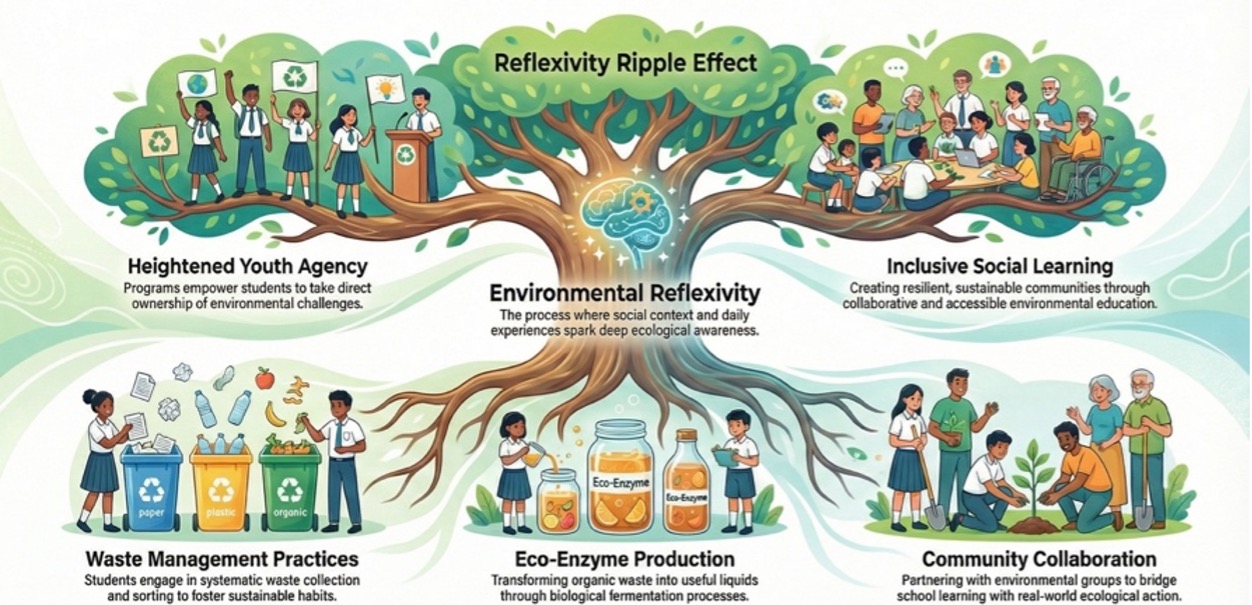
Although the environmental crisis has emerged as a global issue, student involvement in environmental activism remains restricted. This study aims to examine the background and forms of environmental reflexivity of students of Maitreyawira High School, Batam, who are involved in the Baswira waste bank program. This study used a qualitative approach to collect data through observation, in-depth interviews, and document analysis of eight participants. The results show that the background and the nature of the students’ activities were derived from their daily experience and social interaction in the waste bank activities. Consequently, ecological consciousness and responsible behaviour towards the environment have developed gradually. The waste bank programme also functions as a social space for inclusive learning and encourages students to participate actively in sustainability practices. This study highlights the significance of the practical potential of school-based environmental education for the formation of environmental responsibility and the development of sustainable communities.
Downloads
References
Asteria, D., Santoso, T., & Sari, R. (2018). Local action for waste bank management through an environmental communication strategy and a collaborative approach for the sustainability of villages. In R. Adi & R. Achwan (Eds.), Competition and cooperation in social and political sciences (p. 49-54). Routledge.
Azliana, N., Rahman, F. A., & Pratiwi, B. Y. H. (2024). Peningkatan Kesadaran Anak Usia Sekolah Dalam Menjaga Kebersihan Lingkungan Melalui Pembuatan Bank Sampah di Pondok Pesantren Nashriyah NW Sekunyit, Desa Bunut Baok Kabupaten Lombok Tengah. Bhakti: Jurnal Pengabdian Masyarakat, 1(1), 32–41.
Beck, U. (1992). Risk Society: Towards a New Modernity. SAGE Publications.
Beck, U., Bonss, W., & Lau, C. (2003). The Theory of Reflexive Modernization: Problematic, Hypotheses and Research Programme. Theory, Culture & Society. https://doi.org/10.1177/0263276403020002001
Boström, M., Lidskog, R., & Uggla, Y. (2017). A reflexive look at reflexivity in environmental sociology. Environmental Sociology, 3(1), 6–16. https://doi.org/10.1080/23251042.2016.1237336
Butar-butar, S. A., Sunarto, & Wahyuningtyas, R. S. (2025). Sikap Peduli Lingkungan Siswa Terhadap Pelaksanaan Program Adiwiyata Di SMP Negeri 11 Kota Bekasi. BIOSFER, 10(1). https://doi.org/10.23969/biosfer.v10i1.23039
Christley, E., Lai, Y. Y., Brauer, H. B., & Ingersoll, A. A. (2025). A beginner’s guide to reflexivity in energy research and social science. Energy Research and Social Science, 127. https://doi.org/10.1016/j.erss.2025.104267
Creswell, J. W. (2016). Research Design Pendekatan Metode Kualitatif, Kuantitatif, dan Campuran Edisi Keempat. Pustaka Pelajar.
Dompak, T., & Simarmata, N. (2017). Pengaruh Pengetahuan dan Sikap terhadap Partisipasi Masyarakat pada Pengelolaan Bank Sampah di Kecamatan Batu Aji - Kota Batam. Jurnal Dialektika Publik, 2(1). https://doi.org/10.33884/dialektikapublik.v2i1.223
Eurostat. (2024). Waste statistics. Eurostat.Eu. https://ec.europa.eu/eurostat/statistics-explained/index.php?title=Waste_statistics#Hazardous_waste_treatment
FAO and UNEP. (2020). The State of the World’s Forests 2020. Forests, biodiversity and people. In Rome. FAO and UNEP. https://doi.org/10.4060/ca8642en
Fook, J. (1999). Reflexivity as Method. Annual Review of Health Social Science, 9(1), 11–20. https://doi.org/10.5172/hesr.1999.9.1.11
Hakim, M. Z. (2019). Pengelolaan dan Pengendalian Sampah Plastik Berwawasan Lingkungan. Amanna Gappa, 27(2), 111–121.
Hidayati, F., Solida, A., Butar Butar, M., & Rahmat, A. A. (2023). Ekoliterasi Siswa Melalui Pengelolaan Sampah Dan Pelatihan Pembuatan Ecobrick. Jurnal Salam Sehat Masyarakat (JSSM), 5(1), 25–34. https://doi.org/10.22437/jssm.v5i1.28162
Hossain, M. A., Ferdous, N., & Ferdous, E. (2024). Crisis-driven disruptions in global waste management: Impacts, challenges and policy responses amid COVID-19, Russia-Ukraine war, climate change, and colossal food waste. In Environmental Challenges (Vol. 14). Elsevier B.V. https://doi.org/10.1016/j.envc.2023.100807
Kahn, P., Everington, L., Kelm, K., Reid, I., & Watkins, F. (2017). Understanding student engagement in online learning environments: the role of reflexivity. Educational Technology Research and Development, 65(1), 203–218. https://doi.org/10.1007/s11423-016-9484-z
IPCC. (2021). Climate Change 2021: The Physical Science Basis. Contribution of Working Group I to the Sixth Assessment Report of the Intergovernmental Panel on Climate Change. In V. Masson-Delmotte, P. Zhai, A. Pirani, S. L. Connors, C. Pean, Y. Chen, L. Goldfarb, M. I. Gomis, J. B. R. Matthews, S. Berger, M. Huang, O. Yelekci, R. Yu, B. Zhou, E. Lonnoy, T. K. Maycock, T. Waterfield, K. Leitzell, & N. Caud (Eds.), IPCC Sixth Assessment Report. Cambridge University Press. https://doi.org/doi:10.1017/9781009157896
Jarvis, D. S. L. (2007). Risk , Globalisation and the State : A Critical Appraisal of Ulrich Beck and the World Risk Society Thesis. Global Society, 21(1). https://doi.org/10.1080/13600820601116468
Jong, A. (2022). World Risk Society and Constructing Cosmopolitan Realities : A Bourdieusian Critique of Risk Society. Frontiers in Sociology, 7, 1–13. https://doi.org/10.3389/fsoc.2022.797321
Liao, C., & Li, H. (2019). Environmental education, knowledge, and high school students’ intention toward separation of solid waste on campus. International Journal of Environmental Research and Public Health, 16(9). https://doi.org/10.3390/ijerph16091659
Lobo, B. (2025). Environmental crisis in the modern era: a comprehensive analysis of urban growth, consumption, climate change, and sustainability challenges. Revista Científica Sistemática, 15(2). https://doi.org/10.56238/rcsv15n2-010
Maulydazahara, N. (2023). Ekoliterasi Siswa dalam Pengelolaan Sampah di Sekolah Menengah Atas (SMA). Universitas Islam Negeri Raden Intan Lampung.
Miles, M. B., Huberman, A. M., & Saldana, J. (2014). Qualitative Data Analysis (3rd ed.). SAGE Publications.
Ministry of Environment and Forestry of the Republic of Indonesia. (2020). National Plastic Waste Reduction Strategic Actions For Indonesia.
Mourent, F., Pariela, T. D., & Saija, D. E. B. (2023). Partisipasi Masyarakat Dalam Penyelenggaraan Bank Sampah Ambon Hijau Pada Komunitas Green Moluccas. Komunitas: Jurnal Ilmu Sosiologi, 6(2), 86–101.
Munawar, S., Heryanti, E., & Miarsyah, M. (2019). Hubungan Pengetahuan Lingkungan Hidup dengan Kesadaran Lingkungan pada Siswa Sekolah Adiwiyata. Jurnal Pendidikan IPA, 9(1), 2406–7393.
O’Brien, M. (1998). Theorising modernity: Reflexivity, identity and environment in Giddens’ social theory (M. O’Brien, S. Penna, & C. Hay, Eds.). Routledge.
Onny, F. (2025). Implementasi Teknologi dalam Pendidikan Ekologi untuk Meningkatkan Pemahaman Siswa tentang Isu Lingkungan. Educatoria : Jurnal Ilmiah Ilmu Pendidikan, 5(1), 1–8. https://doi.org/10.36312/educatoria.v5i1.332
Pallett, H., & Chilvers, J. (2013). A decade of learning about publics, participation & climate change: institutionalising reflexivity? Environment and Planning A: Economy and Space, 45(5). https://doi.org/10.1068/a45252
Ramdani, R., Yuliana, I., Alpiansah, R., Agus Pratama, A., & Dewi, P. (2024). Discussion on Radio: Peran Generasi Muda dalam Menjaga Lingkungan. JILPI : Jurnal Ilmiah Pengabdian Dan Inovasi, 2(4), 719–728. https://doi.org/10.57248/jilpi.v2i4.392
Rasidi, R., Istiningsih, G., & Pinilih, S. S. (2020). Iptek Mitigasi Sampah Plastik Pada Sekolah Dasar Di Kecamatan Mertoyudan. Jurnal SEMAR, 9(2), 25–38. https://doi.org/10.20961/semar.v9i2.43414
Rokhmah, U. N. (2019). Pelaksanaan Program Adiwiyata sebagai Upaya Pembentukan Karakter Peduli Lingkungan Siswa di Madrasah Ibtidaiyah. Al Qalam: Jurnal Ilmiah Keagamaan Dan Kemasyarakatan, 13(1). http://dx.doi.org/10.35931/aq.v0i0.133
Singh, R. L., & Singh, P. K. (2017). Global Environmental Problems. In R. L. Singh (Ed.), Principles and Applications of Environmental Biotechnology for a Sustainable Future. Applied Environmental Science and Engineering for a Sustainable Future (pp. 13–41). Springer. https://doi.org/10.1007/978-981-10-1866-4_2
van Leeuwen, J., & Surya, I. R. F. (2024). Network power and exclusion of informal waste pickers when plastic flows change: A case study of community waste banks in Klaten Municipality in Indonesia. Marine Policy, 167. https://doi.org/10.1016/j.marpol.2024.106285
Wang, S., Lanau, M., Österbring, M., Wallbaum, H., & Rosado, L. (2026). Barriers to reducing, reusing, and recycling plastic waste in the construction sector: A European perspective for construction companies. In Cleaner Environmental Systems (Vol. 20). Elsevier Ltd. https://doi.org/10.1016/j.cesys.2026.100400
Wynne, B. (2002). Risk and Environment as Legitimatory Discourses of Technology: Reflexivity Inside Out? Current Sociology, 50(3), 459–477. https://doi.org/10.1177/0011392102050003010
Downloads
Submitted
Accepted
Published
How to Cite
Issue
Section
License
Copyright (c) 2026 Sheren Cyntia Kim, Leo Nardion, Martinus Danang Pamungkas, Cindy Xavier

This work is licensed under a Creative Commons Attribution-NonCommercial 4.0 International License.