The Influence of Social Media Use, Demographic, and Critical Thinking Skills on the Digital Citizenship
DOI:
https://doi.org/10.23917/sosial.v7i1.15062Keywords:
critical thinking skills, demographics, digital citizenship, social media useAbstract
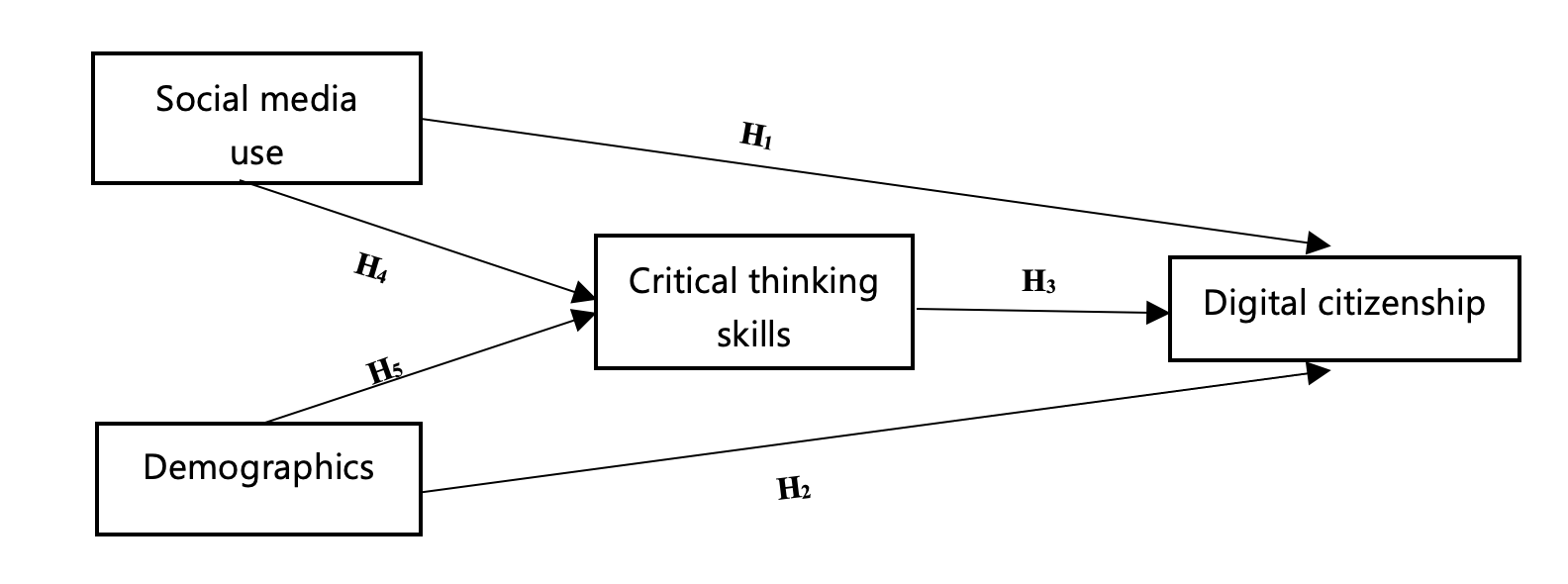
This study aims to analyze the influence of social media use, demographic factors, and critical thinking skills on digital citizenship among students at the Faculty of Teacher Training and Education, Universitas Muhammadiyah Surakarta. This study used a quantitative approach with a correlational design, involving 367 active student respondents who were selected proportionally from various study programs. The results indicate that social media use and critical thinking skills have a positive and significant effect on the digital citizenship. In addition, demographic factors such as gender, parental education, and level of study also have a significant relationship with digital citizenship. Mediation analysis shows that critical thinking skills can mediate the influence of social media use on digital citizenship, but do not mediate the influence of demographics. This study provides a new contribution by revealing the important role of critical thinking skills as a mediator between social media use and digital citizenship among prospective teacher students. These findings are useful for the development of digital literacy curricula in higher education, especially in strengthening digital citizenship competencies through the use of social media and the strengthening of critical thinking skills.Downloads
References
Akduman, G., Karadal, H., & Dinçer, E. (2024). Analysis of demographic variables affecting digital citizenship in turkey. Economics, 18(1). https://doi.org/10.1515/econ-2022-0092
Al-fadhilah, N. Z., & Fatiha, Azzahra, G. (2024). Peranan TIK dalam meningkatkan kualitas pendidikan di era digital. Jurnal Multidisiplin Inovatif, 8(9).
Al-otaibi, N. (2025). Cultural intelligence and its relationship to digital citizenship skills among university students. Humanities & Social Sciences Communications. https://doi.org/https://doi.org/10.1057/s41599-025-06096-w
Al-Zahrani, A. (2015). Toward digital citizenship: examining factors affecting participation and involvement in the internet society among higher education students. International Education Studies, 8(12). https://doi.org/10.5539/ies.v8n12p203
Alamri, H. E., & Alqahtani, A. A. (2022). Digital citizenship among saudi community colleges’ undergraduates : reality and requirements for enablement. European Online Jurnal of Natural and Social Sciences, 11(4), 1144–1165. http://european-sciences.com
Ali, M. R. N. R. (2025). Peran literasi digital dalam mendorong kemampuan berpikir siswa sekolah menengah atas: kajian literatur terkini. Jurnal Riset Dan Pengabdian Interdisipliner, 2(3), 590–596. https://doi.org/10.37905/jrpi.v2i3.33148
Bae, S.-M. (2022). The mediating effect of digital literacy on the relationship between smartphone use motives and life satisfaction for senior citizens in Korea. Iranian Journal of Public Health, 51(2), 336=344. https://ijph.tums.ac.ir/index.php/ijph/article/view/19620
Choi, M. (2016). A concept analysis of digital citizenship for democratic citizenship education in the internet age. Theory & Research in Social Education, 44(4), 1–43. https://doi.org/10.1080/00933104.2016.1210549
Drakel, W. J., Pratiknjo, H. M., & Mulianti, T. (2018). Perilaku mahasiswa dalam menggunakan media sosial di universitas sam ratulangi manado. Journal of Social and Culture. https://ejournal.unsrat.ac.id/index.php/holistik/article/view/20559
Facione, P. a. (2015). Critical thinking : what it is and why it counts. In Insight assessment. https://www.researchgate.net/publication/251303244_Critical_Thinking_What_It_Is_and_Why_It_Counts
Fadil, M. (2025). Pengaruh media sosial terhadap keterampilan berpikir kritis. Sindoro: Cendikia Pendidikan, 17(3). https://doi.org/10.9644/sindoro.v3i9.252
Fitriana, R., & Iskandar, R. (2025). Literasi digital dan kemanusiaan: menjadi cerdas dan bijak di era digital. Jurnal Ilmiah Multidisiplin, 2(5), 665–673. https://doi.org/10.62017/merdeka
Gambeh, T. R., Rukmini, & Kurniawan, A. (2025). Karakteristik demografi dan kinerja karyawan di instalasi farmasi rumah sakit X. Jurnal Kesehatan Tambusai, 6(3).
Hanif, M., & Salsabillah, N. A. (2024). Pendidikan kewarganegaraan di era digital (perspektif teori sosialisasi politik). An-Nuha : Jurnal Kajian Islam, Pendidikan, Budaya Dan Sosial, 11(2), 273–307. https://doi.org/10.36835/annuha.v11i2.749
Ikhsan, M. (2024). analisis kemampuan berpikir kritis dalam pemanfaatan literasi digital untuk penyelesaian tugas mahasiswa PPKn Universitas Jambi [Universitas jambi]. https://repository.unja.ac.id/62544/6/FULL SKRIPSI.pdf
Jabeen, S. S., & Ahmad, F. (2021). Digital citizenship: effective use of digital media. Proccedings of Edulearn21 Conference, 6041–6048. https://doi.org/10.21125/edulearn.2021.1220
Jenkins-guarnieri, M. A., Wright, S. L., & Johnson, B. (2013). Development and validation of a social media use integration scale. Psychology of Popular Media Culture, 2(1), 38–50. https://doi.org/10.1037/a0030277
Meliyani, R. (2024). Pengaruh ketergantungan media internet terhadap kemampuan berpikir kritis pada mahasiswa di kota pekanbaru. Universitas Islam negeri Sultan Syarif Kasim.
Natalia, S., Tan, D., Winata, A. K., Davilia, A. R., Ferdinand, Noverindo, Fan, R., Kendrick, Kevin, Alvina, J., Ferando, A., Saputra, Hendy, Wibowo, Ari, Vinson, K., Huang, E., & Fernando. (2025). Era media sosial dan tantangan kesadaran kritikal di kalangan remaja. Media Mahasiswa Indonesia. https://mahasiswaindonesia.id/era-media-sosial-dan-tantangan-kesadaran-kritikal-di-kalangan-remaja/
Nickerson, C. (2025). Albert bandura ’ s social cognitive theory. Simply Psychology. https://www.simplypsychology.org/social-cognitive-theory.html
Permana, I. K. A., Agus, I. K., Yasa, S., Ari, I. K., Saputra, D., & Sudwika, I. P. R. (2023). Citizenship in the digital age: implications and challenges. Journal of Digital Law and Policy, 3(1). https://ejournal.sidyanusa.org/index.php/jdlp
Pramesty, T. S., Pasaribu, L. H., & Julyanti, E. (2025). Pengaruh tingkat pendidikan orang tua terhadap karakter siswa sekolah menengah pertama. Jurnal Kependidikan, 14(1), 39–50. https:/jurnaldidaktika.org
Purwanti, & Nurhayati, S. (2025). Pentingnya media sosial untuk meningkatkan kemampuan berpikir kritis dan kemampuan pemecahan masalah. Jurnal Akuntansi Keuangan Dan Bisnis, 2(4), 875–878. https://jurnal.ittc.web.id/index.php/jakbs/index
Putri, S., Sinulingga, B., Irwan, M., & Nasution, P. (2024). Analisis tantangan dan peluang dalam perkembangan teknologi informasi dan komunikasi diera digital: perspektif masa depan. Jurnal Ilmiah Ekonomi Dan Manajemen, 2(12), 25–35. https://doi.org/10.61722/jiem.v2i12.3018
Reza, M. (2025). Berfikir kritis sebagai solusi menghadapi krisis informasi dan polarisasi sosial. https://www.researchgate.net/publication/387948583%0ABERFIKIR
Ribble, M. (2015). Digital citizenship in schools: nine elements all students should know. International Society for Tech.
Salifu, I., Arthur, F., Opoku, E., Quayson, E., Boateng, E., Rungson, E., Asare-bediako, S., & Abam, S. (2025). Gender disparities in digital citizenship : insights from economics students in higher education. Social Sciences & Humanities Open, 12, 102233. https://doi.org/10.1016/j.ssaho.2025.102233
Salsabila, F., Daviza, T. P., Istiqomah, K., Ibadillah, Z., Ikhsan, M., Iryani, E., & Asafri, H. (2025). Membangun kecakapan literasi digital di era disinformasi : telaah teoritis dan implikasinya pada perguruan tinggi. PESHUM: Jurnal Pendidikan, Sosial Dan Humaniora, 4(5), 7116–7135.
Sari, Z. A. E. (2019). Literasi privasi pada media sosial instagram di kalangan mahasiswa strata 1 universitas airlangga surabaya [Universitas Airlangga]. https://repository.unair.ac.id/81339/
Wang, X., & Xing, W. (2018a). Exploring the influence of parental involvement and socioeconomic status on teen digital citizenship: a path modeling approach. Educational Technolgy & Society, 21(1), 186–199. https://www.jstor.org/stable/26273879
Wang, X., & Xing, W. (2018b). Social media competence and digital citizenship among college students. Convergence: The International Journal of Research into New Media Technologies, 25(6), 1354–1370. https://doi.org/10.1177/1354856517751390
Warastuti, W., Prayitno, H. J., & Rahmawati, L. E. (2025). Penerapan literasi digital dalam membangun kemampuan berpikir kritis siswa di sekolah dasar. Cetta: Jurnal Ilmu Pendidikan, 8(2), 350–365. https://jayapanguspress.penerbit.org/index.php/cetta
Downloads
Submitted
Accepted
Published
How to Cite
Issue
Section
License
Copyright (c) 2026 Titin Umi Lestari, Wibowo Heru Prasetiyo

This work is licensed under a Creative Commons Attribution-NonCommercial 4.0 International License.