Maqashid Sharia Analysis on Personal Data Protection from the Dangers of Artificial Intelligence Misuse
DOI:
https://doi.org/10.23917/sosial.v6i2.12636Keywords:
Artificial intelligence, Digital ethics, Maqashid Sharia, Personal Data Protection, Prophetic lawAbstract
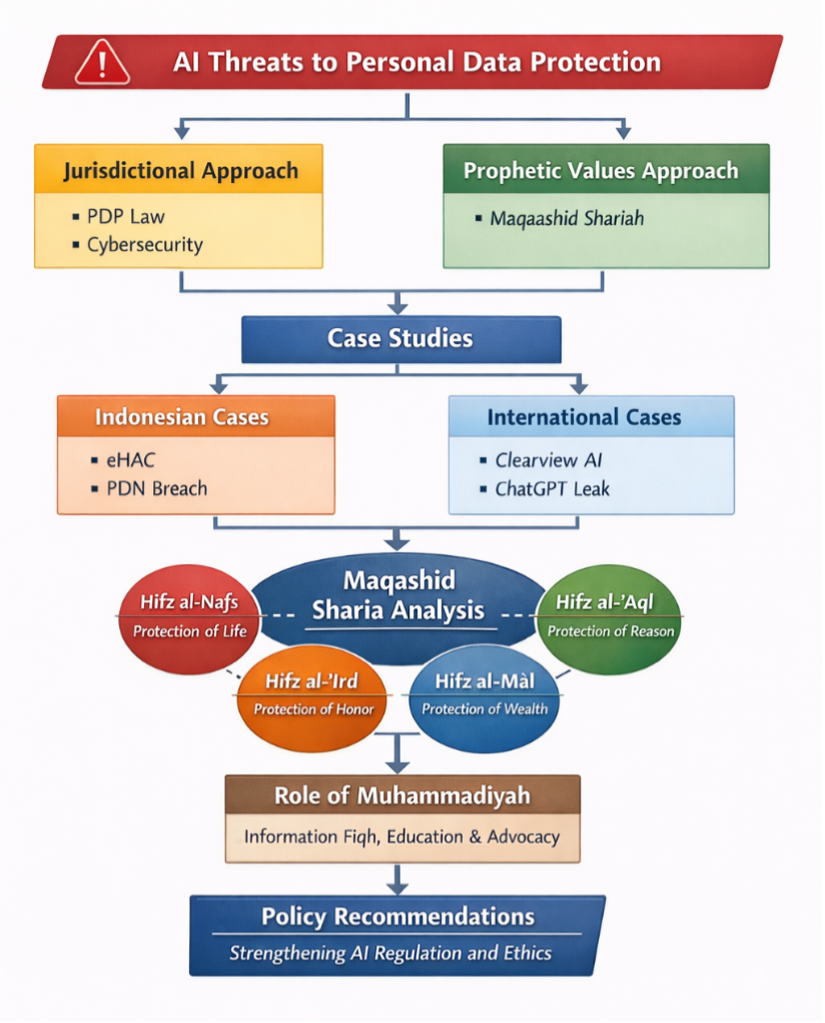
This study examines the use of AI from the perspective of prophetic law, with an emphasis on the values of justice, benefit, and equality of rights in Islamic law, based on maqashid sharia, with the intention of protecting personal data from the uncontrolled use of AI. Additionally, it highlights the role of community organizations, particularly Muhammadiyah, in providing education and advocacy related to the protection of personal data in accordance with progressive Islamic values. The socio-legal method enabled a comprehensive analysis of the social impact and legal regulations on the protection of personal data in the context of the rapid development of AI. The results of the analysis of legal facts and empirical information show that the uncontrolled use of AI is detrimental to society. The misuse of AI has been linked to several personal data leakage issues in various countries. The integration of Islamic values, based on maqashid sharia, into data protection policies is crucial for preventing the unethical exploitation of technology and ensuring that innovation remains within the benefit of the ummah. Personal data protection is intended to maintain digital ethics based on hifzun-nafs (protection of life), hifdzul-‘aql (protection of reason), and hifdzul-‘ird (protection of honor), which can provide moral and ethical justification for the development of more humanized personal data regulations in the AI era.
Downloads
References
Abraham, A. (2021). How Sociology Perspective Influences Law with a Social Context? A Book Review “Pokok-Pokok Sosiologi Hukum”, Prof Dr Soerjono Soekanto SH MA, Rajawali Pers, 269 Pages, ISBN 979-421-131-1. Indonesian Journal of Advocacy and Legal Services, 3(2), 251–256. https://doi.org/10.15294/ijals.v3i2.34788
Absori, A., Budiono, A., Jayanuarto, R., Nugroho, S. S., Nurani, S. S., Hangabei, S. M., Pahlevy, R. R., Nasir, G. A., Damayanti, F. N., Agiyanto, U., Achmadi, A., Isnandar, A., & Utomo, H. D. (2018). Pemikiran Hukum Profetik: Ragam Paradigma Menuju Hukum Berketuhanan (1st ed.). Muhammadiyah University Press. https://publikasiilmiah.ums.ac.id/bitstream/handle/11617/10301/PEMIKIRAN HUKUM PROFETIK.pdf?sequence=1#page=39
Asiri, S., Xiao, Y., & Li, T. (2024). PhishTransformer: A Novel Approach to Detect Phishing Attacks Using URL Collection and Transformer. Electronics (Switzerland), 13(1), 1–16. https://doi.org/10.3390/electronics13010030
Aswindasari, A., & Marhamah, M. (2024). Response of the Qur’an To the Transgender Phenomenon Study of Maqashidi’S Interpretation. QiST: Journal of Quran and Tafseer Studies, 3(2), 281–302. https://doi.org/10.23917/qist.v3i2.4645
Basri, M. R. (2021). Fikih Informasi, Prinsip dan Etika Informasi - Suara Muhammadiyah. https://web.suaramuhammadiyah.id/2019/11/14/fikih-informasi-prinsip-dan-etika-informasi/
Commission Guidelines on prohibited artificial intelligence practices established by Regulation (EU) 2024/1689 (AI Act) EN, Pub. L. No. 1689, 167 (2025).
Crouch, M. (2019). The Politics of Court Reform. In M. Crouch (Ed.), The Politics of Court Reform: Judicial Change and Legal Culture in Indonesia. Cambridge University Press. https://doi.org/10.1017/9781108636131
Effendi, R., Maryani, R., & Justianto, A. (2020). Study of social and economic aspects of renewable energy policies. IOP Conference Series: Earth and Environmental Science, 487(1). https://doi.org/10.1088/1755-1315/487/1/012007
European Data Protection Board, edpb. (2022). The French SA fines Clearview AI EUR 20 million | European Data Protection Board. https://www.edpb.europa.eu/news/national-news/2022/french-sa-fines-clearview-ai-eur-20-million_en?utm_source=chatgpt.com
Fageh, A., & Solikhawati, A. (2022). The Bjorka Hacking Phenomenon on Selling Personal Data as a Digital Asset from The Perspective of Maqashid Sharia. Jurnal Hukum Islam, 20(2), 279–298. https://doi.org/10.28918/jhi.v20i2.6387
Farid, A. M., Febriani, H., & Firmansyah, I. (2023). Realizing a Welfare State Based on Prophetic Islamic Law. De Jure: Jurnal Ilmiah Ilmu Hukum, 5(1), 14–20.
Gad Makhlouf, A. (2023). Continuity and Change of Traditional Islamic Law in Modern Times: tarjīḥ as a Method of Adaptation and Development of Legal Doctrines. Oxford Journal of Law and Religion, June, 55–74. https://doi.org/10.1093/ojlr/rwad010
Heinrich, F., Bornemann, K., Polenz, L., Lawonn, K., & Hansen, C. (2022). Clutch & Grasp: Activation Gestures and Grip Styles for Device-Based Interaction in Medical Spatial Augmented Reality. SSRN Electronic Journal, 180(July), 103117. https://doi.org/10.2139/ssrn.4163379
Ireland, L. (2024). We are all (not) Anonymous: Individual- and country-level correlates of support for and opposition to hacktivism. New Media and Society, 26(8), 4429–4453. https://doi.org/10.1177/14614448221122252
Islam, M. R., Islam, M. M., Afrin, M. S., Antara, A., Tabassum, N., & Amin, A. (2024). PhishGuard: A Convolutional Neural Network-Based Model for Detecting Phishing URLs with Explainability Analysis. 2024 3rd International Conference on Artificial Intelligence For Internet of Things (AIIoT), 1–6. https://doi.org/10.1109/AIIoT58432.2024.10574688
Joyce, K., Smith-Doerr, L., Alegria, S., Bell, S., Cruz, T., Hoffman, S. G., Noble, S. U., & Shestakofsky, B. (2021). Toward a Sociology of Artificial Intelligence: A Call for Research on Inequalities and Structural Change. Socius, 7. https://doi.org/10.1177/2378023121999581
Karimullah, S. S. (2023). Humanity and Justice : Exploring Human Rights in the Context of Islamic Law. TAJDID : Jurnal Ilmu Keislaman Dan Ushuluddin, 30(2), 166–187.
Kathuria, S., Rawat, P., Singh, R., Gehlot, A., Kathuria, N., & Pandey, S. (2023). Artificial Intelligence: Creation of Human Rights in Technology. 2023 International Conference on Artificial Intelligence and Smart Communication (AISC), 328–331. https://doi.org/10.1109/AISC56616.2023.10085265
Lane, L. (2023). Artificial Intelligence and Human Rights: Corporate Responsibility in AI Governance Initiatives. Nordic Journal of Human Rights, 0(0), 1–22. https://doi.org/10.1080/18918131.2022.2137288
Madjid, S. S. (2018). Prinsip-Prinsip (Asas-Asas) Muamalah. J-HES: Jurnal Hukum Ekonomi SyariaH, 2(1), 14–28. https://doi.org/10.26618/j-hes.v2i1.1353
Mallik, S., & Gangopadhyay, A. (2023). Proactive and reactive engagement of artificial intelligence methods for education: a review. Frontiers in Artificial Intelligence, 6. https://doi.org/10.3389/frai.2023.1151391
Martínez-Martínez, D. F. (2018). Unification of personal data protection in the European Union: Challenges and implications. Profesional de La Informacion, 27(1), 185–194. https://doi.org/10.3145/epi.2018.ene.17
Matulionyte, R., Nolan, P., Magrabi, F., & Beheshti, A. (2022). Should AI-enabled medical devices be explainable? International Journal of Law and Information Technology, 30(2), 151–180. https://doi.org/10.1093/ijlit/eaac015
Misruki, M., Kurniati, & Sultan, L. (2023). Aktualisasi Ta’aqquli dan Ta’abbudi dalam Penentuan Batasan Hukum Islam. Shar-E : Jurnal Kajian Ekonomi Hukum Syariah, 8(2), 202–209. https://doi.org/10.37567/shar-e.v8i2.1563
Muslimin, J. (2019). Logics, Objectives and Sociological Sides of Islamic Law. Al-Ulum, 19(1), 129–150. https://doi.org/10.30603/au.v19i1.729
Nebreda, A., Shpakivska-Bilan, D., Camara, C., & Susi, G. (2023). The Social Machine: Artificial Intelligence (AI) Approaches to Theory of Mind. In T. Lopez-Soto, A. Garcia-Lopez, & F. J. Salguero-Lamillar (Eds.), The Theory of Mind Under Scrutiny: Psychopathology, Neuroscience, Philosophy of Mind and Artificial Intelligence (pp. 681–722). Springer Nature Switzerland. https://doi.org/10.1007/978-3-031-46742-4_22
Otto, J. M., & Pompe, S. (2012). Aras Hukum Oriental. In A. W. Bedner, S. Irianto, J. M. Otto, & T. D. Wirastri (Eds.), Kajian Sosio-Legal: Seri Unsur-Unsur Penyusunan Bangunan Negara Hukum (1st ed., pp. 19–44). Pustaka Larasan.
Pratama, A. M., & Pati, U. K. (2021). Analysis Principles of Personal Data Protection on COVID-19 Digital Contact Tracing Application: PeduliLindungi Case Study. Lex Scientia Law Review, 5(2), 65–88. https://doi.org/10.15294/lesrev.v5i2.50601
Ray, A., Adams, B., & Thampapillai, D. (2022). Access to algorithms post-Robodebt: Do Freedom of Information laws extend to automated systems? Alternative Law Journal, 47(1), 10–15. https://doi.org/10.1177/1037969X211029434
Sari, F. I. (2023). Perlindungan Hukum Data Pribadi dalam Bertransaksi di E- Commerce : Perspektif Hukum Islam dan Hukum Positif. Jurnal Studi Islam Dan Hukum Syariah, 1(1), 48–65. https://doi.org/https://doi.org/10.3342/jursih.v1i1.18
Schellekens, M. (2022). Human–machine interaction in self-driving vehicles: a perspective on product liability. International Journal of Law and Information Technology, 30(2), 233–248. https://doi.org/10.1093/ijlit/eaac010
Sezgin, E. (2023). Artificial intelligence in healthcare: Complementing, not replacing, doctors and healthcare providers. Digital Health, 9, 1–5. https://doi.org/10.1177/20552076231186520
Shakhrai, S. M. (2018). Digital Constitution: Fundamental Rights and Freedoms of an Individual in a Totally Informational Society. Herald of the Russian Academy of Sciences, 88(6), 441–447. https://doi.org/10.1134/S1019331618060126
State Commissioner for Data Protection and Freedom of Information, B.-W. (2022). PimEyes: LfDI opens fine proceedings. Data Protection | Press Release. https://www.baden-wuerttemberg.datenschutz.de/pimeyes-lfdi-eroeffnet-bussgeldverfahren/
Suhendar, H., Ulum, M., & Pratami, B. D. (2023). Perlindungan Data Pribadi dalam Penyelenggaraan Fintech Lending Syariah. El Hisbah: Journal of Islamic Economic Law, 3(1), 1–15. https://doi.org/10.28918/el_hisbah.v3i1.7355
Sumantri, V. K. (2019). Legal Responsibility on Errors of the Artificial Intelligence-based Robots. Lentera Hukum, 6(2), 337–352. https://doi.org/10.19184/ejlh.v6i2.10154
Surya, E. D., Mesra, M., & Kadir, Z. A. (2024). Tourism Village Marketing Branding Towards Sustainable Tourism Based on Local Wisdom. Jurnal Manajemen Bisnis, 15(2), 275–294. https://doi.org/10.18196/mb.v15i2.23503
Tikkinen-Piri, C., Rohunen, A., & Markkula, J. (2018). EU General Data Protection Regulation: Changes and implications for personal data collecting companies. Computer Law & Security Review, 34(1), 134–153. https://doi.org/10.1016/j.clsr.2017.05.015
Trovati, M., Teli, K., Polatidis, N., Cullen, U. A., & Bolton, S. (2023). Artificial Intuition for Automated Decision-Making. Applied Artificial Intelligence, 37(1). https://doi.org/10.1080/08839514.2023.2230749
Ulum, M. B., & Dinata, A. W. (2023). Navigating Human Rights in Indonesia and Beyond. Lentera Hukum, 10(1), 1–8. https://doi.org/10.19184/ejlh.v10i1.38435
Utsman, S. (2016). Dasar-Dasar Sosiologi Hukum: Makna Dialog Antara Hukum dan Masyarakat (3rd ed.). Pustaka Pelajar.
Walsh, A., & Hemmens, C. (2016). Law, Justice, and Society: A Sociolegal Introduction (4th ed.). Oxford University Press (OUP).
Wang, C., Zhang, J., Lassi, N., & Zhang, X. (2022). Privacy Protection in Using Artificial Intelligence for Healthcare: Chinese Regulation in Comparative Perspective. Healthcare, 10(10), 1878. https://doi.org/10.3390/healthcare10101878
Zahro, A. K. (2025). Perlindungan Privasi Individu dalam Penggunaan Face Recognition Tinjauan Hukum dan Etika. SPEKTRUM HUKUM, 21(2), 150. https://doi.org/10.56444/sh.v21i2.5779
Zuboff, S. (2022). Surveillance Capitalism or Democracy? The Death Match of Institutional Orders and the Politics of Knowledge in Our Information Civilization. In Organization Theory (Vol. 3, Issue 3). https://doi.org/10.1177/26317877221129290
Downloads
Submitted
Accepted
Published
How to Cite
Issue
Section
License
Copyright (c) 2025 Achmad Miftah Farid, Fauzan Arya Pratama, Dewi Sulistyowati

This work is licensed under a Creative Commons Attribution 4.0 International License.