ICES framework: Reconstruction of Islamic Character Education in Indonesia from a Global Sustainability Perspective
DOI:
https://doi.org/10.23917/profetika.v27i03.17367Keywords:
islamic character education, ices framework, education for sustainable development, islamic values, educational transformationAbstract
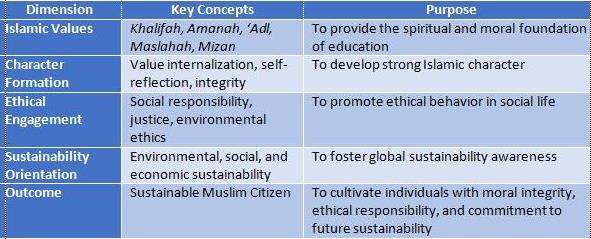
Objective: This study aims to reconstruct Islamic character education from a global sustainability perspective by developing the ICES Framework as an integrative model. Theoretical Framework: This study is grounded in Islamic educational philosophy, character education theory, and the principles of education for sustainable development, which emphasize the integration of spiritual, ethical, social, and ecological dimensions in fostering responsible global citizens. Literature Review: Existing studies indicate character education in theoretical perspective, islamic character education from the perspective of islamic thought and education for sustainable development in theoretical perspective. Methods: This study employs a qualitative research approach based on library research. Data were collected from various scholarly sources, including journal articles, books, research reports, and relevant policy documents related to Islamic education, character education, and sustainability studies. The collected data were analyzed using thematic analysis and interpretative content analysis to identify, classify, and synthesize key concepts concerning Islamic values and global sustainability principles. Results: The findings reveal a strong epistemological convergence between Islamic values such as khalifah fil ardh, ‘adl, maslahah, amanah, and mizan and the core principles of global sustainability. Based on this convergence, the ICES Framework was developed, consisting of four interconnected dimensions: Islamic Values, Character Formation, Ethical Engagement, and Sustainability Orientation. The framework provides a comprehensive approach that integrates moral integrity, spiritual awareness, social responsibility, and ecological consciousness. Implications: The study underscores the importance of reorienting Islamic character education from a predominantly normative approach toward a reflective, contextual, and sustainability-oriented pedagogy. Such a transformation can contribute to the development of individuals who possess both strong moral character and a commitment to sustainable development. Novelty: The novelty of this study lies in the development of the ICES Framework, which systematically integrates Islamic character education with global sustainability principles, offering a conceptual model that bridges local religious values and contemporary global sustainability agendas, particularly in supporting the achievement of the Sustainable Development Goals.
References
[1] R. Horner and D. Hulme, “From International to Global Development: New Geographies of 21st Century Development,” Dev. Change, vol. 50, no. 2, pp. 347–378, 2019, doi: https://doi.org/10.1111/dech.12379.
[2] E. González García, E. Colomo Magaña, and A. Cívico Ariza, “Quality Education as a Sustainable Development Goal in the Context of 2030 Agenda: Bibliometric Approach,” Sustainability, vol. 12, no. 15. p. 5884, 2020. doi: https://doi.org/10.3390/su12155884.
[3] F. M. Reimers, “The sustainable development goals and education, achievements and opportunities,” Int. J. Educ. Dev., vol. 104, p. 102965, 2024, doi: https://doi.org/10.1016/j.ijedudev.2023.102965.
[4] H. Oe, Y. Yamaoka, and H. Ochiai, “A Qualitative Assessment of Community Learning Initiatives for Environmental Awareness and Behaviour Change: Applying UNESCO Education for Sustainable Development (ESD) Framework,” International Journal of Environmental Research and Public Health, vol. 19, no. 6. p. 3528, 2022. doi: https://doi.org/10.3390/ijerph19063528.
[5] P. Glavič, “Identifying Key Issues of Education for Sustainable Development,” Sustainability, vol. 12, no. 16. p. 6500, 2020. doi: https://doi.org/10.3390/su12166500.
[6] N. Khoiriah and B. Sujanto, “Islamic Education Quality from an Islamic Perspective: An Analysis of Improvement Strategies,” J. Contemp. Islam. Educ., vol. 6, no. 1, pp. 1–16, 2026, [Online]. Available: https://journal.iaimnumetrolampung.ac.id/index.php/cie/article/view/7226
[7] T. Lickona, “Character Education The Cultivation of Virtue,” in Instructional-design Theories and Models, London: Routledge, 1999, p. 22.
[8] A. Rijal, A. Kosasih, and E. S. Nurdin, “Thomas Lickona and Yusuf Qardhawi: Creating Value for Character Education Through Narrative,” in Proceedings of the International Conference on Language, Education, and Social Science (ICLESS 2022), Atlantis Press, 2022, pp. 15–24. doi: https://doi.org/10.2991/978-2-494069-15-2_3.
[9] Y. Takizawa, M. Bambling, Y. Matsumoto, Y. Ishimoto, and S. Edirippulige, “Effectiveness of universal school-based social-emotional learning programs in promoting social-emotional skills, attitudes towards self and others, positive social behaviors, and improving emotional and conduct problems among Japanese children: a meta-ana,” Front. Educ., vol. 8, p. 1228269, 2023, [Online]. Available: https://www.frontiersin.org/journals/education/articles/10.3389/feduc.2023.1228269
[10] D. Narvaez and D. Lapsley, “Becoming a Moral Person – Moral Development and Moral Character Education as a Result of Social Interactions,” in Empirically Informed Ethics: Morality between Facts and Norms, M. Christen, C. van Schaik, J. Fischer, M. Huppenbauer, and C. Tanner, Eds., Cham: Springer International Publishing, 2014, pp. 227–238. doi: https://doi.org/10.1007/978-3-319-01369-5_13.
[11] D. Narvaez, “Wellness-Informed Classrooms with Sustaining Climates Foster Compassionate Morality,” in Second International Research Handbook on Values Education and Student Wellbeing, T. Lovat, R. Toomey, N. Clement, and K. Dally, Eds., Cham: Springer International Publishing, 2023, pp. 129–146. doi: https://doi.org/10.1007/978-3-031-24420-9_7.
[12] Anderson, Alida, and L. Valero, “Supporting academic vocabulary and social-emotional skills of students with learning disabilities through an arts-integrated social studies approach,” Teach. Except. Child., vol. 53, no. 2, pp. 150–162, 2020.
[13] A. M. Gómez-Olmedo, C. Valor, and I. Carrero, “Mindfulness in education for sustainable development to nurture socioemotional competencies: a systematic review and meta-analysis,” Environ. Educ. Res., vol. 26, no. 11, pp. 1527–1555, 2020, doi: https://doi.org/10.1080/13504622.2020.1777264.
[14] S. Sterling, “An Analysis of the Development of Sustainability Education Internationally: Evolution, Interpretation and Transformative Potential,” in The Sustainability Curriculum, New York: Routledge, 2004, p. 20.
[15] A. E. J. Wals, “Sustainability-Oriented Ecologies of Learning A response to systemic global dysfunction,” in Ecologies for Learning and Practice, New York: Routledge, 2019, p. 18.
[16] I. Mulà et al., “Catalysing Change in Higher Education for Sustainable Development: A review of professional development initiatives for university educators,” Int. J. Sustain. High. Educ., vol. 18, no. 5, pp. 798–820, Jul. 2017, doi: https://doi.org/10.1108/IJSHE-03-2017-0043.
[17] F. Khalid, “Islam and the Environment – Ethics and Practice an Assessment,” Relig. Compass, vol. 4, no. 11, pp. 707–716, Nov. 2010, doi: https://doi.org/10.1111/j.1749-8171.2010.00249.x.
[18] M. F. Khoirurrijal, A. Ala, and H. Huda, “Integrating religious and environmental education in Indonesian eco-pesantren: does student religiosity enhance environmental awareness?,” Environ. Educ. Res., pp. 1–26, 2025, doi: https://doi.org/10.1080/13504622.2025.2600602.
[19] H. Amin, A. Zaman, and E. Tok, “Education for sustainable development and global citizenship education in the GCC: a systematic literature review,” Glob. Soc. Educ., vol. 24, no. 2, pp. 359–374, 2026, doi: https://doi.org/10.1080/14767724.2023.2265846.
[20] A. Peterson, “Character education, the individual and the political,” J. Moral Educ., vol. 49, no. 2, pp. 143–157, Apr. 2020, doi: https://doi.org/10.1080/03057240.2019.1653270.
[21] J. Mezirow, “Transformative learning theory,” in Contemporary Theories of Learning, London: Routledge, 2018, p. 15.
[22] M. N. Al-Attas, The Concept of Education in Islam. Malaysia: International Institute of Islamic Thought and Civilization (ISATAC), 1980.
[23] A. Poya and H. Rizapoor, “Al-Ghazali’s Theory of Real Knowledge: An Exploration of Knowledge Integration in Islamic Epistemology through Contemporary Perspectives,” Int. J. Humanit. Educ. Soc. Sci., vol. 3, no. 2, Oct. 2023, doi: https://doi.org/10.55227/ijhess.v3i2.627.
[24] I. Sutomo, “Modification of character education into akhlaq education for the global community life,” Indones. J. Islam Muslim Soc., vol. 4, no. 2, pp. 291–316, 2014, doi: https://doi.org/10.18326/ijims.v4i2.291-316.
[25] W. M. Wan Daud, Filsafat dan Praktik Pendidikan Islam Syed Mohammad Naquib al-Attas. Bandung: Mizan, 1998.
[26] J. Auda, Maqasid al-Shariah as philosophy of Islamic law: a systems approach. London: International Institute of Islamic Thought, 2008.
[27] Muannas, M. A. A. Nasution, and Endang Ekowati, “Ecological Crisis: Seyyed Hossein Nasr’s Thought on Theophany,” Sufiya J. Islam. Stud., vol. 3, no. 1, pp. 46–58, Oct. 2025, [Online]. Available: https://journal.sufiya.org/index.php/sjis/article/view/189
[28] R. Khuza’i, I. Safrudin, and H. Suhendi, “The Thought of Isma’il Raji Al-Faruqi and Its Influence in Western and Islamic Civilization,” in Proceedings of the 2nd Social and Humaniora Research Symposium, 2020, pp. 575–579. doi: https://doi.org/10.2991/assehr.k.200225.125.
[29] P. Connolly, Approaches to the study of Religion. London: The Continuum International Publishing Group, 2006.
[30] L. J. Moleong, Metodologi Penelitian Kualitatif. In Metodologi Penelitian Kualitatif, 36th ed. Bandung: PT REMAJA ROSDAKARYA, 2017.
[31] M. Rahmat and Fahrudin, “Understanding the Meaning of Khalifah fil ardhi in the Quran and Implications on Education,” IOP Conf. Ser. Earth Environ. Sci., vol. 145, no. 1, p. 12121, 2018, doi: https://doi.org/10.1088/1755-1315/145/1/012121.
[32] F. Rahman, Islam and Modernity: Transformation of an Intellectual Tradition. London: University of Chicago Press, 1982.
[33] F. Rahman, Islam & Modernity: Transformation of an Intellectual Tradition. London: University of Chicago Press, 2017.
[34] R. Hashim, “AbdulHamid AbuSulayman: The Pioneer of Intellectual and Educational Reform of Contemporary Islamic Education,” IIUM J. Educ. Stud., vol. 14, no. 1, pp. 3–20, 2026, doi: https://doi.org/10.31436/ijes.v14i1.655.
[35] Ibn Khaldun, Muqoddimah, Terj. Ahmadie Thoha. Jakarta: Pustaka Firdaus, 2000.
[36] F. Ferianto, N. Munafiah, M. Makbul, and F. Firmansyah, “Ibnu Khaldun’s Constructivism in Islamic Education,” Al-Hayat J. Islam. Educ., vol. 8, no. 2, pp. 550–561, Apr. 2024, [Online]. Available: https://www.alhayat.or.id/index.php/alhayat/article/view/557
[37] F. Lahmar, “Islamic Education: An Islamic ‘Wisdom-Based Cultural Environment’ in a Western Context,” Religions, vol. 11, no. 8. p. 409, 2020. doi: https://doi.org/10.3390/rel11080409.
[38] V. Shiva, “Development, Ecology and Women,” in Paradigms in Economic Development, New York: Routledge, 1994, p. 11.
[39] Y. Al-Qardawi, Ri’ayat al-Biah fi Shari’ah al-Islam. Kairo: Da>r al-Shuruq, 2001.
[40] Departemen Agama RI, AL-JUMANATUL ‘ALI Al-Qur’an dan Terjemahannya. Bandung: CV. Penerbit J-ART, 2014.
[41] A. Kabir and H. Solihu, “Semantics of the Qur ’ anic Weltanschauung : A Critical Analysis of Toshihiko Izutsu ’ s Works,” Am. J. Islam Soc., vol. 26, no. 4, pp. 1–23, 2009, doi: https://doi.org/10.35632/ajis.v26i4.387.
[42] M. Nur Alif, “Al-Qur’an Semantic Study: The Word Istiwa’ Perspective Of Toshihiko Izutsu,” ARRUS J. Soc. Sci. Humanit., vol. 4, no. 5, p. 622, 2024, doi: https://doi.org/10.35877/soshum3143.
[43] Ibnu Katsir, Tafsir Ibnu Katsir Jilid 8. Sukoharjo: Insan Kamil, 2018.
[44] M. D. Fajri and Amrin, “Integration of Deep Learning in Teaching Local Wisdom Values in Islamic Education,” Mimb. Agama Budaya, vol. 42, no. 1, pp. 25–43, 2025, doi: https://doi.org/ 10.15408/mimbar.v42i1.45709.
[45] A. A. R. Supriyanto, Amrin, “ISLAMIC EDUCATION PARADIGM ( A Case Study at Islamic Boarding School of Al-Muayyad Surakarta ),” Akad. J. Pemikir. Islam, vol. 27, no. 1, pp. 31–46, 2022, doi: https://doi.org/10.32332/akademika.v27i1.4562.
[46] S. P. Bratton, S. C. Boddie, and İ. Özdemir, Handbook on Religion and the Environment. Cheltenham, UK: Edward Elgar Publishing, 2026. doi: https://doi.org/10.4337/9781035321872.
[47] I. bin M. Al-Shatibi, al-Muwafaqat. ttp: Dar Ibn ‘Affa, 1997.
[48] J. Quay, “john Dewey’s conceptualisation of experience,” in Experiential Learning and Outdoor Education, New York: Routledge, 2019, p. 20.
[49] M. Holdo, “Critical Reflection: John Dewey’s Relational View of Transformative Learning,” J. Transform. Educ., vol. 21, no. 1, pp. 9–25, 2023, doi: https://doi.org/10.1177/15413446221086727.
[50] J. Chan and S. Erduran, “Future-Oriented Science Learning and its Effects on Students’ Emotions, Futures Literacy and Agency in the Anthropocene,” Res. Sci. Educ., vol. 55, no. 4, pp. 899–919, 2025, doi: https://doi.org/10.1007/s11165-024-10213-1.
[51] A. Sen, “Development as Freedom: an India perspective,” Indian J. Ind. Relat., pp. 157–169, 2006, [Online]. Available: https://www.jstor.org/stable/27768063
[52] J. Miletzki and N. Broten, An Analysis of Amartya Sen’s Development as Freedom. London: Macat Library, 2017. doi: https://doi.org/10.4324/9781912281275.
[53] A. H. Ghozali, Ihya Ulumuddin, 2nd ed. 2005.
[54] P. Smagorinsky, “Vygotsky’s Stage Theory: The Psychology of Art and the Actor under the Direction of Perezhivanie ,” Mind, Cult. Act., vol. 18, no. 4, pp. 319–341, Oct. 2011, doi: https://doi.org/10.1080/10749039.2010.518300.
[55] Amrin & Amirullah, “Contemporary Legal Istimbat: Study on the Theory of Changes in Fatwa According to Yusuf Qardhawi,” Mizan J. Islam. LawJournal Islam. Law Stud., vol. 6, no. 1, pp. 89–108, 2022, doi: https://doi.org/10.32507/mizan.v6i1.1244.
[56] P. Freire, “Pedagogy of the Oppressed,” in Toward a Sociology of Education, London: Routledge, 1978.
Downloads
Submitted
Accepted
Published
Issue
Section
License
Copyright (c) 2026 Suherman, Nasharudin bin Zainal, Syafril Barus

This work is licensed under a Creative Commons Attribution 4.0 International License.