Maqāṣid Al-Sharī‘Ah and The Sustainable Development Goals (SDGs): Reconstructing Islamic Education for Social Justice and Environmental Balance
Keywords:
maqāṣid al-sharī‘ah, islamic studies, islamic education, environmental balance, sdgsAbstract
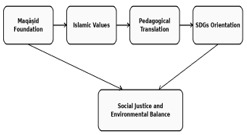
Objective: This research aims to reconstruct Islamic education through the integration of Maqāṣid al-Sharī'ah and SDGs with an emphasis on social justice and environmental balance in the context of madrasas. Theoretical framework: The theoretical framework combines the concepts of Maqāṣid al-Sharī'ah and the SDGs as a foundation in shaping education oriented towards the values of social justice, ethics, and ecological responsibility. Literature review: Literature review confirms the importance of shifting Islamic education from an approach that focuses on ritual aspects to transformative learning that supports social value and sustainability. Method: The research used a qualitative approach with a case study design at Madrasah Ibtidaiyah in Jember. Data was collected through interviews, observations, questionnaires, and documentation, and then analyzed thematically by triangulation. Results: The results show that educational practices in madrassas have reflected the values of maqāṣid and SDGs, such as religious habits, mutual respect, and environmental concern. However, the implementation of the SDGs is still implicit and not fully systematic, especially in the aspect of environmental management. Implications: Madrasas have a strategic role in supporting sustainable value-based development, so the integration of Islamic education and SDGs needs to be strengthened in the curriculum and learning practices. Novelty: This research offers an integrative framework of the Maqāṣid-SDGs that emphasizes the transformation of Islamic education towards the strengthening of social ethics and ecological awareness.
References
[1] S. S. Shikhaliev, “Reconstructing the Biography of M.-S. Saidov: a Dagestan Arabist and Caucasian Scholar,” Hist. Archeol. Ethnogr. Caucasus, vol. 19, no. 3, pp. 703–718, 2023, https://doi.org/10.32653/CH193703-718.
[2] E. A. Samier, "Authentic and Inauthentic Constructions of Islamic Educational Administration and Leadership: Contrasting Discursive Formations of Myths, Assumptions, Stereotypes, and Exclusions". Springer International Publishing, 2022. https://doi.org/10.1007/978-3-030-99097-8_76.
[3] S. Dallou and I. Al-Yabroudi, “The Foundations and Principles of Social Security in Islamic Education Based on the Destinations Vision,” Dirasat Hum. Soc. Sci., vol. 50, no. 1, pp. 1–18, 2023, https://doi.org/10.35516/hum.v50i1.4360.
[4] N. N. Ismail, M. Kamaruding, N. H. N. Ali, D. Khairuddin, A. M. R. A. Muis, and M. Z. M. Ali, “Islamic Principles in Engineering Education: Significance, Challenges, and Strategies,” Stud. Syst. Decis. Control, vol. 568, pp. 555–565, 2025, https://doi.org/10.1007/978-3-031-71526-6_48.
[5] C. Alkouatli, N. Memon, D. Chown, and Y. Sai, “Something more beautiful: educational and epistemic integrations beyond inequities in Muslim-minority contexts,” J. Multicult. Educ., vol. 17, no. 4, pp. 406–418, 2023, https://doi.org/10.1108/JME-05-2022-0062.
[6] R. Rahmawati et al., “Assessing the Implementation of Kampus Mengajar Policy in Islamic Educational Institutions,” J. Pendidik. Islam, vol. 10, no. 2, pp. 234–247, 2024, https://doi.org/10.15575/jpi.v10i2.38976.
[7] F. Mardatillah, M. Muchlinarwati, and D. Abdurrahman, “Integrating Islamic Educational Values in Higher Education: A Framework for Social Cohesion and Peacebuilding in Aceh,” J. Peacebuilding Dev., vol. 20, no. 2 Special Issue: Freedom of Religion, Development, and Peacebuilding, pp. 150–170, 2025, https://doi.org/10.1177/15423166251342683.
[8] U. J. Mirza, “Regime Change: The Need for Scientific Critical Consciousness,” Int. J. Crit. Divers. Stud., vol. 7, no. 1, pp. 86–110, 2025, https://doi.org/10.13169/intecritdivestud.7.1.0086.
[9] H. Hima, ‘Francophone’ education intersectionalities: Gender, language, and religion. Palgrave Macmillan, 2020. https://doi.org/10.1007/978-3-030-38277-3_23.
[10] I. Andriana et al., “Awakening Environmental Responsibility in Youth Through Islamic Values in Green Governance Education,” Munaddhomah, vol. 6, no. 4, pp. 650–660, 2025, https://doi.org/10.31538/munaddhomah.v6i4.2263.
[11] D. O. Khimmataliev et al., “Integrating Islamic Pedagogy and the Sustainable Development Goals in Preparing Future Educators in Uzbekistan,” J. Pendidik. Islam, vol. 11, no. 2, pp. 216–231, 2025, https://doi.org/10.15575/jpi.v11i2.48413.
[12] N. H. R. Zien, N. A. A. Bakar, and R. Saad, “Unveiling insights: A dataset analysis of Islamic quality management systems in educational institutions toward SDG-aligned education,” Data Br., vol. 54, 2024, https://doi.org/10.1016/j.dib.2024.110343.
[13] H. Abdullah et al., “Developing Tahfiz empowerment index based on Maqasid Shariah,” Int. J. Islam. Middle East. Financ. Manag., 2025, https://doi.org/10.1108/IMEFM-06-2024-0317.
[14] F. Ferdinan, A. Abdillah, A. R. Rahman, and A. R. Battiar, “Eco Islamic Education and Its Contribution to Sustainable Development Goals in Muhammadiyah Boarding Schools of South Sulawesi,” Discov. Sustain., vol. 7, no. 1, 2025, https://doi.org/10.1007/s43621-026-02647-6.
[15] M. Y. Adan, “The role of peace education in promoting social justice and sustainable peace in post-conflict societies: a 4Rs framework analysis,” Front. Polit. Sci., vol. 7, 2025, https://doi.org/10.3389/fpos.2025.1650027.
[16] Elihami and H. Pajarianto, “Sustainable development goals through Islamic education: a literature review,” J. Educ. Learn., vol. 19, no. 4, pp. 2042–2053, 2025, https://doi.org/10.11591/edulearn.v19i4.21308.
[17] Raihani, “A model of Islamic teacher education for social justice in Indonesia: a critical pedagogy perspective,” J. Indones. Islam, vol. 14, no. 1, pp. 163–186, 2020, https://doi.org/10.15642/JIIS.2020.14.1.163-186.
[18] M. J. Thalgi, “Altruism and Social Cohesion: An Islamic Perspective of Charitable Acts for Sustainable Development,” J. Islam. Thought Civiliz., vol. 14, no. 2, pp. 42–62, 2024, https://doi.org/10.32350/jitc.142.04.
[19] A. Salim, I. Suyuti, M. Gafarurrozi, L. Badriah, and N. M. S. A. B. N. Abdullah, “Transformation of State Religious School Competence: An Analysis of the 1975 Joint Ministerial Decree and Its Implications in Indonesia,” J. Pendidik. Agama Islam, vol. 21, no. 2, pp. 442–460, 2024, https://doi.org/10.14421/jpai.v21i2.9481.
[20] S. Bin Baba, M. J. Salleh, and T. M. Zayed, “Teacher as a Qudwah (Model) in Outcome-Based Islamic Education (OBLE) in Malaysian Islamic Education Institutions,” Islam. Q., vol. 65, no. 1, pp. 113–144, 2021.
[21] Husni and W. Hayden, “The Epistemology of Ta’dib in Islamic Civilizational Discourse: Reviving and Reconstructing Contemporary Muslim Scholars’ Views,” J. Al-Tamaddun, vol. 19, no. 1, pp. 181–197, 2024, https://doi.org/10.22452/JAT.vol19no1.14.
[22] A. AL-RAYSUNI, Imam Al Shatibi’s Theory of the Higher Objectives and Intents of Islamic Law. London: International Institute of Islamic Thought, 2019. https://doi.org/10.2307/j.ctvkjb1w9.
[23] M. H. Kamali, Maqasid Al-Shariah Made Simple. London: International Institute of Islamic Thought, 2019. https://doi.org/10.2307/j.ctvkc67vz.
[24] M. H. Kamali and T. Ramadan, The Middle Path of Moderation in Islam. Oxford: Oxford University Press, 2015. https://doi.org/10.1093/acprof:oso/9780190226831.001.0001.
[25] C. Tan, Islamic education and indoctrination: The case in Indonesia. New York: Routledge, 2012. https://doi.org/10.4324/9780203817766.
[26] M. C. Nussbaum, Creating Capabilities. Cambridge: Harvard University Press, 2011. https://doi.org/10.4159/harvard.9780674061200.
[27] V. Braun and V. Clarke, “Using thematic analysis in psychology,” Qual. Res. Psychol., vol. 3, no. 2, pp. 77–101, 2006, https://doi.org/10.1191/1478088706qp063oa.
[28] H. Glasser, Minding the gap: The role of social learning in linking our stated desire for a more sustainable world to our everyday actions and policies. Wageningen: Wageningen Academic Publishers, 2007. https://doi.org/10.3920/978-90-8686-594-9.
[29] M. Barth, J. Godemann, M. Rieckmann, and U. Stoltenberg, “Developing key competencies for sustainable development in higher education,” Int. J. Sustain. High. Educ., vol. 8, no. 4, pp. 416–430, 2007, https://doi.org/10.1108/14676370710823582.
[30] R. Lozano, M. Y. Merrill, K. Sammalisto, K. Ceulemans, and F. J. Lozano, “Connecting competences and pedagogical approaches for sustainable development in higher education: A literature review and framework proposal,” Sustain., vol. 9, no. 10, 2017, https://doi.org/10.3390/su9101889.
[31] J. M. Halstead, “An Islamic concept of education,” Comp. Educ., vol. 40, no. 4, pp. 517–529, 2004, https://doi.org/10.1080/0305006042000284510.
[32] J. Auda, Maqasid Al-Shariah As Philosophy Of Islamic Law: A Systems Approach. London & Washington: The International Institute of Islamic Thought, P.O. Box 669, Herndon, VA 20172, USA, 2008, https://doi.org/10.2307/j.ctvkc67tg.
[33] Ismaiza Busti, Rusydi, and R. Saputra, “The Axiological Foundations of Knowledge: A Comparison of Western and Islamic Perspectives and Their Integration in Supporting the Achievement of SDGs,” Profetika J. Stud. Islam, vol. 25, no. 02, pp. 421–432, 2025, https://doi.org/10.23917/profetika.v25i02.8528.
[34] M. Misfah, Rizka, and Muthoifin, “Management Strategies of the Modern Islamic Boarding School Assalaam Cooperative to Enhance Productive Economy in Supporting the Achievement of SDGs,” Profetika J. Stud. Islam, vol. 25, no. 02, pp. 405–420, 2024, https://doi.org/10.23917/profetika.v25i02.2182.
[35] A. A. Al-Barakat, R. M. AlAli, S. B. Alotaibi, T. M. Alrosaa, A. K. Abdullatif, and A. M. Zaher, “The contribution of early science education in developing children's awareness of carbon footprints,” Sci. Rep., vol. 16, no. 1, 2026, https://doi.org/10.1038/s41598-025-34469-3.
[36] Education for Sustainable Development Goals: learning objectives. Paris: UNESCO, 2017. https://doi.org/10.54675/cgba9153.
[37] O. A. M. Hamad, E. Baysen, and A. G. Usman, “Environmental education as a means of combating growing environmental pollution: an optimized- explainable artificial intelligence (XAI) approach,” Sci. Rep., vol. 16, no. 1, 2026, https://doi.org/10.1038/s41598-026-42335-z.
[38] N. P. Shabalala, “School stakeholders’ conceptualisation and management of the environmental education curriculum in KwaZulu-Natal secondary schools,” Discov. Educ., vol. 5, no. 1, 2026, https://doi.org/10.1007/s44217-026-01280-9.
[39] T. Yang, S. Chen, and H. Liu, “The relationship between social networks and pro-environmental behavior: a moderated mediation model,” BMC Public Health, vol. 26, no. 1, 2026, https://doi.org/10.1186/s12889-026-26361-0.
[40] T. M. A. Tran, N. P. W. P. Sari, M. T. Le, M. H. Nguyen, and Q. H. Vuong, “Exploring donation willingness for urban public parks in Vietnam through socio-demographic factors, motivations, and visitation frequency,” Discov. Sustain., vol. 7, no. 1, 2026, https://doi.org/10.1007/s43621-026-02633-y.
[41] J. B. Alves, E. S. Cardozo, V. M. Pinto, and V. B. Pereira, “Climate change in elementary education: an e-book for the transversal teaching of sustainable development goals 4, 9, 11, 12, and 13 in Brazil,” Discov. Educ., vol. 5, no. 1, 2025, https://doi.org/10.1007/s44217-025-01029-w.
Downloads
Submitted
Accepted
Published
Issue
Section
License
Copyright (c) 2026 Muhammad Alfan Fauzi, Nuzulul Ulum, Ahmad Halid, Nasyiatul Lailiyah

This work is licensed under a Creative Commons Attribution 4.0 International License.