Strengthening Student Character and SDGs Alignment via School Security Patrols: An Islamic Primary School Perspective
DOI:
https://doi.org/10.23917/profetika.v28i01.15888Keywords:
school security patrol, character education, graduate profile, experiential learning, sdgsAbstract
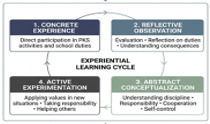
Objective: This study aims to analyze the implementation of the School Security Patrol (PKS: Patroli Keamanan Sekolah) as a means of strengthening character education, the character values developed through its activities, and the supporting and inhibiting factors at Muhammadiyah Sapen Elementary School in Yogyakarta. Theoretical framework: This study draws on Lickona’s character education theory and Kolb’s Experiential Learning Theory to understand PKS as an experience-based co-curricular activity that facilitates the internalization and practice of character values. Literature review: Previous studies have shown that PKS contributes to the development of discipline, responsibility, social awareness, cooperation, and leadership. However, existing research has primarily focused on the secondary school level. Studies examining PKS in Islamic elementary schools and its contribution to the eight dimensions of the Graduate Profile and the Sustainable Development Goals (SDGs) remain limited. Methods: This study employed a qualitative approach using a case study design. Data were collected through non-participant observation, in-depth interviews, and documentation involving the school principal, PKS coordinator, teachers, and purposively selected fourth- and fifth-grade students. Data were analyzed thematically using NVivo and validated through source and method triangulation. Results: The findings show that PKS functions not only to support school safety and order but also as a contextual and experiential platform for character education. PKS activities strengthen discipline, responsibility, cooperation, leadership, social awareness, independence, communication, and faith-related values, contributing to all eight dimensions of the Graduate Profile. Implementation is supported by school culture, parental and community support, teacher commitment, and police collaboration, while challenges include student numbers, attendance, coordination, and time management. PKS is also relevant to SDG 4 (Quality Education) and SDG 16 (Peace, Justice, and Strong Institutions). Implications: PKS can serve as an experiential co-curricular model for strengthening character and Graduate Profile development while supporting SDG 4 and SDG 16. Novelty: This study highlights PKS in an Islamic elementary school as an integrated model of character education, Graduate Profile development, and SDG-oriented learning.
References
[1] Juniarti Detuage, Zulaecha Ngiu, and Candra Cuga, “Development Of A Moral Loving-Based Co-Curricular Module To Foster Character Among Students At Public Elementary Schools In South Bulango District, Bone Bolango Regency,” Sosioedukasi J. Ilm. Ilmu Pendidik. DAN Sos., vol. 15, no. 2, pp. 1569–1584, May 2026, https://doi.org/10.36526/sosioedukasi.v15i2.8212.
[2] A. F. Usama et al., “Penguatan Karakter Siswa SDN 2 Jayamekar melalui Experiential Learning dalam Kolaborasi Indonesia–Jepang SUIJI-SLP 2026,” J. Pus. Inov. Masy., vol. 8, no. 1, pp. 87–99, Apr. 2026, https://doi.org/10.29244/jpim.8.1.87-99.
[3] W. Widaningsih and Y. T. Herlambang, “Sundanese culture-based character learning program ‘Gelar Nyunda’ (Case study at SDN 172 Andir Kidul, Bandung City),” Curricula J. Curric. Dev., vol. 4, no. 2, pp. 1441–1454, Dec. 2025, https://doi.org/10.17509/curricula.v4i2.86745.
[4] R. A. Herdianti, S. A. Zahra, N. Firdausi, N. Zhafira, and M. I. Kurniawan, “The Role of Extracurricular, Co-curricular, and Curricular Activities in the Development of Talent Interests of Elementary School Students,” Procedia Soc. Sci. Humanit. Int. Conf. Psychol. Educ. Transform. Bright Futur., vol. 6, pp. 9–14, Jul. 2024, https://doi.org/10.21070/pssh.v6i.519.
[5] Fahmid Abdullah, Lucyane Djaafar, and Ramli Mahmud, “Strengthening Character Values Through Co-Curricular Activities At State Middle School 2 Gorontalo,” Sosioedukasi J. Ilm. Ilmu Pendidik. DAN Sos., vol. 15, no. 2, pp. 3581–3590, Jun. 2026, https://doi.org/10.36526/sosioedukasi.v15i2.8663.
[6] Maisyatul Azizah, “Eksistensi SD Muhammadiyah Sapen Yogyakarta Sebagai Amal Usaha Muhammadiyah,” J. Stud. Islam dan Kemuhammadiyahan, vol. 2, no. 2, Sep. 2022, https://doi.org/10.18196/jasika.v2i2.33.
[7] A. Rofiah, “Implementasi Program Pendidikan Karakter Dan Program Gerakan Literasi Sekolah Dalam Membentuk Sikap Kemandirian Belajar Siswa Di Sdn Percobaan 2 Dan Sd Muhammadiyah Sapen,” G-Couns J. Bimbing. dan Konseling, vol. 3, no. 2, Aug. 2019, https://doi.org/10.31316/g.couns.v3i2.310.
[8] L. Widiyanti, “Evaluasi Program Pendidikan Karakter Kejujuran Siswa Sd Muhammadiyah Sapen Yogyakarta,” G-Couns J. Bimbing. dan Konseling, vol. 3, no. 2, Aug. 2019, https://doi.org/10.31316/g.couns.v3i2.318.
[9] Ahmad Fadli and Salsabila Putri, “Collaboration Between Schools, Families, and Communities in Developing Elementary School Students’ Character Education,” J. Educ. Didact., vol. 1, no. 2, pp. 23–39, May 2026, https://doi.org/10.67171/en5n4q02.
[10] V. Braun and V. Clarke, “Using thematic analysis in psychology,” Qual. Res. Psychol., vol. 3, no. 2, pp. 77–101, Jan. 2006, https://doi.org/10.1191/1478088706qp063oa.
[11] F. R. Nadhifah and M. I. Kurniawan, “Strengthening Students’ Noble Character Through School–Parent Collaboration: Memperkuat Karakter Mulia Siswa Melalui Kerjasama Sekolah dan Orang Tua,” Indones. J. Educ. Methods Dev., vol. 20, no. 4, pp. 10.21070/ijemd.v20i4.999-10.21070/ijemd.v20i4.999, Aug. 2025, https://doi.org/10.21070/ijemd.v20i4.999.
[12] M. A. Fabris and C. Longobardi, “Editorial: Towards 2030: Sustainable Development Goal 16: Peace, justice, and strong institutions. An educational perspective,” Front. Educ., vol. 7, Jan. 2023, https://doi.org/10.3389/feduc.2022.1130832.
[13] H. Heriyanto, “Thematic Analysis sebagai Metode Menganalisa Data untuk Penelitian Kualitatif,” Anuva, vol. 2, no. 3, p. 317, Nov. 2018, https://doi.org/10.14710/anuva.2.3.317-324.
[14] R. Yunazar and S. I. Liestyasari, “Character Formation Habituation in P5 as Co-Curricular Based Learning in Surakarta City Schools,” J. Dimens. Pendidik. dan Pembelajaran, vol. 13, no. SI1, pp. 14–28, Jan. 2025, https://doi.org/10.24269/dpp.v13i0.11405.
[15] A. nur fuad, S. Maghfirotun Amin, and N. Mariana, “Penerapan program Patroli Keamanan Sekolah (PKS) untuk menguatkan Karakter Disiplin dan Tanggung jawab pada peserta didik kelas 5 SDN Tenggilis Mejoyo I Surabaya,” J. Pancasila dan Kewarganegaraan, vol. 4, no. 3, pp. 62–70, Nov. 2019, https://doi.org/10.24269/jpk.v4.n3.2019.pp62-70.
[16] R. B. Yefterson, Erniwati, Najmi, U. Lionar, Y. Syafrina, and F. F. Mulyani, “Development of Interactive Multimedia Infographics Based on Experiential Learning Theory to Improve Students’ National Identity in High School History Learning,” New Educ. Rev., vol. 82, no. 4, pp. 108–119, 2025, https://doi.org/10.15804/tner.2025.82.4.08.
[17] N. S. Lau and T. K. C. Tse, “Education for Buddhist Modernism: Buddhicised education and reform in Hong Kong schools,” Br. J. Relig. Educ., vol. 46, no. 4, pp. 471–484, 2024, https://doi.org/10.1080/01416200.2024.2344176.
[18] K. Akinyanju, K. Allen, and E. Lorek, “‘Mega Champs’ field trip: A lesson in character development,” Acad. Leadersh., vol. 9, no. 1, 2011, https://doi.org/10.58809/otmm8496.
[19] H. Abdeltawab and K. Luthy, “Cultivating Character and Ethics via a Custom-Built AI-Chatbot in an Electric Circuits Activity,” in Proceedings - Frontiers in Education Conference, FIE, Institute of Electrical and Electronics Engineers Inc., 2025. https://doi.org/10.1109/FIE63693.2025.11328328.
[20] A. Lim, K. X. Tan, and F. M. Noor, Facilitating the Thinking Process of Learners in the 3D Virtual World of Second Life. Brill, 2020. https://doi.org/10.1163/9781848881075_008.
[21] P. W. Liao, “Experiential Education To Train the Construction of Character Belief Index,” Contemp. Educ. Res. Q., vol. 28, no. 3, pp. 29–66, 2020, https://doi.org/10.6151/CERQ.202009_28(3).0002.
[22] H. H. Kuo, S. W. Yang, and Y. C. Kuo, “A character experiential learning system: An animated vignette creating tool,” Adv. Mater. Res., vol. 267, pp. 221–226, 2011, https://doi.org/10.4028/www.scientific.net/AMR.267.221.
[23] T. W. Miller, R. F. Kraus, and L. J. Veltkamp, “Character education as a prevention strategy in school-related violence,” J. Prim. Prev., vol. 26, no. 5, pp. 455–466, 2005, https://doi.org/10.1007/s10935-005-0004-x.
[24] N. K. Afandi and Zurqoni, “Teachers’ Strategies in Cultivating Gratitude Character through Islamic Education and Local Cultural Practices in Primary Schools: A Qualitative Approach,” Nazhruna J. Pendidik. Islam, vol. 9, no. 2, pp. 445–460, 2026, https://doi.org/10.31538/nzh.v9i2.444.
[25] Wildan, L. A. Satriawan, and R. A. Kurniawan, “Cultivating Creativity and Responsibility through the Mandalika Friday Program in the Merdeka Curriculum,” Educ. Process Int. J., vol. 16, 2025, https://doi.org/10.22521/edupij.2025.16.260.
[26] Hasbiyallah, M. Munadi, and D. Nurulhaq, “Character Education Model for High School Students during the Pandemic in terms of Pedagogic Competence and Teacher Personality,” Int. J. Instr., vol. 16, no. 2, pp. 1077–1094, 2023, https://doi.org/10.29333/iji.2023.16257a.
[27] E. Wiyanarti and A. S. Nurjannah, “Influence of Self-Efficacy on Affective Learning Outcomes in Social Studies Education Toward Achieving Sustainable Development Goals (SDGs),” ASEAN J. Educ. Res. Technol., vol. 5, no. 1, pp. 1–18, 2026, [Online]. Available: https://www.scopus.com/pages/publications/105038999243?origin=resultslist
[28] C. J. Margerison and M. D. Ravenscroft, “Coordinating character and curriculum for learning and development,” J. Work. Manag., vol. 12, no. 1, pp. 97–104, 2020, https://doi.org/10.1108/JWAM-11-2019-0034.
[29] N. A. Ramly, A. H. Masnan, S. Othman, and S. N. A. Rahman, “Validating an Islamic Moral Education Module for Preschoolers: A Contextual Evaluation Using the Nominal Group Technique,” Int. J. Early Child., vol. 58, no. 2, pp. 785–801, 2026, https://doi.org/10.1007/s13158-025-00477-7.
[30] I. G. Astawan, I. D. G. B. Utama, W. E. Paramartha, A. Abdurahman, and S. S. Maidin, “Blended Learning for Character Education: Integrating Tri Hita Karana Wisdom to Develop Graduate Competencies Aligned with SDGs,” J. Educ. Technol. Learn. Creat., vol. 3, no. 2, pp. 407–422, 2025, https://doi.org/10.37251/jetlc.v3i2.2498.
[31] B. Prasetiya et al., “Thematic evolution and collaboration networks in character education: A bibliometric perspective,” Multidiscip. Rev., vol. 9, no. 10, 2026, https://doi.org/10.31893/multirev.2026467.
[32] T. Rejekiningsih, S. Sumaryati, D. I. Sari, Y. Ariana, and T. S. Qodr, “Designing a Bullying-Free School to Foster a Safe Environment Based on Sustainable Development Goals: A Mixed Methods Approach,” J. Curric. Stud. Res., vol. 7, no. 2, pp. 373–393, 2025, https://doi.org/10.46303/jcsr.2025.26.
[33] Y. Osman, “Understanding how to develop an effective role-modelling character education programme in Saudi Arabia,” Glob. Soc. Educ., vol. 24, no. 2, pp. 447–462, 2026, https://doi.org/10.1080/14767724.2024.2330363.
[34] E. Brooks and J. L. Villacís, “To educate citizens and citizen-leaders for our society: Renewing character education in universities,” Rev. Esp. Pedagog., vol. 81, no. 284, pp. 51–72, 2023, https://doi.org/10.22550/REP81-1-2023-03.
[35] A. Abdulkarim, N. Ratmaningsih, P. Sopianingsih, D. N. Anggraini, E. D. Pratiwi, and A. P. Ramadani, “Developing a Deep Learning-Oriented Learning Assistance System With Artificial Intelligence (AI) Chatbots for Pancasila Education,” J. Eng. Sci. Technol., vol. 21, no. 1, pp. 1–8, 2026, https://www.scopus.com/pages/publications/105027523526?origin=resultslist
[36] N. T. Martoredjo, Benny, and D. A. Kusumajati, “Increasing Environmental Awareness in Facing Water Scarcity Problems Through Education Based on Local Wisdom Values,” Environ. Sci. Eng., pp. 177–185, 2023, https://doi.org/10.1007/978-3-031-30233-6_16.
[37] D. García-Álvarez, M. J. Soler, R. Cobo-Rendón, and J. Hernández-Lalinde, “Teacher Professional Development, Character Education, and Well-Being: Multicomponent Intervention Based on Positive Psychology,” Sustain., vol. 15, no. 13, 2023, https://doi.org/10.3390/su15139852.
[38] Junaedi, M. A. Dimyathi, Aswadi, I. Syafi’i, and T. T. Tutik, “Tafsir Tarbawi of Restorative Justice in Qur’anic Jinayat Verses; Nahdatul Ulama Pesantren Perspective,” Nazhruna J. Pendidik. Islam, vol. 9, no. 1, pp. 52–69, 2026, https://doi.org/10.31538/nzh.v9i1.470.
[39] M. Pasaribu, F. Khairifa, R. Ali, A. A. Muis, and M. Ritonga, “Youth Character Building through Quality Education in Realizing Golden Indonesia 2045,” J. Ecohumanism, vol. 3, no. 4, pp. 180–192, 2024, https://doi.org/10.62754/joe.v3i4.3473.
[40] N. L. W. Yasmiati, I. W. Lasmawan, I. B. P. Arnyana, I. W. Kertih, and I. K. Gading, “Integrating Educational Psychology and Anti-Corruption Education through Local Wisdom: A Character-Building Model in Indonesian Madrasahs,” Nazhruna J. Pendidik. Islam, vol. 9, no. 2, pp. 421–444, 2026, https://doi.org/10.31538/nzh.v9i2.435.
[41] A. Zuhri et al., “How Madrasahs Build Students’ Character in Indonesia’s Society 5.0 Era: Emerging Challenges,” Nazhruna J. Pendidik Islam, vol. 9, no. 1, pp. 166–186, 2026, https://doi.org/10.31538/nzh.v9i1.412.
Downloads
Submitted
Accepted
Published
Issue
Section
License
Copyright (c) 2026 Narlina Tali Eniyati Hulu, Shely Cathrin, Wuri Wuryandani

This work is licensed under a Creative Commons Attribution 4.0 International License.