The Sedekah Rame Tradition as Social Capital for Strengthening Community Food Security: A Contribution to Achieving the Sustainable Development Goals (SDGs)
Keywords:
food security, local islamic tradition, sdgs, sedekah rame, social capitalAbstract
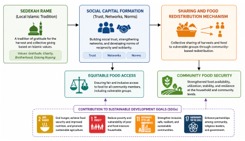
Objective: This study aims to analyze the Sedekah Rame tradition as social capital rooted in Islamic values in strengthening food security among agrarian communities in Lahat Regency, as well as its contribution to the achievement of the Sustainable Development Goals (SDGs). Theoretical Framework: The study employs social capital theory (Putnam and Bourdieu), cultural da’wah, solidarity-based Islamic economics, and the lived Islam perspective to understand the socio-religious functions of Sedekah Rame in community life. Literature Review: Previous studies highlight the importance of local Islamic traditions in maintaining social harmony; however, research linking local religious practices to food security and the SDGs remains limited. Methods: This study employs a qualitative approach using ethnographic methods through participant observation, in-depth interviews with traditional leaders, religious figures, farmers, and village officials, as well as documentation analyzed interactively. Results: Findings indicate that Sedekah Rame functions as social capital that strengthens trust, solidarity, mutual aid, and mechanisms for redistributing harvests. This practice supports household and community food security through the strengthening of social networks, food access, and community participation. Implications: These findings suggest that local Islamic traditions can serve as community-based development strategies that support sustainable food security and social resilience. Novelty: This study offers a new perspective by positioning Sedekah Rame as Islamic social capital that functions in food redistribution and the strengthening of community food security, as well as contributing to the achievement of SDG 2 (Zero Hunger), SDG 11 (Sustainable Cities and Communities), and SDG 17 (Partnerships for the Goals).
References
[1] E. Briones Alonso, L. Cockx, and J. Swinnen, “Culture and food security,” Glob Food Sec, vol. 17, pp. 113–127, June 2018, doi: 10.1016/J.GFS.2018.02.002.
[2] D. Monteza-Quiroz, A. Silva, and M. I. Sactic, “The influence of social capital on food insecurity: Insights from a household survey,” Glob Food Sec, vol. 46, p. 100882, Sep. 2025, doi: 10.1016/J.GFS.2025.100882.
[3] I. Chofyan, I. H. Agustina, R. R. Aji, D. Rosenda, and R. Lazuardi, “Food Security in West Java Through a Traditionalist Paradigm Perspective: A Discourse Analysis,” Journal of Regional and Urban Planning, vol. 20, no. 1, pp. 15–26, Mar. 2025, doi: 10.29313/JPWK.V20I1.6130.
[4] S. Maulidin and Latif Nawawi, “Local Wisdom in Islamic Tradition: Understanding the Contribution of Islamic Culture in Indonesia: Local Wisdom in Islamic Tradition: Contributions to Islamic Culture in Indonesia from an Islamic Education Perspective,” ISEDU: Journal of Islamic Education, vol. 2, no. 2, pp. 117–126, Dec. 2024, doi: 10.59966/ISEDU.V2I2.1473.
[5] H. Maulana, R. Akmalia, and M. A. Sabila, “Islamic Food Banks as a Solution to Food Insecurity from the Perspective of Jamaluddin Athiyyah’s Maqashid al-Sharia,” Citizen: Indonesian Multidisciplinary Scientific Journal, vol. 5, no. 2, pp. 580–589, Apr. 2025, doi: 10.53866/JIMI.V5I2.743.
[6] H. Hidrawati, U. Rianse, R. M. Iswandi, N. Arafah, A. Hamzah, and H. Harviyaddin, “The Role of Traditional Institutions in Supporting Food Security in Small Island Communities,” Journal of Agricultural Economics and Agribusiness, vol. 7, no. 2, pp. 878–887, Apr. 2023, doi: 10.21776/UB.JEPA.2023.007.02.38.
[7] D. N. S. Zepri Hiptraspa, “Islamic Traditions in Local Wisdom: Cultural Practices and Customs in Rural Communities | Hiptraspa | Journal of Religious Extension,” Journal of Religious Extension, vol. 11, no. 2, 2024, Accessed: Jan. 5, 2026. [Online]. Available: https://journal2.uinjkt.ac.id/index.php/jpa/article/view/37982?utm_source=chatgpt.com
[8] S. Fatmawati, M. Fauzi, and R. Hidayat, “The Acculturation of Islamic Values and Local Culture: A Semiotic Analysis of Symbols and Rituals in the Sekura Festival Tradition in West Lampung,” El-Ghiroh: Journal of Islamic Studies, vol. 23, no. 2, pp. 251–266, Sept. 2025, doi: 10.37092/EL-GHIROH.V23I2.1224.
[9] S. I. Fuadi, R. Suyud, and E. Syam, “The Essence of Social Piety in the Halalbihalal Tradition in Indonesia,” Journal of Creative Student Research, vol. 1, no. 3, pp. 12–20, May 2023, doi: 10.55606/JCSRPOLITAMA.V1I3.1585.
[10] A. Baihaqi, A. S. Faiqa, J. Hilmiansyah, and W. Novianti, “SYNERGY BETWEEN ISLAM, LOCAL TRADITIONS, AND CULTURAL RESILIENCE IN THE JAVA-BETAWI COMMUNITY TO MAINTAIN TOLERANCE AND SOCIAL JUSTICE IN JAKARTA,” Pendas: Journal of Basic Education, vol. 10, no. 02, pp. 301–315, June 2025, doi: 10.23969/JP.V10I02.27104.
[11] S. Endarwati and E. S. Wahyuni, “The Influence of Social Capital on Food Security in Farming Households in Ciaruteun Ilir Village, Cibungbulang Subdistrict, Bogor Regency,” Jurnal Penyuluhan, vol. 10, no. 2, August 2014, doi: 10.25015/PENYULUHAN.V10I2.9925.
[12] B. S. Renyoet, O. K. Lakajen, T. Pratiwi, and E. S1, “The Relationship Between Food Security and Vulnerability with Social Capital and Food Choices Among Low-Income Households in Dukuh Village, Sidomukti Subdistrict, Salatiga City,” Ghidza: Journal of Nutrition and Health, vol. 6, no. 1, pp. 26–37, July 2022, doi: 10.22487/GHIDZA.V6I1.424.
[13] J. F. McCarthy and K. Obidzinski, “Framing the problem of food poverty: Policy options and livelihood consequences in Indonesia,” J Rural Stud, vol. 54, pp. 344–354, August 2017, doi: 10.1016/J.JRURSTUD.2017.06.004.
[14] A. D. Kehinde, R. Adeyemo, and A. A. Ogundeji, “Does social capital enhance agricultural productivity and food security? Evidence from cocoa-farming households in Southwest Nigeria,” Heliyon, vol. 7, no. 3, p. e06592, March 2021, doi: 10.1016/J.HELIYON.2021.E06592.
[15] C. Rosin, “Food security and the justification of productivism in New Zealand,” J Rural Stud, vol. 29, pp. 50–58, Jan. 2013, doi: 10.1016/J.JRURSTUD.2012.01.015.
[16] A. Najla et al., “Nationalism Through the Preservation of Traditional Indonesian Food,” Journal of Non-Formal Education, vol. 3, no. 2, pp. 8–8, Dec. 2025, doi: 10.47134/JPN.V3I2.2287.
[17] N. Estu, P. Muchtar, A. U. Humairoh, Z. Nur, K. Melati, and V. N. Laily, “Local Spirituality as a Pillar of Food Security: An Ethnographic Study of Islam in Banjarejo Village,” NUR EL-ISLAM: Journal of Religious Education and Social Affairs, vol. 12, no. 2, pp. 1–21, Oct. 2025, doi: 10.51311/NURIS.V12I2.977.
[18 S. Farmer Empowerment Based on Muna’s Local Wisdom, P. A Socio-Cultural Approach to Strengthening Food Security La Harudin, and H. Tao, “Farmer Empowerment Strategies Based on Muna’s Local Wisdom: A Socio-Cultural Approach to Strengthening Food Security,” Journal of Humanities, Social Sciences, and Education, vol. 1, no. 6, pp. 107–122, August 2025, doi: 10.64690/JHUSE.V1I6.304.
[19] S. Suandi, “SOCIAL CAPITAL AND THE DEVELOPMENT OF SUSTAINABLE FOOD SECURITY,” AGRISEP Journal: Studies on Socio-Economic Issues in Agriculture and Agribusiness, vol. 11, no. 2, pp. 270–281, Oct. 2012, doi: 10.31186/JAGRISEP.11.2.270-281.
[20] H. Karnik and H. H. Peterson, “Food security among low-income immigrant households and the role of social capital: A case study of Somali-American households in the U.S. Midwest,” Food Policy, vol. 117, p. 102456, May 2023, doi: 10.1016/J.FOODPOL.2023.102456.
[21] A. Chriest and M. Niles, “The Role of Community Social Capital in Food Security Following Extreme Weather Events,” J Rural Stud, vol. 64, pp. 80–90, Nov. 2018, doi: 10.1016/J.JRURSTUD.2018.09.019.
[22] A. Craig, C. Hutton, F. B. Musa, and J. Sheffield, “The combination of bonding, bridging, and linking social capital for food access; A gender-based case study exploring temporal differences in Southern Malawi,” J Rural Stud, vol. 101, p. 103039, July 2023, doi: 10.1016/J.JRURSTUD.2023.103039.
[23] A. Fadhilah, “Local Wisdom in Shaping Local Food Security in the Molamahu Pulubala Community, Gorontalo,” Al-Turas Bulletin, vol. 19, no. 1, pp. 23–38, Jan. 2013, doi: 10.15408/BAT.V19I1.3696.
[24] E. Rusmawati et al., “Food Security: The Role of Social Capital in Rural Areas of Indonesia,” Journal of Economic Development Analysis, vol. 10, no. 3, pp. 324–337, Aug. 2021, doi: 10.15294/EDAJ.V10I3.48442.
[25] Z. Hiptraspa and D. N. Saputri, “Islamic Traditions in Local Wisdom: Cultural Practices and Customs in Rural Communities,” Journal of Religious Extension, vol. 11, no. 2, pp. 151–166, Dec. 2024, doi: 10.15408/JPA.V11I2.37982.
[26] J. Sosial, E. Dan, K. Pertanian, S. N. Sari, S. Riyanto, and B. A. Kusuma, “THE INFLUENCE OF SOCIAL CAPITAL ON FOOD AVAILABILITY AMONG MEMBERS OF THE ‘MELATI PUTIH’ SUSTAINABLE FOOD ESTATE (KRPL) IN BANDUNGREJOSARI, SUKUN DISTRICT, MALANG CITY,” Agrisocionomics: Journal of Agricultural Social Economics, vol. 6, no. 1, pp. 148–159, May 2022, doi: 10.14710/AGRISOCIONOMICS.V6I1.8763.
[27] H. Radermacher, S. Feldman, and S. Bird, “Food Security Among Australian Older Adults from Diverse Cultural Backgrounds,” J Nutr Educ Behav, vol. 42, no. 5, pp. 328–336, Sept. 2010, doi: 10.1016/J.JNEB.2009.10.004.
[28] R. Mondesir, “Bridge to citizenship or silo? Islam, religious affiliation, and civic engagement in rural Indonesia,” Soc Sci Res, vol. 112, p. 102876, May 2023, doi: 10.1016/J.SSRESEARCH.2023.102876.
[29] J. Koopman, “Subawe, traditional knowledge, and religion-based organizations promoting social capital and disaster preparedness: A case study in Lombok, Indonesia,” International Journal of Disaster Risk Reduction, vol. 94, p. 103837, August 2023, doi: 10.1016/J.IJDRR.2023.103837.
[30] W. R. Dean and J. R. Sharkey, “Food insecurity, social capital, and perceptions of personal inequality in rural Texas: An individual-level analysis,” Soc Sci Med, vol. 72, no. 9, pp. 1454–1462, May 2011, doi: 10.1016/J.SOCSCIMED.2011.03.015.
[31] L. A. C. Nascimento and P. Fung, “Exploring the incorporation of multicultural ecosystem service values in environmental planning,” Nature-Based Solutions, vol. 6, p. 100184, Dec. 2024, doi: 10.1016/J.NBSJ.2024.100184.
[32] Kuntowijoyo, Methodology of History. Yogyakarta: Tiara Wacana, 2018.
[33] L. J. Moleong, Qualitative Research Methodology. Bandung: PT Remaja Rosdakarya, 2019.
[34] M. B., H. A. M., S. J. Miles, Qualitative Data Analysis: A Methodological Guide. SAGE, 2014. Accessed: August 26, 2025. [Online]. Available: https://cir.nii.ac.jp/crid/1970023484843333791
[35] F. Radlinski and N. Craswell, “A Theoretical Framework for Conversational Search,” CHIIR 2017 - Proceedings of the 2017 Conference on Human-Computer Interaction and Information Retrieval, pp. 117–126, March 2022, doi: 10.1145/3020165.3020183.
[36] M. Burrahmad, “THE INFLUENCE OF SOCIAL CAPITAL ON FOOD SECURITY AMONG FARMING HOUSEHOLDS IN SENTOSA VILLAGE, MUTIARA BARAT SUBDISTRICT, PIDIE REGENCY, ACEH PROVINCE,” Agricore: Journal of Agribusiness and Agricultural Socioeconomics, vol. 3, no. 2, Dec. 2018, doi: 10.24198/AGRICORE.V3I2.19542.
[37] D. Monteza-Quiroz, A. Silva, and M. I. Sactic, “The influence of social capital on food insecurity: Insights from a household survey,” Glob Food Sec, vol. 46, p. 100882, Sept. 2025, doi: 10.1016/J.GFS.2025.100882.
[38] K. S. Martin, B. L. Rogers, J. T. Cook, and H. M. Joseph, “Social capital is associated with reduced risk of hunger,” Soc Sci Med, vol. 58, no. 12, pp. 2645–2654, June 2004, doi: 10.1016/J.SOCSCIMED.2003.09.026.
[39] A. Chriest and M. Niles, “The role of community social capital in post-extreme weather food security,” J Rural Stud, vol. 64, pp. 80–90, Nov. 2018, doi: 10.1016/J.JRURSTUD.2018.09.019.
[40] T. W. Nugroho, N. Hanani, H. Toiba, and S. Sujarwo, “Does Social Capital Enhance Food Security? Evidence from the Indonesian Family Life Survey,” Asian Journal of Agriculture and Rural Development, vol. 12, no. 2, pp. 138–147, May 2022, doi: 10.55493/5005.V12I2.4502.
[41] A. D. Kehinde, R. Adeyemo, and A. A. Ogundeji, “Does social capital enhance agricultural productivity and food security? Evidence from cocoa-farming households in Southwestern Nigeria,” Heliyon, vol. 7, no. 3, p. e06592, March 2021, doi: 10.1016/J.HELIYON.2021.E06592.
[42] G. Prayitno et al., “Community-driven environmental pathways to reduce stunting: Food security, social capital, and open innovation in semi-urban areas of Indonesia,” Environmental Challenges, vol. 21, p. 101350, Dec. 2025, doi: 10.1016/J.ENVC.2025.101350.
[43] S. Nosratabadi et al., “The Contribution of Social Capital to Food Security: A Comprehensive Literature Review,” Foods 2020, Vol. 9, no. 11, Nov. 2020, doi: 10.3390/FOODS9111650.
[44] A. D. Kehinde, R. Adeyemo, and A. A. Ogundeji, “Does social capital enhance agricultural productivity and food security? Evidence from Cocoa-Farming Households in Southwestern Nigeria,” Heliyon, vol. 7, no. 3, p. e06592, March 2021, doi: 10.1016/J.HELIYON.2021.E06592.
[45] D. Sietz et al., “Mapping human-nature archetypes to guide global biodiversity, food security, and land-use policies,” One Earth, vol. 8, no. 8, p. 101416, August 2025, doi: 10.1016/J.ONEEAR.2025.101416.
[46] S. Suandi, “SOCIAL CAPITAL AND SUSTAINABLE FOOD SECURITY DEVELOPMENT,” AGRISEP Journal: Studies on Socio-Economic Issues in Agriculture and Agribusiness, vol. 11, no. 2, pp. 270–281, Oct. 2012, doi: 10.31186/JAGRISEP.11.2.270-281.
[47] E. Rusmawati et al., “Food Security: The Role of Social Capital in Rural Areas of Indonesia,” Journal of Economic Development Analysis, vol. 10, no. 3, pp. 324–337, Aug. 2021, doi: 10.15294/EDAJ.V10I3.48442.
[48] D. Lesmana, S. Nurfillah, and Q. Aini, “Strengthening Farmer Institutions Based on Social Capital to Support Food Security in Kutai Kartanegara Regency, Indonesia,” International Journal of Agricultural and Ecological Research, vol. 26, no. 3, pp. 78–89, May 2025, doi: 10.9734/JAERI/2025/V26I3677.
Downloads
Submitted
Accepted
Published
Issue
Section
License
Copyright (c) 2026 Ivana, Munir, Cholidah Utama

This work is licensed under a Creative Commons Attribution 4.0 International License.