Technological Mastery and Competence Development of Islamic Religious Education Teachers in Wonogiri: Supporting SDG 4 on Quality Education
DOI:
https://doi.org/10.23917/profetika.v26i01.11744Keywords:
technology, sdgs, islamic education teachers, competence, developmentAbstract
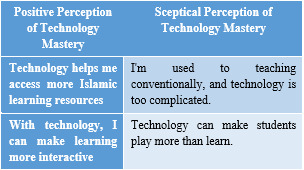
Objective: This research aims to analyse the importance of technology mastery in improving the competence of Islamic Religious Education teachers who are members of the Teacher Working Group Forum to support the achievement of SDG 4. Theoretical Framework: Serves as a conceptual foundation that explains the relationship between mastery of technology, increasing the competence of Islamic Religious Education teachers, and the role of the Teacher Working Group Forum as a forum for developing teacher professionalism. Literature Review: To review various theories and previous research relevant to technology mastery, improving the competence of Islamic Religious Education teachers, and the role of the Teacher Working Group Forum in supporting teacher professional development related to SDG 4. Methods: This study used a qualitative method, the analysis of which involved the content of the technology mastery text, the competence of Islamic Religious Education teachers, and the Teacher Working Group Forum. Data were collected through document analysis and interviews with Islamic Religious Education teachers, the head of the teachers' working group forum, school principals, and policymakers. Results: Islamic Religious Education teachers have a positive perception of technology mastery, as it helps them access more Islamic learning resources, reach a wider range of students, especially in distance learning, and make learning more interactive; in addition, the Teachers Working Group Forum plays a role in helping them learn technology gradually, although there are still challenges such as the lack of technical training, limited technology facilities in schools, the low level of digital literacy of Islamic Religious Education teachers, and concerns about the negative impact of technology use. Implications: In addition, this research contributes to the achievement of the SDGs, particularly in quality education (SDG 4), technological innovation in education (SDG 9), reducing disparities in access to education (SDG 10), and strengthening partnerships in the development of technology-based education (SDG 17). Novelty: Overall, this research brings a new perspective to the field of Islamic religious education by highlighting how mastery of technology can improve the competence of Islamic Religious Education teachers, as well as how the Teacher Working Group Forum can act as a catalyst in digital transformation for religious educators.
References
[1] C. Zhang, I. Khan, V. Dagar, A. Saeed, and M. W. Zafar, “Environmental impact of information and communication technology: Unveiling the role of education in developing countries,” Technol. Forecast. Soc. Change, vol. 178, p. 121570, 2022, https://doi.org/10.1016/j.techfore.2022.121570.
[2] H. Kuznetsova, I. Danylchenko, Z. Т., N. Rostykus, and O. Lushchynska, “Incorporating innovative technologies into higher education teaching: Mastery and implementation perspectives for educators,” Multidiscip. Rev.., vol. 7, 2024, https://doi.org/10.31893/multirev.2024spe027.
[3] B. Subali and L. D. Handoyo, “The Mastery of Technological, Pedagogical, and Content Knowledge among Indonesian Biology Teachers,” Eur. J. Educ. Res., vol. 10, no. 3, pp. 1063–1073, 2021, https://doi.org/10.12973/eu-jer.10.3.1063.
[4] E. A. Abedi, S. Prestridge, and S. Hodge, “Teachers’ beliefs about technology integration in Ghana: a qualitative study of teachers’, headteachers’ and education officials’ perceptions,” Educ. Inf. Technol., vol. 29, no. 5, pp. 5857–5877, 2024, https://doi.org/10.1007/s10639-023-12049-0.
[5] C. Minga and S. Ghosh, “Teachers’ perceptions of ICT use in promoting teaching-learning processes and its outcomes at senior secondary level in Mbeya region, Tanzania: A review,” J. Educ. Soc. Behav. Sci., vol. 37, no. 1, pp. 39–50, 2024, https://doi.org/10.9734/jesbs/2024/v37i11296.
[6] J. Sim, S. Ha, and K. Jo, “Korean Elementary English Teachers’ Professionalism Development in Using EdTech: A Grounded Theory Study,” English Teach., vol. 79, no. 1, pp. 93–120, 2024, https://doi.org/10.15858/engtea.79.1.202403.93.
[7] E. A. Abedi, F. R. Ackah-Jnr, and A. K. Ametepey, “Learning through informal spaces for technology integration: unpacking the nature of teachers’ learning and its implications for classroom pedagogy,” Education, vol. 3–13, pp. 1–16, 2024, https://doi.org/10.1080/03004279.2023.2278175.
[8] A. Aseery, “Enhancing learners’ motivation and engagement in religious education classes at elementary levels,” Br. J. Relig. Educ., vol. 46, no. 1, pp. 43–58, 2024, https://doi.org/10.1080/01416200.2023.2256487.
[9] M. Khadafie, “Construction of Islamic Religious Education in the Era of the Covid-19 Pandemic,” Profetika J. Stud. Islam, vol. 24, no. 01, pp. 94–102, 2023, https://doi.org/10.23917/profetika.v24i01.1690.
[10] A. Z. Mitev, R. Tóth, and B. Vaszkun, “Role transition of higher education teachers due to disruptive technological change: Identity reconstruction for a better teacher-student relationship,” Int. J. Manag. Educ., vol. 22, no. 2, p. 100978, 2024, https://doi.org/10.1016/j.ijme.2024.100978.
[11] E. A. Abedi, “We [teachers] first require basic technical [skills] training”: Investigating formal professional development pathways and knowledge needs of teachers for technology integration,” Educ. Inf. Technol., vol. 29, no. 10, pp. 11793–11814, 2024, https://doi.org/10.1007/s10639-023-12344-w.
[12] J. Crawford, K. A. Allen, B. Pani, and M. Cowling, “When artificial intelligence substitutes humans in higher education: the cost of loneliness, student success, and retention,” Stud. High. Educ., vol. 49, no. 5, pp. 883–897, 2024, https://doi.org/10.1080/03075079.2024.2326956.
[13] R. Luckin and M. Cukurova, “Designing Educational Technologies in the Age of AI: A Learning Science Driven Approach,” Br. J. Educ. Tecnol., vol. 50, no. 6, 2019, https://doi.org/10.1111/bjet.12861.
[14] J. Tondeur, “Teacher Educators as Gatekeepers: Preparing the Next Generation of Teachers for Technology Integration in Education,” Br. J. Educ. Tecnol., vol. 50, no. 6, 2019, https://doi.org/10.1111/bjet.12748.
[15] F. Muharom, “Analysis of the Value of Religious Moderation in Learning Module of Islamic Religious Education and Character,” Profetika J. Stud. Islam, vol. 24, no. 01, pp. 159–170, 2023, https://doi.org/10.23917/profetika.v24i01.1787.
[16] A. Akbar and N. Noviani, “Tantangan & Solusi dalam Perkembangan Teknologi Pendidikan di Indonesia,” in Prosiding Seminar Nasional Pendidikan Program Pascasarjana Universitas PGRI Palembang. Palembang:03 Mei 2019, 2019, pp. 18–25.
[17] W. Waston, A. R. Ridha, and K. Kumaidi, “Theoretical Construct and Development of Wasatiyah Measurement Instruments,” Profetika J. Stud. Islam, vol. 24, no. 01, pp. 137–148, 2023, https://doi.org/10.23917/profetika.v24i01.1730.
[18] D. Fitriah and M. U. Miranda, “Kesiapan Guru Dalam Menghadapi Tantangan Pendidikan Berbasis Teknologi,” in Prosiding Seminar Nasional Pendidikan Program Pascasarjana Universitas PGRI Palembang. Palembang:03 Mei 2019, 2019, pp. 148–153.
[19] A. Purba Ramen and dkk, Teknologi Pendidikan. Medan:Yayasan Kita Menulis, 2022.
[20] Sutama, Metode Penelitian Pendidikan. Cetakan Pertama. Surakarta: Fairuz Media, 2010.
[21] C. J. W, Research design pendekatan kualitatif, kuantitatif dan campuran. Yogyakarta: Pustaka Belajar, 2016.
[22] M. B. Miles and A. M. Huberman, “Qualitative Data Analysis (terjemahan.” Jakarta, 2007.
[23] F. S. P. Pribowo, Persepsi guru SD Muhammadiyah terhadap penggunaan gawai dalam pembelajaran di kelas. Proceeding Umsurabaya, 2020.
[24] N. Ghamrawi, T. Shal, and N. A. Ghamrawi, “Exploring the impact of AI on teacher leadership: regressing or expanding?” Educ. Inf. Technol., vol. 29, no. 7, pp. 8415–8433, 2024, https://doi.org/10.1007/s10639-023-12174-w.
[25] E. A. Abedi, “Tensions between technology integration practices of teachers and ICT in education policy expectations: implications for change in teacher knowledge, beliefs, and teaching practices,” J. Comput. Educ., vol. 11, no. 4, pp. 1215–1234, 2024, https://doi.org/10.1007/s40692-023-00296-6.
[26] M. Alwaqdani, Investigating teachers’ perceptions of artificial intelligence tools in education: potential and difficulties. Education and Information Technologies, 2024, https://doi.org/10.1007/s10639-024-12903-9.
[27] A. Spaska, H. Kozub, G. Abylasynova, V. Kozub, and Y. Koval, “Evaluation Of Innovative Teaching Methods Using Modern Information Technologies,” J. Ilm. Ilmu Terap. Univ. Jambi, vol. 9, no. 1, pp. 422–440, 2025, https://doi.org/10.22437/jiituj.v9i1.38107.
[28] M. Fatimah, A. Husaen Sastra Negara, W. Waston, S. Hidayat, A. Abdul Adzim, and M. Zakir Husain, “Teacher Communication Patterns To Improve Students’ Religious Character Values At Vocational Schools,” Profetika J. Stud. Islam, vol. 24, no. 02, pp. 217–225, 2023, https://doi.org/10.23917/profetika.v24i02.2063.
[29] R. Kyere Asomah, D. Darko Agyei, G. Assamah, and K. Darko Amponsah, “Examining teachers’ perceptions of the impact of the government of Ghana’s wi-fi technology program on teaching practices: an empirical study from the senior high schools in the Cape Coast metropolis,” Cogent Educ., vol. 11, no. 1, p. 2296455, 2024, https://doi.org/10.1080/2331186X.2023.2296455.
[30] D. R. Purwasari, W. Waston, and M. N. Rochim Maksum, “The Strategy of Islamic Education Teachers in Instilling Student Moral Values at State Vocational High School 6 Sukoharjo Indonesia,” Solo Int. Collab. Publ. Soc. Sci. Humanit., vol. 1, no. 01, pp. 12–23, 2023, https://doi.org/10.61455/sicopus.v1i01.17
[31] D. Istiawan, A. G. Santoso, Rosidin, and Ika Safitri Windiarti, “Religious Harmony Index in Special Region of Yogyakarta,” Profetika J. Stud. Islam, vol. 24, no. 02, pp. 171–186, 2023, https://doi.org/10.23917/profetika.v24i02.1900.
[32] N. A. Dahri, N. Yahaya, W. M. Al-Rahmi, A. S. Almogren, and M. S. Vighio, “Investigating factors affecting teachers’ training through mobile learning: Task technology fit perspective,” Educ. Inf. Technol., vol. 29, no. 12, pp. 14553–14589, 2024, https://doi.org/10.1007/s10639-023-12434-9.
[33] J. S. V Holguín, E. Intriago-Toala, J. Ramos-Zambrano, and L. Mena-Sánchez, “Educational technology and teachers: effective teaching time in the classroom during the practicum,” Int. J. Interdiscip. Stud., vol. 6, no. 1, pp. 25007– 25007, 2025, https://doi.org/10.51798/sijis.v6i1.909.
[34] A. K. Gupta, V. Aggarwal, V. Sharma, and M. Naved, “Education 4.0 and Web 3.0 Technologies Application for Enhancement of distance learning management Systems in the Post–COVID-19 ERa,” in The Role of Sustainability and Artificial Intelligence in Education Improvement, Chapman and Hall/CRC, 2024, https://doi.org/10.1201/9781003425779-4.
[35] F. M. Teane, “Technological literacy and its influence on teachers’ adoption of a blended learning approach,” Read. Writing-Journal Read. Assoc. South Africa, vol. 15, no. 1, p. 426, 2024, https://doi.org/10.4102/rw.v15i1.426.
[36] A. O. Theodorio, “Examining the support required by educators for successful technology integration in teacher professional development program,” Cogent Educ., vol. 11, no. 1, p. 2298607, 2024, https://doi.org/10.1080/2331186X.2023.2298607.
[37] A. Ngodu, P. M. Ndibalema, and F. William, “Context-relevant strategies for ICT integration in teaching and learning science subjects in Tanzania secondary schools,” Educ. Technol. Q., vol. 2024, no. 1, pp. 20–37, 2024, https://doi.org/10.55056/etq.704.
[38] C. I. Pappa, D. Georgiou, and D. Pittich, “Technology education in primary schools: addressing teachers’ perceptions, perceived barriers, and needs,” Int. J. Technol. Des. Educ., vol. 34, no. 2, pp. 485–503, 2024, https://doi.org/10.1007/s10798-023-09828-8.
[39] M. H. Gonfa, A. L. Birhanu, and K. M. Gendo, “Review on practice and challenges of ICT integration as pedagogical tools in Ethiopian primary school curriculum implementation,” Discov. Educ., vol. 3, no. 1, p. 88, 2024, https://doi.org/10.1007/s44217-024-00184-w.
[40] O. Dele-Ajayi, O. D. Fasae, and A. Okoli, “Teachers’ concerns about integrating information and communication technologies in the classrooms,” PLoS One, vol. 16, no. 5, p. 249703, 2021, https://doi.org/10.1371/journal.pone.0249703.
Submitted
Accepted
Published
Issue
Section
License
Copyright (c) 2025 Meti Fatimah, Edy Muslimin, Aminatus Sayidah, Alwy Ahmed Mohamed

This work is licensed under a Creative Commons Attribution 4.0 International License.