Leadership and Subordinate Engagement in Transforming Islamic Higher Education Institutions to Advance the SDGs: Evidence from Central Java
DOI:
https://doi.org/10.23917/profetika.v26i01.11743Keywords:
leadership, subordinate involvement, leadership transformation, institutional management, sdgs in higher educationAbstract
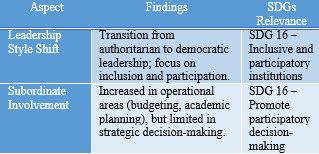
Objective: This study explores the leadership transformation of Islamic higher education institutions (Perguruan Tinggi Keagamaan Islam Swasta/PTKIS), focusing on the Mamba'ul 'Ulum Islamic Institute Indonesia (IIMU) from 2020 to 2025. Theoretical framework: Anchored in the theory of democratic leadership in Islamic education, the study emphasizes participation, authority distribution, and inclusivity as key pillars for organizational transformation. Literature review: A literature review highlights the relevance of transformational, participatory, structural, and cultural dimensions in shaping effective leadership in Islamic educational settings. Methods: The research employs a qualitative case study method, utilizing in-depth interviews, participatory observations, and document analysis. The participants include institutional leaders, lecturers, and staff across different departments at IIMU. Results: Findings reveal that although IIMU adopts a democratic leadership style in principle, the actual involvement of subordinates in strategic decision-making and program implementation remains minimal. Structural hierarchies, centralized decision-making practices, and entrenched work cultures present significant barriers. Nonetheless, where subordinate engagement is enhanced, there is a notable improvement in managerial efficiency and the overall quality of educational programs. In alignment with Sustainable Development Goal (SDG) 4, which promotes inclusive and equitable quality education and lifelong learning opportunities for all, this study underlines the importance of collaborative governance in Islamic education. Implications: It suggests that strengthening participatory leadership could support institutional innovation, accountability, and inclusive development. Furthermore, promoting internal dialogue and professional empowerment aligns with SDG 16, which calls for effective, accountable, and inclusive institutions. Novelty: The study’s novelty lies in its contribution to the discourse on democratic values in Islamic education leadership, particularly in PTKIS transformation. It highlights how empowering subordinates can enhance educational service delivery and institutional sustainability. These insights are vital for stakeholders aiming to align Islamic higher education with national education reforms and global development agendas such as the SDGs.
References
[1] J. Ghofir and H. Umam, “Transformasi nilai pendidikan keberagamaan pada generasi milenial,” Tadris J. Penelit. dan Pemikir. Pendidik. Islam, vol. 14, no. 1, pp. 92–111, 2020, https://doi.org/10.51675/jt.v14i1.74.
[2] A. Rouf, “Transformasi dan Inovasi Manajemen Pendidikan Islam,” Manag. J. Manaj. Pendidik. Islam Vol., vol. 1, no. 20, pp. 333–354, 2016, https://doi.org/10.14421/manageria.2016.12-09.
[3] L. Y. Yani, S. Aimah, A. Setiawan, K. H. Mukhtar, and B. Banyuwangi, “Revitalisasi Kepemimpinan Pesantren : Kajian Peran Perempuan Dalam Transformasi Pendidikan Islam,” El-Idare J. Islam. Educ. Manag., vol. 11, no. 1, pp. 1–10, 2025, https://doi.org/10.19109/elidare.v11i1.26741.
[4] A. Apiyani, “Transformasi Pendidikan Islam : Kepemimpinan Kepala Madrasah Dan Implementasi Supervisi Efektif,” IHSANIKA J. Pendidik. Agama Islam, vol. 2, no. 3, pp. 322–330, 2024, https://doi.org/10.59841/ihsanika.v2i3.1450.
[5] B. Nasukah and E. Winarti, “Teori Transformasi dan Implikasinya pada Pengelolaan Lembaga Pendidikan Islam,” Southeast Asian J. Islam. Educ. Manag., vol. 2, no. 2, pp. 177–190, 2021, https://doi.org/10.21154/sajiem.v2i2.43.
[6] S. A. J. Al Idrus, “Manajemen Resiko Dalam Perubahan Budaya Kerja Perguruan Tinggi Keagamaan Islam Swasta Di Lombok,” Islam. J. Keislam. dan Ilmu Pendidik., vol. 5, pp. 876–889, 2023, https://doi.org/10.36088/islamika.v5i2.3273.
[7] R. Pardian et al., “Penyusunan Rencana Strategis Dalam Rangka Transformasi Stie Ganesha Menuju Universitas Graha Ganesha,” Communnity Dev. J., vol. 5, no. 1, pp. 1868–1880, 2024, https://doi.org/10.31004/cdj.v5i1.25685.
[8] A. Chairy and A. Firdianti, “Peran Kepemimpinan dalam Penjaminan Mutu Perguruan Tinggi Keagamaan Islam Swasta,” TAFAHUS J. Pengkaj. Islam, vol. 1, no. 1, pp. 113–124, 2021, http://journal.kopertais15.or.id/index.php/tafahus
[9] S. Rodliyah, “Leadership Pesantren : Urgensi Pendidikan dalam Menyiapkan Pemimpin Bangsa Berkualitas dan Bermoral,” Manag. J. Manaj. Pendidik. Islam, vol. 4, no. 1, pp. 169–182, 2019, https://doi.org/10.14421/manageria.2019.41-10.
[10] A. Sholikhah, “Statistik Deskriptif Dalam Penelitian Kualitatif,” KOMUNIKA J. Dakwah dan Komun., vol. 10, no. 2, pp. 342–362, 2016, https://doi.org/10.24090/komunika.v10i2.953.
[11] W. Yuliani, “Metode Penelitian Deskriptif Kualitatif Dalam Perspektif Bimbingan Dan Konseling,” QUANTA J. Kaji. Bimbing. dan Konseling dalam Pendidik., vol. 2, no. 2, pp. 1–10, 2018, https://doi.org/10.22460/q.v2i2p83-91.1641.
[12] A. A. Mekarisce, “Teknik Pemeriksaan Keabsahan Data pada Penelitian Kualitatif di Bidang Kesehatan Masyarakat,” JJurnal Ilm. Kesehat. Masy. Media Komun. Komunitas Kesehat. Masy., vol. 12, no. 3, pp. 145–151, 2020, https://doi.org/10.52022/jikm.v12i3.102.
[13] M. Mulyadi, “Penelitian Kuantitatif Dan Kualitatif Serta Pemikiran Dasar Menggabungkannya,” J. Stud. Komun. dan Media, vol. 15, no. 1, p. 128, 2013, https://doi.org/10.31445/jskm.2011.150106.
[14] Q. A’yuni, J. S. Pangesti, and M. F. Suparman, “Tujuan, fungsi dan prinsip evaluasi pembelajaran pendidikan agama islam di pondok pesantren suryani surakarta,” Mamba’ul ’Ulum, vol. 20, no. 2, pp. 154–168, 2024, https://doi.org/10.54090/mu.349.
[15] F. Azis et al., Pengelolaan Pendidikan Era Merdeka Belajar: Teori dan Praktik. Tahta Media Group, 2023. [Online]. Available: https://tahtamedia.co.id/index.php/issj/article/view/405
[16] Y. Zulkarnain and Mujiyati, “Peran Kepemimpinan dan Komunikasi dalam Manajemen Filantropi : Analisis terhadap Implementasi Program Bantuan Sosial,” Pawarta J. Commun. Da’wah, vol. 2, no. 1, pp. 1–12, 2024, https://doi.org/10.54090/pawarta.572.
[17] M. Fatimah, P. Azhari, and M. Sanusi, “Relevansi Konsep Supervisi dan Kepemimpinan Menurut Perspektif Islam Serta Penerapannya di Era Modern,” Bunyan al-Ulum J. Stud. Islam, vol. 1, no. 2, pp. 149–175, 2024, https://doi.org/10.58438/bunyanalulum.v1i2.271.
[18] Mulyanto, D. Saefuddin, A. Husaini, and T. A. Bachtiar, “Manajemen Resiko Dalam Perubahan Budaya Kerja Perguruan Tinggi Keagamaan Islam Swasta Di Lombok,” Edukasi Islam. J. Pendidik. Islam, vol. 08, no. 02, pp. 369–396, 2019, https://doi.org/10.30868/ei.v8i2.537.
[19] J. Kolong et al., Kepemimpinan Pendidikan. Tahta Media Group, 2023. [Online]. Available: https://tahtamedia.co.id/index.php/issj/article/view/232
[20] A. Mahabie and Institut, “Akulturasi Budaya Timur Tengah Di Indonesia (Kedatangan Islam dan Pengaruh Budaya),” Mamba’ul ‘Ulum, vol. 16, no. 1, pp. 1–13, 2020, https://doi.org/10.54090/mu.1.
[21] A. Nabila, Muhammad Samsuri, I. Mukhlisah, and M. Fatimah, “Peran Guru Dalam Pembentukan Kepribadian Siswa,” Mamba’ul ’Ulum, vol. 19, no. 1, pp. 1–11, 2023, https://doi.org/10.54090/mu.98.
[22] Sukari, “Analisis dampak kebijakan periodisasi kepala sekolah,” Mamba’ul ‘Ulum, vol. 18, no. 2, pp. 202–210, 2022, https://doi.org/10.54090/mu.70.
[23] H. Sa’diyah, Kamaria, R. Mubarok, A. F. Harwisaputra, Tasbih, and S. Azahra, “Model Pengambilan Keputusan Berbasis Kolaboratif Di Lembaga Pendidikan Raudlatul Athfal,” An-Nadzir J. Manaj. Pendidik. Islam, vol. 02, no. 02, 2024, https://doi.org/10.55799/annadzir.v2i02.578.
[24] Irwanto, Susrianingsih, Habibi, and Ardat, “Manajemen Lembaga Pendidikan Islam Di Madrasah : Analisis Tentang Model dan Implementasinya,” Fitrah J. Islam. Educ., vol. 4, no. 1, pp. 162–174, 2023, https://doi.org/10.53802/fitrah.v4i1.396.
[25] M. Najamudin, “Sistem Informasi Manajemen Terhadap Pengambilan Keputusan di Lembaga Pendidikan Islam,” Tadarus J. Pendidik. Islam, vol. 5, no. 1, pp. 104–122, 2016, https://doi.org/10.30651/td.v5i1.347.
[26] A. Alam, R. T. Ratnasari, N. A.-K. Makkawi, and A. Ma’ruf, “The Problem of Murabaha Financing of Islamic Microfinance Institution and The Handling Strategies in Indonesia: A Literature Review,” Al-Muzara’Ah, vol. 11, no. 1, pp. 17–30, 2023, https://doi.org/10.29244/jam.11.1.17-30.
[27] M. Farid, T. Ibrahim, Hasbiyallah, and O. Arifudin, “Mekanisme pengambilan keputusan berbasis sistem informasi manajemen dalam lembaga pendidikan islam,” J. Tahsinia, vol. 6, no. 1, pp. 86–103, 2025, https://doi.org/10.57171/jt.v6i1.599.
[28] Y. Tamiang, “Pengambilan Keputusan Dan Peningkatan Mutu Pendidikan Di SMK Negeri 2 Medan,” J. Abil. J. Educ. Soc. Anal., vol. 3, no. 1, pp. 46–55, 2022, https://doi.org/10.51178/jesa.v3i1.389.
[29] M. Anggung and M. Prasetyo, “Pesantren Efektif : Studi Gaya Kepemimpinan Partisipatif,” Munaddhomah J. Manaj. Pendidik. Islam, vol. 3, no. 1, pp. 1–12, 2022, https://doi.org/10.31538/munaddhomah.v3i1.159.
[30] T. Trianung, D. Susanto, A. Graciana, K. Mela, S. Zahrah, and N. G. Namsan, “Analisis terhadap potensi risiko pengambilan keputusan dalam dunia pendidikan,” JPPI (Jurnal Penelit. Pendidik. Indones., vol. 10, no. 2, pp. 180–190, 2024, https://doi.org/10.29210/020243848.
[31] A. Sirojuddin et al., “Peranan Sistem Informasi Manajemen Dalam Pengambilan Keputusan Di Madrasah Ibtidaiyah Darussalam Pacet Mojokerto,” ZAHRA Res. Taught Elementary School. Islam J., vol. 3, no. 1, pp. 19–33, 2022, https://doi.org/10.37812/zahra.v3i1.395.
[32] N. N. Fitria, L. Luk, N. Mufidah, and P. Setiawati, “Summative Assessment of Islamic Education Subject in Merdeka Curriculum,” J. Educ. Res. Pract., vol. 2, no. 3, 2024, https://doi.org/10.70376/jerp.v2i3.157.
[33] A. Matinul Haq and E. Roesminingsih, “Situational Leadership Skills of Foundation Heads in Human Resource Development for Early Childhood Education,” Munaddhomah J. Manaj. Pendidik. Islam, vol. 5, no. 1, pp. 26–40, 2023, https://doi.org/10.31538/munaddhomah.v5i1.545.
[34] E. Knies, P. Boselie, J. Gould-Williams, and W. Vandenabeele, “Strategic human resource management and public sector performance: context matters,” Int. J. Hum. Resour. Manag., vol. 35, no. 14, pp. 2432–2444, 2024, https://doi.org/10.1080/09585192.2017.1407088.
[35] S. Firdaus, Bachroni, and A. Disuma, “Kontribusi Kelompok Bimbingan Haji dalam Penanaman Nilai-nilai Pendidikan Islam Multikultural di Masyarakat,” Indones. Res. J. Educ., vol. 4, no. 2, 2024, https://doi.org/10.31004/irje.v4i2.711.
[36] N. Hamid, S. Hidayat, and A. Nirwana, “Creative Leadership: An Implementation Study Of Transformative Leadership Models In High School For Sustainable Development Goals,” J. Lifestyle SDG Rev.., vol. 5, no. 1, 2024, https://doi.org/10.47172/2965-730X.SDGsReview.v5.n01.pe01686.
[37] A. A. Musadad and M. A. Adha, “Does Multicultural School Leadership Foster a Multicultural Teacher Culture? The Mediating Role of Multicultural Inspiration, Personality, and Attitude,” Eur. J. Educ. Res., vol. 11, no. 4, pp. 2387–2399, 2022, https://doi.org/10.12973/eu-jer.11.4.2387.
[38] B. Vanblaere and G. Devos, “Relating school leadership to perceived professional learning community characteristics: A multilevel analysis,” Teach. Teach. Educ., vol. 57, pp. 26–38, 2016, https://doi.org/10.1016/j.tate.2016.03.003.
[39] A. Mukti and K. Imron Rosadi, “Faktor Yang Mempengaruhi Pendidikan Islam: Sistem Berfikir Kebenaran, Pengetahuan, Nilai Dan Moralitas (Literature Review Manajmen Pendidikan Islam),” J. Ilmu Hukum, Hum. dan Polit., vol. 2, no. 1, pp. 1–12, 2022, https://doi.org/10.38035/jihhp.v2i1.852.
[40] M. R. Amalia, “The Impact of Digital Era 4.0 Transformation on Human Resources Management,” Manag. Stud. Bus. J., vol. 1, no. 1, pp. 89–98, 2024, https://doi.org/10.62207/9btfqx28.
[41] A. Alkhoraif, H. Rashid, and P. McLaughlin, “Lean implementation in small and medium enterprises: Literature review,” Oper. Res. Perspect., vol. 6, no. December 2018, p. 100089, 2019, https://doi.org/10.1016/j.orp.2018.100089.
Submitted
Accepted
Published
Issue
Section
License
Copyright (c) 2025 Edy Muslimin, Giyoto, Yusup Rohmadi

This work is licensed under a Creative Commons Attribution 4.0 International License.