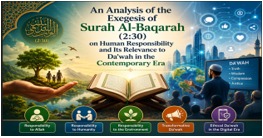
An Analysis of the Exegesis of Surah Al-Baqarah (2:30) on Human Responsibility and Its Relevance to Da'wah in the Contemporary Era
DOI:
https://doi.org/10.23917/profetika.v27i02.11411Keywords:
human responsibility, amanah, contemporary da'wah, digital ethics, qur'anic exegesisAbstract
Objective: This study examines the concept of amanah (human responsibility) in the interpretation of QS. Al-Baqarah verse 30 and explores its relevance as a normative framework for contemporary da'wah in addressing the ethical and social challenges of the digital era. Theoretical framework: The study is grounded in thematic Qur'anic exegesis (tafsīr maudū‘ī), the Qur'anic concept of human responsibility, Islamic ethics, and contemporary da'wah theory, positioning amanah as a comprehensive paradigm integrating theological, ethical, social, and ecological dimensions. Literature review: Previous studies have discussed ‘khilāfah’, Islamic ethics, and contemporary da'wah separately. However, limited research has reconstructed ‘amanah’ in QS. Al-Baqarah verse 30 as an integrated interpretive framework for responding to digital transformation, misinformation, moral decline, social polarization, and environmental responsibility. This study addresses that gap by connecting Qur'anic interpretation with contemporary da'wah discourse. Method: This research employs a qualitative library research design using a thematic Qur'anic exegesis approach. Data were collected from classical and contemporary Qur'anic commentaries and relevant scholarly literature, then analyzed through qualitative content analysis. Results: The findings reveal that ‘amanah’ in QS. Al-Baqarah verse 30 comprises three interrelated dimensions: responsibility toward Allah through obedience and accountability, responsibility toward fellow human beings through justice and social welfare, and responsibility toward the environment through sustainable stewardship. These dimensions provide a normative foundation for transformative da'wah that promotes ethical communication, counters misinformation and intolerance, strengthens digital integrity, and fosters moral awareness and social responsibility. Consequently, da'wah should be understood not merely as the transmission of religious teachings but as a process of ethical and civilizational transformation. Implications: The study offers a conceptual framework for strengthening contemporary da'wah through Qur'anic values while contributing to interdisciplinary discussions on Islamic communication and digital ethics. Novelty: This study reconstructs ‘amanah’ in QS. Al-Baqarah verse 30 as an integrated paradigm that links Qur'anic exegesis with contemporary da'wah, thereby enriching both Qur'anic studies and the theoretical development of da'wah in the digital age..
References
[1] “Indonesia | Reuters Institute for the Study of Journalism.” Diakses: 17 Juli 2026. [Daring]. Tersedia pada: https://reutersinstitute.politics.ox.ac.uk/digital-news-report/2024/indonesia?utm_source=chatgpt.com
[2] “Online disinformation : UNESCO unveils action plan to regulate social.” Diakses: 17 Juli 2026. [Daring]. Tersedia pada: https://www.unesco.org/en/articles/online-disinformation-unesco-unveils-action-plan-regulate-social-media-platforms
[3] A. Ridwan, “DAKWAH DAN DIGITAL CULTURE Membangun Komunikasi Dakwah di Era Digital,” LANTERA: Jurnal Komunikasi dan Penyiaran Islam, vol. 1, no. 1, hlm. 74–84, Des 2022, doi: 10.30999/lantera.v1i1.2526.
[4] S. Suhendra dan F. S. Pratiwi, “Peran komunikasi digital dalam pembentukan opini publik: Studi kasus media sosial,” dipresentasikan pada Iapa Proceedings Conference, 2024, hlm. 293–315.
[5] S. Nurwahida, “Fenomena Keislaman Sebagai Gejala Budaya dan Sosial,” AL-IBROH: Jurnal Ilmu Pendidikan dan Keguruan, vol. 2, no. 02, hlm. 117–134, 2025.
[6] U. S. Hasibuan, P. I. Utami, S. Novia, C. Surahman, dan E. Sumarna, “Konsep Khalifah dalam Qs. Al-Baqarah/2: 30 dan Implikasinya Terhadap Tujuan Pendidikan Islam di Era Society 5.0,” JOURNAL OF QUR’AN AND HADITH STUDIES, vol. 13, no. 2, hlm. 272–285, 2024.
[7] M. R. Alfares, A. Ashadi, dan N. Wendry, “Ragam Pemaknaan Konsep Khalifah dalam QS. Al-Baqarah [2]: 30: Studi Living Qur’an terhadap Hizbut Tahrir Indonesia, Muhammadiyah, dan Nahdlatul Ulama,” Jurnal Keilmuan dan Keislaman, hlm. 166–194, 2026.
[8] J. As-Suyuthi dan J. Al-Mahalli, “Tafsir jalalain,” Surabaya: Imaratullah, 2003.
[9] A. Zakiy dan R. Ali, “Pandangan Thabathaba’i Tentang Implikasi Potensi Manusia Terhadap Misi Fungsionalnya,” Jalsah: The Journal of Al-Quran and As-Sunnah Studies, vol. 3, no. 2, hlm. 21–53, 2023.
[10] H. B. El-Rasheed, Tafsir ayat-ayat Kebangsaan. brillyelrasheed, 2023.
[11] M. Q. Shihab, Malaikat dalam al-Qur’an: Yang Halus dan Tak Terlihat. Lentera Hati Group, 2010.
[12] M. I. Muttaqin dan L. M. Pd, Rahasia Besar Struktur Al-Qur’an: Membaca Mushaf Dalam 7 Bagian Besar. Dr. Mohammad Izdiyan Muttaqin, Lc. M. Pd., 2026.
[13] R. Armedi, “Tujuan Pendidikan Islam Perspektif Quraish Shihab: Era Digital,” Muqoddima: Jurnal Pemikiran Dan Riset Sosiologi, vol. 5, no. 2, hlm. 123–138, 2024.
[14] A. R. Firdausy, “Dasar Dan Prinsip Penerapan Ekonomi Islam Dalam Al-Qur’an,” TAFAQQUH, vol. 8, no. 02, hlm. 1–26, 2023.
[15] D. N. Fardani, Nilai Kejujuran dan Pentingnya Menuntut Ilmu: Pilar Kesuksesan Hidup. PT Traz Media Publishing, 2026.
[16] F. A. Winata, M. Alfiansyah, L. Khairani, P. Iraya, dan H. Hamdani, “Istilah Pendidikan Islam (Ta’lim) Dalam Qs. Al-Baqarah: 31 Menurut Tafsir Al-Munir,” Innovative: Journal of social science Research, vol. 3, no. 4, hlm. 6105–6116, 2023.
[17] I. F. Rusmiati dan H. Mahmud, “Dakwah Ekologis Khalifah: Telaah Al-Baqarah Ayat 30 dan Relevansinya terhadap Sustainability Management,” Journal of Da’wah, vol. 4, no. 1, hlm. 49–75, 2025.
[18] M. Saefullah, “Melacak Trilogi Hubungan Manusia Dalam Akhlak Pendidikan Islam (Teo-Sosio-Ekologis): Analisis Pakeliran Wayang Kulit Dalam Garap Catur Lakon Pandawa Matirta Oleh Ki Cahyo Kuntadi,” Khazanah Akademia, vol. 10, no. 01, hlm. 29–50, 2026.
[19] S. Oktafiani, R. Damis, dan M. Irham, “Sistematisasi nilai ekologis dalam Al-Qur’an: Kajian tematik atas konsep iṣlāḥ, fasād, dan ‘imārah sebagai etika pelestarian lingkungan,” Journal of Islamic Studies, vol. 3, no. 1, hlm. 13–21, 2025.
[20] F. N. S. Alam, “Kriteria Pemimpin Menurut Al-Qur’an: Analisis Semantik Kata Imam, Khalifah, dan Malik dalam Konteks Kekuasaan Kontemporer,” Ma’rifatuna: Jurnal Pendidikan dan Studi Islam, vol. 2, no. 02, hlm. 51–69, 2026.
[21] Y. I. Saputra, “Peran Akal dalam Al-Qur’an dengan Pendekatan Rasional dan Filosofis dalam Kitab Mafatih Al-Ghaib,” Ta’wiluna: Jurnal Ilmu Al-Qur’an, Tafsir dan Pemikiran Islam, vol. 6, no. 1, hlm. 346–362, 2025.
[22] A. Zaiyadi, “Penafsiran Ayat-Ayat Kisah Penciptaan Nabi Adam Dalam Perspektif Tafsir Maqasidi,” Al-Bayan: Jurnal Ilmu al-Qur’an dan Hadist, vol. 8, no. 2, hlm. 256–275, 2025.
[23] A. H. Ansori, “Strategi peningkatan sumber daya manusia dalam pendidikan Islam,” Qathruna, vol. 2, no. 02, hlm. 19–56, 2016.
[24] D. W. Toha, E. Puroman, dan F. Setiawati, “Internalisasi Nilai Tauhid Sebagai Pilar Pendidikan Islam Transformatif,” Journal of Education and Social Culture, vol. 1, no. 1, hlm. 80–85, 2025.
[25] M. M. Rosyadi, S. Adib, dan M. SI, “Hak-Hak Alam Semesta Dalam QS Al-A’raf [7]: 56-58 (Analisis Terhadap Tafsir Al-Misbah),” 2020.
[26] B. M. N. Abiyyu, “Al-Ijtihād Al-Maqāṣidī Dalam Perspektif: Ontologi, Epistemologi, Dan Aksiologi,” Amorti: Jurnal Studi Islam Interdisipliner, hlm. 751–759, 2026.
[27] T. Akhyar, “Dakwah dan Perubahan sosial,” Wardah, vol. 15, no. 2, hlm. 113–119, 2014.
[28] N. R. Pohan dan T. Salsabilla, “Jalan Qur’ani dalam Membangun Ketahanan Keluarga dan Kohesi Nasional,” Ta’wiluna: Jurnal Ilmu Al-Qur’an, Tafsir dan Pemikiran Islam, vol. 7, no. 1, hlm. 375–388, 2026.
Downloads
Submitted
Accepted
Published
Issue
Section
License
Copyright (c) 2026 Mastori, Otong Surasman, Moh. Sitoh Anang, Muhammad Ridwan, Chandra Gunawan

This work is licensed under a Creative Commons Attribution 4.0 International License.