Value Education and Emotional Intelligence: Building A Resilient Generation in the Digital Era to Achieve Sdgs
DOI:
https://doi.org/10.23917/profetika.v26i01.11151Keywords:
value-based education, emotional intelligence, digital age, sustainability, sdgsAbstract
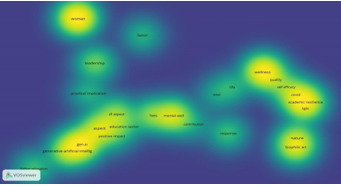
Objective: This study aims to analyze the integration of value-based education and emotional intelligence (EI) in shaping a resilient generation in the digital era to support sustainable education and the achievement of the SDGs. Theoretical framework: Based on the theory of emotional intelligence that emphasizes the management of emotions, empathy, and social skills, as well as the theory of value-based education that places moral character as the main focus of holistic education. Literature review: The literature shows the importance of integrating values and EI in improving students' learning motivation, self-efficacy, academic resilience, and emotional well-being, as well as the role of technology in supporting reflective and value-oriented education. Methods: Using a bibliometric literature analysis of 633 articles from the Scopus database published in 2022–2024 to map trends, key themes, and relationships between variables. Results: Five main clusters were found: the role of technology, sustainability policies, the transformation of educational institutions, teacher contribution and digital literacy, and character education in early childhood. EI has been shown to increase motivation, self-efficacy, academic resilience, and emotional well-being. Implications: There is a need for the development of a holistic education system that integrates values, EI, and empathy-based technologies to support the SDGs. Novelty: Develop a conceptual framework that integrates value education, emotional intelligence, and empathy-based technology in the modern education system to create more humane and reflective learning.
References
[1] K. Prummer, S. Human-Vogel, M. A. Graham, and D. Pittich, “The role of mentoring in developing leaders’ emotional intelligence: exploring mentoring types, emotional intelligence, organizational factors, and gender,” Front. Educ., vol. 9, 2024, https://doi.org/10.3389/feduc.2024.1393660.
[2] M. Fragkaki, A. Kavga-Paltoglou, M. Kelesi-Stavropoulou, and G. Fasoi, “Emotional Intelligence of Primary Health Care Nurses: A Longitudinal Randomized Clinical Trial,” Open Public Health J., vol. 17, no. 1, pp. 1–16, 2024, https://doi.org/10.2174/0118749445329730240729162817.
[3] Y. Suprayogi, S. Luckyardi, D. Kurnia, and M. A. Khairusy, “Linguistic Technopreneurship in Business Success Digitalization for Small Medium Enterprises in West Java: Implication for Language Education,” Int. J. Lang. Educ., vol. 8, no. 2, pp. 343–358, 2024, https://doi.org/10.26858/ijole.v8i2.64117.
[4] D. Rusdin, I. Indrawati, Marzuki, and Hidayati, “Indonesian High School Teachers’ Views on Media Education: Challenges and Prospects in EFL Instruction,” Int. J. Media Inf. Lit., vol. 8, no. 2, pp. 360–370, 2023, https://doi.org/10.13187/IJMIL.2023.2.360.
[5] W. Yuan, S. Samsudin, B. Abdullah, N. H. Farizan, M. Z. Hassan, and J. Cheng, “The Value, Obstacle and Strategy of Digital Empowerment Physical Education in Primary School,” J. Ecohumanism, vol. 3, no. 7, pp. 2752–2768, 2024, https://doi.org/10.62754/joe.v3i7.4415.
[6] A. Lesková, Z. Uličná, H. Tkáčová, K. Leka, and D. Alvarez Mateo, “Challenges and Current Issues of Education in the Era of Digital and Technological Changes,” J. Educ. Cult. Soc., vol. 14, no. 2, pp. 319–327, Sep. 2023, https://doi.org/10.15503/jecs2023.2.319.327.
[7] M. A. Momen, S. Sultana, M. A. Hoque, S. H. B. Shahriar, and A. S. M. Ashif, “Determinants of students’ satisfaction with digital classroom services: moderating effect of students’ level of study,” Asian Assoc. Open Univ. J., vol. 18, no. 2, pp. 160–175, 2023, https://doi.org/10.1108/AAOUJ-09-2022-0124.
[8] J. Qiu, “A Philosophical Inquiry into Practical Music Education in the Digital Age,” Appl. Math. Nonlinear Sci., vol. 9, no. 1, pp. 1–19, 2024, https://doi.org/10.2478/amns-2024-0065.
[9] S. Anwar and U. N. Saraih, “Digital leadership in the digital era of education: enhancing knowledge sharing and emotional intelligence,” Int. J. Educ. Manag., 2024, https://doi.org/10.1108/IJEM-11-2023-0540.
[10] J. Qiu, “A Philosophical Inquiry into Practical Music Education in the Digital Age,” Appl. Math. Nonlinear Sci., vol. 9, no. 1, 2024, https://doi.org/10.2478/amns-2024-0065.
[11] S. García-Merino, R. M. Rodríguez-Jiménez, A. Bustamante-Sánchez, and M. Carmona, “Promoting Values, Emotional Intelligence, And Physical Condition In Socio-Economically Disadvantaged Adolescents Through Basketball,” J. Sport Heal. Res., vol. 15, no. 2, pp. 283–300, 2023, https://doi.org/10.58727/jshr.90590.
[12] A. Viviani, “Inclusion and education for sustainable development: The experience of the University of Siena,” Perspect. Educ., vol. 40, no. 3, pp. 132–145, 2022, https://doi.org/10.18820/2519593X/pie.v40.i3.9.
[13] Y.-C. Chang and Y.-T. Tsai, “The Effect of University Students’ Emotional Intelligence, Learning Motivation and Self-Efficacy on Their Academic Achievement—Online English Courses,” Front. Psychol., vol. 13, 2022, https://doi.org/10.3389/fpsyg.2022.818929.
[14] Y. Liao, “Effects of Immersive Virtual Reality Technology on Online Learning Outcomes,” Int. J. Emerg. Technol. Learn., vol. 18, no. 13, pp. 62–73, 2023, https://doi.org/10.3991/ijet.v18i13.41201.
[15] P. A. Aure and O. Cuenca, “Fostering social-emotional learning through human-centered use of generative AI in business research education: an insider case study,” J. Res. Innov. Teach. Learn., vol. 17, no. 2, pp. 168–181, 2024, https://doi.org/10.1108/JRIT-03-2024-0076.
[16] A. Fereidouni, E. Teymoori, T. Bahmani, H. R. Sabet, Z. Maleki, and M. Gharibi, “Correlation between critical thinking and emotional intelligence: a national cross-sectional study on operating room nursing students in Iran,” Front. Nurs., vol. 11, no. 1, pp. 99–104, 2024, https://doi.org/10.2478/FON-2024-0010.
[17] N. Semenova, O. Semenov, N. Alendar, and A. Zdikhovskyi, “Psychological Peculiarities of Organization of Parent-Child Relationships Among Older Preschoolers,” Insight, no. 12, pp. 268–289, 2024, https://doi.org/10.32999/2663-970X/2024-12-12.
[18] S. Raheja, R. Gupta, and G. Yadav, “Spiritual Intelligence, happiness and success of students in select higher education institutions of the University of Delhi,” Environ. Soc. Psychol., vol. 9, no. 6, 2024, https://doi.org/10.54517/esp.v9i6.1984.
[19] P. Maharaj and A. Ramsaroop, “Enhancing emotional intelligence for well-being in higher education: Supporting SDG 3 amid adversity,” SA J. Hum. Resour. Manag., vol. 22, pp. 1–13, 2024, https://doi.org/10.4102/sajhrm.v22i0.2705.
[20] N. Ghag, H. Sonar, and G. Chaudhary, “Altruism in management education: a closer look at yoga-based practices,” Cogent Soc. Sci., vol. 10, no. 1, 2024, https://doi.org/10.1080/23311886.2024.2367087.
[21] S. Avsec, M. Jagiełło-Kowalczyk, and A. Żabicka, “Enhancing Transformative Learning and Innovation Skills Using Remote Learning for Sustainable Architecture Design,” Sustain., vol. 14, no. 7, 2022, https://doi.org/10.3390/su14073928.
[22] E. J. Pérez, M.-I. D. V. Yagüe Jara, R. G. Fresneda, and P. G. Guirao, “Sustainable education, emotional intelligence, and mother-child reading competencies within multiple mediation models,” Sustain., vol. 13, no. 4, pp. 1–16, 2021, https://doi.org/10.3390/su13041803.
[23] J. Liang, “Developing emotional intelligence in a static and interactive music learning environment,” Front. Psychol., vol. 15, 2024, https://doi.org/10.3389/fpsyg.2024.1279530.
[24] M. Mustaffa and S. H. Husain, “Unravelling the Key Ingredients of Employability Skills for Surveyor Graduates: A Systematic Literature Review,” Pertanika J. Soc. Sci. Humanit., vol. 32, pp. 69–92, 2024, https://doi.org/10.47836/pjssh.32.S4.04.
[25] E. Marheni et al., “Integrating Emotional Intelligence and Mental Education in Sports to Improve Personal Resilience of Adolescents,” Retos, vol. 51, pp. 649–656, 2024, https://doi.org/10.47197/retos.v51.101053.
[26] M. Estrada, D. Monferrer, A. Rodríguez, and M. A. Moliner, “Does emotional intelligence influence academic performance? The role of compassion and engagement in education for sustainable development,” Sustain., vol. 13, no. 4, pp. 1–18, 2021, https://doi.org/10.3390/su13041721.
[27] F. Muhammad, A. M. Abitolkha, and L. Dodi, “Dimensions of Sufism Within The Islamic Religious Education Curriculum in Higher Education: Multicase Study In East Java, Indonesia,” Nazhruna J. Pendidik. Islam, vol. 7, no. 1, pp. 40–58, 2024, https://doi.org/10.31538/nzh.v7i1.4525.
[28] B. Cai, Z. Shafait, and L. Chen, “Teachers’ Adoption of Emotions-Based Learning Outcomes: Significance of Teachers’ Competence, Creative Performance, and University Performance,” Front. Psychol., vol. 13, 2022, https://doi.org/10.3389/fpsyg.2022.812447.
[29] H. Yang, M. Cai, Y. Diao, R. Liu, L. Liu, and Q. Xiang, “How does interactive virtual reality enhance learning outcomes via emotional experiences? A structural equation modeling approach,” Front. Psychol., vol. 13, 2023, https://doi.org/10.3389/fpsyg.2022.1081372.
[30] I. García-Martínez, J. M. Augusto-Landa, R. Quijano-López, and S. P. León, “Self-Concept as a Mediator of the Relation Between University Students’ Resilience and Academic Achievement,” Front. Psychol., vol. 12, 2022, https://doi.org/10.3389/fpsyg.2021.747168.
[31] D. Ngo, A. Nguyen, B. Dang, and H. Ngo, “Facial Expression Recognition for Examining Emotional Regulation in Synchronous Online Collaborative Learning,” Int. J. Artif. Intell. Educ., vol. 34, no. 3, pp. 650–669, 2024, https://doi.org/10.1007/s40593-023-00378-7.
[32] M. Saad, N. A. Shah, K. Supian, A. A. Rani, and I. Abidin, “Emotional and spiritual quotient for sustainable education’s service quality,” Int. J. Eval. Res. Educ., vol. 12, no. 4, pp. 1781–1790, 2023, https://doi.org/10.11591/ijere.v12i4.25434.
[33] A. Kuk, M. Guszkowska, and A. Gala-Kwiatkowska, “Changes in the emotional intelligence of university students participating in psychological workshops and their predictors,” Curr. Psychol., vol. 40, no. 4, pp. 1864–1871, 2021, https://doi.org/10.1007/s12144-018-0115-1.
[34] J. Liu and H. Wang, “Analysis of Educational Mental Health and Emotion Based on Deep Learning and Computational Intelligence Optimization,” Front. Psychol., vol. 13, 2022, https://doi.org/10.3389/fpsyg.2022.898609.
[35] Y. Xing et al., “Developing an AI-Based Digital Biophilic Art Curation to Enhance Mental Health in Intelligent Buildings,” Sustain., vol. 16, no. 22, 2024, https://doi.org/10.3390/su16229790.
[36] X. Dong, O. A. Kalugina, D. G. Vasbieva, and A. Rafi, “Emotional Intelligence and Personality Traits Based on Academic Performance,” Front. Psychol., vol. 13, 2022, https://doi.org/10.3389/fpsyg.2022.894570.
[37] A. Almufarreh, “Determinants of Students’ Satisfaction with AI Tools in Education: A PLS-SEM-ANN Approach,” Sustain. , vol. 16, no. 13, 2024, https://doi.org/10.3390/su16135354.
[38] B. Xiong, “Research on Educational Guidance of College Students’ Career Planning Awareness in the Context of Informatization,” Appl. Math. Nonlinear Sci., vol. 9, no. 1, 2024, https://doi.org/10.2478/amns-2024-2272.
[39] B. Xiong, “Research on Educational Guidance of College Students’ Career Planning Awareness in the Context of Informatization,” Appl. Math. Nonlinear Sci., vol. 9, no. 1, pp. 1–16, 2024, https://doi.org/10.2478/amns-2024-2272.
[40] T. V Dube, “Library staff support with Fourth Industrial Revolution’s application to provide information resources to remote clients during the COVID-19 library services,” Libr. Manag., vol. 43, no. 1–2, pp. 148–160, 2022, https://doi.org/10.1108/LM-10-2021-0085.
Submitted
Accepted
Published
Issue
Section
License
Copyright (c) 2025 Muhammad Alfi Syahrin, Khoiriyah, Heri Rifhan Halili, Ammar Wangyee

This work is licensed under a Creative Commons Attribution 4.0 International License.