DEVELOPMENT AND PRELIMINARY CHARACTERISATION OF A MULTI-ORIENTATION PROPELLER TEST BENCH FOR STATIC THRUST-VECTOR MEASUREMENT IN TILT-CAPABLE UAV APPLICATIONS
DOI:
https://doi.org/10.23917/mesin.v27i2.16440Keywords:
UAV propulsion, tilt-capable UAV, propeller test bench, thrust vectoring, experimental instrumentationAbstract
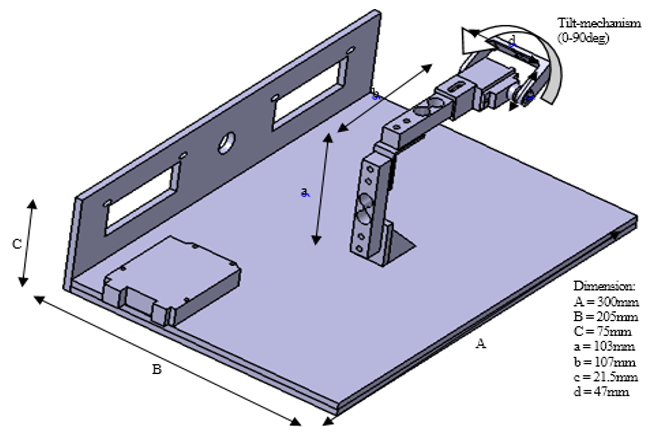
This study develops and preliminarily characterises a low-cost multi-orientation propeller test bench for static thrust-vector measurements relevant to tilt-capable unmanned aerial vehicle (UAV) propulsion research. The platform combines a servo-actuated 0-90 degree tilt mechanism, an Arduino Uno data-acquisition unit, nominal 1 kgf load-cell instrumentation with HX711 conditioning, an MPU6050 orientation sensor, RPM monitoring, and an inline electrical power meter. The prototype was evaluated using a 63.5 mm HQProp T63-6 propeller driven by an iFlight XING 1404 4600 KV motor at discrete tilt angles of 0, 30, 45, 60, and 90 degrees over several rotational-speed settings. The preliminary measurements show the expected redistribution of the propulsion-force vector in the laboratory reference frame: the horizontal component is dominant at 0 degrees, the vertical component is dominant at 90 degrees, and approximately balanced components occur near 45 degrees. Increasing rotational speed increases the measured force magnitude across the tested orientations. The present experiment is intentionally interpreted as static multi-orientation force-vector characterisation rather than a reproduction of transition-flight aerodynamics, because no external freestream was imposed. The results demonstrate the practical functionality of the rotating test-bench architecture and its suitability as a foundation for more rigorous propulsion-system characterisation.
Downloads
Downloads
Submitted
Accepted
Published
Issue
Section
License
Copyright (c) 2026 Buyung Junaidin, Agung Prakoso, Sarjito

This work is licensed under a Creative Commons Attribution 4.0 International License.