PERFORMANCE EVALUATION OF A SMALL-SCALE LPG ALUMINIUM MELTING FURNACE USING FOUR-LAYER REFRACTORY INSULATION
DOI:
https://doi.org/10.23917/mesin.v27i2.13553Keywords:
aluminium, daur ulang, peleburan, tungku, insulasiAbstract
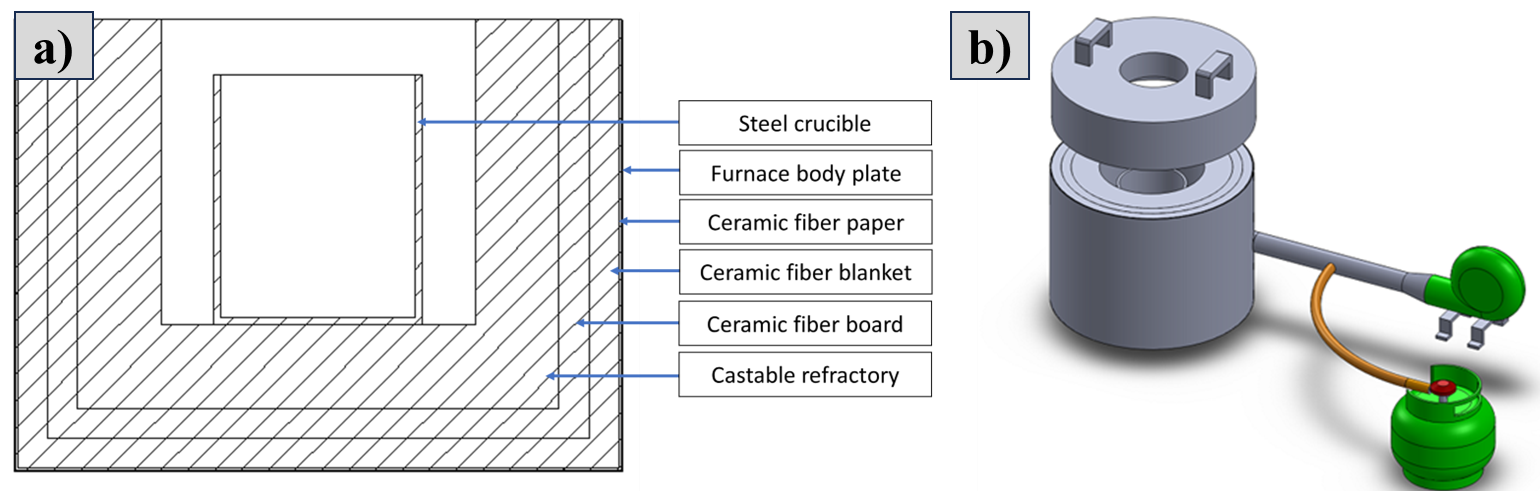
Aluminium scrap derived from automotive and industrial machinery components holds considerable potential for recycling; however, small and medium enterprises (SMEs) and vocational institutions still need compact, thermally efficient melting furnaces. This study outlines the design, thermal performance analysis, and experimental assessment of a 7 kg LPG-fired aluminium melting furnace, which features a four-layer refractory lining made up of ceramic fibre paper, ceramic fibre blanket, ceramic fibre board, and LCF384A insulating castable. The furnace includes a combustion chamber with a diameter of 280 mm and a height of 320 mm, along with a steel crucible that measures 165 mm in diameter and 233 mm in height. Thermal analysis indicated that the crucible offers an effective volume of 3.49 dm³, which corresponds to a capacity of 9.44 kg of solid aluminium and 8.05–8.24 kg of molten aluminium. The multilayer refractory lining achieved an overall thermal resistance of 0.809 K/W, leading to an estimated conductive heat loss of around 1.195 kW at a furnace temperature of 1000 °C. Six melting trials were performed using aluminium scrap from pistons, engine blocks, and textile machines. The furnace successfully melted 7 kg of aluminium within a time frame of 1380–1965 seconds (23.0–32.8 minutes) while consuming between 2.0 and 3.2 kg of LPG. The combustion parameter (λ) varied from 1.02 to 1.21, indicating stable and clean combustion. Optical emission spectroscopy revealed that the recycled engine block and piston alloys had chemical compositions that were closest to those of commercial casting aluminium alloys, although additional Cu is necessary to fully meet standard specifications. The proposed furnace exhibits dependable thermal performance, minimal conductive heat loss, and stable melting characteristics, making it ideal for vocational education and small-scale aluminium casting applications.
Downloads
Downloads
Submitted
Accepted
Published
Issue
Section
License
Copyright (c) 2026 Hariningsih, Arif Syamsudin, Bangun Rifki Darmawan

This work is licensed under a Creative Commons Attribution 4.0 International License.