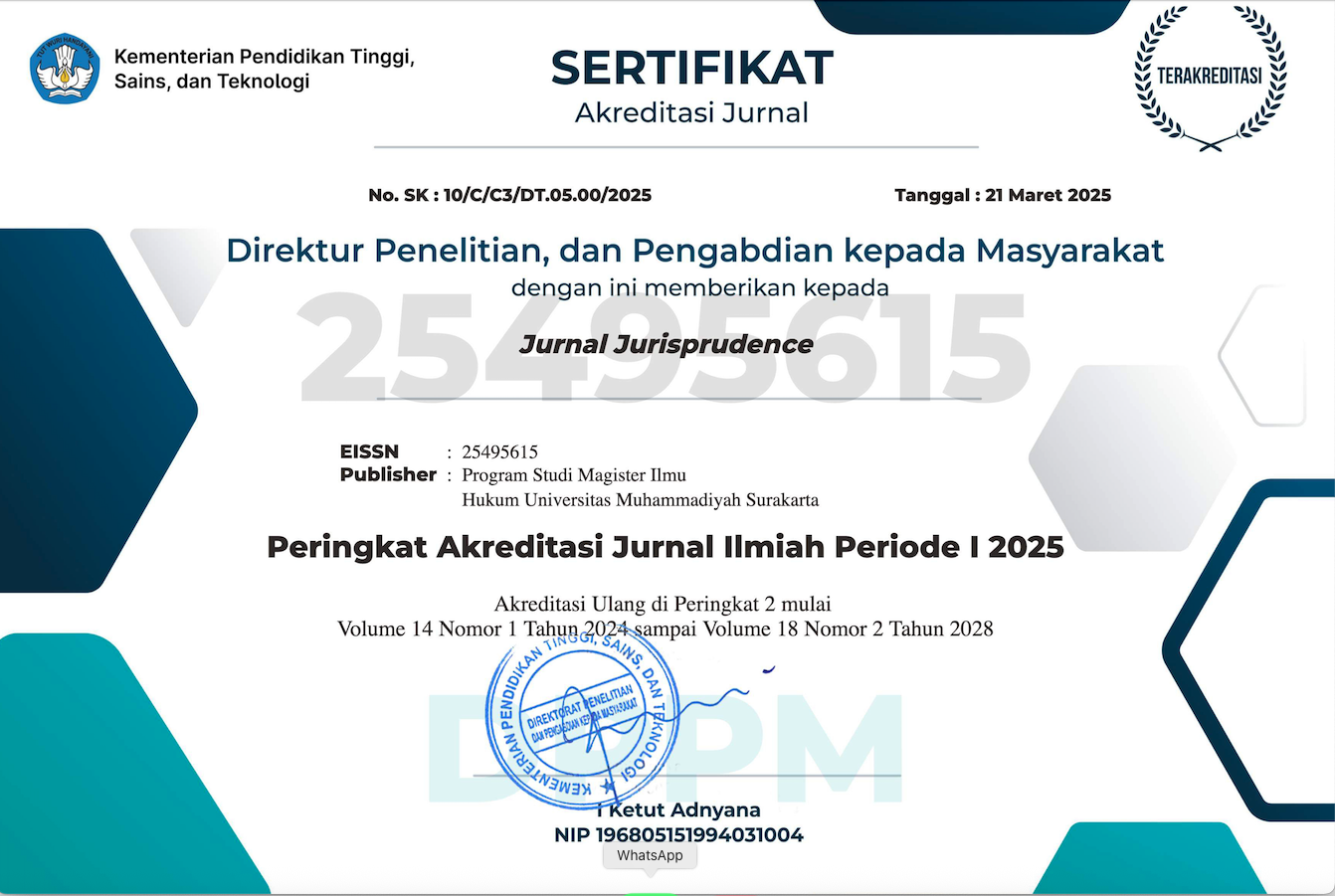
Between Legality and Justice: A Critical Study of the Supreme Court’s Judicial Reasoning in Dispute of the Awyu Customary Forest
DOI:
https://doi.org/10.23917/jurisprudence.v15i2.11442Keywords:
Judicial Decision, Legal Positivism, Substantive Justice, Indigenous People, Awyu TribeAbstract
ABSTRACT
Purpose of the Study: This research aims to analyze the application of legal positivism and living law approaches in judicial reasoning, particularly in the decisions of the Jayapura Administrative Court No. 6/G/LH/2023/PTUN.JPR, the Manado High Administrative Court No. 92/B/LH/2023/PT.TUN.MDO, and the Supreme Court Decision No. 458 K/TUN/LH/2024. In addition, this study evaluates the extent to which the principles of substantive justice and the protection of customary communities are accommodated in Indonesia’s judicial practice.
Methodology: This study employed a normative legal research method using three main approaches: the statutory approach, the case approach, and the conceptual approach. The case approach was used to profoundly analyze three judicial decisions involving the Awyu indigenous people, namely the Jayapura Administrative Court Decision No. 6/G/LH/2023/PTUN.JPR, the Manado High Administrative Court Decision No. 92/B/LH/2023/PT.TUN.MDO, and the Supreme Court Decision No. 458 K/TUN/LH/2024. The conceptual approach linked the theories of legal positivism, living law, and substantive justice.
Results: The findings indicate a dominance of formal legality and legal positivism in the judicial reasoning at both the appellate and cassation levels. The Supreme Court rejected the lawsuit of the Awyu indigenous people on the grounds of expiration, as it exceeded the 90-day filing period, without addressing the substantive issues of violations of environmental and indigenous rights. This formal-positivistic pattern of judgment creates a judicial barrier that hinders customary communities’ access to justice and disregards living law.
Applications of this Study: This study contributes scientifically to strengthening the discourse on legal pluralism and developing a paradigm of substantive justice within Indonesia’s legal system. It emphasizes the importance of integrating customary legal values and ecological justice into judicial processes.
Novelty/Originality of this Study: The novelty of this research lies in its critical and comparative analysis of judicial reasoning across three levels of adjudication in the Awyu case, including the examination of dissenting opinions at the Supreme Court level. It reveals the historical tension between positive law and the substantive justice values of indigenous peoples, highlighting the urgency of reconstructing the judicial paradigm.
Keywords: Judicial Decision; Legal Positivism; Substantive Justice; Indigenous People; Awyu Tribe.
ABSTRAK
Tujuan Penelitian: Penelitian ini bertujuan untuk menganalisis penerapan pendekatan positivisme hukum dan living law dalam pertimbangan hakim, khususnya pada Putusan PTUN Jayapura No. 6/G/LH/2023/PTUN.JPR, Putusan PT.TUN Manado No. 92/B/LH/2023/PT.TUN.MDO, dan Putusan Mahkamah Agung No. 458 K/TUN/LH/2024. Selain itu, penelitian ini menilai sejauh mana prinsip keadilan substantif dan perlindungan terhadap Masyarakat Hukum Adat (MHA) diakomodasi dalam praktik peradilan Indonesia.
Metodologi: Penelitian ini menggunakan metode hukum normatif dengan tiga pendekatan utama: pendekatan perundang-undangan, pendekatan kasus, dan pendekatan konseptual. Pendekatan kasus digunakan untuk menganalisis secara mendalam tiga putusan pengadilan dalam sengketa Suku Awyu, yaitu Putusan PTUN Jayapura No. 6/G/LH/2023/PTUN.JPR, Putusan PT.TUN Manado No. 92/B/LH/2023/PT.TUN.MDO, dan Putusan Mahkamah Agung No. 458 K/TUN/LH/2024. Pendekatan konseptual mengaitkan teori hukum positivistik, living law, dan keadilan substantif.
Hasil: Hasil penelitian menunjukkan adanya dominasi pendekatan legalitas formal dan positivisme hukum dalam praktik peradilan tingkat banding dan kasasi. Putusan MA menolak gugatan MHA Suku Awyu berdasarkan alasan kedaluwarsa karena melampaui batas waktu 90 hari, tanpa menyentuh substansi pelanggaran lingkungan dan hak adat. Pola putusan formil-positivistik ini menciptakan judicial barrier yang menghambat akses MHA terhadap keadilan dan mengabaikan living law.
Aplikasi Penelitian: Penelitian ini bermanfaat sebagai kontribusi ilmiah untuk penguatan wacana pluralisme hukum dan pengembangan paradigma keadilan substantif dalam sistem hukum Indonesia. Studi ini menekankan pentingnya integrasi nilai-nilai hukum adat dan keadilan ekologis ke dalam proses peradilan.
Kebaruan: Kebaruan studi ini terletak pada analisis kritis dan komparatif terhadap pola pertimbangan hakim pada tiga tingkat peradilan kasus Suku Awyu, termasuk menguji argumen dissenting opinion di tingkat MA, untuk mengungkap ketegangan historis antara hukum positif dan nilai-nilai keadilan substantif MHA, serta urgensi rekonstruksi paradigma peradilan.
Kata Kunci; Putusan Hakim; Positivisme Hukum, Keadilan Substantif; Masyarakat Hukum Adat; Suku Awyu
References
A, T. M., & Sunitha, V. (2023). Influence of Societal Norms in Mahesh Dattani’s Bravely Fought the Queen. Migration Letters, 21(1). https://doi.org/10.59670/ml.v21is1.5935
Akmal, D. U., Kusnandar, M. I., & Muin, F. (2025). Perlindungan Hak Konstitusional Masyarakat Hukum Adat Melalui Pembentukan Hukum. Jurnal Konstitusi, 22(1), 66-87. https://doi.org/10.31078/jk2214
Akter, S., Williams, C., Talukder, A., Islam, M. N., Escallon, J. V., Sultana, T., Kapil, N., & Sarker, M. (2021). Harmful Practices Prevail Despite Legal Knowledge: A Mixed-Method Study on the Paradox of Child Marriage in Bangladesh. Sexual and Reproductive Health Matters, 29(2). https://doi.org/10.1080/26410397.2021.1885790
Anisah, S., & Hadi, S. (2023). The Human Right to a Fair Trial in Competition Law Enforcement Procedures: A Rising Issue in Indonesian Experiences. Laws, 12(3), 55. https://doi.org/10.3390/laws12030055
Arsenault, R., Bourassa, C., Diver, S., McGregor, D., & Witham, A. A. (2019). Including Indigenous Knowledge Systems in Environmental Assessments: Restructuring the Process. Global Environmental Politics, 19(3), 120-132. https://doi.org/10.1162/glep_a_00519
Asteria, D., Brotosusilo, A., Negoro, H. A., & Sudrajad, M. R. (2021). Contribution of Customary Law in Sustainable Forest Management for Supporting Climate Action. Iop Conference Series Earth and Environmental Science. https://doi.org/10.1088/1755-1315/940/1/012080
Aunuh, N. (2024). Customary Law ``Bolit Mate Nawar Uman" as ``Living Law" in West Kutai Regency, East Kalimantan. Kne Social Sciences, 8(21). https://doi.org/10.18502/kss.v8i21.14763
Badano, G. (2017). If You’re a Rawlsian, How Come You’re So Close to Utilitarianism and Intuitionism? A Critique of Daniels’s Accountability for Reasonableness. Health Care Analysis, 26(1), 1-16. https://doi.org/10.1007/s10728-017-0343-9
Bakri, M., Damayanti, R., Sandra, G., & Priatama Amar, A. A. (2023). The Role of Customary Law in Regarding Theft Offenses by Minors. Journal La Sociale, 4(3). https://doi.org/10.37899/journal-la-sociale.v4i3.847
Basoeky, U. (2019). Legal Reconstruction: Ingsutan Paradigmatic on the Determination of the Positivism Paradigm and Legal Positivism in Law Enforcement in Indonesia. International Journal of Science and Society, 1(4). https://doi.org/10.54783/ijsoc.v1i4.323
Bentsen, H. L. (2019). Dissent, Legitimacy, and Public Support for Court Decisions: Evidence From a Survey-Based Experiment. Law & Society Review, 53(2), 588-610. https://doi.org/10.1111/lasr.12402
Bombang, S., Haling, S., & Halim, P. (2019). Lex Superior Versus Lex Inferior: Selection Between Social Norms and Applicable Legal Norms. https://doi.org/10.31227/osf.io/rw352
Br Nababan, N. O., Wiwoho, J., Ayu Handayani, I. G., & Karjoko, L. (2024). Legal Politics of Water Resources Regulation in Achieving Social Welfare, 9(4) https://doi.org/10.2991/978-2-38476-218-7_28
Bricker, B. (2017). Breaking the Principle of Secrecy: An Examination of Judicial Dissent in the European Constitutional Courts. Law & Policy, 39(2), 170-191. https://doi.org/10.1111/lapo.12072
Buell, M.-C., Ritchie, D., Ryan, K., & Metcalfe, C. D. (2020). Using Indigenous and Western Knowledge Systems for Environmental Risk Assessment. Ecological Applications, 30(7). https://doi.org/10.1002/eap.2146
Chung, H. (2018). Rawls’s Self-Defeat: A Formal Analysis. Erkenntnis, 85, 1169-1197. https://doi.org/10.1007/s10670-018-0079-4
Datta, R., & Marion, W. P. (2021). Ongoing Colonization and Indigenous Environmental Heritage Rights: A Learning Experience With Cree First Nation Communities, Saskatchewan, Canada. Heritage, 4(3). https://doi.org/10.3390/heritage4030076
Dawson, N., & Suich, H. (2025). Advancing Social Impact Assessments for More Effective and Equitable Conservation. Conservation Biology, 39(2). https://doi.org/10.1111/cobi.14453
de Paranhos, D. G., Matias, E. A., de Sá, N. M., & Garrafa, V. (2018). As Teorias Da Justiça, De John Rawls E Norman Daniels, Aplicadas À Saúde. Saúde Em Debate, 49(119), 1102-1011. https://doi.org/10.1590/0103-1104201811917
Dewi, I. G., Wiryani, M., Adhi, Y. P., & Prasetyo, A. B. (2023). Legal Study on Customary Land Business Agreements by Companies and Indigenous Peoples. https://doi.org/10.2991/978-2-38476-164-7_17
Diala, A. (2021). Legal Pluralism and the Future of Personal Family Laws in Africa. SSRN Electronic Journal, 35(1), 1-17. https://doi.org/10.2139/ssrn.3899110
Disantara, F. P. (2021). Konsep Pluralisme Hukum Khas Indonesia Sebagai Strategi Menghadapi Era Modernisasi Hukum. Al-Adalah Jurnal Hukum Dan Politik Islam, 6(1). https://doi.org/10.35673/ajmpi.v6i1.1129
Drumbl, M. A. (2020). Memorializing Dissent: Justice Pal in Tokyo. Ajil Unbound. https://doi.org/10.1017/aju.2020.26
Dunoff, J. L., & Pollack, M. A. (2022). The Road Not Taken: Comparative International Judicial Dissent. American Journal of International Law, 116(2), 340-396. https://doi.org/10.1017/ajil.2022.1
Fanani, A. Z., & Zulkarnain, M. S. (2022). Understanding John Austin’s Legal Positivism Theory and Hans Kelsen’s Pure Legal Theory. Peradaban Journal of Law and Society, 1(2). https://doi.org/10.59001/pjls.v1i2.41
Foran, M. P. (2019). The Rule of Good Law: Form, Substance and Fundamental Rights. The Cambridge Law Journal, 78(3), 570-595. https://doi.org/10.1017/s0008197319000618
Frima Sumbara, A. P. (2023). Legal Analysis of Communal Rights of Ammatoa Kajang Customary Law Community on Customary Forest in Bulukumba District. Edunity Kajian Ilmu Sosial Dan Pendidikan, 2(7). https://doi.org/10.57096/edunity.v2i7.114
Fuchs, W. A. (2020). Litigious Bukovina: Eugen Ehrlich’s ›Living Law‹ and the Use of Civil Justice in the Late Habsburg Monarchy. Administory, 5(1). https://doi.org/10.2478/adhi-2020-0015
Gališanka, A. (2019). John Rawls: The Path to a Theory of Justice. Harvard University Press. https://doi.org/10.2307/j.ctvfb6z6f
Gimenez, R. M. (2022). Making Space for Indigenous Law in State‐led Decisions About Hydropower Dams: Lessons From Environmental Assessments in Canada and Brazil. Review of European Comparative & International Environmental Law, 31(2), 233-245. https://doi.org/10.1111/reel.12432
Grey, C. (2018). Stability and the Sense of Justice. Philosophy & Social Criticism, 44(9). https://doi.org/10.1177/0191453718768353
Grote, K. M. (2022). Controlling the Narrative: Critiquing the Geopolitical Narratives of US Environmental Impact Assessments and Exclusion of Indigenous Communities. Environment and Planning F, 1(2-4). https://doi.org/10.1177/26349825221123571
Halkis, M., & Amri, F. (2019). Position of the Ulayat Rights in the Law and Government Policy After the Regional Autonomy in Singingi Region, Riau Province, Indonesia. JLPG, 83. https://doi.org/10.7176/jlpg/83-05
Harrisa, S. I., Kristanto, Y., Sendra, I. M., & Ridho, R. O. (2023). Development Model of Traditional Ritual Festivalization as Cultural Tourism Attraction in Padang Panjang City, West Sumatra. Asian Journal of Social and Humanities, 1(11). https://doi.org/10.59888/ajosh.v1i11.94
Hartiwiningsih, H., Pratiwi, D. E., & Parwitasari, T. A. (2024). Political Shift Law Settlement of Fly Ash and Bottom Ash (Faba) Coal Based on Ecological Justice. Journal of Law and Sustainable Development, 12(4). https://doi.org/10.55908/sdgs.v12i4.433
Huerta, E. O. (2021). Transnational Corporate Liability Litigation and Access to Environmental Justice: The Vedanta v Lungowe Case. Lselr, 6(3). https://doi.org/10.61315/lselr.166
Idrus, S. H., Sumartono, E., Wartono, W., Suharto, S., & Syahriar, I. (2024). Harnessing Digital Transformation for Improved Public Service Delivery: Lessons From Global Administrative Practices. Join: Journal of Social Science, 1(3). https://doi.org/10.59613/k8s6s859
Jaya, I. G. G. M. A., Santiago, F., & Fakrulloh, Z. A. (2023). Restorative Justice as an Effort to Settle Traffic Accident Crime Cases. Interdiciplinary Journal and Hummanity (Injurity), 2(2). https://doi.org/10.58631/injurity.v2i2.29
Jiang, W., Wang, X., & Du, L. (2023). Intergenerational Externalities and Corporate Green Innovation. Sustainable Development, 31(4), 2212-2221. https://doi.org/10.1002/sd.2501
Jiménez, F. M. (2023). Legal Positivism for Legal Officials. Canadian Journal of Law & Jurisprudence, 36(2), 359-386. https://doi.org/10.1017/cjlj.2022.36
Jodyvash, M. (2025). The Role of Cultural Pluralism in Indigenous Peoples’ Defense of Nature’s Rights. Oñati Socio-Legal Series, 15(4). https://doi.org/10.35295/osls.iisl.2228
Juhana, U., Prasetyo, S. N., & Erdianti, R. N. (2024). Community Service Sentencing: Its Urgency in and Contribution to Future Criminal Law in Indonesia. JLPG, 140. https://doi.org/10.7176/jlpg/140-01
Kaharuddin, K. (2023). Legal Sociology Approach: A Critical Study on Understanding the Law. Veteran Law Review, 6(Special Issue). https://doi.org/10.35586/velrev.v6ispecialissues.4955
Kędziora, K. (2019). Habermas and Rawls on an Epistemic Status of the Principles of Justice. Acta Universitatis Lodziensis Folia Philosophica Ethica-Aesthetica-Practica, 34. https://doi.org/10.18778/0208-6107.34.03
Kharisma Pradana, G. Y. (2018). Legal Pluralism Politics Towards Recognition of Social Unity in Customary Law and Local Regulation. International Journal of Social Sciences and Humanities, 2(2). https://doi.org/10.29332/ijssh.v2n2.152
Kridasakti, S. W., Majid, A., & Yuningsih, H. (2022). Restorative Justice Tindak Pidana “Elopement” Hukum Adat Dalam Konstruksi Hukum Pidana Positif Indonesia. Jurnal Supremasi, 12(2). https://doi.org/10.35457/supremasi.v12i2.1839
Kubal, A. (2023). Dissenting Consciousness: A Socio-Legal Analysis of Russian Migration Cases Before the European Court of Human Rights. The International Journal of Interdisciplinary Civic and Political Studies, 18(2). https://doi.org/10.18848/2327-0071/cgp/v18i02/57-77
Kyllönen, S. (2022). Towards a Multispecies Population Ethics. Environmental Ethics, 44(4), 347-366. https://doi.org/10.5840/enviroethics2022102748
Laia, F. F. D. (2024). Restorative Justice and Living Law Based on Dayak Ngaju Adat Law: A Comprehensive Analysis. Sign Jurnal Hukum, 6(2), 363. https://doi.org/10.37276/sjh.v6i2.363
Liddell, J. L., Kington, S., & McKinley, C. E. (2022). “We Live in a Very Toxic World”: Changing Environmental Landscapes and Indigenous Food Sovereignty. Studies in Social Justice, 16(3). https://doi.org/10.26522/ssj.v16i3.2746
Makhmari, M., Al-Hammouri, A., Al-Billeh, T., Alkhseilat, A., & Almamari, A. (2024). The Role of International Judiciary in Protecting the Environmental Rights of Future Generations. PJC, 16(2), 619-634. https://doi.org/10.62271/pjc.16.2.619.634
Manalu, F. H., Saraswati, R., & Yulida, D. (2023). Political Law Interpretation on President’s Refusal to Sign an Approved Bill With the House of Representatives. Jurnal Dinamika Hukum, 23(1). https://doi.org/10.20884/1.jdh.2023.23.1.3267
Marah, T. S. (2025). Legal Protection of Indigenous Peoples Under International Environmental Law. Ijlj, 2(4). https://doi.org/10.47134/ijlj.v2i4.4112
Mazor, J. (2022). On Environmental Justice, Part II: Non-Absolute Equal Division of Rights to the Natural World. Economics and Philosophy, 39(2), 256-284. https://doi.org/10.1017/s0266267122000050
Mei, L. C. (2023). Logging and Indigenous Peoples’ Well-Being: An Overview of the Relevant International Human Rights Jurisprudence. The International Forestry Review, 25(1), 17-27. https://doi.org/10.1505/146554823836902608
Muharman, D. (2025). Analysis of Recognition and Protection of Indigenous Peoples Rights in Land Policy in Indonesia. Nawala Journal. https://doi.org/10.62872/xqyx4373
Munawar, S., Jan Butt, M. A., & Zaka, S. (2023). The Influence of Materialism on Politics: An Examination Through the Lens of Karl Marx’s Perspective. Bbe, 12(3), 352-355. https://doi.org/10.61506/01.00040
Muntaha, S. (2024). Comparison of Sanctions for the Crime of Adultery in Toraja Customary Law and National Law in Indonesia. Jurnal Hukum Politik Dan Ilmu Sosial. https://doi.org/10.55606/jhpis.v3i1.3385
Muro, S., Amaral‐Garcia, S., Chehtman, A., & Garoupa, N. (2020). Exploring Dissent in the Supreme Court of Argentina. International Review of Law and Economics. https://doi.org/10.1016/j.irle.2020.105909
Nadler, J. (2017). Expressive Law, Social Norms, and Social Groups. Law & Social Inquiry, 42(1), 60-75. https://doi.org/10.1111/lsi.12279
Nesterova, Y. (2020). Rethinking Environmental Education With the Help of Indigenous Ways of Knowing and Traditional Ecological Knowledge. Journal of Philosophy of Education, 54(4), 1047-1057. https://doi.org/10.1111/1467-9752.12471
Noor, H. J., Afkar, K., & Glaser, H. (2021). Application of Sanctions Against State Administrative Officials in Failure to Implement Administrative Court Decisions. Bestuur, 9(1). https://doi.org/10.20961/bestuur.v9i1.49686
Nugraha, X., Aryani Wibisono, A. M., Angelia, A., S., B. O., & Answendy, P. R. (2023). Strengthening Customary Forest Rights for Indigenous People in Indonesia Green Constitution Framework. Jurnal Kajian Pembaruan Hukum, 3(2). https://doi.org/10.19184/jkph.v3i2.43367
Nur, A. I., Al-Fatih, S., & Intania, C. C. (2024). Revitalising Indigenous Rights Participation in Mining Lawmaking Process: Evaluation and Proposal for Indonesia. Law Reform, 20(1). https://doi.org/10.14710/lr.v20i1.63684
Pereira, R. (2021). Public Participation, Indigenous Peoples’ Land Rights and Major Infrastructure Projects in the Amazon: The Case for a Human Rights Assessment Framework. Review of European Comparative & International Environmental Law, 30(2). https://doi.org/10.1111/reel.12400
Poesoko, H., Rato, D., & Prabu Rumiartha, I. N. (2019). The Nature of Customary Land Concession in the Customary Law Society. International Journal of Social Sciences, 3(1). https://doi.org/10.31295/ijss.v3n1.111
Rahail, E. B., Jotam Kalalo, J. J., Betaubun, H. F., & Kalalo, C. N. (2018). Environmental Law Politics and Malind Anim Indigenous People Rights Protection Based on Free and Prior Informed Consent Principles. E3s Web of Conferences. https://doi.org/10.1051/e3sconf/20187302017
Rahardjo, S. (1991). Ilmu Hukum (revisi). Citra Aditya Bakti.
Rasdi, R. (2020). Criminal Politics (Enforcement) of Criminal Law Based on Pancasila Equity. Jurnal Pengabdian Hukum Indonesia (Indonesian Journal of Legal Community Engagement) Jphi, 5(2). https://doi.org/10.15294/ijcls.v5i2.28107
Reed, G., Brunet, N. D., Longboat, S., & Natcher, D. (2020). Indigenous Guardians as an Emerging Approach to Indigenous Environmental Governance. Conservation Biology, 35(1), 179-189. https://doi.org/10.1111/cobi.13532
Richards, M. A. (2020). John Rawls: The Path to a Theory of Justice. Contemporary Political Theory. Jstor. https://doi.org/10.1057/s41296-020-00394-5
Riswadi, R., & Santoso, H. (2024). Implementation of Investigations and Prosecution by the Corruption Eradication Commission Based on Law of the Republic of Indonesia Number 19 of 2019 Concerning the Corruption Eradication Commission. International Journal of Engineering Business and Social Science, 2(3). https://doi.org/10.58451/ijebss.v2i03.132
Roseffendi. (2018). Hubungan Korelatif Hukum Dan Masyarakat Ditinjau Dari Perspektif Sosiologi Hukum. Al-Imarah, 3(2), 189–197. https://doi.org/10.1017/CBO9781107415324.004
Sangren, K. M. (2022). Processual Recognition in Chinese Traffic Disputes. Polar Political and Legal Anthropology Review, 45(1), 26-41. https://doi.org/10.1111/plar.12465
Sanklecha, P. (2017). Should There Be Future People? A Fundamental Question for Climate Change and Intergenerational Justice. Wiley Interdisciplinary Reviews Climate Change, 8(3). https://doi.org/10.1002/wcc.453
Setiawan, A., & Aisyiah Ismail, R. R. (2023). Paradigma Positivisme Hukum John Austin Di Era Posmodernisme. Arena Hukum, 16(3). https://doi.org/10.21776/ub.arenahukum.2023.01603.3
Setiawan, I. Wahyu, A. M., Rahman, A., & Sutrisno, A. (2024). Juridical Study of Customary Law in the Indonesian National Legal System. Asian Journal of Social and Humanities. https://doi.org/10.59888/ajosh.v2i8.317
Silipigni, D. (2021). State Law, Dispute Processing, and Legal Pluralism: Unspoken Dialogues From Rural India, by Kalindi Kokal, London: Routledge, 2020, 218 Pp. Nordic Journal on Law and Society, 4(2). https://doi.org/10.36368/njolas.v4i02.229
Similä, J., & Wallén, H. (2023). Justice, Mining, and Legal Reforms in the Finnish Arctic. Arctic Review on Law and Politics, 14. https://doi.org/10.23865/arctic.v14.5903
Siregar, T. (2018). Adoption of Ethnic Customary System (Adat) in Modern Confliction Resolution. The Turkish Online Journal of Design Art and Communication, 8. https://doi.org/10.7456/1080sse/134
Skerletopoulos, L., Makris, A., & Khaliq, M. (2020). “Trikala Quits Smoking”: A Citizen Co-Creation Program Design to Enforce the Ban on Smoking in Enclosed Public Spaces in Greece. Social Marketing Quarterly, 26(3). https://doi.org/10.1177/1524500420942437
Soemanto, R. B. (2018). 9. Regulation and Social Changes Within Public Bureaucracy. Proceedings of the 5th International Conference on Social and Political Sciences. https://doi.org/10.2991/icosaps-18.2018.9
Strother, L., & Glennon, C. (2020). An Experimental Investigation of the Effect of Supreme Court Justices’ Public Rhetoric on Perceptions of Judicial Legitimacy. Law & Social Inquiry, 46(2). https://doi.org/10.1017/lsi.2020.38
Suarjana, K., Chalidyanto, D., Qomaruddin, M. B., & Wahyuni, C. U. (2021). Factors Associated to Smoking Behavior in Worship Places in Denpasar Bali Indonesia. International Conference on Public Health. https://doi.org/10.17501/24246735.2020.6102
Supriyadi, M. W., & Supriyadi, S. (2024). Do the Tax Court Decisions Fulfill Tax Justice? Literature Review. Educoretax, 4(1). https://doi.org/10.54957/educoretax.v4i1.625
Susmiyati, H. R., Grizelda, G., Harjanti, W., Alfian, A., & Subroto, A. (2024). Affirmative Action Model for the Rights Fulfillment of Indigenous Peoples in the Nusantara Capital (IKN) Area. Jurnal Ham, 15(3). https://doi.org/10.30641/ham.2024.15.219-238
Tan, D., & Sudirman, L. (2020). Final Income Tax: A Classic Contemporary Concept to Increase Voluntary Tax Compliance Among Legal Professions in Indonesia. Journal of Indonesian Legal Studies, 5(1). https://doi.org/10.15294/jils.v5i1.37308
Teodoro, J. D., Doorn, N., Kwakkel, J. H., & Comes, T. (2022). Flexibility for Intergenerational Justice in Climate Resilience Decision-Making: An Application on Sea-Level Rise in the Netherlands. Sustainability Science, 18, 1355-1365. https://doi.org/10.1007/s11625-022-01233-9
The, S. C., Warka, M., Suhartono, S., & Prasetyawati, E. (2022). Legal Protection of Ulayat Lands of Indigenous Peoples Against the Threat of Land Commercialization. International Journal of Multicultural and Multireligious Understanding, 9(12). https://doi.org/10.18415/ijmmu.v9i12.4288
Tolkah, T. (2021). Customary Law Existency in the Modernization of Criminal Law in Indonesia. Varia Justicia, 17(1). https://doi.org/10.31603/variajusticia.v17i1.5024
Tongat, T., Prasetyo, S. N., Aunuh, N., & Fajrin, Y. A. (2020). Hukum Yang Hidup Dalam Masyarakat Dalam Pembaharuan Hukum Pidana Nasional. Jurnal Konstitusi, 1(17). https://doi.org/10.31078/jk1717
Tran, T. C., Ban, N. C., & Bhattacharyya, J. (2020). A Review of Successes, Challenges, and Lessons From Indigenous Protected and Conserved Areas. Biological Conservation, 241. https://doi.org/10.1016/j.biocon.2019.108271
Voyevodin, I. (2023). International Legal Mechanism for the Protection of the Environmental Rights of Indigenous Peoples. Analytical and Comparative Jurisprudence. https://doi.org/10.24144/2788-6018.2023.04.89
Wienhues, A. (2020). Ecological Justice and the Extinction Crisis: Giving Living Beings Their Due. Bristol University Press, 242. https://doi.org/10.1332/policypress/9781529208511.001.0001
Wiguna, M. O. C. (2023). Implikasi Filsafat Positivisme Terhadap Ilmu Hukum Dan Penegakannya. Unes Journal of Swara Justisia, 7(2). https://doi.org/10.31933/ujsj.v7i2.374
Wiratraman, H. P., & Putro, W. D. (2019). Tantangan metode penelitian interdisipliner dalam pendidikan hukum Indonesia. Mimbar Hukum, 31, 402–418. https://doi.org/10.22146/jmh.44305
Yuliartini, N. P. R., Sudika Mangku, D. G., & Sari Adnyani, N. K. (2021). Recognition of Society Rights in Tradition Specially in Tourism Regulation Based on Article 18b Paragraph (2) of the 1945 Constitution of the Republic Indonesia. Journal Equity of Law and Governance, 1(1). https://doi.org/10.55637/elg.1.1.3242.25-36
Zeitlin, S. G. (2021). Rawlsian Jurisprudence and the Limits of Democracy. Perspectives on Political Science, 50(4), 278-288. https://doi.org/10.1080/10457097.2021.1950488
Zhang, M. (2018). Intergenerational Justice and Solidarity on Sustainability in China: A Case Study in Nanjing, Yangtze River Delta. Sustainability, 10(11). https://doi.org/10.3390/su10114296

Downloads
Submitted
Accepted
Published
How to Cite
Issue
Section
License
Copyright (c) 2025 Jurnal Jurisprudence

This work is licensed under a Creative Commons Attribution 4.0 International License.