
Enhancing critical thinking through differentiated challenge-based STEM context learning integrated AI-Website: An analysis of adversity quotient
Article Sidebar
- Adversity quotient, Artificial intelligence website, CBL-STEM context, Critical thinking skills , Differentiated learning
Abstract
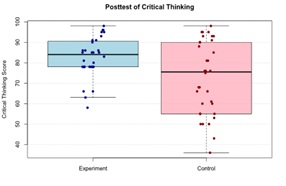
Society 5.0 transforms education, urging students to develop their critical thinking for complex problems. Indonesia's low proportion of students with these skills highlights the need to develop learning innovations. Beyond innovations, this research also considers affective factors like the Adversity Quotient in their impact on critical thinking. On the other hand, there has been no research that integrates Challenge-Based STEM Context Learning, AI-Websites, and differentiated learning simultaneously and examines the influence of AQ within that framework. Therefore, this study aims to determine the effectiveness of differentiated CBL-STEM Context learning integrated by AI-Website to improve critical thinking skills, analyze the influence of AQ on critical thinking skills, and describe those critical thinking skills based on the students' AQ categories. This research used a mixed-method with a sequential explanatory design in all eighth-grade students at one of the state junior high schools in Semarang, represented by two sample groups. Conducted over four weeks, it collected quantitative data through tests and questionnaires, and qualitative data via interviews. Quantitative data were analysed with R software, while qualitative data were condensed and compared to assess critical thinking skills indicators. The results show that the learning model effectively improved students’ critical thinking skills, with the experimental group achieving a 75.6% improvement. Regression analysis indicated that the adversity quotient contributed only 8.4% to critical thinking skills in this learning. Field interviews show students meet interpretation and analysis indicators across AQ categories, with differences in other critical thinking areas. This study suggests that similar research should include AQ differentiation in the learning process.
Full text article
References
Anggraini, T. W., & Mahmudi, A. (2021). Exploring the students’ adversity quotient in online mathematics learning during the covid-19 pandemic. Journal of Research and Advances in Mathematics Education, 6(3), 221–238. https://doi.org/10.23917/jramathedu.v6i3.13617
Attard, C., & Holmes, K. (2020). An exploration of teacher and student perceptions of blended learning in four secondary mathematics classrooms, 9(1), 26. https://doi.org/10.1007/s13394-020-00359-2
Chiu, T. K. (2021). Digital support for student-centered learning environments: Analyzing the ecosystem of pedagogy and technological tools. British Journal of Educational Technology, 52(4), 1542–1558 http://doi.org/10.11591/ijere.v13i5.29449
Chiu, T. K. (2022). Applying the self-determination theory to investigate the roles of teacher encouragement and digital tool integration in affective and cognitive learning. British Journal of Educational Technology, 53(3), 654–670. https://doi.org/10.1080/15391523.2021.1891998
Creswell, J. W., & Creswell, J. D. (2017). Research design: Qualitative, quantitative, and mixed methods approaches. SAGE Publications.
Field, A., Field, Z., & Miles, J. (2012). Discovering statistics using R. SAGE Publications.
Gerlich, M. (2025). AI tools in society: Impacts on cognitive offloading and the future of critical thinking. Societies, 15(1), 6. https://doi.org/10.3390/soc15010006
Gomede, E., de Barros, R. M., & Mendes, L. de S. (2021). Deep auto encoders to adaptive E-learning recommender system. Computers and Education: Artificial Intelligence, 2, 100009. https://doi.org/10.1016/j.caeai.2021.100009
Hamedani, S. S., Aslam, S., Mundher Oraibi, B. A., Wah, Y. B., & Hamedani, S. S. (2024). Transitioning towards tomorrow’s workforce: Education 5.0 in the landscape of Society 5.0: A systematic literature review. Education Sciences, 14(10), Article 1041. https://doi.org/10.3390/educsci14101041
He, A., Yuan, W., Lee, L. S., & Tian, T. (2025). AI-driven predictive models for optimizing mathematics education technology: Enhancing decision-making through educational data mining and meta-analysis. Smart Learning Environments, 12(1), 1-42. https://doi.org/10.1186/s40561-025-00415-z
Khusna, A. H., Siswono, T. Y. E., & Wijayanti, P. (2024). Research trends in critical thinking skills in mathematics: A bibliometric study. International Journal of Evaluation and Research in Education, 13(1), 18–30. https://doi.org/10.11591/ijere.v13i1.26013
Manousou, E. (2025). Critical thinking in distance education: The challenges in a decade (2016–2025) and the role of artificial intelligence. Education Sciences, 15(6), 757. https://doi.org/10.3390/educsci15060757
Masinading, Z. M. B., & Gaylo, D. N. (2022). Differentiated scaffolding strategies in triangle congruence: their effects on learners' academic performance and confidence in mathematics. International Journal of Education and Literacy Studies, 10(2), 131-140. https://doi.org/10.7575/aiac.ijels.v.10n.2p.131
Mat, H., Mustakim, S. S., Razali, F., & Ghazali, N. (2024). Effectiveness of digital learning on students' higher-order thinking skills. International Journal of Evaluation and Research in Education (IJERE), 13(5), 2817–2824. https://doi.org/10.11591/ijere.v13i5.29449
Melisa, R., Ashadi, A., Triastuti, A., Hidayati, S., Salido, A., Ero, P. E. L., et al. (2025). Critical thinking in the age of AI: A systematic review of AI's effects on higher education. Educational Process: International Journal, 14(3). https://doi.org/10.22521/edupij.2025.14.31
Mustikasari, D. A. (2022). The effect of problem-based learning on critical thinking skills on IPS spelling. Social Landscape Journal, 3(1), 36–45. https://doi.org/10.56680/slj.v3i1.30957
Nasir, M., Cari, C., Sunarno, W., & Rahmawati, F. (2022). The effect of STEM-based guided inquiry on light concept understanding and scientific explanation. Eurasia Journal of Mathematics, Science and Technology Education, 18(11). https://doi.org/10.29333/ejmste/12499
Nida, N. K., Usodo, B., & Saputro, D. R. S. (2020). The blended learning with Whatsapp media on Mathematics creative thinking skills and math anxiety. Journal of Education and Learning (EduLearn), 14(2), 227–234. https://doi.org/10.11591/edulearn.v14i2.16233
Nugraheni, L. P., & Marsigit, M. (2021). Realistic mathematics education: An approach to improve problem solving ability in primary school. Journal of Education and Learning (EduLearn), 15(4), 546–553. https://doi.org/10.11591/edulearn.v15i4.19354
OECD. (2023). PISA 2022 Results (Volume I): The State of Learning and Equity in Education. OECD Publishing. https://doi.org/10.1787/53f23881-en
Omer, S. M., Evers, K., Wang, C. Y., & Chen, S. (2025). Technology-enhanced mathematics learning: review of the interactions between technological attributes and aspects of mathematics education from 2013 to 2022. Humanities and Social Sciences Communications, 12(1), Artikel 5475. https://doi.org/10.1057/s41599-025-05475-7
Panggabean, F. T. M., Sutiani, A., Purba, J., Dibyantini, R. E., Hasibuan, M. H. E., & Krisbiantoro, P. A. (2025). Enhancing higher-order thinking skills in chemistry education: A validated canva-IBL-STEM model for stoichiometry learning. Jurnal Pendidikan IPA Indonesia, 14(4). https://doi.org/10.15294/jpii.v14i4.33559
Pramuditya, S. A., Noto, M. S., & Azzumar, F. (2022). Characteristics of students' mathematical problem-solving abilities in open-ended-based virtual reality game learning. Infinity Journal, 11(2), 255–272. https://doi.org/10.22460/infinity.v11i2.p255-272. https://doi.org/10.23887/ijee.v8i1.64295
Putri, N. D. S., & Alyani, F. (2023). Mathematical critical thinking ability reviewing from domicile, gender, and adversity quotient. Jurnal Pengembangan Pembelajaran Matematika (JPPM), 5(1), 1–16. https://doi.org/10.14421/jppm.2023.51.1-16
Putri, S. N. E., Bharati, D. A. L., & Astuti, P. (2021). Undergraduate english students’ perception, plan, and implementation of critical thinking skills in their presentation. English Education Journal, 11(4), 485–494. https://doi.org/10.15294/eej.v11i1.48028
Rahmadani, E., Armanto, D., Sitompul, P., & Syafitri, E. (2025). The Role of Adversity Quotient in Shaping Academic Resilience among Junior High School Students in Kisaran Timur. AL-ISHLAH: Jurnal Pendidikan, 17(4). https://doi.org/10.35445/alishlah.v17i4.8088
Ramlawati, R., Sari, N. I., Kusumawati, R., Yesin, M., Ilmi, N., & Arsyad, A. A. (2025). The Effect of Differentiated Science Inquiry Learning Model Based on Teaching at the Right Level on Students’ Critical Thinking and Science Process Skills. Jurnal Pendidikan IPA Indonesia, 14(1). https://doi.org/10.15294/jpii.v14i1.19479
Rensburg, J., & Rauscher, W. (2022). Strategies for fostering critical thinking dispositions in the technology classroom. International Journal of Technology and Design Education, 32(4), 2141–2161. http://doi.org/10.1007/s10798-021-09690-6
Setyaningrum, W., Pastoriko, F. M., Fabian, K., & Ying, C. Y. (2024). The effect of scaffolding-based digital instructional media on higher-order thinking skills. Journal on Mathematics Education, 15(4), 1077–1094. https://doi.org/10.22342/jme.v15i4.pp1077-1094
Shamim, M. R. H., Al Mamun, A., & Raihan, A. (2022). Mapping the research of technical teachers' pedagogical beliefs about science technology engineering and mathematics (STEM) education. International Journal of Instruction, 15(4), 797-818. https://doi.org/10.29333/iji.2022.15443a
Stoltz, P. G. (1997). Adversity Quotient: Turning Obstacles into Opportunities. John Wiley & Sons. ISBN 0-471-17892-6.
Suratmi, S., & Sopandi, W. (2022). Knowledge, skills, and attitudes of teachers in training critical thinking of elementary school students. Journal of Education and Learning (EduLearn), 16(3), 291–298. https://doi.org/10.11591/edulearn.v16i3.20493
Susilo, M. J., Dewantoro, M. H., & Yuningsih, Y. (2022). Character education trend in Indonesia. Journal of Education and Learning (EduLearn), 16(2), 180–188. https://doi.org/10.11591/edulearn.v16i2.20411
Sutama, S. (2022). Collaborative mathematics learning management: Critical thinking skills in problem solving. International Journal of Evaluation and Research in Education (IJERE), 11(3), 1225–1234. http://doi.org/10.11591/ijere.v11i3.22193
Tehlan, A. (2025). Innovative trends in mathematical education for its sustainable development in higher education. International Journal of Scientific Research in Engineering and Management, 9(12), 1–9. https://doi.org/10.55041/IJSREM55115
Usman, U. (2024). Enhancing critical thinking and academic achievement through different learning. International Journal of Evaluation and Research in Education (IJERE), 13(6), 3799–3806. http://doi.org/10.11591/ijere.v13i6.27993
Veenman, M. V. (2021). Metacognition and learning in complex problem-solving environments: Analyzing the role of persistence and strategic adjustments. Metacognition and Learning, 16(2), 231–248. https://doi.org/10.1007/s11409-006-6893-0
Wu, C. H., Weng, T. S., & Liu, C. H. (2025). Exploring ChatGPT’s potential to enhance problem-solving and critical thinking in education. Educational Technology & Society, 28(2), 310–326. https://doi.org/10.30191/ETS.202504_28(2).TP04
Zabian, A. H. (2025). Efficiency algorithm: new AI-based tools for an adaptive learning environment. Frontiers in Education, 10, 1702662. https://doi.org/10.3389/feduc.2025.1702662
Zhao, Y. & Sang, B. (2023). The role of emotional quotients and adversity quotients in career success. Front: Psychol. 14, 1128773. https://doi.org/10.3389/fpsyg.2023.1128773
Zhu, X., Xiong, Z., Zheng, T., Li, L., Zhang, L., & Yang, F. (2021). Case‐based learning combined with science, technology, engineering and math (STEM) education concept to improve clinical thinking of undergraduate nursing students: A randomized experiment. Nursing Open, 8(1), 415-422. https://doi.org/10.1002/nop2.642
Authors
Copyright (c) 2026 Wahid Jauhari, Adi Satrio Ardiansyah, Eny Agustianingsih

This work is licensed under a Creative Commons Attribution-NonCommercial 4.0 International License.