
Proof in mathematics education: A bibliometric analysis using R biblioshiny and VOSviewer
Article Sidebar
- Proof, Mathematics Education, Web of Science Database, Biblioshiny, VOSviewer
Abstract
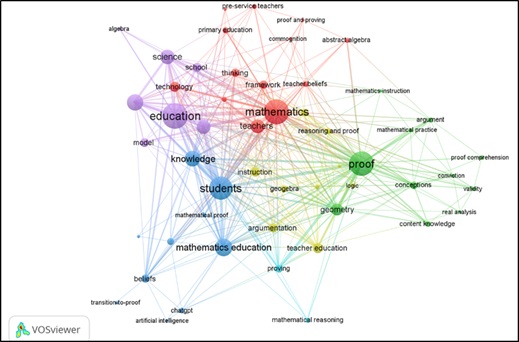
The modern mathematics curriculum internationally places proof as a central component that should be integrated from primary school to university. Empirical research on proof in mathematics education has grown rapidly in the last two decades; however, few studies have attempted to map this research landscape. This article provides a comprehensive mapping of research on proof through a bibliometric approach using the Web of Science Core Collection (WoSCC) database. Data from 157 articles published between 2016 and 2025 were analyzed using the biblioshiny R-package and VOSviewer. Results show that publication numbers fluctuated, peaking in 2024, with Dawkins et al. being the most cited and ZDM-Mathematics Education the most prolific source. Keyword analysis reveals six distinct clusters, with the USA as the leading contributor. Beyond these trends, the study identifies a significant shift toward the integration of artificial intelligence within the transition-to-proof process. These findings offer a strategic roadmap for researchers to bridge the gap between technological mediation and formal mathematical validation, emphasizing the need for instructional designs that harmonize generative tools with the rigorous construction of deductive proofs. Ultimately, this mapping highlights the urgency of ensuring that digital advancements support the authenticity of proving activities rather than merely facilitating the mechanical production of logical steps.
Full text article
References
Arnesen, K. K., & Skartsæterhagen, Ø. I. (2025). Mathematical induction in education research: a systematic review. Educational Studies in Mathematics, 119(1), 79–100. https://doi.org/10.1007/s10649-024-10373-x
Bieda, K. N. (2010). Enacting Proof-Related Tasks in Middle School Mathematics: Challenges and Opportunities. Journal for Research in Mathematics Education, 41(4), 351–382. https://doi.org/10.5951/jresematheduc.41.4.0351
Buchbinder, O., & McCrone, S. (2020). Preservice teachers learning to teach proof through classroom implementation: Successes and challenges. The Journal of Mathematical Behavior, 58, 100779. https://doi.org/10.1016/j.jmathb.2020.100779
CadwalladerOlsker, T. (2011). What Do We Mean by Mathematical Proof? Journal of Humanistic Mathematics, 1(1), 33–60. https://doi.org/10.5642/jhummath.201101.04
Cobo, M. J., López-Herrera, A. G., Herrera-Viedma, E., & Herrera, F. (2011). Science mapping software tools: Review, analysis, and cooperative study among tools. Journal of the American Society for Information Science and Technology, 62(7), 1382–1402. https://doi.org/10.1002/asi.21525
David, E. J., & Zazkis, D. (2020). Characterizing introduction to proof courses: a survey of U.S. R1 and R2 course syllabi. International Journal of Mathematical Education in Science and Technology, 51(3), 388–404. https://doi.org/10.1080/0020739X.2019.1574362
Dawkins, P. C., & Weber, K. (2017). Values and norms of proof for mathematicians and students. Educational Studies in Mathematics, 95(2), 123–142. https://doi.org/10.1007/s10649-016-9740-5
Delgado-Rebolledo, R., & Zakaryan, D. (2020). Relationships Between the Knowledge of Practices in Mathematics and the Pedagogical Content Knowledge of a Mathematics Lecturer. International Journal of Science and Mathematics Education, 18(3), 567–587. https://doi.org/10.1007/s10763-019-09977-0
Durán-Sánchez, A., de la Cruz del Río-Rama, M., Sereno-Ramírez, A., & Bredis, K. (2017). Sustainability and Quality of Life in Smart Cities: Analysis of Scientific Production (pp. 159–181). https://doi.org/10.1007/978-3-319-40895-8_12
Dutilh Novaes, C. (2016). Reductio ad absurdum from a dialogical perspective. Philosophical Studies, 173(10), 2605–2628. https://doi.org/10.1007/s11098-016-0667-6
Fukawa-Connelly, T., Weber, K., & Mejía-Ramos, J. P. (2017). Informal Content and Student Note-Taking in Advanced Mathematics Classes. Journal for Research in Mathematics Education, 48(5), 567–579. https://doi.org/10.5951/jresematheduc.48.5.0567
Gan, Y., Li, D., Robinson, N., & Liu, J. (2022). Practical guidance on bibliometric analysis and mapping knowledge domains methodology – A summary. European Journal of Integrative Medicine, 56, 102203. https://doi.org/10.1016/j.eujim.2022.102203
Glänzel, W., & Schubert, A. (2004). Analysing Scientific Networks Through Co-Authorship. In Handbook of Quantitative Science and Technology Research (pp. 257–276). Kluwer Academic Publishers. https://doi.org/10.1007/1-4020-2755-9_12
Hanna, G. (1990). Some pedagogical aspects of proof. Interchange, 21(1), 6–13. https://doi.org/10.1007/BF01809605
Hanna, G. (2000). Proof, Explanation and Exploration: An Overview. Educational Studies in Mathematics, 44(1–3), 5–23. https://doi.org/10.1023/A:1012737223465
Hanna, G., & Knipping, C. (2020). Proof in Mathematics Education , 1980-2020 : An Overview. Journal of Educational Research in Mathematics, 1–13. https://doi.org/10.29275/jerm.2020.08.sp.1.1
Hemmi, K., Lepik, M., & Viholainen, A. (2013). Analysing proof-related competences in Estonian, Finnish and Swedish mathematics curricula—towards a framework of developmental proof. Journal of Curriculum Studies, 45(3), 354–378. https://doi.org/10.1080/00220272.2012.754055
Henriksen, D. (2016). The rise in co-authorship in the social sciences (1980–2013). Scientometrics, 107(2), 455–476. https://doi.org/10.1007/s11192-016-1849-x
Julius, R., Abd Halim, M. S., Abdul Hadi, N., Alias, A. N., Mohd Khalid, M. H., Mahfodz, Z., & Ramli, F. F. (2021). Bibliometric Analysis of Research in Mathematics Education using Scopus Database. Eurasia Journal of Mathematics, Science and Technology Education, 17(12), em2040. https://doi.org/10.29333/ejmste/11329
Kartika, H., Budiarto, M. T., Fuad, Y., & Bonyah, E. (2023). Bibliometrics Analysis of Research on Argumentation in Mathematics Education. International Journal of Education in Mathematics, Science and Technology, 11(5), 1346–1365. https://doi.org/10.46328/ijemst.2904
Knuth, E. J. (2002a). Proof as a Tool for Learning Mathematics. The Mathematics Teacher, 95(7), 486–490. https://doi.org/10.5951/MT.95.7.0486
Knuth, E. J. (2002b). Secondary School Mathematics Teachers’ Conceptions of Proof. Journal for Research in Mathematics Education, 33(5), 379. https://doi.org/10.2307/4149959
Knuth, E. J. (2002c). Teachers’ Conceptions of Proof in the Context of Secondary School Mathematics. Journal of Mathematics Teacher Education, 5(1), 61–88. https://doi.org/10.1023/A:1013838713648
Kosiol, T., Rach, S., & Ufer, S. (2019). (Which) Mathematics Interest is Important for a Successful Transition to a University Study Program? International Journal of Science and Mathematics Education, 17(7), 1359–1380. https://doi.org/10.1007/s10763-018-9925-8
Lazarides, M. K., Lazaridou, I.-Z., & Papanas, N. (2025). Bibliometric Analysis: Bridging Informatics With Science. The International Journal of Lower Extremity Wounds, 24(3), 515–517. https://doi.org/10.1177/15347346231153538
McAllister, J. T., Lennertz, L., & Atencio Mojica, Z. (2022). Mapping A Discipline: A Guide to Using VOSviewer for Bibliometric and Visual Analysis. Science & Technology Libraries, 41(3), 319–348. https://doi.org/10.1080/0194262X.2021.1991547
Mejia-Ramos, J. P., Fuller, E., Weber, K., Rhoads, K., & Samkoff, A. (2012). An assessment model for proof comprehension in undergraduate mathematics. Educational Studies in Mathematics, 79(1), 3–18. https://doi.org/10.1007/s10649-011-9349-7
Melhuish, K., Thanheiser, E., & Guyot, L. (2020). Elementary school teachers’ noticing of essential mathematical reasoning forms: justification and generalization. Journal of Mathematics Teacher Education, 23(1), 35–67. https://doi.org/10.1007/s10857-018-9408-4
Miyazaki, M., Fujita, T., & Jones, K. (2017). Students’ understanding of the structure of deductive proof. Educational Studies in Mathematics, 94(2), 223–239. https://doi.org/10.1007/s10649-016-9720-9
Mukuka, A., & Tatira, B. (2025). Analysis of pre-service mathematics teachers’ proof comprehension through Toulmin’s argumentation model. Journal on Mathematics Education, 16(1), 111–130. https://doi.org/10.22342/jme.v16i1.pp111-130
Na, G., & Choi, J. (2023). Looking Around Research on Proof in Mathematics Education in Korea. The Korean Society of Educational Studies in Mathematics - Journal of Educational Research in Mathematics, 33(3), 745–769. https://doi.org/10.29275/jerm.2023.33.3.745
Nunokawa, K. (2010). Proof, Mathematical Problem-Solving, and Explanation in Mathematics Teaching. In Explanation and Proof in Mathematics (pp. 223–236). Springer US. https://doi.org/10.1007/978-1-4419-0576-5_15
Risalah, D., & Hodiyanto, H. (2022). Mathematics communication as an alternative to overcome the obstacles of undergraduate students in mathematical proof. International Journal of Trends in Mathematics Education Research, 5(2), 125–132. https://doi.org/10.33122/ijtmer.v5i2.141
Rocha, H. (2019). Mathematical proof: from mathematics to school mathematics. Philosophical Transactions of the Royal Society A: Mathematical, Physical and Engineering Sciences, 377(2140), 20180045. https://doi.org/10.1098/rsta.2018.0045
Rota, G. C. (1997). The Phenomenology of Mathematical Proof. Synthese, 111(2), 183–196. https://doi.org/10.1023/A:1004974521326
Şanlı, A. N. (2022). Update of the 100 Most Cited Articles on Breast Cancer: A Bibliometric Analysis. European Journal of Breast Health, 18(3), 258–270. https://doi.org/10.4274/ejbh.galenos.2022.2022-3-8
Stylianides, A. J. (2007). Proof and Proving in School Mathematics. Journal for Research in Mathematics Education, 38(3), 289–321. https:/doi.org/10.2307/30034869
Stylianides, A. J., & Ball, D. L. (2008). Understanding and describing mathematical knowledge for teaching: knowledge about proof for engaging students in the activity of proving. Journal of Mathematics Teacher Education, 11(4), 307–332. https://doi.org/10.1007/s10857-008-9077-9
Stylianides, A. J., Bieda, K. N., & Morselli, F. (2016). Proof and Argumentation in Mathematics Education Research. In The Second Handbook of Research on the Psychology of Mathematics Education (pp. 315–351). SensePublishers. https://doi.org/10.1007/978-94-6300-561-6_9
Stylianides, G. J., & Stylianides, A. J. (2009). Facilitating the Transition from Empirical Arguments to Proof. Journal for Research in Mathematics Education, 40(3), 314–352. https://doi.org/10.5951/jresematheduc.40.3.0314
Stylianides, G. J., & Stylianides, A. J. (2017). Research-based interventions in the area of proof: the past, the present, and the future. Educational Studies in Mathematics, 96(2), 119–127. https://doi.org/10.1007/s10649-017-9782-3
Stylianou, D. A., Blanton, M. L., & Knuth, E. J. (2009). Teaching and Learning Proof Across the Grades: A K-16 Perspective (1st ed.) (D. A. Stylianou, M. L. Blanton, & E. J. Knuth (eds.)). Routledge. https://doi.org/10.4324/9780203882009
Sun, J., Liu, C., Liu, D., Hu, X., Ren, S., Jiang, G., Zhang, D., Hu, S., Yuan, X., & Tao, J. (2025). Bibliometric analysis of immunogenic cell death in hepatocellular carcinoma. Discover Oncology, 16(1), 1569. https://doi.org/10.1007/s12672-025-03362-w
Thompson, D. R., Senk, S. L., & Johnson, G. J. (2012). Opportunities to Learn Reasoning and Proof in High School Mathematics Textbooks. Journal for Research in Mathematics Education, 43(3), 253–295. https://doi.org/10.5951/jresematheduc.43.3.0253
Varghese, T. (2017). Proof, Proving and Mathematics Curriculum. Transfomations, 3(1).
Villiers, M. (1990). The Role and Function of Proof in Mathematics. Pythagoras, 24, 17–24.
Zazkis, D., Weber, K., & Mejía-Ramos, J. P. (2016). Bridging the gap between graphical arguments and verbal-symbolic proofs in a real analysis context. Educational Studies in Mathematics, 93(2), 155–173. https://doi.org/10.1007/s10649-016-9698-3
Authors
Copyright (c) 2026 Haeruddin Haeruddin, Ridwan Ridwan

This work is licensed under a Creative Commons Attribution-NonCommercial 4.0 International License.