Demographic Transition and Economic Development: Theoretical and Empirical Analysis in Western and Islamic Perspectives
DOI:
https://doi.org/10.23917/jep.v27i1.9899Keywords:
demographic transition, economic developmentAbstract
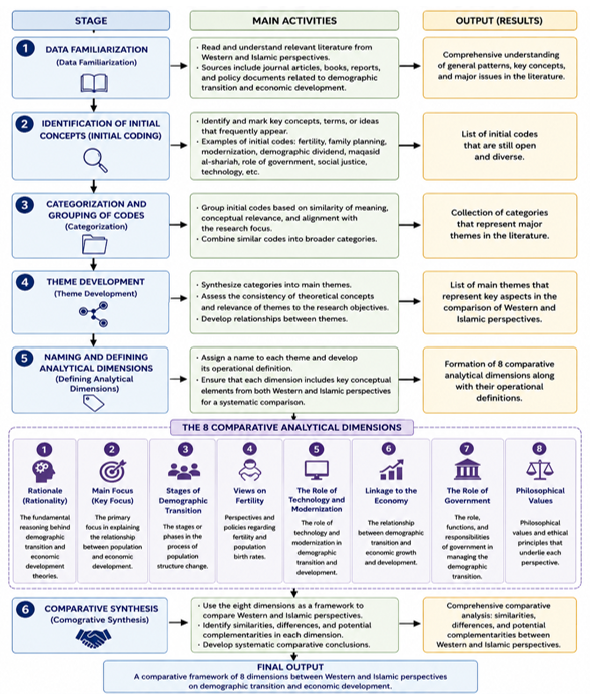
This study examines demographic transition and its implications for economic development from Western and Islamic perspectives through a comparative theoretical and empirical approach. The study is motivated by the limited integration between conventional demographic theories and Islamic economic perspectives in explaining demographic change and economic development. This research employs a qualitative approach using comparative content analysis and narrative literature review methods. Data were collected through library research from academic books, journal articles, institutional reports, and relevant official publications. The analysis was conducted using thematic coding and descriptive-comparative analysis. The findings show that Western perspectives emphasize modernization, industrialization, labor productivity, and institutional efficiency, while Islamic perspectives emphasize justice, social welfare, maqasid al-shariah, and ethical responsibility. Empirical evidence from Western countries, developing countries, and Muslim-majority countries indicates that demographic transition can promote economic growth through the expansion of the productive-age population, educational investment, and human capital development. However, the benefits of demographic dividends largely depend on institutional quality, labor-market absorption, equitable welfare distribution, and inclusive development policies. The originality of this study lies in its integrative comparative framework that combines structural-economic and ethical-humanistic approaches to provide a more comprehensive understanding of demographic transition and sustainable economic development.
Downloads
References
Abbasi-Shavazi, M. J., Mehryar, A., Jones, G., & Mcdonald, P. (1999). Revolution, war and modernization: Population policy and fertility change in Iran. Journal of Population Research, 19(1), 25–46. https://link.springer.com/article/10.1007/BF03031967
Açıkalın, Ş. N., & Güngör, H. (2019). Are demographic transition and economic growth triggering each other? In A. A. Lew (Ed.), Economic growth and demographic transition in third world nations (pp. 147–156). Routledge. https://doi.org/10.1201/9780429433894-8
Aghajanian, A., & Merhyar, A. H. (1999). Fertility, contraceptive use and family planning program activity in the Islamic Republic of Iran. International Family Planning Perspectives, 25(2), 98–102. https://www.jstor.org/stable/2991948
Ahmad, N., & Nayyab, S. (2021). Impact of demographic variables on economic growth in South Asian Countries: A panel data analysis. Sustainable Business and Society in Emerging Economies, 3(1), 49–58. https://doi.org/10.26710/sbsee.v3i1.1814
Al-Qaradawi, Y. (1960). The Lawful and The Prohibited in Islam. Al-Aflah Foundation.
Ali, M. M., & Rehman, N. (2024). Demographic transition and human capital developing countries : An empirical analysis. Journal of Human Dynamics, 2(1), 29–36. https://doi.org/10.55627/jhd.002.01.0755
Arini, G. A., Daeng, A., & Putri, I. A. (2022). Analisis keseimbangan jangka panjang pengaruh transisi demografi terhadap pertumbuhan ekonomi Indonesia. Elastisitas - Jurnal Ekonomi Pembangunan, 4(1), 41–58. https://doi.org/10.29303/e-jep.v4i1.55
Asadullah, M. N., Mansoor, N., Randazzo, T., & Wahhaj, Z. (2021). Is son preference disappearing from Bangladesh? World Development, 140, 105353. https://doi.org/10.1016/j.worlddev.2020.105353
Bawazir, A. A. A., Aslam, M. & Osman, A. F. B. (2020) Demographic change and economic growth: empirical evidence from the Middle East. Economic Change and Restructuring, 53, 429–450. https://doi.org/10.1007/s10644-019-09254-8
Chapra, M. U. (2000). The future of economics: An Islamic perspective. The Islamic Foundation.
Chapra, M. U. (2008). The Islamic vision of development in the light of maqasid al-shariah. Islamic Research and Training Institute.
Choudhry, M. T., & Elhorst, J. P. (2010). Demographic transition and economic growth in China, India and Pakistan. Economic Systems, 34(3), 218–236. https://doi.org/10.1016/j.ecosys.2010.02.001
Cilliers, J. (2021). The future of Africa: Human development in an era of global uncertainty. Palgrave Macmillan. https://doi.org/10.1007/978-3-030-46590-2
Crombach, L., & Smits, J. (2022). The demographic window of opportunity and economic growth at sub-national level in 91 developing countries. Social Indicators Research, 161(1), 171–189. https://doi.org/10.1007/s11205-021-02802-8
Farah, A., & Sugiyanto, F. X. (2024). Contribution of demographic factors to Indonesia’s economic growth. Jurnal Ekonomi Pembangunan: Kajian Masalah Ekonomi dan Pembangunan, 25(2), 171–181. https://doi.org/10.23917/jep.v25i2.23816
Febryanna, S. (2022). Pengaruh transisi demografi terhadap kemiskinan. Jurnal Ekonomi dan Kebijakan Publik Indonesia, 9(1), 68–77. https://doi.org/10.24815/ekapi.v9i1.29696
Gakpa, L. L., & Kouadio, H. K. (2023). Effect of demographic transition on economic growth: Does economic freedom matter? Evidence from ECOWAS countries. Studies in Economics and Econometrics, 47(3), 199–222. https://doi.org/10.1080/03796205.2023.2201892
Gbehe, B. Y. G., Konan, Y. S., & Ballo, Z. (2024). Demographic structure, structural change, and economic growth: Panel evidence in sub-Saharan African countries. Cogent Economics & Finance, 12(1). https://doi.org/10.1080/23322039.2024.2375786
Harahap, I. (2019). Ekonomi pembangunan: Pendekatan transdisipliner. Perdana Publishing. https://books.google.co.id/books?id=4Gt0yQEACAAJ
Hidayah, N., Wahyuningrum, D., Kamara, I. S., & Rahmah, J. L. (2023). Determinants of green Gross Domestic Product (GDP) in ASEAN-5 countries. Jurnal Ekonomi Pembangunan: Kajian Masalah Ekonomi dan Pembangunan, 24(2), 256–264. https://doi.org/10.23917/jep.v24i2.22488
Huang, Q., Xie, Y., & Zhang, X. (2024). The demographic transition and rural industrialization in China. Economic Development and Cultural Change, 72(4), 1863–1892. https://doi.org/10.1086/725727
Ibn Khaldūn. (2015). The Muqaddimah: An introduction to history (F. Rosenthal, Trans.; abridged ed., B. B. Lawrence, Intro.). Princeton University Press.
International Islamic Fiqh Academy and Organization of Islamic Cooperation. (2024). Resolution and Recommendations of the International Islamic Fiqh Academy (Third Edit). International Islamic Fiqh Academy.
Kurniawati, E., & Sugiyanto, C. (2021). Pengaruh struktur umur penduduk terhadap pertumbuhan ekonomi di Indonesia. Jurnal Ekonomi dan Pembangunan Indonesia, 21(1), 41–58. https://doi.org/10.21002/jepi.2021.04
M’baye, C. K. (2023). Fertility, employment, and the demographic dividend in sub-Saharan African countries with incipient demographic transition: Evidence from Mali. Journal of Population Research, 40(2), 7. https://doi.org/10.1007/s12546-023-09299-7
Mafrudlo, A. M., Mansur, Z. A., Mustofa, M., & Janwari, Y. (2024). Economic development theory of Ibnu Khaldun: Interrelation between justice and umran al-alam. Share: Jurnal Ekonomi dan Keuangan Islam, 13(1), 43–70. https://doi.org/10.22373/share.v13i1.20552
Maliki, A., & Arif, Z. (2024). Optimalisasi bonus demografi dan peningkatan kualitas sumber daya manusia dalam perspektif ekonomi Islam Ibn Khaldun : Studi kasus Kabupaten Belitung Timur. Misykat Al-Anwar Jurnal Kajian Islam dan Masyarakat, 7(2), 105–118. https://doi.org/10.24853/ma.7.2.105-118
Maulida, Y., Harlen, H., Sari, D. R., & Zacharias, T. (2023). Factors predicting fertility rate in Indonesia. Jurnal Ekonomi Pembangunan: Kajian Masalah Ekonomi dan Pembangunan, 24(1), 1–11. https://doi.org/10.23917/jep.v24i1.20076
Mukhtar, H., & Hassan, H. M. (2018). Demographic transition and economic implications in Sudan. SSRN Electronic Journal, 1–13. https://doi.org/10.2139/ssrn.3137464
Pan, Z., Wang, Z., & Cui, X. (2024). New interpretation of human–land relation: Differentiated impacts of global demographic transition on carbon emissions. Sustainability (Switzerland), 16(12). https://doi.org/10.3390/su16125168
Panggabean, M. (2022). Bonus demografi dan capaian indikator pembangunan sosial ekonomi Kabupaten Sanggau dan Kota Pontianak. Prosiding Seminar Nasional Seminar Akademik Tahunan Ilmu Ekonomi dan Studi Pembangunan, 5, 180–192. https://feb.untan.ac.id/wp-content/uploads/2023/06/14.pdf
Prasetyani, D., Cahyadin, M., Yong Sze Wei, & Rosalia, A. C. T. (2023). Do corruption and institutions contribute to the economic growth in ASEAN countries during 2000-2018? Jurnal Ekonomi Pembangunan: Kajian Masalah Ekonomi dan Pembangunan, 24(1), 141–160. https://doi.org/10.23917/jep.v24i1.21426
Purwati, W. D., & Prasetyanto, P. K. (2022). Analisis pengaruh bonus demografi terhadap pertumbuhan ekonomi di Indonesia. Jurnal Economina, 1(3), 532–546. https://doi.org/10.55681/economina.v1i3.130
Rajagukguk, W. (2016). Monograf pertumbuhan ekonomi dengan memanfaatkan bonus demografi di Provinsi Nusa Tenggara Timur. UKI Press.
Solow, R. M. (2000). Growth Theory: An Exposition. Oxford University Press.
Tambunan, K. (2020). Ekonomi Pembangunan. Medan: FebiPressUINSU
Thi Mai, A. N., Xuan, V. N., Mai, H. Le, Xuan, H. P., & Thi Phuong, T. N. (2024). Population, carbon dioxide emissions and renewable energy consumption nexus: New insights from Vietnam. Energy Exploration and Exploitation, 42(5), 1763–1798. https://doi.org/10.1177/01445987241252453
Todaro, M. P., & Smith, S. C. (2020). Economic Development (Thirteenth). Pearson Education Limited.
Tomala, J., Mierzejewski, M., Urbaniec, M., & Martinez, S. (2021). Towards sustainable energy development in sub-Saharan Africa: Challenges and opportunities. Energies, 14(19). https://doi.org/10.3390/en14196037
Wang, Y., Fan, H., & Guo, C. (2021). Trend and factors of population fertility changes from the perspective of economics and education — China, 1949–2020. China CDC Weekly, 3(28), 599–604. https://doi.org/10.46234/ccdcw2021.159
Wang, Z., Pan, Z., Xu, Z., Cui, X., & Zhang, X. (2024). How does demographic transition affect energy conservation? Evidences from the resource effects of global demographic transition. Journal of Cleaner Production, 441, 140954. https://doi.org/10.1016/j.jclepro.2024.140954
Wibowo, T. S., Ariprabowo, T., Waluyo, S. P., Asiyah, S. N., Putri, S. A. A., Lestari, Y. D., & Wijaya, M. P. (2023). Pembangunan Ekonomi. CV. Mega Press Nusantara. https://www.google.co.id/books/edition/Pembangunan_Ekonomi/
Wietzke, F. B. (2020). Poverty, inequality, and fertility: The contribution of demographic change to global poverty reduction. Population and Development Review, 46(1), 65–99. https://doi.org/10.1111/padr.12317
Wilopo, S. A. (1995). Transisi demografi dan pembangunan berkelanjutan. Populasi, 6(1), 19–37. https://doi.org/10.22146/jp.11443
Woldegiorgis, M. M. (2023a). Drivers of demographic dividend in sub-Saharan Africa. Review of Evolutionary Political Economy, 4(2), 387–413. https://doi.org/10.1007/s43253-023-00094-x
Woldegiorgis, M. M. (2023b). Towards inclusive development through harnessing demographic dividend ? Empirics for Africa. Journal of Social and Economic Development, 25(2), 380–402. https://doi.org/10.1007/s40847-023-00243-2
Submitted
Accepted
Published
How to Cite
Issue
Section
License
Copyright (c) 2026 Nofinawati, M. Shabri Abd. Majid, Adanan Murroh Nasution, Ifelda Nengsih, Pepy Afrilian

This work is licensed under a Creative Commons Attribution 4.0 International License.