Economic Empowerment of Squatter Communities in Tangerang City: Tridaya Program Perspective
DOI:
https://doi.org/10.23917/jep.v26i2.8891Keywords:
squatter community, Tridaya Program, economic empowerment, Tangerang cityAbstract
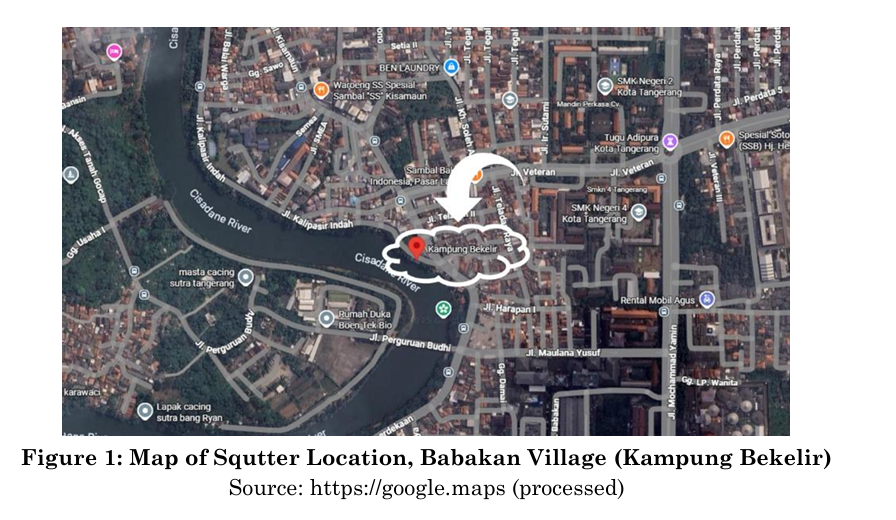
Squatter communities are commonly categorized as illegal slum settlements because they occupy land without legal ownership, most of which belongs to the government or the private sector. To address this issue, the Tangerang City Government has implemented the Tridaya program, which emphasizes three dimensions: economic empowerment, improvement of the physical environment, and socio-cultural development. This study aims to evaluate the implementation of the Tridaya program and its effectiveness in improving the welfare and quality of life of squatter communities. The study employs a mixed-methods design with an evaluative orientation. Quantitative data were collected through purposive sampling, while qualitative data were obtained through interviews with key stakeholders in four locations: Babakan Village, Mekarsari Village, Kedaung Wetan RT 03/03, and Kedaung Wetan RT 02/03. The findings indicate that from an economic perspective, 51.72 percent of respondents earn between Rp200,000 and Rp500,000 per month, with most engaged in informal and irregular employment. Manual laborers account for 40.22 percent of respondents, followed by street vendors at 27.58 percent. From the perspective of the physical environment, housing conditions are generally very poor and fail to meet basic standards of adequacy and health. From a socio-cultural perspective, educational attainment is low, with 89.56 percent of respondents having completed no more than junior high school. Overall, the results suggest that economic empowerment through the Tridaya program has not yet been optimal, as community welfare and quality of life remain low. The study recommends affirmative and community-based policies that prioritize sustainable economic activities, humane settlement planning, and the strengthening of socio-cultural capacity as social capital for local development.
Downloads
References
Andriana, L., & Manaf, A. (2017). Relevansi aspek kemiskinan dan fisik lingkungan kumuh pada penentuan lokasi penerima program Kotaku (Studi kasus Kecamatan Pamekasan Kabupaten Pamekasan). Jurnal Pengembangan Kota, 5(2), 131. https://doi.org/10.14710/jpk.5.2.131-139
Arikunto, S. (2007). Prosedur Penelitian: Suatu Pendekatan Praktik. Rineka Cipta.
Arisandi, Muthalib, A. A., Gamsir, Saenong, Z., & Balaka, M. Y. (2023). Economic empowerment and collaboration of urban slum arrangement: Review the Kotaku program in Kendari City. International Journal of Professional Business Review, 8(6). https://doi.org/10.26668/businessreview/2023.v8i6.2338
Capello, R. (2009). Spatial spillovers and regional growth: A cognitive approach. European Planning Studies, 17(5). https://doi.org/10.1080/09654310902778045.
Dollah, R., Jafar, A., Radzi, M. M., Sakke, N., Mapa, M. T., Maraining, A. (2023). Elevating the community-based approach towards river management: A case study of squatter's community in Inanam-Likas river basin in Sabah, Malaysia. The Indonesian Journal of Geography, 55(3), 553-563. https://doi.org/10.22146/ijg.77869.
Elghazouly, H. G., Elnaggar, A. M., Ayaad, S. M., & Nassar, E. T. (2024). Framework for integrating multi-criteria decision analysis and geographic information system (MCDA-GIS) for improving slums interventions policies in Cairo, Egypt. Alexandria Engineering Journal, 86. https://doi.org/10.1016/j.aej.2023.11.059.
Feng, S., & Patton, M. (2017). Empirical analysis of differential spillover effects within a growth equilibrium framework: Urban–rural versus rural–rural linkages. Papers in Regional Science, 96(4). https://doi.org/10.1111/pirs.12226
Idris, A. M., Worosuprojo, S., Baiquni, M. (2014). Slum, Squatter, and Quasi-Squatter Housing Depravity in Yogyakarta. Jurnal Teknosains, 4(1). https://doi.org/10.22146/teknosains.6046
Mahabir, R., Crooks, A., Croitoru, A., & Agouris, P. (2016). The study of slums as social and physical constructs: Challenges and emerging research opportunities. Regional Studies, Regional Science, 3(1). https://doi.org/10.1080/21681376.2016.1229130
Minnery, J., Argo, T., Winarso, H., Hau, D., Veneracion, C. C., Forbes, D., & Childs, I. (2013). Slum upgrading and urban governance: Case studies in three South East Asian cities. Habitat International, 39. https://doi.org/10.1016/j.habitatint.2012.12.002
Sen, A. (1989). Development as capability expansion. Journal of Development Planning, 19, 41–58. https://livelihoods.net.in/wp-content/uploads/2020/05/DEVELOPMENT-AS-CAPABILITY-EXPANSION.pdf
Sugiyono. (2013). Metode Penelitian Kuantitatif, Kualitatif, dan R&D. Bandung, Alfabeta.
The Tangerang City Population and Civil Registration Office (2020) (Dinas Kependudukan dan Pencatatan Sipil Kota Tangerang). https://disdukcapil.tangerangkota.go.id/
The Community-Squatter Empowerment Program (PPM-S) (2017). The Tangerang City Population and Civil Registration Office (2020) https://www.tangerangkota.go.id/
Uzun, B., & Simsek, N. C. (2015). Upgrading of illegal settlements in Turkey; the case of North Ankara Entrance Urban Regeneration Project. Habitat International, 49. https://doi.org/10.1016/j.habitatint.2015.05.026
Wondimu, H. (2021). The Subsequent Challenges of the Slum and Squatter Settlements: In the City of Addis Ababa. European Journal of Research Development and Sustainability, 2(1), 24-34. https://doi.org/10.2139/ssrn.3877007
Yin, R. K. (2018). Case Study Research and Applications: Design and Methods (6th ed.). Thousand Oaks, CA: Sage. https://lccn.loc.gov/2017040835
Submitted
Accepted
Published
How to Cite
Issue
Section
License
Copyright (c) 2025 Mukhaer Pakkanna, Uki Masduki

This work is licensed under a Creative Commons Attribution 4.0 International License.