Classifying Villages by Rural Development Performance: Evidence from Belitung Regency, Indonesia
DOI:
https://doi.org/10.23917/jep.v27i1.8870Keywords:
Village typology, Indicators, Poverty, Rural developmentAbstract
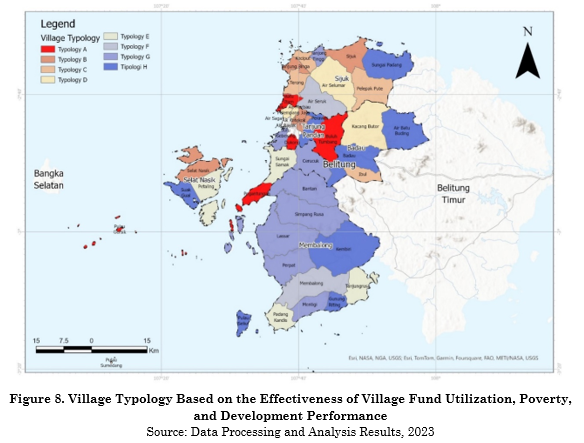
The implementation of village development must be guided by the achievement of development goals, namely creating an independent, advanced, prosperous, and just village community. The goals of village development can be realized if the development process is carried out by considering the potential, problems, characteristics, and typology of the village itself. This is necessary so that village development is on target, so that village development goals can be achieved. Based on this, the purpose of this study is to analyze village typologies based on the effectiveness of village fund utilization, poverty levels, and village development performance using effectiveness analysis methods, geographically weighted regression (GWR), and Moran index analysis. Based on the results of this analysis, village typologies can be developed that will serve as the basis for formulating more effective, efficient, and targeted village development policies. The goal is to increase the effectiveness and efficiency of village financial resource utilization, poverty alleviation, and improve village development performance in terms of governance, physical infrastructure development, community development, and community empowerment. The results of the study indicate that villages in Belitung Regency can be classified into eight village typologies, namely Typologies A, B, C, D, E, F, G, and H. Based on their conditions, villages included in Typology A are villages whose rural development needs to be prioritized by Belitung Regency.
Downloads
References
Alfatih, A. (2016). Panduan praktis penelitian deskriptif kuantitatif (p. 155). UPT Penerbit dan Percetakan Universitas Sriwijaya.
Anser, M. K., Yousaf, S. U., Usman, B., Azam, K., Bandar, N. F. A., Jambari, H., Sriyanto, S., & Zaman, K. (2023). Beyond climate change: Examining the role of environmental justice, agricultural mechanization, and social expenditures in alleviating rural poverty. Sustainable Futures, 6(July), 100130. https://doi.org/10.1016/j.sftr.2023.100130
Arifin, B., Wicaksono, E., Tenrini, R. H., Wardhana, I. W., Setiawan, H., Damayanty, S. A., Solikin, A., Suhendra, M., Saputra, A. H., Ariutama, G. A., Djunedi, P., Rahman, A. B., & Handoko, R. (2020). Village fund, village-owned-enterprises, and employment: Evidence from Indonesia. Journal of Rural Studies, 79(September), 382–394. https://doi.org/10.1016/j.jrurstud.2020.08.052
Artino, A., Juanda, B., & Mulatsih, S. (2019). Keterkaitan dana desa terhadap kemiskinan di Kabupaten Lombok Utara. Tataloka, 21(3), 381. https://doi.org/10.14710/tataloka.21.3.381-389
Benzaken, D., Paul, J., Virdin, J., & Voyer, M. (2024). From concept to practice: Financing sustainable blue economy in Small Island Developing States, lessons learnt from the Seychelles experience. Marine Policy, 163(December 2023), 106072. https://doi.org/10.1016/j.marpol.2024.106072
Burke, P. J., & Siyaranamual, M. D. (2019). No one left behind in Indonesia? Bulletin of Indonesian Economic Studies, 55(3), 269–293. https://doi.org/10.1080/00074918.2019.1690410
Chen, X., Emam, M., Zhang, L., Rifhat, R., Zhang, L., & Zheng, Y. (2023). Analysis of spatial characteristics and geographic weighted regression of tuberculosis prevalence in Kashgar, China. Preventive Medicine Reports, 35(July), 102362. https://doi.org/10.1016/j.pmedr.2023.102362
Chen, Z., Zhang, S., Geng, W., Ding, Y., & Jiang, X. (2022). Use of Geographically Weighted Regression (GWR) to reveal spatially varying relationships between Cd accumulation and soil properties at field scale. Land, 11(5). https://doi.org/10.3390/land11050635
Colocci, A., Gioia, E., Casareale, C., Marchetti, N., & Marincioni, F. (2023). The role of sustainable energy and climate action plans: Synergies with regional sustainable development strategies for a local 2030 agenda. Environmental Development, 47, 100894. https://doi.org/10.1016/j.envdev.2023.100894
Hammond, E. B., Coulon, F., Hallett, S. H., Thomas, R., Dick, A., Hardy, D., Dickens, M., Washbourn, E., & Beriro, D. J. (2024). The development of a novel decision support system for regional land use planning for brownfield land. Journal of Environmental Management, 349(October 2023), 119466. https://doi.org/10.1016/j.jenvman.2023.119466
Handayani, E., Garad, A., Suyadi, A., & Tubastuvi, N. (2023). Increasing the performance of village services with good governance and participation. World Development Sustainability, 3(July 2022), 100089. https://doi.org/10.1016/j.wds.2023.100089
Hariyanto, A., Juanda, B., Rustiadi, E., & Mulatsih, S. (2023). The effectiveness of Village Funds in alleviating rural poverty: A case study of Belitung Regency. MIMBAR Jurnal Sosial dan Pembangunan, 39, 197–208. https://doi.org/10.29313/mimbar.v39i1.2309
Hilmawan, R., Aprianti, Y., Vo, D. T. H., Yudaruddin, R., Bintoro, R. F. A., Fitrianto, Y., & Wahyuningsih, N. (2023). Rural development from village funds, village-owned enterprises, and village original income. Journal of Open Innovation: Technology, Market, and Complexity, 9(4), 100159. https://doi.org/10.1016/j.joitmc.2023.100159
Khedmati Morasae, E., Derbyshire, D., Amini, P., & Ebrahimi, T. (2024). Social determinants of spatial inequalities in COVID-19 outcomes across England: A multiscale geographically weighted regression analysis. SSM - Population Health, 25(November 2023), 101621. https://doi.org/10.1016/j.ssmph.2024.101621
Lee, J., & Wong, D. (2001). Statistical analysis with Arcview GIS. John Wiley & Sons, Inc.
Li, X., Peng, X., & Peng, Y. (2023). Unravelling the influence and mechanism of agricultural inputs on rural poverty vulnerability: Evidence from China. Heliyon, 9(12). https://doi.org/10.1016/j.heliyon.2023.e22851
Lingua, V., & Caruso, E. (2022). Futures Literacy as a reading key for strategic spatial planning: A community learning process for defining shared futures in the Ombrone River Agreement. Futures, 140(June 2020), 102935. https://doi.org/10.1016/j.futures.2022.102935
Liu, B., Zhang, X., Tian, J., Cao, R., Sun, X., & Xue, B. (2023). Rural sustainable development: A case study of the Zaozhuang Innovation Demonstration Zone in China. Regional Sustainability, 4(4), 390–404. https://doi.org/10.1016/j.regsus.2023.11.004
Manurung, N., Harahap, R. H., Siregar, F. A., & Andayani, L. S. (2024). Collaboration and involvement of village heads, public health officer, and village midwives in improving adherence of tuberculosis patients. Clinical Epidemiology and Global Health, 26(October 2023), 101528. https://doi.org/10.1016/j.cegh.2024.101528
Muzaqi, A. H., Djoko, S., Abror, M. D., & Ambulanto, T. (2022). Analisis kebijakan Dana Desa dalam merespon masalah kemiskinan di Indonesia. Jurnal Ilmiah Manajemen Publik dan Kebijakan Sosial, 6(2), 122–144. https://doi.org/10.25139/jmnegara.v6i2.4847
Nielsen, S., Østergaard, P. A., & Sperling, K. (2023). Renewable energy transition, transmission system impacts and regional development – a mismatch between national planning and local development. Energy, 278(January). https://doi.org/10.1016/j.energy.2023.127925
Nugroho, A. D. (2010). Komoditas unggulan tanaman pangan di Pulau Jawa. Agro Ekonomi, 17(1). https://doi.org/10.22146/agroekonomi.17868
Oloyede, A. A., Faruk, N., Noma, N., Tebepah, E., & Nwaulune, A. K. (2023). Measuring the impact of the digital economy in developing countries: A systematic review and meta- analysis. Heliyon, 9(7), e17654. https://doi.org/10.1016/j.heliyon.2023.e17654
Purnamasari, R., Hasanudin, A. I., Zulfikar, R., & Yazid, H. (2024). Do internal control and information systems drive sustainable rural development in Indonesia? Journal of Open Innovation: Technology, Market, and Complexity, 10(1), 100242. https://doi.org/10.1016/j.joitmc.2024.100242
Quashie, R., Fugar, F. D. K., Antwi-afari, P., & Ng, S. T. (2024). Evaluating the key competency skills of construction professionals for the attainment of circular construction in developing economies. Cleaner Production Letters, 6(November 2023), 100060. https://doi.org/10.1016/j.clpl.2024.100060
Reku, U., & Resosudarmo, B. P. (2024). Regional science policy & practice traditional slavery institutions and democratization: Insights into intercaste human capital disparities in Sumba Island’ s rural areas, Indonesia. Regional Science Policy & Practice, 16(5), 100011. https://doi.org/10.1016/j.rspp.2024.100011
Sifriyani, Budiantara, I. N., Mardianto, M. F. F., & Asnita. (2024). Determination of the best geographic weighted function and estimation of spatio temporal model – Geographically weighted panel regression using weighted least square. MethodsX, 12(August 2023), 102605. https://doi.org/10.1016/j.mex.2024.102605
Stasi, R., Ruggiero, F., & Berardi, U. (2024). Natural ventilation effectiveness in low-income housing to challenge energy poverty. Energy and Buildings, 304(August 2023), 113836. https://doi.org/10.1016/j.enbuild.2023.113836
Ullah, A., Khan, S., & Pinglu, C. (2024). Income distribution and sustainable development nexus: Fostering poverty reduction and integrated sustainability amidst multi-dimensional regional integration. Sustainable Futures, 7(December 2023), 100159. https://doi.org/10.1016/j.sftr.2024.100159
Venkadavarahan, M., Joji, M. S., & Marisamynathan, S. (2023). Development of spatial econometric models for estimating the bicycle sharing trip activity. Sustainable Cities and Society, 98(August), 104861. https://doi.org/10.1016/j.scs.2023.104861
Wang, Y., Yue, X., Wang, M., & Huang, G. (2024). Identifying the spatial heterogeneity of housing financialization in China: Insights from a multiscale geographically weighted regression. Heliyon, 10(6), e27542. https://doi.org/10.1016/j.heliyon.2024.e27542
Watts, J. D., Tacconi, L., Irawan, S., & Wijaya, A. H. (2019). Village transfers for the environment: Lessons from community-based development programs and the village fund. Forest Policy and Economics, 108(June 2018), 101863. https://doi.org/10.1016/j.forpol.2019.01.008
Weng, Q., Lian, H., & Qin, Q. (2022). Spatial disparities of the coupling coordinated development among the economy, environment and society across China’s regions. Ecological Indicators, 143(January), 109364. https://doi.org/10.1016/j.ecolind.2022.109364
Wu, H., & Yabar, H. (2021). Impacts of additive manufacturing to sustainable urban–rural interdependence through strategic control. Results in Control and Optimization, 5(August), 100066. https://doi.org/10.1016/j.rico.2021.100066
Yao, Y., & Jiang, L. (2021). Urbanization forces driving rural urban income disparity: Evidence from metropolitan areas in China. Journal of Cleaner Production, 312(May), 127748. https://doi.org/10.1016/j.jclepro.2021.127748
Zheng, L., Shepherd, D., & Batuo, M. E. (2021). Variations in the determinants of regional development disparities in rural China. Journal of Rural Studies, 82(January), 29–36. https://doi.org/10.1016/j.jrurstud.2020.08.011
Zhu, C., Su, Y., Fan, R., Qin, M., & Fu, H. (2024). Exploring provincial carbon-pollutant emission efficiency in China: An integrated approach with social network analysis and spatial econometrics. Ecological Indicators, 159(November 2023), 111662. https://doi.org/10.1016/j.ecolind.2024.111662
Submitted
Accepted
Published
How to Cite
Issue
Section
License
Copyright (c) 2026 Asep Hariyanto, Riswandha Risang Aji, Suci Rahmawati, Sarah Nita Hasibuan

This work is licensed under a Creative Commons Attribution 4.0 International License.