Industrialization, Economic Growth, and Food Security in The Gambia: An ARDL Approach
DOI:
https://doi.org/10.23917/jep.v27i1.15513Keywords:
Industrialization, Economic Growth, Food Security, Gambia, ARDLAbstract
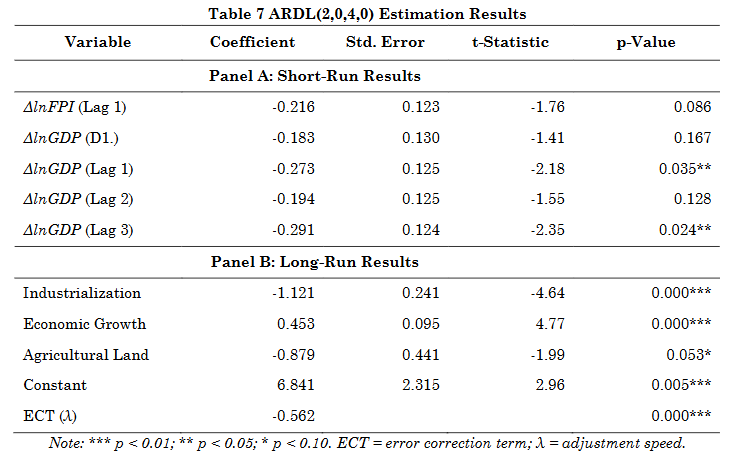
This study investigates the long-run and short-run effects of industrialization, GDP per capita and agricultural land on food security in The Gambia. An Autoregressive Distributed Lag (ARDL) framework was utilized to estimate an annual time series data spanning from 1970 to 2023. The ARDL bounds test confirms a stable long-run cointegrating relationship among the variables. The long-run estimates find that industrialization exerts a significant negative effect on food production (coefficient = -1.121, p < 0.01), suggesting that industrial expansion is not always favorable to food security. GDP per capita exerts a significant positive long-run effect (coefficient = 0.453, p < 0.01), indicating that income growth is associated with improved food production outcomes. Agricultural land registers a negative long-run effect (coefficient = −0.879, p < 0.10), consistent with evidence from the literature that land extensification does not guarantee increased food production in land-constrained economies. The error correction term confirms adjustment toward long-run equilibrium at approximately 56 percent per period. Diagnostic and stability tests validate the model. The findings call for industrialization policies that complement rather than crowd out agricultural development, alongside land management strategies that prioritize productivity over area expansion in the for quest for sustainable food security.
Downloads
References
Addo, F., & Palazzo, A. (2023). Securing sustainable and resilient food systems for The Gambia (IIASA Policy Brief No. 36). International Institute for Applied Systems Analysis. https://pure.iiasa.ac.at/id/eprint/18583/
Ardianti, D. M., & Hartono, D. (2022). Internet use and agricultural household food insecurity in Indonesia. Jurnal Ekonomi Pembangunan: Kajian Masalah Ekonomi dan Pembangunan, 23(2), 179–191. https://doi.org/10.23917/JEP.V23I2.18077
Bambi, P. D. R., & Pea-Assounga, J. B. B. (2024). Assessing the influence of land use, agricultural, industrialization, CO2 emissions, and energy intensity on cereal production. Journal of Environmental Management, 370, 122612. https://doi.org/10.1016/J.JENVMAN.2024.122612
Banerjee, A., Dolado, J. J., Galbraith, J. W., & Hendry, D. (1993). Co-integration, error correction, and the econometric analysis of non-stationary data. Oxford University Press. https://doi.org/10.1093/0198288107.001.0001
Bellemare, M. F., & Novak, L. (2017). Contract farming and food security. American Journal of Agricultural Economics, 99(2), 357–378. https://doi.org/10.1093/AJAE/AAW053
Belton, B., Win, M. T., Zhang, X., & Filipski, M. (2021). The rapid rise of agricultural mechanization in Myanmar. Food Policy, 101, 102095. https://doi.org/10.1016/J.FOODPOL.2021.102095
Ben, H. T., & El Bilali, H. (2022). Impacts of the Russia-Ukraine war on global food security: Towards more sustainable and resilient food systems? Foods 2022, Vol. 11, 11(15). https://doi.org/10.3390/FOODS11152301
Bogmans, C., Pescatori, A., & Prifti, E. (2025). How do economic growth and food inflation affect food insecurity? Macroeconomic Dynamics, 29, e134. https://doi.org/10.1017/S1365100525100369
Bojang, B., & Emang, D. (2024). Can cashew value chain industry improve food security: An empirical study from the Gambia. Sustainability, 16(15). https://doi.org/10.3390/SU16156607
Brown, R. L., Durbin, J., & Evans, J. M. (1975). Techniques for testing the constancy of regression relationships over time. Journal of the Royal Statistical Society Series B: Statistical Methodology, 37(2), 149–163. https://doi.org/10.1111/J.2517-6161.1975.TB01532.X
Cao, J., Wosene, G., Pang, Y., Aynalem, M., & Jadoon, A. U. (2026). Impact of climate change, agricultural credit and inflation on cereal crop productivity in Ethiopia: Novel dynamic simulated ARDL approach. Food Science & Nutrition, 14(2), e71559. https://doi.org/10.1002/FSN3.71559
Ceesay, E. K., & Ndiaye, M. B. O. (2022). Climate change, food security and economic growth nexus in the Gambia: Evidence from an econometrics analysis. Research in Globalization, 5, 100089. https://doi.org/10.1016/J.RESGLO.2022.100089
Chamberlin, J., Jayne, T. S., & Headey, D. (2014). Scarcity amidst abundance? Reassessing the potential for cropland expansion in Africa. Food Policy, 48, 51–65. https://doi.org/10.1016/J.FOODPOL.2014.05.002
Cramer, C., Di John, J., & Sender, J. (2022). Classification and roundabout production in high-value agriculture: A fresh approach to industrialization. Development and Change, 53(3), 495–524. https://doi.org/10.1111/dech.12708
Debrah, B. (2024). Food Security Situation in Ghana and a Comparative Analysis with Neighboring Countries. International Journal of Research and Innovation in Social Science, VIII(VII), 1740–1755. https://doi.org/10.47772/IJRISS.2024.807138
Deininger, K., Jin, S., & Ma, M. (2022). Structural transformation of the agricultural sector in low- and middle-income economies. Annual Review of Resource Economics, 14, 221–241. https://doi.org/10.1146/annurev-resource-111820-033252
Diao, X., McMillan, M., & Rodrik, D. (2019). The recent growth boom in developing economies: A structural-change perspective. Springer Books, 281–334. https://doi.org/10.1007/978-3-030-14000-7_9
Farah, A., & Sugiyanto, F. X. (2024). Contribution of demographic factors to Indonesia’s economic growth. Jurnal Ekonomi Pembangunan: Kajian Masalah Ekonomi dan Pembangunan, 25(2), 171–181. https://doi.org/10.23917/JEP.V25I2.23816
Food and Agriculture Organization of the United Nations, International Fund for Agricultural Development, United Nations Children's Fund, World Food Programme, & World Health Organization. (2024). The state of food security and nutrition in the world 2024: Financing to end hunger, food insecurity and malnutrition in all its forms. FAO. https://doi.org/10.4060/CD1254EN
Ghufran, M., Aldieri, L., Pyka, A., Ali, S., Bimonte, G., Senatore, L., & Vinci, C. P. (2024). Food security assessment in the light of sustainable development goals: A post-Paris Agreement era. Environment, Development and Sustainability, 27(2), 4541–4569. https://doi.org/10.1007/S10668-023-04089-W
Gobezie, Y. M., & Boka, J. B. (2023). The nexus between greenhouse gas emissions and food security in sub-Saharan Africa: A system GMM analysis. Cogent Economics & Finance, 11(2), 2273590–2273590. https://doi.org/10.1080/23322039.2023.2273590
Göçoğlu, V., & Göksu, S. (2024). How do industrialization and agricultural land use affect urban population in Turkey? Policy implications in the context of SDGs. Journal of Policy Modeling, 46(1), 198–211. https://doi.org/10.1016/J.JPOLMOD.2023.08.004
Hassen, A. A., Yimam, Z. G., & Awoke, A. J. (2024). The effect of output level and inflation on food security in Ethiopia: An empirical analysis using the ARDL framework. Studies in Economics and Econometrics, 48(3), 221–235. https://doi.org/10.1080/03796205.2024.2355107
Herrendorf, B., Rogerson, R., & Valentinyi, Á. (2014). Growth and structural transformation. Handbook of Economic Growth, 2, 855–941. https://doi.org/10.1016/B978-0-444-53540-5.00006-9
Jayne, T. S., Chamberlin, J., & Headey, D. D. (2014). Land pressures, the evolution of farming systems, and development strategies in Africa: A synthesis. Food Policy, 48, 1–17. https://doi.org/10.1016/j.foodpol.2014.05.014
Johnston, B. F., & Mellor, J. W. (1961). The role of agriculture in economic development. The American Economic Review. 51(14), 566-593. https://www.jstor.org/stable/1812786
Kocur-Bera, K., & Pszenny, A. (2020). Conversion of agricultural land for urbanization purposes: A case study of the suburbs of the capital of Warmia and Mazury, Poland. Remote Sensing, 12(14), 2325. https://doi.org/10.3390/RS12142325
Koryo-Dabrah, A., Ansong, R., Setorglo, J., & Steiner-Asiedu, M. (2021). Food and nutrition security situation in Ghana: Nutrition implications for national development. Afjand (African Journal of Food, Agriculture, Nutrition, and Development), 21(5), 18005–18018. https://doi.org/10.18697/ajfand.100.20160
Kripfganz, S., & Schneider, D. C. (2020). Response Surface Regressions for Critical Value Bounds and Approximate p-values in Equilibrium Correction Models. Oxford Bulletin of Economics and Statistics, 82(6), 1456–1481. https://doi.org/10.1111/OBES.12377
Lan, Y., Xu, B., Huan, Y., Guo, J., Liu, X., Han, J., & Li, K. (2023). Food security and land use under sustainable development goals: Insights from food supply to demand side and limited arable land in China. Foods, 12(22). https://doi.org/10.3390/FOODS12224168
Lewis, W. A. (1954). Economic Development with Unlimited Supplies of Labour. The Manchester School, 22(2), 139–191. https://doi.org/10.1111/J.1467-9957.1954.TB00021.X
Li, M., Li, J., ul Haq, S., & Nadeem, M. (2024). Agriculture land use transformation: A threat to sustainable food production systems, rural food security, and farmer well-being? PLOS ONE, 19(1), e0296332. https://doi.org/10.1371/JOURNAL.PONE.0296332
Maisonnave, H., & Mamboundou, P. N. (2022). Agricultural economic reforms, gender inequality and poverty in Senegal. Journal of Policy Modeling, 44(2), 361–374. https://doi.org/10.1016/J.JPOLMOD.2022.03.006
McMillan, M., & Zeufack, A. (2022). Labor productivity growth and industrialization in Africa. Journal of Economic Perspectives, 36(1), 3–32. https://doi.org/10.1257/JEP.36.1.3
Miladinov, G. (2023). Impacts of population growth and economic development on food security in low-income and middle-income countries. Frontiers in Human Dynamics, 5, 1121662. https://doi.org/10.3389/fhumd.2023.1121662
Mohamed, E., Tarihi, G., & Saeed, E. (2022). Climate change, agricultural production and food security in Sudan. Journal of Economics and Research, 3(1), 1–19. https://doi.org/10.53280/JER.1082393
Neglo, W., Gebrekidan, T., Lyu, K., Carolan, M. S., & Rosen, M. A. (2021). The role of agriculture and non-farm economy in addressing food insecurity in Ethiopia: A review. Sustainability 2021, 13(7), 3874. https://doi.org/10.3390/SU13073874
Ntiamoah, E. B., Chandio, A. A., Yeboah, E. N., Twumasi, M. A., Siaw, A., & Li, D. (2023). How do carbon emissions, economic growth, population growth, trade openness and employment influence food security? Recent evidence from the East Africa. Environmental Science and Pollution Research, 30(18), 51844–51860. https://doi.org/10.1007/S11356-023-26031-3
Nyathi, D. (2025). Motives and constraints of rural livelihoods diversification in dry-land agrarian settings of Matabeleland, Zimbabwe. Journal of Asian and African Studies, 60(7), 4403–4421. https://doi.org/10.1177/00219096241257696
Pawlak, K., & Kołodziejczak, M. (2020). The role of agriculture in ensuring food security in developing countries: Considerations in the context of the problem of sustainable food production. Sustainability, 12(13), 5488. https://doi.org/10.3390/SU12135488
Rahim, D. A., Priyarsono, D. S., Rustiadi, E., & Syaukat, Y. (2023). Sustainable development of Indonesia’s land border areas; Overview from an economic perspective. Jurnal Ekonomi Pembangunan: Kajian Masalah Ekonomi dan Pembangunan, 24(1), 172–189. https://doi.org/10.23917/JEP.V24I1.20387
Ravallion, M. (2016). The economics of poverty: History, measurement, and policy. The Economics of Poverty. https://doi.org/10.1093/ACPROF:OSO/9780190212766.001.0001
Sarwar, M., Mehmood, S., & Habib, W. (2025). Assessing Urban Expansion and Land Cover Change in City District Lahore using Multi-Stage Satellite Data. International Journal of Innovations in Science & Technology, 7(9), 94-107. https://doi.org/10.33411/IJIST/1508
Segbefia, E., Dai, B., Adotey, P., & Sampene, A. K. (2023). A step towards food security: The effect of carbon emission and the moderating influence of human capital. Evidence from Anglophone countries. Heliyon, 9(12), e22171. https://doi.org/10.1016/J.HELIYON.2023.E22171
Setiawan, A. B., Nugroho, A. D., Wiyanti, D. T., Yusuf, M., Maslikhatun, A., & Bowo, P. A. (2023). Indonesian food production challenges: Climate, land and industrialization. JEJAK: Jurnal Ekonomi dan Kebijakan, 16(1), 16. https://doi.org/10.15294/JEJAK.V16I1.43334
Timmer, C. P. (2017). Food security, structural transformation, markets and government policy. Asia and the Pacific Policy Studies, 4(1), 4–19. https://doi.org/10.1002/APP5.161
Twumasi-Ankrah, S., Pels, W. A., Arthur, D., & Danquah, D. K. (2020). Modeling the effect of climate change and economic growth on food security indicators in Ghana. International Journal of Innovative Technology and Exploring Engineering, 9(8), 909–917. https://doi.org/10.35940/IJITEE.B7265.069820
Ungwa, A. D., & Godwin, K. (2024). Industrialization and food security in Nigeria: Is there asymmetry? Journal of Public Administration, Finance and Law, 33, 345-365. https://doi.org/10.47743/jopafl-2024-33-25
Wang, X. (2022). Managing land carrying capacity: Key to achieving sustainable production systems for food security. Land 2022, 11(4). https://doi.org/10.3390/LAND11040484
World Bank. (2023). Carbon dioxide (CO2) emissions (total) excluding LULUCF (Mt CO2e) | World Bank Data360. World Bank Group. https://data360.worldbank.org/en/indicator/WB_WDI_EN_GHG_CO2_MT_CE_AR5?view=trend&average=MIC
World Food Programme. (2025). Annual country report 2024: The Gambia, GM03. https://www.wfp.org/operations/annual-country-report?operation_id=GM03&year=2024#/32373
World Food Programme. (2025). Contributions to WFP in 2025. World Food Programme. https://www.wfp.org/funding/2025
Yulianti, D., Elmin, M., & Prahasta, E. (2021). Food insecurity during a pandemic: System thinking-based analysis. Jurnal Ekonomi Pembangunan: Kajian Masalah Ekonomi dan Pembangunan, 22(2), 181–191. https://doi.org/10.23917/JEP.V22I2.15394
Yusuf, M., & Setiawan, A. B. (2022). The nexus between health and economic growth: Empirical evidence from Indonesia. Jurnal Ekonomi Pembangunan: Kajian Masalah Ekonomi dan Pembangunan, 23(2), 192–210. https://doi.org/10.23917/JEP.V23I2.20018
Zhang, C., Kuang, W., Wu, J., Liu, J., & Tian, H. (2020). Industrial land expansion in rural China threatens environmental securities. Frontiers of Environmental Science & Engineering 2020 15:2, 15(2), 29-. https://doi.org/10.1007/S11783-020-1321-2
Zhou, Y., Yue, D., Guo, J., Chao, Z., & Meng, X. (2021). Assessing the impact of land conversion and management measures on the net primary productivity in the Bailong River Basin, in China. CATENA, 207, 105672. https://doi.org/10.1016/J.CATENA.2021.105672
Submitted
Accepted
Published
How to Cite
Issue
Section
License
Copyright (c) 2026 Ebrima Khan, Mian Muhammad Ajmal Khan, Bakary Manneh, Saikou Darboe

This work is licensed under a Creative Commons Attribution 4.0 International License.