U.S. Monetary Policy Spillovers and Macroeconomic Adjustment in ASEAN-4
DOI:
https://doi.org/10.23917/jep.v27i1.13920Keywords:
Federal Funds Rate, monetary policy spillover, Vector Autoregression, Impulse Response Function, Forecast Error Variance DecompositionAbstract
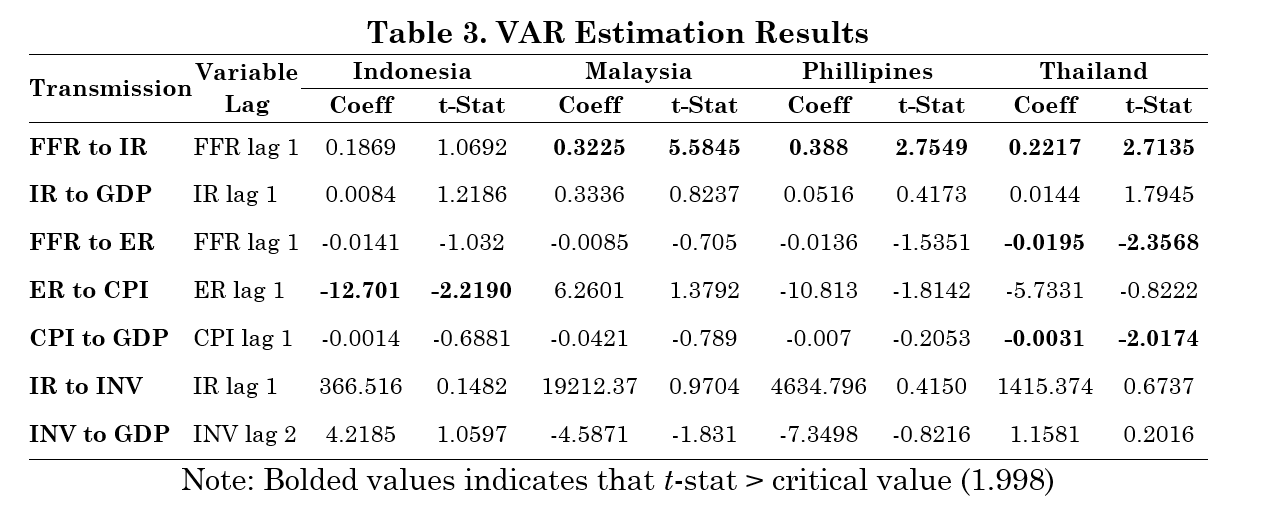
The increase in the Federal Funds Rate (FFR) by the United States increases the potential for spillovers to the macroeconomic stability of developing countries, particularly in the ASEAN region, which has a high level of trade openness and financial integration. This study aims to analyze the transmission mechanism of US monetary policy spillovers to macroeconomic fundamentals in Indonesia, Malaysia, the Philippines, and Thailand through the interest rate, exchange rate, and investment channels. The study uses quarterly data for the 2005–2024 period using a Vector Autoregression (VAR) approach supported by the Impulse Response Function (IRF) and Forecast Error Variance Decomposition (FEVD) to evaluate the dynamic relationships, responses to shocks, and the relative contribution of each variable. The results show that US monetary policy spillovers are heterogeneous and are transmitted more predominantly through the monetary channel than the real sector. VAR estimates indicate that the Federal Funds Rate (FFR) transmission is most consistent through the domestic interest rate channel in Malaysia, the Philippines, and Thailand, while Indonesia is more responsive through the exchange rate channel to inflation. However, this influence does not continue significantly on investment or economic growth. The IRF analysis shows that Indonesia, the Philippines, and Thailand exhibit convergent adjustment mechanisms to FFR shocks, while Malaysia exhibits an unstable response. The FEVD results confirm that variations in economic growth in Indonesia, the Philippines, and Thailand are still dominated by domestic shocks. This finding confirms that the effectiveness of global monetary policy transmission is largely determined by domestic economic fundamentals, policy credibility, and the structural characteristics of each country. Therefore, strengthening the mix of monetary, fiscal, and macroprudential policies, as well as deepening financial markets, are key to increasing macroeconomic resilience to global monetary shocks.
Downloads
References
Ahmed, S., Akinci, O., & Queralto, A. (2021). U.S. Monetary policy spillovers to emerging markets: Both shocks and vulnerabilities matter. SSRN Electronic Journal. https://doi.org/10.2139/ssrn.3875652
Aizenman, J., Chinn, M. D., & Ito, H. (2013). The “Impossible Trinity” hypothesis in an era of global imbalances: Measurement and testing. Review of International Economics, 21(3), 447–458. https://doi.org/10.1111/roie.12047
Akpa, A. F., Okafor, V. I., Osabuohien, E., & Bowale, E. (2024). Financial development and income inequality: Direct and indirect transmission mechanisms in Sub-Saharan Africa. Transnational Corporations Review, 16(3). https://doi.org/10.1016/j.tncr.2024.200048
Albagli, E., Ceballos, L., Claro, S., & Romero, D. (2019). Channels of US monetary policy spillovers to international bond markets. Journal of Financial Economics, 134(2), 447–473. https://doi.org/10.1016/j.jfineco.2019.04.007
Bank for International Settlements. 2023. BIS Annual Economic Report 2023.
Bartocci, A., Cantelmo, A., Notarpietro, A., & Pisani, M. (2024). Monetary policy tightening in response to uncertain stagflationary shocks: A model-based analysis. SSRN Electronic Journal. https://doi.org/10.2139/ssrn.4849537
Bergin, P., & Corsetti, G. (2023). The Macroeconomic Stabilization of Tariff Shocks: What is the Optimal Monetary Response? SSRN Electronic Journal. https://doi.org/10.2139/ssrn.4386801
Bernanke, B. S., Gertler, M., & Gilchrist, S. (1999). The financial accelerator in a quantitative business cycle framework. In J. B. Taylor & M. Woodford (Eds.), Handbook of macroeconomics (Vol. 1, Part C, pp. 1341–1393). Elsevier. https://doi.org/10.1016/S1574-0048(99)10034-X
Bruno, V., & Shin, H. S. (2015). Cross-Border Banking and Global Liquidity. Review of Economic Studies, 82(2), 535–564. https://doi.org/10.1093/restud/rdu042
Cecchetti, S. G., Mancini-Griffoli, T., Narita, M., & Sahay, R. (2020). US or domestic monetary policy: Which matters more for financial stability? IMF Economic Review, 68(1), 35–65. https://doi.org/10.1057/s41308-020-00108-2
Cheng, P., & You, Y. (2025). U.S. monetary policy spillovers to emerging market countries: Responses to cost-push and natural rate shocks. Economic Modelling, 143. https://doi.org/10.1016/j.econmod.2024.106971
Davis, S., & Zlate, A. (2017). Monetary Policy Divergence, Net Capital Flows, and Exchange Rates: Accounting for Endogenous Policy Responses. Federal Reserve Bank of Dallas, Globalization and Monetary Policy Institute Working Papers, 2017(328). https://doi.org/10.24149/gwp328
Edwards, S. (2010). The international transmission of interest rate shocks: The Federal Reserve and emerging markets in Latin America and Asia. Journal of International Money and Finance, 29(4), 685–703. https://doi.org/10.1016/j.jimonfin.2010.01.003
Eklou, K. (2023). The anatomy of monetary policy transmission in an emerging market. IMF Working Papers, 2023(146), 1. https://doi.org/10.5089/9798400247910.001
Enders, W. (2015). Applied Econometric Time Series (4th ed.). John Wiley & Sons.
Escolano, J., Kolerus, C., & Lonkeng Ngouana, C. (2014). Global Monetary Tightening: Emerging Markets Debt Dynamics and Fiscal Crises. IMF Working Papers, 14(215), 1. https://doi.org/10.5089/9781475584691.001
Fan, Z., & Chen, X. (2024). The impact of unconventional monetary policy on China’s economic and financial cycle: Application of a Structural Vector Autoregression model based on high-frequency data. Mathematics, 12(13). https://doi.org/10.3390/math12131967
Feng, L., Pei, T., & Zhou, Z. (2024). The impact of U.S. monetary policy on Chinese firms’ innovation. International Review of Economics and Finance, 92, 1097–1111. https://doi.org/10.1016/j.iref.2024.02.006
Georgiadis, G. (2016). Determinants of global spillovers from US monetary policy. Journal of International Money and Finance, 67, 41–61. https://doi.org/10.1016/j.jimonfin.2015.06.010
Hamilton, J. D. (1994). Time Series Analysis. Princeton University Press.
Harjes, T., Hofman, D., Nier, E., & Olafsson, T. (2020, May 8). Monetary and financial policy responses for emerging market and developing economies (Special Series on COVID-19). International Monetary Fund. https://www.imf.org/-/media/files/publications/covid19-special-notes
Huang, Z. (2010). Monetary policy and trade imbalance adjustment. Journal of Chinese Economic and Business Studies, 8(3), 269–292. https://doi.org/10.1080/14765284.2010.493641
Jump, R. C., & Michell, J. (2023). Dollar liquidity, financial vulnerability and monetary sovereignty. Development and Change, 54(5), 1087–1113. https://doi.org/10.1111/dech.12799
Kallianiotis, I. N. (2019). Monetary policy, real cost of capital, financial markets and the real economic growth. Journal of Applied Finance and Banking, 9(1), 75-118. https://www.scienpress.com/journal_focus.asp?main_id=56&Sub_id=IV&Issue=810815
Khotiawan, J., Sakti, M., & Wahyudi, R. K. (2023). An analysis of the effects of spatial dependence on economic growth among regencies and cities in Java. Jurnal Ekonomi Pembangunan: Kajian Masalah Ekonomi dan Pembangunan, 24(2), 202–220. https://doi.org/10.23917/jep.v24i1.22109
Klau, M., & Mohanty, M. S. (2011). Monetary policy rules in emerging market economies: Issues and evidence. SSRN Electronic Journal, (149). https://doi.org/10.2139/ssrn.901388
Lastauskas, P., & Nguyen, A. D. M. (2024). Spillover effects of US monetary policy on emerging markets amidst uncertainty. Journal of International Financial Markets, Institutions and Money, 92(February), 101956. https://doi.org/10.1016/j.intfin.2024.101956
Lütkepohl, H. (2005). New Introduction to Multiple Time Series Analysis. Springer.
Miranda-Agrippino, S., & Rey, H. (2020). U.S. Monetary policy and the global financial cycle. Review of Economic Studies, 87(6), 2754–2776. https://doi.org/10.1093/restud/rdaa019
Nguyen, T. M. L. (2020). Output Effects of Monetary Policy in Emerging and Developing Countries: Evidence from a Meta-Analysis. Emerging Markets Finance and Trade, 56(1), 68–85. https://doi.org/10.1080/1540496X.2019.1601081
Obstfeld, M., Ostry, J. D., & Qureshi, M. S. (2017, June). A tie that binds: Revisiting the trilemma in emerging market economies (IMF Working Paper No. WP/17/130). International Monetary Fund. https://doi.org/10.5089/9781484302620.001
Obstfeld, M., & Rogoff, K. (1995). Exchange rate dynamics redux. Journal of Political Economy, 103(3), 624–660. https://doi.org/10.1086/261997
Perego, E., Bodart, V., & Courtoy, F. (2024, February 7). US monetary policy spillovers to developing countries: The commodity-financial channel (SSRN Scholarly Paper No. 4724150). SSRN. https://dx.doi.org/10.2139/ssrn.4724150
Retnasih, N. R., & Herdianti, Y. M. (2023). Pandemic shock and economic variables responses in ASEAN countries using Panel Vector Autoregressive model. Jurnal Ekonomi Pembangunan: Kajian Masalah Ekonomi dan Pembangunan, 95–111. https://doi.org/10.23917/jep.v24i1.19850
Retnasih, N. R., & Syahda, P. E. (2025). Macroeconomic shifts in Indonesia: Analyzing the impact of the United States (US) – China trade war. Jurnal Ekonomi Pembangunan: Kajian Masalah Ekonomi dan Pembangunan, 21–44. https://doi.org/10.23917/jep.v26i1.10790
Rey, H. (2015, May). Dilemma not trilemma: The global financial cycle and monetary policy independence (NBER Working Paper No. 21162). National Bureau of Economic Research. https://www.nber.org/papers/w21162
Sen, A., & Sensarma, R. (2026). Beyond borders: spillover effects of US monetary policy on the financial stress of emerging market economies. Journal of International Money and Finance, 161. https://doi.org/10.1016/j.jimonfin.2025.103500
Sikhwal, S. (2024). Quantifying the spillover effects of U.S. economic policy uncertainty on emerging market economies using GMM-PVAR model. Russian Journal of Economics, 10(3), 229–245. https://doi.org/10.32609/j.ruje.10.128666
Sims, C. A. (1980). Macroeconomics and Reality. Econometrica, 48(1), 1–48. https://doi.org/10.2307/1912017
Sosa, M., Cabello-Rosales, A., & Calisto, E. O. (2025). US monetary policy uncertainty impact on Latin American currency market volatility. Economic Analysis Review, 40(1). https://www.rae-ear.org/index.php/rae/article/view/1078
Tian, S., Wang, D., & Wang, L. (2023). Spillover impact of the U.S. monetary policy shock on China’s economy: capital flow channel. Economic Research-Ekonomska Istrazivanja, 36(1), 3328–3350. https://doi.org/10.1080/1331677X.2022.2108099
Tillmann, P. (2020). Monetary policy uncertainty and the response of the yield curve to policy shocks. Journal of Money, Credit and Banking, 52(4), 803–833. https://doi.org/10.1111/jmcb.12657
Tran, T. B. N., & Pham, H. C. H. (2020). The spillover effects of the US unconventional monetary policy: New evidence from Asian developing countries. Journal of Risk and Financial Management, 13(8). https://doi.org/10.3390/jrfm13080165
Willems, T. (2020). What do monetary contractions do? Evidence from large tightenings. Review of Economic Dynamics, 38, 41–58. https://doi.org/10.1016/j.red.2020.03.002
Wu, J. C., & Xia, F. D. (2016). Measuring the macroeconomic impact of monetary policy at the zero lower bound. Journal of Money, Credit and Banking, 48(2–3), 253–291. https://doi.org/10.1111/jmcb.12300
Yoldas, E. (2024, May 10). Monetary policy and exchange rates during the global tightening. Board of Governors of the Federal Reserve System. https://doi.org/10.17016/2380-7172.3489
Zhang, M., Mei, D., & Lei, W. (2024). International transmission of China’s monetary policy. Applied Economics. https://doi.org/10.1080/00036846.2024.2325377
Submitted
Accepted
Published
How to Cite
Issue
Section
License
Copyright (c) 2026 Yulia Indrawati, Muhammad Tojibus Sabirin, Ahmed Mohamed Annegrat

This work is licensed under a Creative Commons Attribution 4.0 International License.