Quantifying the Poverty Paradox: Indonesian Labor Migration
DOI:
https://doi.org/10.23917/jep.v26i2.13174Keywords:
Poverty paradox, Labour migration, Indonesian migrant workers, Panel data analysisAbstract
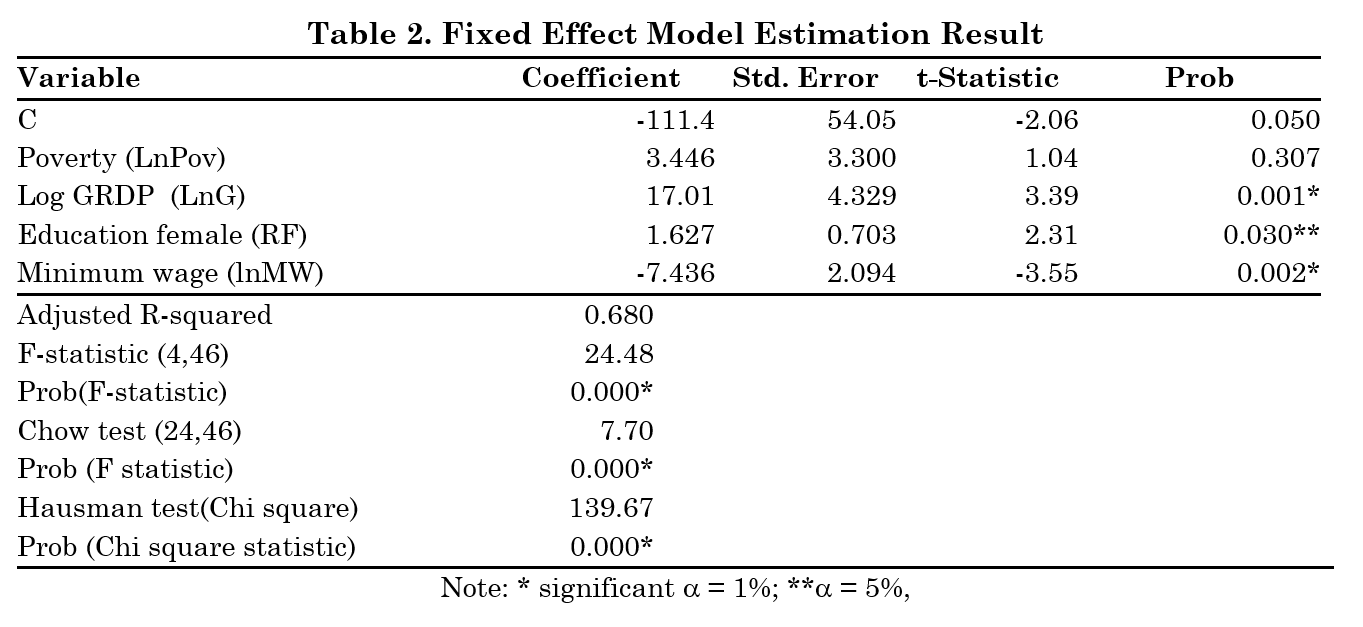
The relationship between poverty and labour migration often reflects a paradox: while poverty pushes households to seek opportunities abroad, migration also requires resources that the poorest can't easily afford. This study explores the poverty paradox in the context of Indonesian labour migration by analysing district/city-level panel data from 2021 to 2023. Using fixed effect data panel, the research examines how poverty, Gross Regional Domestic Product (GRDP), male education, female education, and minimum wage influence the number of Indonesian migrant workers. The results reveal a positive but not significant effect of poverty on the number of migrant workers. In contrast, regional income has a strong positive influence, confirming that migration is facilitated by economic capacity. Female education emerges as a significant driver of migration, reflecting the gendered structure of Indonesia’s overseas labour markets, while minimum wages exert a significant negative effect, indicating that improved local wage conditions can partially reduce migration incentives. Overall, the findings highlight with the COVID-19 pandemic and the post-COVID period, Indonesian labour migration is driven less by poverty alone than by the interaction of regional economic capacity, gender-specific human capital, and local labour market conditions. Policy efforts should therefore focus on inclusive regional development, gender-responsive education, and the expansion of decent domestic employment to reduce long-term dependence on international labour migration.
Downloads
References
Arifin, R., Zulfa, E. A., Hanita, M., & Runturambi, A. J. S. (2024). Unveiling Indonesia’s migration and border governance: Challenges and imperatives post-pandemic. Social Sciences & Humanities Open, 10, 101202. https://doi.org/10.1016/j.ssaho.2024.101202
Ben, D., & Schneiderheinze, C. (2024). Higher economic growth in poor countries , lower migration flows to the OECD – Revisiting the migration hump with panel data. 182(June). https://doi.org/10.1016/j.worlddev.2024.106655
Colin Cameron, A., & Miller, D. L. (2015). A Practitioner’s Guide to Cluster-Robust Inference. Journal of Human Resources, 50(2), 317–372. https://doi.org/10.3368/jhr.50.2.317
Huang, T., Zhou, H., Jones, L., & Wen, C. (2024). Us or them: How COVID- 19 vaccine priority influences perceptions of local- migrant worker relations . Asian Journal of Social Psychology Us, (September), 995–1010. https://doi.org/10.1111/ajsp.12653
International Labour Organization (Ed.). (2021). ILO global estimates on international migrant workers: Results and methodology. International labour organization.
Kusumawati, M. P. (2024). Indonesian Migrant Workers (IMW) and human trafficking: perspectives from Islamic and human rights standpoints. Kanun Jurnal Ilmu Hukum, 26(1), 81–100. https://doi.org/10.24815/kanun.v26i1.37153
Lukasiewicz, K. (2017). Exile to Poverty: Policies and Poverty Among Refugees in Poland. 55(6). https://doi.org/10.1111/imig.12356
Maksum, A. (2021). Indonesian post-migrant workers: A challenging problem for human security. Social Sciences & Humanities Open, 4(1), 100223. https://doi.org/10.1016/j.ssaho.2021.100223
Muslihatinningsih, F. Sinaga, J. P., & Istiyani, N. (2020). Migrasi internasional penduduk Pulau Jawa menjadi pekerja migran Indonesia di luar negeri. Jurnal Ekonomi Pembangunan, 9(2), 106–115.
Nababan, F., Matin, M., & Suryadi, S. (2022). Are the Migrant Worker Empowerment Program’s Objectives Effective? Journal of International Conference Proceedings, 5(1). https://doi.org/10.32535/jicp.v5i1.1479
Nisa, A. K., Soelistijo, D., Susilo, S., & Deffinika, I. (2023). Perempuan pekerja migran: analisis hubungan faktor usia, pendidikan dan status perkawinan terhadap partisipasi kerja migran Hong Kong di Kecamatan Sukun Kota Malang. DEMOS: Journal of Demography, Ethnography and Social Transformation, 3(2), 100–115. https://doi.org/10.30631/demos.v3i2.1976
Niua, A., Handayani, D., & Karma, I. D. G. (2022). Do amenities and economic factors affect migration? Empirical evidence. Environment and Urbanization ASIA 13(1), 11–26. https://doi.org/10.1177/09754253221083169
Oliinyk, O., Bilan, Y., Mishchuk, H., Akimov, O., & Vasa, L. (2021). The impact of migration of highly skilled workers on the country’s competitiveness and economic growth. Montenegrin Journal of Economics, 17(3), 7–19. https://doi.org/10.14254/1800-5845/2021.17-3.1
Puspitasari, W. I., & Kusreni, S. (2017). Faktor-faktor yang mempengaruhi migrasi tenaga kerja ke luar negeri berdasarkan provinsi di Indonesia. Jurnal Ilmu Ekonomi Terapan, 2(1). https://doi.org/10.20473/jiet.v2i1.5505
Robiyatin, S., Muktiyanto, A., Fatimah, F., & Daulay, P. (2024). Financial management analysis of Indonesian migrant workers: Case study of Indonesian female migrant workers in Singapore. International Journal of Science and Society, 6(3), 358-368. https://doi.org/10.54783/ijsoc.v6i3.1250
Stark, O., & Bloom, D. E. (1985). The New Economics of Labor Migration. The American Economic Review, 75(2,), 173–178.
Suryaningsih, Nulhaqim, S. A., Fedryansyah, M., & Sugandi, Y. S. (2023). Employment opportunities and social networks of Indonesian women migrant workers at the border. Journal of Law and Sustainable Development, 11(2), e403. https://doi.org/10.55908/sdgs.v11i2.403
Uddin, M. S., & Mohammed, A. A. (2022). Poor Income and Unemployment as Determinants of Labour Migration: Empirical Evidence From Bangladeshi Migrant Workers in Klang , Malaysia. 12(3), 22–39. https://doi.org/10.5296/ijhrs.v12i3.20088
UNDP. (2024). Empowering Migrants: Feasibility Study of Innovative Financing Mechanism on Migration.
Wajdi, N., Adioetomo, S. M., & Mulder, C. H. (2017). Gravity Models of Interregional Migration in Indonesia. Bulletin of Indonesian Economic Studies, 53(3), 309–332. https://doi.org/10.1080/00074918.2017.1298719
Wajdi, N., Adioetomo, S. M., & Mulder, C. H. (2018). Gravity Models of interregional migration in Indonesia. Bulletin of Indonesian Economic Studies. 4918. https://doi.org/10.1080/00074918.2017.1298719
World Bank (Ed.). (2020). Trading for development in the age of global value chains (2020). International Bank for Reconstruction and Development/The World Bank.
Xu, D., Luo, D., He, X., Lin, T., & Wang, C. (2024). Intensity and Determinants of Rural Migrant Workers’ Multidimensional Poverty in China. 9(4). https://doi.org/10.20849/ajsss.v9i4.1449
Submitted
Accepted
Published
How to Cite
Issue
Section
License
Copyright (c) 2025 Dini Yuniarti, Herlin Astuti, Fajar Agung Triatmojo, Muhammad Safar Nasir; Hassan Swedy Lunku

This work is licensed under a Creative Commons Attribution 4.0 International License.