Structural Analysis of Critical Variables for Culinary Tourism Development: A MICMAC Approach
DOI:
https://doi.org/10.23917/jep.v26i2.12749Keywords:
MICMAC, culinary tourism, structural analysis, Bogor, key variablesAbstract
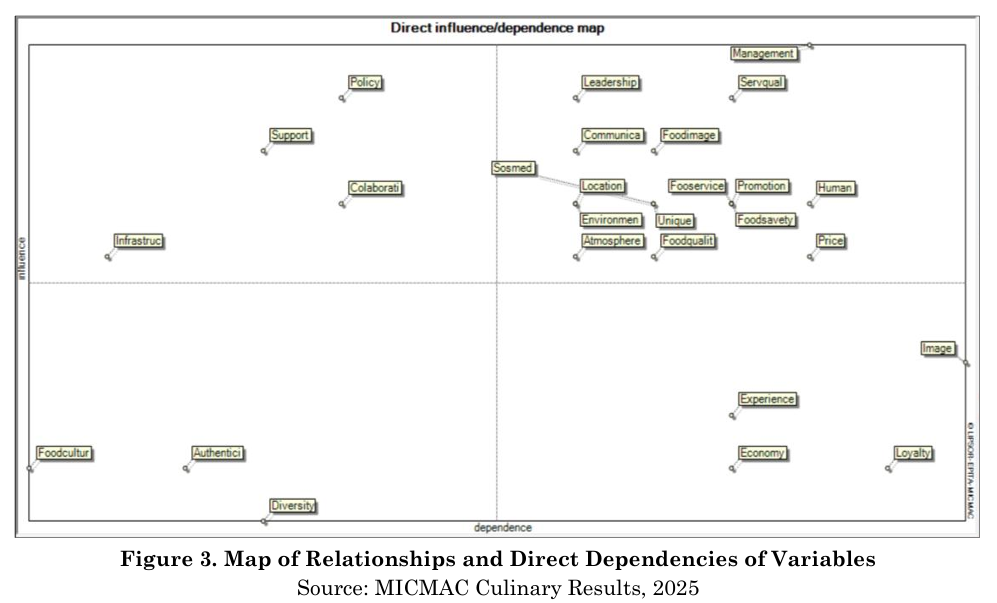
This study analyzed the structure of critical variables influencing the development of culinary tourism in Bogor City using the MICMAC (Cross-Impact Matrix Multiplication Applied to Classification) approach. Data were collected through focus group discussions with key stakeholders, and matrices of direct and indirect influences among variables were then constructed to generate an influence–dependence map. The analysis results identified four determinant variables that acted as stable primary drivers of the system, namely government policy, budget and resource support, multi-stakeholder collaboration, and infrastructure. In addition, a group of relay variables—including leadership, environment, location, atmosphere, communication, food image, uniqueness, social media, food quality, promotion, food safety, food service, human resources, service quality, management, and price—functioned as the main link between determinant variables and outcome variables, namely tourist experience, destination image, loyalty, and economic impact. Culinary cultural identity (food culture, authenticity, diversity) played a symbolic strengthening role but did not act as a primary structural driver. These findings highlighted the need for development strategies that focused on strengthening determinant variables and managing relay variables in an integrated manner to enhance the competitiveness and sustainability of culinary tourism in Bogor.
Downloads
References
Abriani, A. (2022). Economic impact of culinary tourism center management. Journal of Social Commerce, 2(4), 144–153. https://doi.org/10.56209/jommerce.v2i4.43
Anika, J. J., Khan, M. Y. H., & Hassan, A. (2020). The role of local government in tourism development: Evidence from Kuakata, Bangladesh. Tourism Policy and Planning in Bangladesh (pp. 33-50). Springer Singapore. https://doi.org/10.1007/978-981-15-7014-8_3
Ariyani, N., & Fauzi, A. (2019). Analysis of strategic variables for ecotourism development; An application of Micmac. South Asian Journal of Social Studies and Economics, 3(3), 1–12. https://doi.org/10.9734/sajsse/2019/v3i330107
Ariyani, N., & Fauzi, A. (2023). Pathways toward the transformation of sustainable rural tourism management in Central Java, Indonesia. Sustainability, 15(3). https://doi.org/10.3390/su15032592
Ariyani, N., Fauzi, A., & Suherlan, A. (2023). Measuring economic resilience of tourist villages overtime: An analysis of temporal variations of pre and post the Covid-19 pandemic. Jurnal Ekonomi Pembangunan: Kajian Masalah Ekonomi dan Pembangunan, 24(2), 233–255. https://doi.org/10.23917/jep.v24i2.23036
Badan Perencanaan Pembangunan, Penelitian, dan Pengembangan Daerah Kota Bogor. (2024). Laporan akhir RPJMD Teknokratik Kota Bogor 2025–2029 [Final report of the technocratic regional medium-term development plan (RPJMD) of Bogor City 2025–2029]. https://bapperida.kotabogor.go.id/po-content/uploads/laporan_akhir_rpjmd_teknokratik_kota_bogor_2025_2029.pdf
Bain, A. (2024). Effect of culinary tourism on local economic development in South Africa. Journal of Hospitality and Tourism, 4(2), 34–44. https://doi.org/10.47672/jht.2382
Björk, P., & Kauppinen-Räisänen, H. (2016). Exploring the multi-dimensionality of travellers’ culinary-gastronomic experiences. Current Issues in Tourism Journals, 19(12), 1260–1280. https://doi.org/10.1080/13683500.2013.868412
Bonanza, O., Sofiantina Rahayu, K., Prabandari, D., Patabang, M., & Lidya, L. (2023). Analysis of tourist motivation for traditional culinary tourism in Bogor. E3S Web of Conferences, 454, 1–7. https://doi.org/10.1051/e3sconf/202345403019
Di-Clemente, E., Hernández-Mogollón, J. M., & López-Guzmán, T. (2020). Culinary tourism as an effective strategy for a profitable cooperation between agriculture and tourism. Social Sciences, 9(3). https://doi.org/10.3390/socsci9030025
Fauzi, A. (2019). Teknis Analisis Keberlanjutan. Gramedia Pustaka Utama.
Fistola, R., & La Rocca, R. A. (2017). Driving functions for urban sustainability: The double-edged nature of urban tourism. International Journal of Sustainable Development and Planning, 12(3), 425–434. https://doi.org/10.2495/SDP-V12-N3-425-434
Fufurida, Oktavila, S., Karsinah, & Fauziah, S. (2020). Development of Potential Culinary and Shopping Tourism in Central Java Province. Jurnal Ekonomi Pembangunan: Kajian Masalah Ekonomi dan Pembangunan, 21(2), 107–117. https://doi.org/10.23917/jep.v21i2.10590
Godet, M. (1994). From anticipation to ation A handbook of strategic prospective (Issue 112). UNESCO. http://en.laprospective.fr/dyn/anglais/ouvrages/from-anticipation.pdf
Godet, M. (2000). The Art of Scenarios and Strategic Planning: Tools and Pitfalls. Technological Forecasting and Social Change, 65(1), 3–22. https://doi.org/10.1016/s0040-1625(99)00120-1
Godet, M., Durance, P., & Gerber, A. (2008). Strategic foresight, la prospective, use and misuse of scenario building (LIPSOR Research Working Paper No. 10). LIPSOR. http://en.laprospective.fr/dyn/anglais/ouvrages/sr10veng.pdf
Hajarrahmah, D., Daniels-Llanos, M. (2017). Developing culinary tourism to support local tourism development and preserving food heritage in Indonesia. Proceedings of the 6th International Conference of Arte-Polis. Springer, Singapore. https://doi.org/10.1007/978-981-10-5481-5_3
Horng, J.-S., & Tsai, C.-T. (2012). Culinary tourism strategic development: An Asia-Pacific perspective. International Journal of Tourism Research, 14(1), 40–55. https://doi.org/10.1002/jtr.834
Ilhami, W. T., Arifin, H. S., Pramudya, B., & Kosmaryandi, N. (2024). Sustainable scientific tourism development planning using Micmac-Mactor in Bogor City. Jurnal Pengelolaan Sumberdaya Alam dan Lingkungan, 14(4), 757. https://doi.org/10.29244/jpsl.14.4.757
Karim, S. A., & Chi, C. G.-Q. (2010). Culinary Tourism as a destination attraction: An empirical examination of destinations’ food image. Journal of Hospitality Marketing & Management, 19, 531–555. https://doi.org/10.1080/19368623.2010.493064
Kivela, J., & Crotts, J. C. (2006). Tourism and gastronomy: Gastronomy’s influence on how tourists experience a destination. Journal of Hospitality & Tourism Research, 3(3). https://doi.org/10.1177/1096348006286797
Kovalenko, A., Dias, Á., Pereira, L., & Simões, A. (2023). Gastronomic experience and consumer behavior: Analyzing the influence on destination image. Foods, 12(2). https://doi.org/10.3390/foods12020315
Kristanti, M., Jokom, R., & Widjaja, D. C. (2019). Culinary experience of domestic tourists in Indonesia: A study on Denpasar and Yogyakarta tourist destinations. Proceedings of the 2018 International Conference on Tourism, Economics, Accounting, Management, and Social Sciences (TEAMS-18). Atlantis Press. https://www.atlantis-press.com/proceedings/teams-18/55911630
Kristyadi, G. A., & Facrureza, D. (2024). Analysis of local culinary consumption on the attractiveness of culinary tourism in The Surya Kencana area of Bogor. International Journal of Acounting, Management,Economics, and Social Science, 2(5), 1612–1619. https://doi.org/10.61990/ijamesc.v2i5.279
Lacap, J. P. G. (2019). The effects of food related motivation, local food involvement, and destination loyalty: The case of Angeles City, Philippines. Advances in Hospitality and Tourism Research (AHTR), 7(2), 238–257. https://doi.org/10.30519/ahtr.550600
Laverde, W. E. M., Espinosa, C. P. G., & Mass, R. C. O. (2023). Legal Component of The Tourism System To Make Concencus Decision With Micmac Prospective Technique: Case Study of The Municipality of La Vega - Cundimarca. 11(5), 3051–3059. https://www.russianlawjournal.org/index.php/journal/article/view/3231?utm_source=chatgpt.com
Levyda, L., Giyatmi, G., Ratnasari, K., & Valeriani, D. (2024). Embracing culinary tourism as a Strategy for boosting regional development: Bangka Belitung case studies. IJBE (Integrated Journal of Business and Economics), 8(3), 332. https://doi.org/10.33019/ijbe.v8i3.888
Long, B., Yusof, N. S., & Azmy, M. M. (2024). factors influencing the sustainability of food tourism destinations: Evidence from the World Heritage Site of Guilin. Sustainability, 16(22), 10027. https://doi.org/10.3390/su162210027
Long, L. M. (2012). Culinary Tourism. The Oxford Handbook of Food History (Issue November 2012). https://doi.org/10.1093/oxfordhb/9780199729937.013.0022
Mafruhah, I., Mulyani, N. S., Istiqomah, N., & Ismoyowati, D. (2018). Development of ecotourism based on community empowerment (A case study of Kebumen Regency). Jurnal Ekonomi Pembangunan: Kajian Masalah Ekonomi dan Pembangunan, 19(2), 196–206. https://doi.org/10.23917/jep.v19i2.6996
Mau, D. P., Mau, Y. P., Wibowo, O. H., Kurniansah, R., Artana, I. W. A., & Ariawan, I. W. A. P. (2024). Preservation of local culinary tourism in improving the economy of local communities in Surabaya. Greenomika, 6(2), 123–134. https://doi.org/10.55732/unu.gnk.2024.06.2.3
Moradi-Lakeh, M., Goharinezhad, S., Amirkafi, A., Zahraei, S. M., Tehrani-Banihashemi, A., & Esteghamati, A. (2024). Analysis of driving factors influencing vaccine policy in Iran: a cross-impact analysis. Foresight, 26(2), 337–350. https://doi.org/10.1108/FS-05-2022-0050
Ndlovu, J. (2023). Food Tourism as a Strategy for Local Economic Development in Durban. African Journal of Hospitality, Tourism and Leisure, 12(5SE), 1806–1821. https://www.ajhtl.com/uploads/7/1/6/3/7163688/article_14_12_se5_1806-1821.pdf
Nematpour, M., & Faraji, A. (2019). Structural analysis of the tourism impacts in the form of future study in developing countries (Cstudy: Iran). Journal of Tourism Futures, 5(3), 259–282. https://doi.org/10.1108/JTF-05-2018-0028
Nugraha, I. G. P., Parma, I. P. G., Agustina, M. D. P., & Hutnaleontina, P. N. (2024). The role of government and community participation in realizing sustainable tourism development in Tihingan Village, Bali, Indonesia. Journal of Infrastructure, Policy and Development, 8(8). https://doi.org/10.24294/jipd.v8i8.4621
Nur, A. C., Koliopoulos, T., Niswaty, R., & Akib, H. (2023). The importance of the government’s role in sustainable development in rural areas. Smart Tourism, 4(1), 1–13. https://doi.org/10.54517/st.v4i1.2253
Park, E., & Widyanta, A. (2022). Food tourism experience and changing destination foodscape: An exploratory study of an emerging food destination. Tourism Management Perspectives, 42(April), 100964. https://doi.org/10.1016/j.tmp.2022.100964
Safian, S. S. S., Osman, A. A., Wahab, S. N., Othman, N., & Mohammad Azhar, N. A. Z. (2021). The effect of culinary tourism on tourists’ loyalty and satisfaction: A comparison analysis between the first and revisit to Malaysia. International Journal of Academic Research in Business and Social Sciences, 11(8). https://doi.org/10.6007/ijarbss/v11-i8/10535
Statistics Indonesia. (2025). Kabupaten Bogor dalam Angka 2025 [Bogor Municipality in Figures 2025].
Stratigea, A. (2013). Participatory policy making in foresight studies at the regional level: A methodological approach. Regional Science Inquiry, 5(1), 145–161. (PDF) Participatory policy making in foresight studies at the regional level: A methodological approach
Sukenti, K. (2014). Gastronomy tourism in several neighbor countries of Indonesia: A brief review. Journal of Indonesian Tourism and Development Studies, 2(2), 55–63. https://doi.org/10.21776/ub.jitode.2014.002.02.03
Thio, S., Jokom, R., & Widjaja, D. C. (2024). The contribution of perceived food consumption value on destination attractiveness and revisit intention. Journal of Culinary Science and Technology, 22(4), 727–743. https://doi.org/10.1080/15428052.2022.2074331
Untari, D. T., & Satria, B. (2025). Reimagining Indonesia’s culinary tourism: The power of gastronomy and branding. Greenation International Journal of Tourism and Management, 3(2), 150–155. https://doi.org/10.38035/gijtm.v3i2.329
Vuksanović, N., Demirović Bajrami, D., Petrović, M. D., Radovanović, M. M., Malinović-Milićević, S., Radosavac, A., Obradović, V., & Ergović Ravančić, M. (2024). The role of culinary tourism in local marketplace business—New outlook in the selected developing area. Agriculture, 14(1). https://doi.org/10.3390/agriculture14010130
Wijaya, P. Y., Kawiana, I. G. P., Suasih, N. N. R., Hartati, P. S., & Sumadi, N. K. (2020). SWOT and Micmac analysis to determine the development strategy and sustainability of the bongkasa pertiwi tourism village, Bali Province, Indonesia. Decision Science Letters, 9(3), 439–452. https://doi.org/10.5267/j.dsl.2020.3.002
Wijaya, S. (2019). Indonesian food culture mapping: A starter contribution to promote Indonesian culinary tourism. Journal of Ethnic Foods, 6(1), 1–10. https://doi.org/10.1186/s42779-019-0009-3
Wijaya, S., Morrison, A., Nguyen, T.-H., & King, B. (2016). Exploration of Culinary Tourism in Indonesia: What Do the International Visitors Expect? Asia Tourism Forum 2016 – The 12th Biennial Conference of Hospitality and Tourism Industry in Asia (ATF-16) Exploration, February 2021. https://doi.org/10.2991/atf-16.2016.56
Wondirad, A., Kebete, Y., & Li, Y. (2021). Culinary tourism as a driver of regional economic development and socio-cultural revitalization: Evidence from Amhara National Regional State, Ethiopia. Journal of Destination Marketing and Management, 19(March), 100482. https://doi.org/10.1016/j.jdmm.2020.100482
Wondirad, A., & Verheye, G. (2023). Does gastronomy determine visitors’ holiday destination choice? Empirical evidence based on a mixed-method research approach. Cogent Food and Agriculture, 9(2), 1–19. https://doi.org/10.1080/23311932.2023.2266195
World Tourism Organization. (2012). Global report on food tourism (Affiliate Members Global Report, Vol. 4). World Tourism Organization. https://doi.org/10.18111/9789284414819
Wulan, M. K. (2025, August 5). Kontribusi Signifikan, Perkembangan Industri Kuliner Perlu Dipercepat. Kompas. https://www.kompas.id/artikel/kontribusi-ekonomi-cukup-besar-perkembangan-industri-kuliner-perlu-dipercepat
Zhang, T., Chen, J., & Hu, B. (2019). Authenticity, quality, and loyalty: Local food and sustainable tourism experience. Sustainability, 11(12), 1–18. https://doi.org/10.3390/su11123437
Submitted
Accepted
Published
How to Cite
Issue
Section
License
Copyright (c) 2025 Nafiah Ariyani, Liew Huey Min, Annisa Retno Utami, Euis Widiati

This work is licensed under a Creative Commons Attribution 4.0 International License.