Digitalization and Inclusive Growth: The Moderating Role of Human Development
DOI:
https://doi.org/10.23917/jep.v27i1.12488Keywords:
Inclusive Growth, Human Development Index, ICT Index, Regional Inequality, DigitalizationAbstract
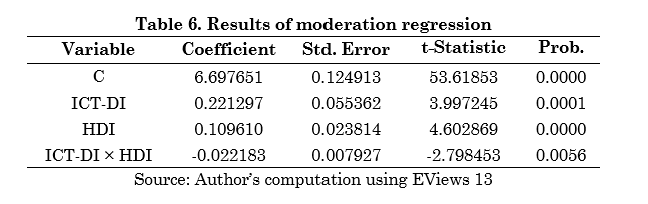
This study examines the effect of the Information and Communication Technology Development Index (ICT-DI on inclusive economic growth by emphasizing the moderating role of the Human Development Index (HDI). It utilizes provincial panel data of Indonesia from 2017 to 2023. This study employs a panel data regression model with an interaction term, estimated using a random effect approach, to examine the moderating effect of HDI. The findings reveal that digitalization positively affects inclusive growth. However, the moderating effect of HDI is negative and significant. To further examine heterogeneity, the sample is split into two groups based on the 2023 national average HDI as the threshold, and the model is re-estimated separately for provinces above and below this threshold. The split-sample results indicate contrasting dynamics: digitalization has a positive and significant effect on inclusive growth in provinces with low HDI, while it has a negative and significant effect in provinces with high HDI. This suggests that in more developed regions, digitalization tends to favor skilled workers, leading to labor market polarization and reduced inclusivity of growth. These findings highlight the need for context-specific digital policies that consider regional disparities in human development. In lower-HDI provinces, policies should focus on expanding digital infrastructure and access, while in higher-HDI provinces, emphasis should be placed on strengthening digital skills and inclusive labor market policies to mitigate inequality.
Downloads
References
Adiningsih, S., Setiaji, S. N., & Ardiansyah, S. R. (2019). Unequal developments in indonesia’s digital-based economy and its implications. Jurnal Ekonomi Indonesia, 8(1), 171–190. https://doi.org/10.52813/jei.v8i1.17
Ahmad, S. (2020). Digital initiatives for access and quality in higher education: An overview. Prabandhan: Indian Journal of Management, 13(1), 9. https://doi.org/10.17010/pijom/2020/v13i1/149944
Amaglobeli, D., Moszoro, M., & Kumar, U. (2023). Determinants and social dividends of digital adoption. IMF Working Papers, 2023(065), 1. https://doi.org/10.5089/9798400237997.001
Ariansyah, K., Anandhita, V. H., & Sari, D. (2019). Investigating the next level digital divide in Indonesia. 2019 4th Technology Innovation Management and Engineering Science International Conference (TIMES-ICON), 1–5. https://doi.org/10.1109/TIMES-iCON47539.2019.9024668
Aziz, A., & Hossain, T. (2024). Digital access, resources, and literacy: Mapping the digital divide and ICT learning challenges among undergraduate students in Bangladesh. Asiascape: Digital Asia, 11(3), 246–267. https://doi.org/10.1163/22142312-bja10064
Bai, C., Quayson, M., & Sarkis, J. (2021). COVID-19 pandemic digitization lessons for sustainable development of micro-and small- enterprises. Sustainable Production and Consumption, 27, 1989–2001. https://doi.org/10.1016/j.spc.2021.04.035
Basnayake, D., Naranpanawa, A., Selvanathan, S., & Bandara, J. S. (2024). Financial inclusion through digitalization and economic growth in Asia-Pacific countries. International Review of Financial Analysis, 96, 103596. https://doi.org/10.1016/j.irfa.2024.103596
Bello, A. A., Hassan, A., Akadiri, S. Saint, Onuogu, I. C., & Aliyu, U. S. (2024). Towards ICT diffusion and trade liberalisation on inclusive growth in Sub-Saharan Africa. Environment, Development and Sustainability, 27(5), 11221–11246. https://doi.org/10.1007/s10668-023-04355-x
Chaikin, O., & Usiuk, T. (2019). The imperatives of inclusive economic growth theory. Scientific Horizons, 84(11), 3–12. https://doi.org/10.33249/2663-2144-2019-84-11-3-12
Dao, T. H. A., Sisavath, C., Bui, H. T. T., Bui, T. Q., & Le, T. H. (2025). Digital workforce training, employee motivation, job satisfaction, digital behavior as determinants of employee performance: Empirical research from Vietnam. Sage Open, 15(4). https://doi.org/10.1177/21582440251395698
Daud, S. N. M., & Ahmad, A. H. (2023). Financial inclusion, economic growth and the role of digital technology. Finance Research Letters, 53, 103602. https://doi.org/10.1016/j.frl.2022.103602
Du, Z.-Y., & Wang, Q. (2024). Digital infrastructure and innovation: Digital divide or digital dividend? Journal of Innovation & Knowledge, 9(3), 100542. https://doi.org/10.1016/j.jik.2024.100542
Gegenfurtner, A., Schmidt‐Hertha, B., & Lewis, P. (2020). Digital technologies in training and adult education. International Journal of Training and Development, 24(1), 1–4. https://doi.org/10.1111/ijtd.12172
Ha, H., & Chuah, C. K. P. (2023). Digital economy in Southeast Asia: challenges, opportunities and future development. Southeast Asia: A Multidisciplinary Journal, 23(1), 19–35. https://doi.org/10.1108/SEAMJ-02-2023-0023
Hadi, A. (2018). Bridging Indonesia’s digital divide: Rural-urban linkages? Jurnal Ilmu Sosial dan Ilmu Politik, 22(1), 17. https://doi.org/10.22146/jsp.31835
Hartono, R., Koestiono, D., Syafrial, S., Toiba, H., & Purnonomo, M. (2023). The role of non-cognitive skills in the adoption of information and communication technology in Indonesia. Asian Economic and Financial Review, 13(3), 192–201. https://doi.org/10.55493/5002.v13i3.4741
Hay, C., Hunt, T., & McGregor, J. A. (2022). Inclusive growth: the challenges of multidimensionality and multilateralism. Cambridge Review of International Affairs, 35(6), 888–914. https://doi.org/10.1080/09557571.2020.1784849
Hermawan, W., Heriyaldi, H., & Tjahjawandita, A. (2024). The influence of financial inclusion and internet access on the income of poor households. Jurnal Ekonomi Pembangunan: Kajian Masalah Ekonomi dan Pembangunan, 25(1), 84–104. https://doi.org/10.23917/jep.v25i1.23517
Iskandar, I. (2017). Effect of human development index fund on economic growth through a special autonomy. Jurnal Ekonomi Pembangunan: Kajian Masalah Ekonomi dan Pembangunan, 18(1), 50. https://doi.org/10.23917/jep.v18i1.2920
Jamil, H. (2022). Less inclusive growth in Indonesia? The unintended consequences of internet penetration. Jurnal Ekonomi Bisnis dan Kewirausahaan, 11(2), 197. https://doi.org/10.26418/jebik.v11i2.53871
Kartiasih, F., Djalal Nachrowi, N., Wisana, I. D. G. K., & Handayani, D. (2023). Inequalities of Indonesia’s regional digital development and its association with socioeconomic characteristics: a spatial and multivariate analysis. Information Technology for Development, 29(2–3), 299–328. https://doi.org/10.1080/02681102.2022.2110556
Kou, W. (2024). The widening role of the digital economy on regional income differences - Evidence from the national pilot zone for innovative development of the digital economy. Journal of Education, Humanities and Social Sciences, 39, 187–197. https://doi.org/10.54097/ptj0d165
Kouladoum, J.-C. (2023). Digital infrastructural development and inclusive growth in Sub-Saharan Africa. Journal of Social and Economic Development, 25(2), 403–427. https://doi.org/10.1007/s40847-023-00240-5
Kwilinski, A., Lyulyov, O., & Pimonenko, T. (2023). Inclusive economic growth: Relationship between energy and governance efficiency. Energies, 16(6), 2511. https://doi.org/10.3390/en16062511
Laddha, Y., Tiwari, A., Kasperowicz, R., Bilan, Y., & Streimikiene, D. (2022). Impact of Information Communication Technology on labor productivity: A panel and cross-sectional analysis. Technology in Society, 68, 101878. https://doi.org/10.1016/j.techsoc.2022.101878
Laitsou, E., Katsianis, D., Xenakis, A., & Gerogiannis, V. C. (2025). Pacing the digital decade: Digital evolution and its impact on human well-being. Telecommunications Policy, 49(1), 102868. https://doi.org/10.1016/j.telpol.2024.102868
Li, Y., Jin, G., Cui, Z., Lv, B., & Xu, Z. (2024). Does digital inclusive finance promote regional green inclusive growth? Finance Research Letters, 62, 105163. https://doi.org/10.1016/j.frl.2024.105163
Liu, H., Wang, X., Wang, Z., & Cheng, Y. (2024). Does digitalization mitigate regional inequalities? Evidence from China. Geography and Sustainability, 5(1), 52–63. https://doi.org/10.1016/j.geosus.2023.09.007
Manoby, W. M., Afriyanni, A., Fitri, S. E., Pranasari, M. A., Setyaningsih, E., Rosidah, R., & Saksono, H. (2021). Digital village: The importance of strengthening village resilience in the digital age. Jurnal Bina Praja, 53–63. https://doi.org/10.21787/jbp.13.2021.53-63
Matli, W., & Wamba, S. F. (2023). Work from anywhere: inequalities in technology infrastructure distribution for digit workers. Digital Transformation and Society, 2(2), 149–162. https://doi.org/10.1108/DTS-08-2022-0042
Ministry of National Development Planning (Bappenas). (2025). Data Pilar 2: Pemerataan Pendapatan dan Pengurangan Kemiskinan [Pillar 2 Data: Income Equality and Poverty Reduction]. Indeks Pembangunan Ekonomi Inklusif. https://inklusif.bappenas.go.id/data/pilar2
Mutiiria, O. M., Ju, Q., & Dumor, K. (2020). Infrastructure and inclusive growth in sub-Saharan Africa: An empirical analysis. Progress in Development Studies, 20(3), 187–207. https://doi.org/10.1177/1464993420927507
Nchake, M. A., & Shuaibu, M. (2022). Investment in ICT infrastructure and inclusive growth in Africa. Scientific African, 17, e01293. https://doi.org/10.1016/j.sciaf.2022.e01293
Nelson, R. R., & Phelps, E. S. (1966). Investment in humans, technological diffusion, and economic growth. The American Economic Review, 56(1/2), 69–75. http://www.jstor.org/stable/1821269
Nguyen, V. B. (2021). The digitalization – economic growth relationship in developing countries and the role of governance. Scientific Annals of Economics and Business, 68(4), 481–493. https://doi.org/10.47743/saeb-2021-0028
Ofori, I. K., Ojong, N., & Gbolonyo, E. Y. (2024). Foreign aid, infrastructure, and the inclusive growth agenda in sub‐Saharan Africa. Growth and Change, 55(4). https://doi.org/10.1111/grow.70004
Pan, W., Xie, T., Wang, Z., & Ma, L. (2022). Digital economy: An innovation driver for total factor productivity. Journal of Business Research, 139, 303–311. https://doi.org/10.1016/j.jbusres.2021.09.061
Ratnasari, C. D. (2021). Internet utilization and income of entrepreneurs in the informal sector. Jurnal Ekonomi Pembangunan: Kajian Masalah Ekonomi dan Pembangunan, 22(2), 129–138. https://doi.org/10.23917/jep.v22i2.16094
Ren, S., Li, L., Han, Y., Hao, Y., & Wu, H. (2022). The emerging driving force of inclusive green growth: Does digital economy agglomeration work? Business Strategy and the Environment, 31(4), 1656–1678. https://doi.org/10.1002/bse.2975
Rogers, E. M. (1962). Diffusion of Innovations. http://www.gbv.de/dms/ilmenau/toc/364512504.PDF
Romer, P. M. (1990). Endogenous technological change. Journal of Political Economy, 98(5, Part 2), S71–S102. https://doi.org/10.1086/261725
Saladin, T., & Faoziyah, S. (2024). Digital transformation: Opening up economic opportunities in the digital era. International Journal of Business, Law, and Education, 5(2), 2849–2855. https://doi.org/10.56442/ijble.v5i2.947
Sari, V. K., Cahyadin, M., & Ignasiak-Szulc, A. (2022). Does health contribute to economic growth? Evidence from regional levels in Indonesia. Jurnal Ekonomi Pembangunan: Kajian Masalah Ekonomi dan Pembangunan, 23(2), 283–294. https://doi.org/10.23917/jep.v23i2.20106
Schultz, T. W. (1961). Investment in human capital. The Economic Journal, 51(1), 1–17. https://doi.org/10.2307/2230051
Sharma, J. K. (2019). Inclusive health-care: The best raw material for progressive and inclusive growth in India. International Journal of Applied Science and Engineering, 7(1). https://doi.org/10.30954/2322-0465.1.2019.3
Statistics Indonesia (BPS). (2019). Indeks Pembangunan Teknologi, Informasi, dan Komunikasi 2018 [ICT Development Index 2018]. https://www.bps.go.id/id/publication/2019/11/29/0328ba9a85b461816e917291/indeks-pembangunan-teknologi-informasi-dan-komunikasi-2018.html
Statistics Indonesia (BPS). (2020). Indeks Pembangunan Teknologi, Informasi, dan Komunikasi 2019 [ICT Development Index 2019]. https://www.bps.go.id/id/publication/2020/12/15/f52c2f6c113db406967d5cb0/indeks-pembangunan-teknologi-informasi-dan-komunikasi-2019-.html
Statistics Indonesia (BPS). (2021). Indeks Pembangunan Teknologi, Informasi, dan Komunikasi 2020 [ICT Development Index 2020]. https://www.bps.go.id/id/publication/2021/10/06/c17a0162c93579c862278ae6/indeks-pembangunan-teknologi-informasi-dan-komunikasi-2020.html
Statistics Indonesia (BPS). (2022). Indeks Pembangunan Teknologi, Informasi, dan Komunikasi 2021 [ICT Development Index 2021]. https://www.bps.go.id/id/publication/2022/09/30/5fe4f0dbccd96d07098c78d3/indeks-pembangunan-teknologi-informasi-dan-komunikasi-2021.html
Statistics Indonesia (BPS). (2023a). Indeks Pembangunan Manusia (IPM) Indonesia tahun 2023 mencapai 74,39 [Human Development Index (HDI) of Indonesia in 2023 reached 74.39]. https://www.bps.go.id/id/pressrelease/2023/11/15/2033/indeks-pembangunan-manusia--ipm--indonesia-tahun-2023-mencapai-74-39--meningkat-0-62-poin--0-84-persen--dibandingkan-tahun-sebelumnya--73-77--.html
Statistics Indonesia (BPS). (2023b). Indeks Pembangunan Teknologi, Informasi, dan Komunikasi 2022 [ICT Development Index 2022]. https://www.bps.go.id/id/publication/2023/09/29/cfa3a7c9e8b2397799ec6bb3/indeks-pembangunan-teknologi-informasi-dan-komunikasi-2022.html
Statistics Indonesia (BPS). (2024a). [Metode Baru] Indeks Pembangunan Manusia menurut Provinsi, 2016-2018 [New Method: Human Development Index by Province, 2016-2018]. https://www.bps.go.id/id/statistics-table/2/NDk0IzI=/-metode-baru--indeks-pembangunan-manusia-menurut-provinsi.html
Statistics Indonesia (BPS). (2024b). Indeks Pembangunan Teknologi, Informasi, dan Komunikasi 2023 [ICT Development Index 2023]. https://www.bps.go.id/id/publication/2024/09/30/b50f00b8615fc8716c8e02d4/indeks-pembangunan-teknologi-informasi-dan-komunikasi-2023.html
Tan, B., Ng, E., & Jiang, J. (2018). The process of Technology Leapfrogging: Case analysis of the national ICT infrastructure development journey of Azerbaijan. International Journal of Information Management, 38(1), 311–316. https://doi.org/10.1016/j.ijinfomgt.2017.10.008
Tsaurai, K., & Ndou, A. (2019). Infrastructure, human capital development and economic growth in transitional countries. Comparative Economic Research. Central and Eastern Europe, 22(1), 33–52. https://doi.org/10.2478/cer-2019-0003
United Nations Department of Economic and Social Affairs. (2024). E-Government Survey 2024: Accelerating Digital Transformation for Sustainable Development. https://publicadministration.un.org/egovkb/en-us/Reports/UN-E-Government-Survey-2024
Wang, W., He, T., & Li, Z. (2023). Digital inclusive finance, economic growth and innovative development. Kybernetes, 52(9), 3064–3084. https://doi.org/10.1108/K-09-2021-0866
Wargadinata, E. L., & Tendean, N. R. P. (2024). Amidst the euphoria of digitalization public services in municipal government: Raising public acceptance. Jurnal Bina Praja, 16(2), 335–346. https://doi.org/10.21787/jbp.16.2024.335-346
Westmore, B. (2017). Sharing the benefits of China’s growth by providing opportunities to all. Journal of International Commerce, Economics and Policy, 1409. https://doi.org/10.1787/639cfdcc-en
Wiston, A. R., & Edgar, J. S. C. (2019). On the impact of innovation and inequality in economic growth. Economics of Innovation and New Technology, 28(1), 64–81. https://doi.org/10.1080/10438599.2018.1429534
World Bank. (2025). Digital Transformation. https://www.worldbank.org/en/topic/digital/overview
Xiang, X., Yang, G., & Sun, H. (2022). The impact of the digital economy on low-carbon, inclusive growth: Promoting or restraining. Sustainability, 14(12), 7187. https://doi.org/10.3390/su14127187
Yang, J., Guo, X., & Zhang, X. (2024). Analysis of the effect of digital financial inclusion in promoting inclusive growth: Mechanism and statistical verification. Economics, 18(1). https://doi.org/10.1515/econ-2022-0078
Zang, L., Zhu, Y., & Cheng, D. (2025). Inequality through digitalization: investigation of mediating and moderating mechanisms. Information Technology for Development, 31(4), 821–836. https://doi.org/10.1080/02681102.2024.2423390
Zhukovska, A. (2019). An inclusive approach to economic development: genesis and key points. Herald of Economics, 2(92), 7–23. https://doi.org/10.35774/visnyk2019.02.007
Submitted
Accepted
Published
How to Cite
Issue
Section
License
Copyright (c) 2026 Nurul Hidayah, Istiqomah, Khalid Eltayeb Elfaki

This work is licensed under a Creative Commons Attribution 4.0 International License.