
Impact the Labirin: the board game on the student’s numeracy ability
Article Sidebar
- Numeracy Skills, Learning Media, Labyrinth Game; The Board Game, Perception
Abstract
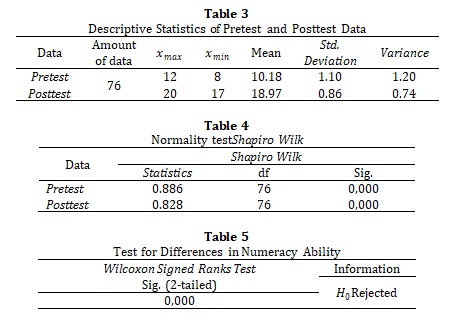
This research aims to improve the numeracy abilities of secondary students after using the Labirin: the board game and students' perceptions of mathematics learning using the game. This empirical study research used a one-group pretest posttest design. The research population is all grade-8 students in one of the Islamic public secondary schools (MTsN) in Serang City. The sample is 76 students from two classes as the experimental class who implemented the game in learning mathematics. The instruments used to collect the data are the numeracy ability tests and students' perception questionnaires. Before use, both instruments are tested for validity and reliability. The findings showed that the students' numeracy abilities improved after implementing the game and helped students to learn mathematics easily, especially in whole numbers and fractions. In addition, the student's understanding is also achieved. The implementation of the game also showed that this learning media helps students learn in the classroom and interest in using the game. It can be concluded that, the Labirin: the board game improved the student’s numeracy ability.
Full text article
References
Ailulia, R., Putri, A. V. E., & Rohmah, H. (2022). Efektivitas Media Pembelajaran Plotagon Fan Math Terhadap Kemampuan Numerasi Siswa Kelas VI Sekolah Dasar Negeri 1 Sowan Lor. In Seminar Nasional Pendidikan Sultan Agung IV (Vol. 4, No. 1).
Alhaddad, I. (2016). Perkembangan pembelajaran matematika masa kini. Delta-Pi: Jurnal Matematika dan Pendidikan Matematika, 4(1). https://doi.org/10.33387/dpi.v1i1.82
Anggraena Y., dkk, 2019. Buku Pengayaan & Penilaian MOZAIK Matematika: SMP/MTS kelas VII, Jakarta: Yudhistira
Blackman, T. R., & Belcher, J. (2017). Using a mathematics cultural resonance approach for building capacity in the mathematical sciences for African American communities. Transdisciplinary in Mathematics Education, 125–149. https://doi.org/10.1007/978-3-319-63624-5_7
Burkhardt, H. (2018). Ways to teach modelling—a 50-year study. ZDM, 50, 61-75. https://doi.org/10.1007/s11858-017-0899-8
Cahyanovianty, A. D., & Wahidin, W. (2021). Analisis kemampuan numerasi peserta didik kelas viii dalam menyelesaikan soal asesmen kompetensi minimum (AKM). Jurnal Cendekia: Jurnal Pendidikan Matematika, 5(2), 1439-1448.
Cheung, S., K., & McBride, C. (2016). Effectiveness of Parent–Child Number Board Game Playing in Promoting Chinese Kindergarteners’ Numeracy Skills and Mathematics Interest. Early Education and Development. 28. 1-18. https://doi.org/10.1080/10409289.2016.1258932
Chou, M. (2017). Board Games Play Matters: A Rethinking on Children's Aesthetic Experience and Interpersonal Understanding. Eurasia Journal of Mathematics, Science and Technology Education, 13, 2405-2421. https://doi.org/10.12973/eurasia.2017.01232a
Deana, Z. L. Analisis Pengaruh Gamifikasi Pada Online Travel Agent Terhadap Continuance Use Intention Dengan Menggunakan Expection-Confirmation Model (Ecm) (Bachelor's thesis, Fakultas Sains dan Teknologi UIN Syarif Hidayatullah Jakarta).
Degest. (2020). Assesment Kompetensi Minimum (AKM).
Fathurrohman, M., Nindiasari, H., & Rahayu, I. (2022). A conventional and digital mathematical board game design and development for use by students in learning arithmetic. Journal on Mathematics Education, 13(4), 631-660. https://doi.org/10.22342/jme.v13i4.pp631-660
Fontana, M., T. (2020). Gamification of ChemDraw during the COVID-19 Pandemic: Investigating How a Serious, Educational-Game Tournament (Molecule Madness) Impacts Student Wellness and Organic Chemistry Skills while Distance Learning. Journal of Chemical Education, Volume 97(9). https://doi.org/10.1021/acs.jchemed.0c00722
Fouze, A. Q., & Amit, M. (2018). Development of Mathematical Thinking through Integration of Ethnomathematic Folklore Game in Math Instruction. Eurasia Journal of Mathematics, Science and Technology Education, 14(2), 617-630. https://doi.org/10.12973/ejmste/80626
Gao, F., Li, L. & Sun, Y. (2020). A systematic review of mobile gamebased learning in STEM education. Education Tech Research Dev 68, 1791–1827. https://doi.org/10.1007/s11423-020-09787-0
Indrawati, N. L. (2022). Pengembangan Media Pembelajaran Fun Thinkers Book Berbasis Numerasi Terhadap Kemampuan Literasi Numerasi Siswa Kelas Ii Sekolah Dasar (Doctoral dissertation, Universitas Pendidikan Ganesha).
Istiqlal, M. (2017). Pengembangan multimedia interaktif dalam pembelajaran matematika. JIPMat, 2(1). https://doi.org/10.26877/jipmat.v2i1.1480
Kania, M. A., Faza, M. R., Nuryanti, R. E., Izzati, L., & Rini, H. M. (2023, January). Analisis Kebutuhan Inovasi Pembelajaran Berupa Media Pembelajaran Matematika Pada Siswa Smp Guna Meningkatkan Literasi Numerasi. In ProSANDIKA UNIKAL (Prosiding Seminar Nasional Pendidikan Matematika Universitas Pekalongan) (Vol. 4, No. 1, pp. 347-354).
Kemendikbud. 2018, Matematika Kelas VII SMP/MTS: Buku Peserta didik Semester 1, Jakarta: Puskurbuk.
Kemdikbud. (2022). Memacu Guru Meningkatkan Kemampuan Numerasi Peserta Didik.
Kustantina, V. A., Nuryadi, N., & Marhaeni, N. H. (2021). Analisis Kebutuhan Komik Matematika Untuk Meningkatkan Kemampuan Literasi Numerasi dan Motivasi Belajar Siswa. KoPeN: Konferensi Pendidikan Nasional, 3(2), 201-205. https://doi.org/10.55943/jipmukjt.v3i1.24
Lazeem, S., and Jad, H., A. (2017). We Play We Learn: Exploring the Value of Digital Educational Games in Rural Egypt. Proceedings of the 2017 CHI Conference on Human Factors in Computing Systems v. https://doi.org/10.1145/3025453.3025593
Libertus, M. E., Liu, A., Pikul, O., Jacques, T., Cardoso-Leite, P., Halberda, J., & Bavelier, D. (2017). The Impact of Action Video Game Training on Mathematical Abilities in Adults. AERA Open. https://doi.org/10.1177/2332858417740857
Manasikana, A. (2022). Analisis Kemampuan Numerasi Matematis Siswa Sekolah Dasar Berdasarkan Kemampuan Awal Matematika (Doctoral dissertation, IAIN Ponorogo).
Muhamad, I. (2023). Penerapan Pendekatan Saintifik Pada Pembelajaran Matematika di SMP Negeri 1 Purwokerto (Doctoral dissertation, UIN Prof. KH Saifuddin Zuhri).
Muhtarom, M., Adrillian, H., MH, A. B. H., & Ribowo, M. (2022). Pengembangan Game Edukasi Matematika untuk Meningkatkan Kemampuan Numerasi Siswa SMP. Transformasi: Jurnal Pendidikan Matematika dan Matematika, 6(2), 95-108. https://doi.org/10.36526/tr.v6i2.2176
Mullis, I. V. S., Martin, M. O., Foy, P., & Arora, A. 2015. The TIMSS 2015 International Results in Mathematics. In The TIMSS 2015 International Results in Mathematics.
Nasrullah, & Zulkardi. (2011). Building counting by traditional game: A Mathematics Program for Young Children. Journal on Mathematics Education, 2(1), 41-54. https://doi.org/10.22342/jme.2.1.781.41-54
Nindiasari, H., Fatah, A., & MAdadina, M. (2022). E-Module Interactive of Minimum Competency Assessment: Development and Understanding for Mathematics Teachers. E-Module Interactive of Minimum Competency Assessment: Development and Understanding for Mathematics Teachers, 13(2), 339-352.
Nuharini D., dan Wahyuni T., 2009, Matematika konsep dan aplikasinya: Buku untuk kelas VII SMP dan MTS, Jakarta: Pusat Perbukuan
Nurfadhillah, S., Wahidah, A. R., Rahmah, G., Ramdhan, F., & Maharani, S. C. (2021). Penggunaan Media dalam Pembelajaran Matematika dan Manfaatnya di Sekolah Dasar Swasta Plus Ar-Rahmaniyah. EDISI, 3(2), 289-298.
Park, J., and Lee, K. (2017). Using board games to improve mathematical creativity. International Journal of Knowledge and Learning, 12:1, 49-58. https://doi.org/10.1504/IJKL.2017.088182
Prastyo, Hendri, (2020), Kemampuan Matematika Siswa Indonesia Berdasarkan TIMSS, Jurnal Padegogik Volume 3 Issue 2, E – ISSN: 2715-106. https://doi.org/10.35974/jpd.v3i2.2367
R. Suryanto Kusumaryono. (2020). Merdeka Belajar. Kemendikbud.Go.Id.
Ramadhan, W. S., Rubiati, D., Abi Fawwaz, B., Adiluhur, T. T., Syahron, M. A., Megawanti, P., & Suhendri, H. (2023). Pengembangan Media Pembelajaran Berbasis Permainan terhadap Kemampuan Numerasi di SDS Dharma Bhakti. Diskusi Panel Nasional Pendidikan Matematika, 9.
Sakti, H. G., & Kartiani, B. S. (2023). Efektivitas Penggunaan Media Board Game Terhadap Peningkatan Hasil Belajar Siswa. Jurnal Visionary: Penelitian dan Pengembangan di bidang Administrasi Pendidikan, 11(1), 116-121. https://doi.org/10.33394/vis.v11i1.7791
Salsabila, R. (2017). Pengembangan Desain Papan Permainan Labirin Matematika Untuk Siswa Kelas VII SMP (Doctoral dissertation, Universitas Sultan Ageng Tirtayasa).
Sardone, N. B. (2018). Attitudes Toward Game Adoption: Preservice Teachers Consider Game-Based Teaching and Learning. International Journal of Game Based Learning, 8(3), 1-14. https://doi.org/10.4018/IJGBL.2018070101
Satsangi, R. & Bofferding, L. (2017), Improving the Numerical Knowledge of Children with Autism Spectrum Disorder: The Benefits of Linear Board Games. Journal of Research in Special Education Needs, 17: 218-226. https://doi.org/10.1111/1471-3802.12380
Simanjuntak, I. D. B. (2022). Pengembangan Media Labirin Math Story Pada Materi Statistika Siswa Kelas VIII (Doctoral dissertation, Universitas Islam Riau).
Skillen, J., Berner, V., & Seitz-Stein, K. (2018). The rule counts! Acquisition of mathematical competencies with a number board game. The Journal of Educational Research, 111:5, 554-563. https://doi.org/10.1080/00220671.2017.1313187
Solicha, D. R. Pengaruh Media board game (police emergency) Terhadap Kemampuan Pemecahan Masalah Matematika Kelas 5 SDN 03 Pisangan (Bachelor's thesis, (Jakarta: FITK UIN Syarif Hidayatullah Jakarta)).
Suliani, M. (2020). Persepsi siswa terhadap penggunaan alat peraga dalam pembelajaran matematika. SJME (Supremum Journal of Mathematics Education), 4(1), 92-100. https://doi.org/10.35706/sjme.v4i1.3143
Viorika, E. (2019). Pengembangan game edukasi" Labirin Matematika" sebagai media latihan soal materi bilangan. Digital Library. UIN Sunan Ampel.
Widya, S. (2019). PENERAPAN MODEL PEMBELAJARAN MAKE A MATCH BERDASARKAN TEORIDIENES TERHADAP KEMAMPUAN BERPIKIR KREATIF DAN MINAT BELAJAR MATEMATIKA PADA SISWA KELAS VII SMPN 03 BANJAR MARGO (Doctoral dissertation, UIN Raden Intan Lampung).
Yunarti, T., & Amanda, A. (2022, November). Pentingnya kemampuan numerasi bagi siswa. In Seminar Nasional Pembelajaran Matematika, Sains dan Teknologi (Vol. 2, No. 1, pp. 44-48).
Yusuf, R. M. M., & Ratnaningsih, N. (2022). Analisis Kesalahan Numerasi Peserta Didik dalam Menyelesaikan Soal Asesmen Kompetensi Minimum. Jurnal Paedagogy, 9(1), 24-33. https://doi.org/10.33394/jp.v9i1.4507
Authors
Copyright (c) 2024 Deni Dwi Putra, Aan Subhan Pamungkas, Hepsi Nindiasari, Maman Fathurrohman, Anne Porter

This work is licensed under a Creative Commons Attribution-NonCommercial 4.0 International License.