

Article Sidebar
Downloads
Main Article Content
Abstract
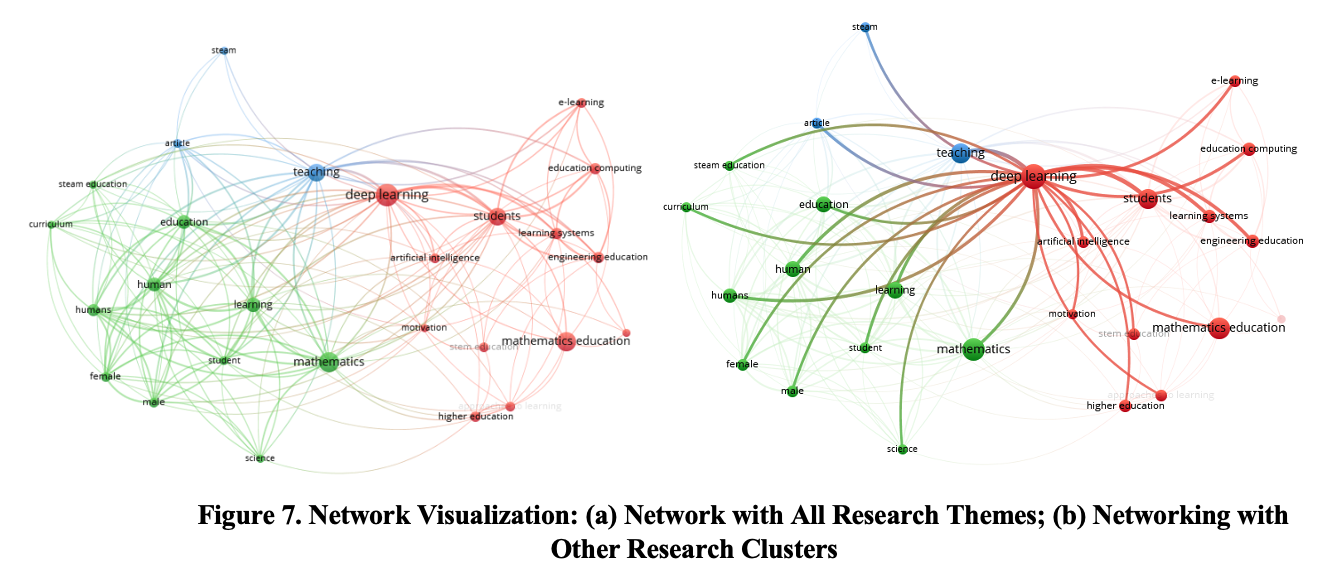
This study aims to map the research landscape of deep learning in mathematics education using bibliometric mapping based on Scopus indexed data from 2011 to 2025. Using scientific mapping methods via VOSviewer and R Bibliometrix, a total of 201 publitions meeting the inclusion criteria were analyzed. To address construct validity, the study explicitly differentiates between deep learning as a computational artificial intelligence (AI) methodology and deep learning as a pedagogical concept (deep vs. surface learning), analyzing their respective representations across clusters. The findings demonstrate: (1) a rapid growth trajectory in publications, peaking at 45 articles in 2025; (2) the top contributing journals are Education Sciences, Eurasia Journal of Mathematics, Science and Technology Education, Frontiers in Psychology, International Journal of Mathematical Education in Science and Technology (5 articles each), and Educational Studies in Mathematics (4 articles); (3) Y.F. Zakariya is the most prolific author (4 articles); (4) Beijing Normal University (China) and Universitetet i Agder (Norway) are the most productive institutional affiliations; (5) the United States leads global production (61 articles), followed by China (28 articles) and Australia (16 articles), with Indonesia ranking fourth (11 articles); and (6) three primary thematic clusters were delineated: the Red Cluster (AI computational models and e learning applications), the Green Cluster (pedagogical constructs of mathematical deep learning and cognition), and the Blue Cluster (STEM/STEAM integration and instructional design). Emerging frontiers highlight the integration of generative AI at the elementary education level and cross disciplinary STEAM frameworks, offering promising avenues for future research.
Keywords
Article Details
Copyright (c) 2026 Tazkia Amalia Tazkia, Hodiyanto

This work is licensed under a Creative Commons Attribution 4.0 International License.
References
- Aktoprak, A., & Hursen, C. (2022). A bibliometric and content analysis of critical thinking in primary and secondary education. Thinking Skills and Creativity, 44, 101029. https://doi.org/10.1016/j.tsc.2022.101029
- Alnasyan, B., Basheri, M., Alassafi, M., & Alnasyan, K. (2025). Kanformer: An attention-enhanced deep learning model for predicting student performance in virtual learning en-vironments. Social Network Analysis and Mining, 15(1), 25. https://doi.org/10.1007/s13278-025-01446-7
- Börner, K., Chen, C., & Boyack, K. W. (2003). Visualizing knowledge domains. Annual Revi-ew of Information Science and Technology, 37(1), 179–255. https://doi.org/10.1002/aris.1440370106
- Bradbury, N., Smith, J., & Taylor, R. (2024). Systematic qualitative synthesis in bibliometric studies using the PAGER framework. Journal of Educational Research Methodology, 18(2), 145–162.
- Chen, X., Zou, D., Xie, H., Cheng, G., & Liu, C. (2020). Two decades of artificial intelligence in education. Educational Technology & Society, 25(1), 28–47. https://doi.org/10.30191/ETS.202201_25(1).0003
- Ding, J. (2024). A practical study on integrating ecological education in university mathematics education in the context of deep learning. Applied Mathematics and Nonlinear Sciences, 9(1), 20230901. https://doi.org/10.2478/amns.2023.2.00901
- Donthu, N., Kumar, S., Mukherjee, D., Pandey, N., & Lim, W. M. (2021). How to conduct a bibliometric analysis: An overview and guidelines. Journal of Business Research, 133, 285–296. https://doi.org/10.1016/j.jbusres.2021.04.070
- Drijvers, P., Grauwin, S., & Trouche, L. (2020). When bibliometrics met mathematics educa-tion research: The case of instrumental orchestration. ZDM, 52(7), 1455–1469. https://doi.org/10.1007/s11858-020-01169-3
- Ellegaard, O., & Wallin, J. A. (2015). The bibliometric analysis of scholarly production: How great is the impact? Scientometrics, 105(3), 1809–1831. https://doi.org/10.1007/s11192-015-1645-z
- Fitch, A. L., Iu, H. H. C., & Lu, D. D. C. (2011). An Analog Computer for Electronic Engine-ering Education. IEEE Transactions on Education, 54(4), 550–557. https://doi.org/10.1109/TE.2010.2090350
- Granberg, C., Palm, T., & Palmberg, B. (2021). A case study of a formative assessment practi-ce and the effects on students’ self-regulated learning. Studies in Educational Evalua-tion, 68, 100955. https://doi.org/10.1016/j.stueduc.2020.100955
- Guo, H., Johnson, M., Ercikan, K., Saldivia, L., & Worthington, M. (2024). Large-Scale As-sessments for Learning: A Human-Centred AI Approach to Contextualizing Test Per-formance. Journal of Learning Analytics, 11(2), 229–245. https://doi.org/10.18608/jla.2024.8007
- Ha, C. T., Thao, T. T. P., Trung, N. T., Huong, L. T. T., Dinh, N. V., & Trung, T. (2020). A bibliometric review of research on STEM education in ASEAN: Science mapping the literature in Scopus database, 2000 to 2019. Eurasia Journal of Mathematics, Science and Technology Education, 16(10), em1889. https://doi.org/10.29333/ejmste/8500
- Hallinger, P., & Kovačević, J. (2019). A bibliometric review of research on educational admi-nistration: Science mapping the literature, 1960 to 2018. Review of Educational Rese-arch, 89(3), 335–369. https://doi.org/10.3102/0034654319830380
- Hammadi, S. S., Majeed, B. H., & Hassan, A. K. (2023). Impact of deep learning strategy in mathematics achievement and practical intelligence among high school students. Inter-national Journal of Emerging Technologies in Learning, 18(4), 32–48. https://doi.org/10.3991/ijet.v18i04.36
- Hodiyanto, H., Heryadi, Y., & Hidayat, A. (2025). A bibliometric analysis of abstraction in mathematics education using Scopus database from 2008 to 2022. Eurasia Journal of Mathematics, Science and Technology Education, 21(1), em2557. https://doi.org/10.29333/ejmste/15530
- Huan, N. T., Ha, C. T., Tuyen, B. T., Thao, T. T. P., Huong, L. T. T., Trung, T., & Anh, N. T. (2022). Research on mathematics education in Southeast Asia: A bibliometric review from Scopus database. Journal on Mathematics Education, 13(3), 393–420. https://doi.org/10.22342/jme.v13i3.pp393-420
- Hwang, G.-J., & Tu, Y.-F. (2021). Roles and research trends of artificial intelligence in ma-thematics education: A bibliometric mapping analysis and systematic review. Mathema-tics, 9(6), 584. https://doi.org/10.3390/math9060584
- Julius, R., Halim, M. S. A., Hadi, N. A., Alias, A. N., Khalid, M. H. M., Mahfodz, Z., & Ramli, F. F. (2021). Bibliometric analysis of research in mathematics education using Scopus database. Eurasia Journal of Mathematics, Science and Technology Education, 17(12), em2040. https://doi.org/10.29333/EJMSTE/11329
- Kadarisma, G., Juandi, D., & Darhim, D. (2024). Global trends in flipped classroom research within mathematics education over past two decade: A bibliometric analysis. Infinity Journal, 13(2), 531–552. https://doi.org/10.22460/infinity.v13i2.p531-552
- Kartika, H., Budiarto, M. T., Fuad, Y., & Bonyah, E. (2023). Bibliometrics analysis of rese-arch on argumentation in mathematics education. International Journal of Education in Mathematics, Science and Technology, 11(5), 1346–1365. https://doi.org/10.46328/ijemst.2904
- LeCun, Y., Bengio, Y., & Hinton, G. (2015). Deep learning. Nature, 521(7553), 436–444. https://doi.org/10.1038/nature14539
- Linnenluecke, M. K., Marrone, M., & Singh, A. K. (2020). Conducting systematic literature reviews and bibliometric analyses. Australian Journal of Management, 45(2), 175–194. https://doi.org/10.1177/0312896219877678
- Liu, X., Zhan, F. B., Hong, S., Niu, B., & Liu, Y. (2013). Replies to comments on “a bibliome-tric study of earthquake research: 1900–2010.” Scientometrics, 96(3), 933–936. https://doi.org/10.1007/s11192-012-0914-3
- Mathankar, A. R. (2018). Bibliometrics: An overview. International Journal of Library & In-formation Science (IJLIS), 7(3), 9–15.
- Moral-Muñoz, J. A., Herrera-Viedma, E., Santisteban-Espejo, A., & Cobo, M. J. (2020). Sof-tware tools for conducting bibliometric analysis in science: An up-to-date review. El Profesional de La Información, 29(1), e290103. https://doi.org/10.3145/epi.2020.ene.03
- Phan, T. T., Do, T. T., Trinh, T. H., Tran, T., Duong, H. T., Trinh, T. P. T., Do, B. C., & Ngu-yen, T.-T. (2022). A bibliometric review on realistic mathematics education in Scopus database between 1972–2019. European Journal of Educational Research, 11(2), 1133–1149. https://doi.org/10.12973/eu-jer.11.2.1133
- Qiao, Y., & Fu, H. (2022). Study on OBE Teaching Concept in the Context of Deep Learning for the Construction of University Mathematics Microcourses. Computational Intelli-gence and Neuroscience, 2022, 1–10. https://doi.org/10.1155/2022/6860842
- Qiu, Y., & Ishak, N. A. (2025). AI-Assisting Technology and Social Support in Enhancing Deep Learning and Self-Efficacy among Primary School Students in Mathematics in China. International Journal of Learning, Teaching and Educational Research, 24(2), 21–37. https://doi.org/10.26803/ijlter.24.2.2
- Qu, G., Hu, W., Jiao, W., & Jin, J. (2021). Application of Deep Learning-Based Integrated Trial-Error + Science, Technology, Reading/Writing, Engineer, Arts, Mathematics Tea-ching Mode in College Entrepreneurship Education. Frontiers in Psychology, 12, 739362. https://doi.org/10.3389/fpsyg.2021.739362
- Saefudin, A. A., Wijaya, A., & Dwiningrum, S. I. A. (2023). Mapping research trends in ma-thematical creativity in mathematical instructional practices: A bibliometric analysis. Journal of Pedagogical Research, 7(4), 439–458. https://doi.org/10.33902/JPR.202322691
- Sánchez-Álvarez, I., Zambrano-Valdivieso, Ó. D., & Berrios-Aguayo, B. (2022). Bibliometric analysis of STEAM education research: Current status and emerging trends. Education Sciences, 12(4), 254. https://doi.org/10.3390/educsci12040254
- Stålne, K., Weurlander, M., & Andersson, R. (2021). Students’ experiences of deep learning in a higher education course – A qualitative analysis. Higher Education, 82(3), 499–514. https://doi.org/10.1007/s10734-020-00641-3
- Suseelan, M., Chew, C. M., & Chin, H. (2022). Research on mathematics problem solving in elementary education conducted from 1969 to 2021: A bibliometric review. Internatio-nal Journal of Education in Mathematics, Science and Technology, 10(4), 1003–1029. https://doi.org/10.46328/ijemst.2198
- Van de Walle, J. A., Karp, K. S., & Bay-Williams, J. M. (2019). Elementary and middle scho-ol mathematics: Teaching developmentally (10th ed.). Pearson.
- van Eck, N. J., & Waltman, L. (2022). VOSviewer manual. Universiteit Leiden. https://www.vosviewer.com/documentation/Manual_VOSviewer_1.6.18.pdf
- Winje, Ø., & Løndal, K. (2020). Bringing deep learning to the surface: A systematic mapping review of 48 years of research in primary and secondary education. Nordic Journal of Comparative and International Education (NJCIE), 4(2), 25–41. https://doi.org/10.7577/njcie.3798
- Xu, S., & Pan, C. (2024). Deep learning algorithm-oriented blended teaching in secondary school mathematics courses in ethnic areas. Applied Mathematics and Nonlinear Scien-ces, 9(1), 20230727. https://doi.org/10.2478/amns.2023.2.00727
- Zawacki-Richter, O., Marín, V. I., Bond, M., & Gouverneur, F. (2019). Systematic review of research on artificial intelligence applications in higher education – Where are the edu-cators? International Journal of Educational Technology in Higher Education, 16(1), 39. https://doi.org/10.1186/s41239-019-0171-0
- Zhao, D., Li, H., Xu, A., & Song, T. (2022). Psychological Mobilization of Innovative Tea-ching Methods for Students’ Basic Educational Curriculum Reform Under Deep Lear-ning. Frontiers in Psychology, 13, 843493. https://doi.org/10.3389/fpsyg.2022.843493
- Zupic, I., & Čater, T. (2015). Bibliometric methods in management and organization. Organi-zational Research Methods, 18(3), 429–472. https://doi.org/10.1177/1094428114562629
References
Aktoprak, A., & Hursen, C. (2022). A bibliometric and content analysis of critical thinking in primary and secondary education. Thinking Skills and Creativity, 44, 101029. https://doi.org/10.1016/j.tsc.2022.101029
Alnasyan, B., Basheri, M., Alassafi, M., & Alnasyan, K. (2025). Kanformer: An attention-enhanced deep learning model for predicting student performance in virtual learning en-vironments. Social Network Analysis and Mining, 15(1), 25. https://doi.org/10.1007/s13278-025-01446-7
Börner, K., Chen, C., & Boyack, K. W. (2003). Visualizing knowledge domains. Annual Revi-ew of Information Science and Technology, 37(1), 179–255. https://doi.org/10.1002/aris.1440370106
Bradbury, N., Smith, J., & Taylor, R. (2024). Systematic qualitative synthesis in bibliometric studies using the PAGER framework. Journal of Educational Research Methodology, 18(2), 145–162.
Chen, X., Zou, D., Xie, H., Cheng, G., & Liu, C. (2020). Two decades of artificial intelligence in education. Educational Technology & Society, 25(1), 28–47. https://doi.org/10.30191/ETS.202201_25(1).0003
Ding, J. (2024). A practical study on integrating ecological education in university mathematics education in the context of deep learning. Applied Mathematics and Nonlinear Sciences, 9(1), 20230901. https://doi.org/10.2478/amns.2023.2.00901
Donthu, N., Kumar, S., Mukherjee, D., Pandey, N., & Lim, W. M. (2021). How to conduct a bibliometric analysis: An overview and guidelines. Journal of Business Research, 133, 285–296. https://doi.org/10.1016/j.jbusres.2021.04.070
Drijvers, P., Grauwin, S., & Trouche, L. (2020). When bibliometrics met mathematics educa-tion research: The case of instrumental orchestration. ZDM, 52(7), 1455–1469. https://doi.org/10.1007/s11858-020-01169-3
Ellegaard, O., & Wallin, J. A. (2015). The bibliometric analysis of scholarly production: How great is the impact? Scientometrics, 105(3), 1809–1831. https://doi.org/10.1007/s11192-015-1645-z
Fitch, A. L., Iu, H. H. C., & Lu, D. D. C. (2011). An Analog Computer for Electronic Engine-ering Education. IEEE Transactions on Education, 54(4), 550–557. https://doi.org/10.1109/TE.2010.2090350
Granberg, C., Palm, T., & Palmberg, B. (2021). A case study of a formative assessment practi-ce and the effects on students’ self-regulated learning. Studies in Educational Evalua-tion, 68, 100955. https://doi.org/10.1016/j.stueduc.2020.100955
Guo, H., Johnson, M., Ercikan, K., Saldivia, L., & Worthington, M. (2024). Large-Scale As-sessments for Learning: A Human-Centred AI Approach to Contextualizing Test Per-formance. Journal of Learning Analytics, 11(2), 229–245. https://doi.org/10.18608/jla.2024.8007
Ha, C. T., Thao, T. T. P., Trung, N. T., Huong, L. T. T., Dinh, N. V., & Trung, T. (2020). A bibliometric review of research on STEM education in ASEAN: Science mapping the literature in Scopus database, 2000 to 2019. Eurasia Journal of Mathematics, Science and Technology Education, 16(10), em1889. https://doi.org/10.29333/ejmste/8500
Hallinger, P., & Kovačević, J. (2019). A bibliometric review of research on educational admi-nistration: Science mapping the literature, 1960 to 2018. Review of Educational Rese-arch, 89(3), 335–369. https://doi.org/10.3102/0034654319830380
Hammadi, S. S., Majeed, B. H., & Hassan, A. K. (2023). Impact of deep learning strategy in mathematics achievement and practical intelligence among high school students. Inter-national Journal of Emerging Technologies in Learning, 18(4), 32–48. https://doi.org/10.3991/ijet.v18i04.36
Hodiyanto, H., Heryadi, Y., & Hidayat, A. (2025). A bibliometric analysis of abstraction in mathematics education using Scopus database from 2008 to 2022. Eurasia Journal of Mathematics, Science and Technology Education, 21(1), em2557. https://doi.org/10.29333/ejmste/15530
Huan, N. T., Ha, C. T., Tuyen, B. T., Thao, T. T. P., Huong, L. T. T., Trung, T., & Anh, N. T. (2022). Research on mathematics education in Southeast Asia: A bibliometric review from Scopus database. Journal on Mathematics Education, 13(3), 393–420. https://doi.org/10.22342/jme.v13i3.pp393-420
Hwang, G.-J., & Tu, Y.-F. (2021). Roles and research trends of artificial intelligence in ma-thematics education: A bibliometric mapping analysis and systematic review. Mathema-tics, 9(6), 584. https://doi.org/10.3390/math9060584
Julius, R., Halim, M. S. A., Hadi, N. A., Alias, A. N., Khalid, M. H. M., Mahfodz, Z., & Ramli, F. F. (2021). Bibliometric analysis of research in mathematics education using Scopus database. Eurasia Journal of Mathematics, Science and Technology Education, 17(12), em2040. https://doi.org/10.29333/EJMSTE/11329
Kadarisma, G., Juandi, D., & Darhim, D. (2024). Global trends in flipped classroom research within mathematics education over past two decade: A bibliometric analysis. Infinity Journal, 13(2), 531–552. https://doi.org/10.22460/infinity.v13i2.p531-552
Kartika, H., Budiarto, M. T., Fuad, Y., & Bonyah, E. (2023). Bibliometrics analysis of rese-arch on argumentation in mathematics education. International Journal of Education in Mathematics, Science and Technology, 11(5), 1346–1365. https://doi.org/10.46328/ijemst.2904
LeCun, Y., Bengio, Y., & Hinton, G. (2015). Deep learning. Nature, 521(7553), 436–444. https://doi.org/10.1038/nature14539
Linnenluecke, M. K., Marrone, M., & Singh, A. K. (2020). Conducting systematic literature reviews and bibliometric analyses. Australian Journal of Management, 45(2), 175–194. https://doi.org/10.1177/0312896219877678
Liu, X., Zhan, F. B., Hong, S., Niu, B., & Liu, Y. (2013). Replies to comments on “a bibliome-tric study of earthquake research: 1900–2010.” Scientometrics, 96(3), 933–936. https://doi.org/10.1007/s11192-012-0914-3
Mathankar, A. R. (2018). Bibliometrics: An overview. International Journal of Library & In-formation Science (IJLIS), 7(3), 9–15.
Moral-Muñoz, J. A., Herrera-Viedma, E., Santisteban-Espejo, A., & Cobo, M. J. (2020). Sof-tware tools for conducting bibliometric analysis in science: An up-to-date review. El Profesional de La Información, 29(1), e290103. https://doi.org/10.3145/epi.2020.ene.03
Phan, T. T., Do, T. T., Trinh, T. H., Tran, T., Duong, H. T., Trinh, T. P. T., Do, B. C., & Ngu-yen, T.-T. (2022). A bibliometric review on realistic mathematics education in Scopus database between 1972–2019. European Journal of Educational Research, 11(2), 1133–1149. https://doi.org/10.12973/eu-jer.11.2.1133
Qiao, Y., & Fu, H. (2022). Study on OBE Teaching Concept in the Context of Deep Learning for the Construction of University Mathematics Microcourses. Computational Intelli-gence and Neuroscience, 2022, 1–10. https://doi.org/10.1155/2022/6860842
Qiu, Y., & Ishak, N. A. (2025). AI-Assisting Technology and Social Support in Enhancing Deep Learning and Self-Efficacy among Primary School Students in Mathematics in China. International Journal of Learning, Teaching and Educational Research, 24(2), 21–37. https://doi.org/10.26803/ijlter.24.2.2
Qu, G., Hu, W., Jiao, W., & Jin, J. (2021). Application of Deep Learning-Based Integrated Trial-Error + Science, Technology, Reading/Writing, Engineer, Arts, Mathematics Tea-ching Mode in College Entrepreneurship Education. Frontiers in Psychology, 12, 739362. https://doi.org/10.3389/fpsyg.2021.739362
Saefudin, A. A., Wijaya, A., & Dwiningrum, S. I. A. (2023). Mapping research trends in ma-thematical creativity in mathematical instructional practices: A bibliometric analysis. Journal of Pedagogical Research, 7(4), 439–458. https://doi.org/10.33902/JPR.202322691
Sánchez-Álvarez, I., Zambrano-Valdivieso, Ó. D., & Berrios-Aguayo, B. (2022). Bibliometric analysis of STEAM education research: Current status and emerging trends. Education Sciences, 12(4), 254. https://doi.org/10.3390/educsci12040254
Stålne, K., Weurlander, M., & Andersson, R. (2021). Students’ experiences of deep learning in a higher education course – A qualitative analysis. Higher Education, 82(3), 499–514. https://doi.org/10.1007/s10734-020-00641-3
Suseelan, M., Chew, C. M., & Chin, H. (2022). Research on mathematics problem solving in elementary education conducted from 1969 to 2021: A bibliometric review. Internatio-nal Journal of Education in Mathematics, Science and Technology, 10(4), 1003–1029. https://doi.org/10.46328/ijemst.2198
Van de Walle, J. A., Karp, K. S., & Bay-Williams, J. M. (2019). Elementary and middle scho-ol mathematics: Teaching developmentally (10th ed.). Pearson.
van Eck, N. J., & Waltman, L. (2022). VOSviewer manual. Universiteit Leiden. https://www.vosviewer.com/documentation/Manual_VOSviewer_1.6.18.pdf
Winje, Ø., & Løndal, K. (2020). Bringing deep learning to the surface: A systematic mapping review of 48 years of research in primary and secondary education. Nordic Journal of Comparative and International Education (NJCIE), 4(2), 25–41. https://doi.org/10.7577/njcie.3798
Xu, S., & Pan, C. (2024). Deep learning algorithm-oriented blended teaching in secondary school mathematics courses in ethnic areas. Applied Mathematics and Nonlinear Scien-ces, 9(1), 20230727. https://doi.org/10.2478/amns.2023.2.00727
Zawacki-Richter, O., Marín, V. I., Bond, M., & Gouverneur, F. (2019). Systematic review of research on artificial intelligence applications in higher education – Where are the edu-cators? International Journal of Educational Technology in Higher Education, 16(1), 39. https://doi.org/10.1186/s41239-019-0171-0
Zhao, D., Li, H., Xu, A., & Song, T. (2022). Psychological Mobilization of Innovative Tea-ching Methods for Students’ Basic Educational Curriculum Reform Under Deep Lear-ning. Frontiers in Psychology, 13, 843493. https://doi.org/10.3389/fpsyg.2022.843493
Zupic, I., & Čater, T. (2015). Bibliometric methods in management and organization. Organi-zational Research Methods, 18(3), 429–472. https://doi.org/10.1177/1094428114562629