

Article Sidebar
Downloads
Main Article Content
Abstract
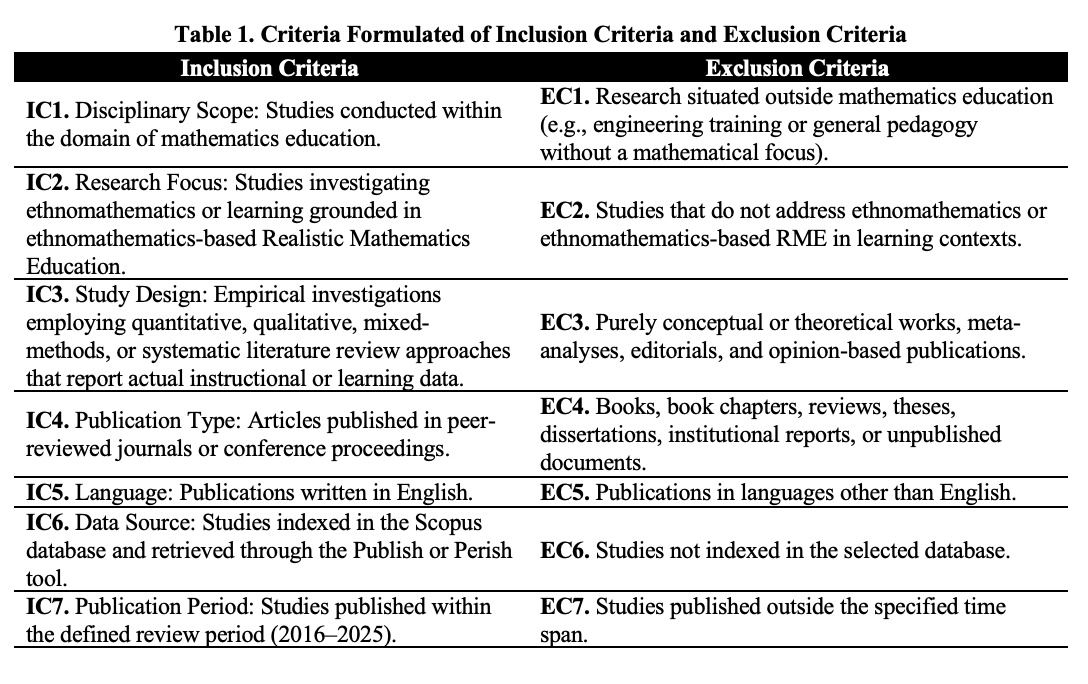
Research on ethnomathematics-based Realistic Mathematics Education (Ethno-RME) has grown significantly in recent years, particularly in relation to its potential to support meaningful and culturally grounded mathematics learning. However, there remains limited systematic understanding of how multiple mathematical representations function within this framework, especially in facilitating representational transitions and conceptual understanding. This study aims to synthesize and analyze research on Multiple Mathematical Representations (MMR) within Ethno-RME through a Systematic Literature Review. The review identifies the types of representations employed, their roles in the mathematization process, and their contributions to mathematics learning outcomes. A systematic procedure consisting of planning, conducting, and reporting stages was implemented. Articles were retrieved from the Scopus database using the Publish or Perish tool and selected based on predefined inclusion and exclusion criteria, resulting in ten eligible peer-reviewed studies published between 2016 and 2025. The findings indicate that Ethno-RME consistently promotes the development and coordination of multiple representations, including visual, symbolic, verbal, contextual, and technological forms. Cultural contexts function as meaningful entry points that initiate representational construction and facilitate the transition from informal situational models to formal mathematical abstraction through progressive mathematization. The synthesis further reveals that representational coordination enhances conceptual understanding, problem-solving ability, numeracy skills, creativity, and higher-order thinking. Moreover, mathematical representation emerges as a bridging role linking contextual experience and formal reasoning. Overall, this review establishes that multiple mathematical representations constitute a foundational mechanism within ethnomathematics-based RME, supporting meaningful, culturally grounded, and conceptually robust mathematics learning.
Keywords
Article Details
Copyright (c) 2026 Rini Setianingsih, Mochammad Reval Ardhi Yudi Prayogo, Alvinna Mei Yunia Putri

This work is licensed under a Creative Commons Attribution 4.0 International License.
References
- Abdullah, Ahmad Anis, Rino Richardo, Muhammad Najib Mubarok, and Widya Sekar Bayu. 2025. “Ethnomathematics: Mathematical Activities of Hand-Drawn Batik Craf-tsmen Community in Giriloyo Yogyakarta, Indonesia.” The Journal of Education Cul-ture and Society 1.
- Ahmar, Dewi Satria, and Muhammad Fath Azzajjad. 2025. “Multiple Representation Strate-gy through Team-Based Representational Activities with Creative Exploration via Le-arning through Video on Cell Fundamentals.” Daengku: Journal of Humanities and Social Sciences Innovation 5(2):299–309. https://doi.org/10.35877/454RI.daengku3906
- Ainsworth, Shaaron. 1999. “The Functions of Multiple Presentations.” Computer & Educa-tion 33(2–3):131–52. https://doi.org/10.1016/S0360-1315(99)00029-9
- Alim, Jesi Alexander, Ahmad Fauzan, I. Made Arwana, and Edwin Musdi. 2020. “Model of Geometry Realistic Learning Development with Interactive Multimedia Assistance in Elementary School.” Journal of Physics: Conference Series 1471(1):012053. https://doi.org/10.1088/1742-6596/1471/1/012053
- Alyanak, Mehmet, and Ali Özkaya. 2026. “Socio-Economic Challenges in Education: Short Film Designs Utilizing a Realistic Mathematics Education Approach.” International Journal of Science and Mathematics Education 24(1):3. https://doi.org/10.1007/s10763-025-10623-1
- Andzin, Nadya Syifa, Putri Yulia Puspita Sari, Ridwan Cahyo Widodo, Dinda Iren Sukowa-ti, Sabrina Indriastuti, and Farida Nursyahidah. 2024. “Arithmetic Sequences and Se-ries Learning Using Realistic Mathematics Education Assisted by Augmented Rea-lity.” Jurnal Pendidikan Matematika 18(1):139–48. https://doi.org/10.22342/jpm.v18i1.pp139-148
- Anriana, Rena, Gustimal Witri, Zetra Hainul Putra, Muhammad Fendrik, Dahnilsyah, and Ayman Aljarrah. 2023. “Ethnomathematics Study in Measurement of Bengkalis Ma-lay Community as Mathematics Resouurces for Elementary School.” Ethnography and Education 299–322.
- Ayeh, Isaac Gyan. 2025. “Students’ Mathematics Conceptual Challenges: Exploring Stu-dents’ Thinking, Understanding, and Misconceptions in Functions and Graphs.” Eu-ropean Journal of Science and Mathematics Education 13(3):191–206. https://doi.org/10.30935/scimath/16596
- Bicer, Ali. 2021. “Multiple Representations and Mathematical Creativity.” Thinking Skills and Creativity 47. https://doi.org/10.1016/j.tsc.2021.100960
- Cesaria, Anna, Dewi Yuliana Fitri, and Wahyudi Rahmat. 2022. “Ethnomathematic Explora-tion based on Realistic Mathematics Education (RME) in the Traditional Game ‘Lo-re.’” AKSIOMA: Jurnal Program Studi Pendidikan Matematika 11(2). https://doi.org/10.24127/ajpm.v11i2.4958
- Divis, Danielle, Beth L. MacDonald, Beth L. MacDonald, and Katherine N. Vela. 2025. “Mathematics Students’ Translations With Music as a Contextual Representation.” School Science and Mathematics. https://doi.org/10.1111/ssm.18366
- Dreher, Anika, Ting-Ying Wang, Paul Feltes, Feng-Jui Hsieh, and Anke Lindmeier. 2024. “High-Quality Use of Representations in the Mathematics Classroom – a Matter of the Cultural Perspective?” ZDM – Mathematics Education 56(5):965–80.
- https://doi.org/10.1007/s11858-024-01597-5
- Ernie, Kathryn, Rebecca LeDocq, Sherrie Serros, and Simei Tong. 2023. MATHEMATICAL REASONING Challenging Students’ Beliefs about Mathematics. 1st ed. New York: Routledge.
- Fajri, Hadrian Mei, Arita Marini, and Suyono. 2025. “Trends and Patterns in Realistic Ma-thematics Education Research in Elementary Schools: A Bibliometric Approach.” So-cial Sciences & Humanities Open 12:101730. https://doi.org/10.1016/j.ssaho.2025.101730
- Febrian, Febrian, and Puji Astuti. 2018. “The RME Principles on Geometry Learning with Focus of Transformation Reasoning through Exploration on Malay Woven Motif.” Journal of Turkish Science Education.
- Fitria, Wenny, Rudi Susilana, Nanang Priatna, and Rusman. 2025. “Investigation of the Im-pact Online Single and Multiple Representation Scaffolding on Mathematical Concept Mastery and Mathematical Problem-Solving Skill.” Journal on Mathematics Educa-tion 16(2):709–28. https://doi.org/10.22342/jme.v16i2.pp709-728
- Fredriksen, Helge. 2020. “Exploring Realistic Mathematics Education in a Flipped Classro-om Context at the Tertiary Level.” International Journal of Science and Mathematics Education 19(2):377–96. https://doi.org/10.1007/s10763-020-10053-1
- Freudenthal, Hans. 2002. Revisiting Mathematics Education. Vol. 9.
- Gebremeskel, Alemayehu Anbess, Mulugeta Atnafu Ayele, and Tadele Ejigu Wondimuneh. 2025. “Student Engagement, Conceptual-Understanding, and Problem-Solving Ability in Learning Plane Geometry through an Integrated Instructional Approach.” Eurasia Journal of Mathematics, Science and Technology Education 21(5):em2634.
- https://doi.org/10.29333/ejmste/16391
- Hadi, Sutarto, Maarten Dolk, Kamaliyah, and Taufiq Hidayanto. 2025. “Mathematical Reas-oning: How Students Learn Mathematics?” Journal on Mathematics Education 16(3):937–54. https://doi.org/10.22342/jme.v16i3.pp937-954
- Heuvel-Panhuizen, Marja Van den, and Paul Drijvers. 2020. Encyclopedia of Mathematics Education. Cham: Springer International Publishing.
- Jäder, Jonas, and Helena Johansson. 2025. “Exploring Students’ Conceptual Understanding through Mathematical Problem Solving: Students’ Use of and Shift between Different Representations of Rational Numbers.” Research in Mathematics Education 1–18. https://doi.org/10.1080/14794802.2025.2456840
- Kang, Rui, and Di Liu. 2018. “The Importance of Multiple Representations of Mathematical Problems: Evidence from Chinese Preservice Elementary Teachers’ Analysis of a Le-arning Goal.” International Journal of Science and Mathematics Education 16(1):125–43. https://doi.org/10.1007/s10763-016-9760-8
- Kartini, Nuraini, Heri Retnawati, and Elly Arliani. 2025. “The Effectiveness Of Realistic Mathematics Education (RME) Assisted By GeoGebra On Students’ Mathematical Li-teracy.” International Journal of Multicultural and Multireligious Understanding 12(9):39–50. https://dx.doi.org/10.18415/ijmmu.v12i9.6998
- Mainali, Bhesh. 2020. “Representation in Teaching and Learning Mathematics.” Internatio-nal Journal of Education in Mathematics, Science and Technology 9(1):1–21. https://doi.org/10.46328/ijemst.1111
- Muhammad, Iryana, Dadang Juandi, and Al Jupri. 2025. “Implementation of Ethnomathe-matics Realistic Mathematic Education (Ethno-RME) in Mathematics Learning: Sys-tematic Literature Review (SLR).” in AIP Conference Proceedings. Vol. 3142.
- Nursyahidah, Farida, Wardono, Scolastika Mariani, and Kristina Wijayanti. 2025. “Integra-ting Technology, Javanese Ethnomathematics, and Realistic Mathematics Education in Supporting Prospective Mathematics Teachers’ Numeracy Skills: A Learning Trajec-tory.” Journal on Mathematics Education 16(2):671–88. https://doi.org/10.22342/jme.v16i2.pp671-688
- Nursyahidah, Farida, Wardono Wardono, Scolastika Mariani, and Kristina Wijayanti. 2025. “Integrating Technology, Ethnomathematics, and Realistic Mathematics Education in Learning Statistics: A Learning Trajectory.” Infinity Journal 14(3):633–54. https://doi.org/10.22460/infinity.v14i3.p633-654
- Ott, Natalie, Roland Brünken, Markus Vogel, and Sarah Malone. 2018. “Multiple Symbolic Representations: The Combination of Formula and Text Supports Problem Solving in the Mathematical Field of Propositional Logic.” Learning and Instruction 58:88–105. https://doi.org/10.1016/j.learninstruc.2018.04.010
- Putri, Amellia, Imam Sujadi, Yuli Bangun Nursanti, and Farida Nurhasanah. 2025. “Syste-matic Literature Review on Mathematical Representation: The Connection between Theories and Implementation.” 01(01).
- Rittle-Johnson, Bethany, and Robert S. Siegler. 1998. “The Relation between Conceptual and Procedural Knowledge in Learning Mathematics: A Review.” in The Development of Mathematical Skills.
- Rosa, Milton, Ubiratan D’Ambrosio, Daniel Clark Orey, Lawrence Shirley, Wilfredo V. Alangui, Pedro Palhares, and Maria Elena Gavarrete. 2016. Current and Future Pers-pectives of Ethnomathematics as a Program. ICME-13 Topical Surveys. Cham: Sprin-ger International Publishing.
- Santosa, Yoga Tegar, Mutiara Hisda Mahmudah, Devi Yulindra, and Akbar Waliyuddin. 2026. “Reflective Thinking and Self-Efficacy: A Meta-Analysis and Its Implica- Tions for Mathematics Learning.” 1(1).
- Sari, Yurizka Melia, Shofan Fiangga, Yulia Izza El Milla, Masitah Shahrill, and Liza Puspita Yanti. 2025. “Prospective Teachers’ Iceberg Designs in Realistic Mathematics Educa-tion Approach: Connecting Mathematics and the SDGs.” Journal on Mathematics Education 16(3):981–1000. https://doi.org/10.22342/jme.v16i3.pp981-1000
- Savard, Annie. 2020. “What Did They Have to Say about Money and Finance? Grade 4 Students’ Representations about Financial Concepts When Learning Mathematics.” Education 3-13 50(3):316–28. https://doi.org/10.1080/03004279.2020.1850826
- Sunzuma, Gladys, and Aneshkumar Maharaj. 2020. “In-Service Zimbabwean Teachers’ Obstacles in Integrating Ethnomathematics Approaches into the Teaching and Lear-ning of Geometry.” Journal of Curriculum Studies 53(5):601–20.
- https://doi.org/10.1080/00220272.2020.1825820
- Utomo, Dwi Priyo, and Dita Latifatu Syarifah. 2021. “Challenging Students’ Beliefs about Mathematics.” International Journal of Education in Mathematics, Science, and Technology (IJEMST) 9(3):540–56. https://doi.org/10.46328/ijemst.1685
- Wahyuningrum, Endang, Sudirman Sudirman, and Camilo Andrés Rodríguez-Nieto. 2025. “Geometry from Coastal Life: A Grounded Theory of Primary Students’ 3D Geome-try Understanding in Northern Coastal West Java.” Journal of Advanced Sciences and Mathematics Education 5(2):281–99. https://doi.org/10.58524/jasme.v5i2.813
- Xiao, Yu, and Maria Watson. 2017. “Guidance on Conducting a Systematic Literature Revi-ew.” Journal of Planning Education and Research 39(1).
- https://doi.org/10.1177/0739456X17723971
- Yuanita, Putri, Hutkemri Zulnaidi, and Effandi Zakaria. 2018. “The Effectiveness of Realis-tic Mathematics Education Approach: The Role of Mathematical Representation as Mediator between Mathematical Belief and Problem Solving” edited by C. E. King. PLOS ONE 13(9):e0204847. https://doi.org/10.1371/journal.pone.0204847
References
Abdullah, Ahmad Anis, Rino Richardo, Muhammad Najib Mubarok, and Widya Sekar Bayu. 2025. “Ethnomathematics: Mathematical Activities of Hand-Drawn Batik Craf-tsmen Community in Giriloyo Yogyakarta, Indonesia.” The Journal of Education Cul-ture and Society 1.
Ahmar, Dewi Satria, and Muhammad Fath Azzajjad. 2025. “Multiple Representation Strate-gy through Team-Based Representational Activities with Creative Exploration via Le-arning through Video on Cell Fundamentals.” Daengku: Journal of Humanities and Social Sciences Innovation 5(2):299–309. https://doi.org/10.35877/454RI.daengku3906
Ainsworth, Shaaron. 1999. “The Functions of Multiple Presentations.” Computer & Educa-tion 33(2–3):131–52. https://doi.org/10.1016/S0360-1315(99)00029-9
Alim, Jesi Alexander, Ahmad Fauzan, I. Made Arwana, and Edwin Musdi. 2020. “Model of Geometry Realistic Learning Development with Interactive Multimedia Assistance in Elementary School.” Journal of Physics: Conference Series 1471(1):012053. https://doi.org/10.1088/1742-6596/1471/1/012053
Alyanak, Mehmet, and Ali Özkaya. 2026. “Socio-Economic Challenges in Education: Short Film Designs Utilizing a Realistic Mathematics Education Approach.” International Journal of Science and Mathematics Education 24(1):3. https://doi.org/10.1007/s10763-025-10623-1
Andzin, Nadya Syifa, Putri Yulia Puspita Sari, Ridwan Cahyo Widodo, Dinda Iren Sukowa-ti, Sabrina Indriastuti, and Farida Nursyahidah. 2024. “Arithmetic Sequences and Se-ries Learning Using Realistic Mathematics Education Assisted by Augmented Rea-lity.” Jurnal Pendidikan Matematika 18(1):139–48. https://doi.org/10.22342/jpm.v18i1.pp139-148
Anriana, Rena, Gustimal Witri, Zetra Hainul Putra, Muhammad Fendrik, Dahnilsyah, and Ayman Aljarrah. 2023. “Ethnomathematics Study in Measurement of Bengkalis Ma-lay Community as Mathematics Resouurces for Elementary School.” Ethnography and Education 299–322.
Ayeh, Isaac Gyan. 2025. “Students’ Mathematics Conceptual Challenges: Exploring Stu-dents’ Thinking, Understanding, and Misconceptions in Functions and Graphs.” Eu-ropean Journal of Science and Mathematics Education 13(3):191–206. https://doi.org/10.30935/scimath/16596
Bicer, Ali. 2021. “Multiple Representations and Mathematical Creativity.” Thinking Skills and Creativity 47. https://doi.org/10.1016/j.tsc.2021.100960
Cesaria, Anna, Dewi Yuliana Fitri, and Wahyudi Rahmat. 2022. “Ethnomathematic Explora-tion based on Realistic Mathematics Education (RME) in the Traditional Game ‘Lo-re.’” AKSIOMA: Jurnal Program Studi Pendidikan Matematika 11(2). https://doi.org/10.24127/ajpm.v11i2.4958
Divis, Danielle, Beth L. MacDonald, Beth L. MacDonald, and Katherine N. Vela. 2025. “Mathematics Students’ Translations With Music as a Contextual Representation.” School Science and Mathematics. https://doi.org/10.1111/ssm.18366
Dreher, Anika, Ting-Ying Wang, Paul Feltes, Feng-Jui Hsieh, and Anke Lindmeier. 2024. “High-Quality Use of Representations in the Mathematics Classroom – a Matter of the Cultural Perspective?” ZDM – Mathematics Education 56(5):965–80.
https://doi.org/10.1007/s11858-024-01597-5
Ernie, Kathryn, Rebecca LeDocq, Sherrie Serros, and Simei Tong. 2023. MATHEMATICAL REASONING Challenging Students’ Beliefs about Mathematics. 1st ed. New York: Routledge.
Fajri, Hadrian Mei, Arita Marini, and Suyono. 2025. “Trends and Patterns in Realistic Ma-thematics Education Research in Elementary Schools: A Bibliometric Approach.” So-cial Sciences & Humanities Open 12:101730. https://doi.org/10.1016/j.ssaho.2025.101730
Febrian, Febrian, and Puji Astuti. 2018. “The RME Principles on Geometry Learning with Focus of Transformation Reasoning through Exploration on Malay Woven Motif.” Journal of Turkish Science Education.
Fitria, Wenny, Rudi Susilana, Nanang Priatna, and Rusman. 2025. “Investigation of the Im-pact Online Single and Multiple Representation Scaffolding on Mathematical Concept Mastery and Mathematical Problem-Solving Skill.” Journal on Mathematics Educa-tion 16(2):709–28. https://doi.org/10.22342/jme.v16i2.pp709-728
Fredriksen, Helge. 2020. “Exploring Realistic Mathematics Education in a Flipped Classro-om Context at the Tertiary Level.” International Journal of Science and Mathematics Education 19(2):377–96. https://doi.org/10.1007/s10763-020-10053-1
Freudenthal, Hans. 2002. Revisiting Mathematics Education. Vol. 9.
Gebremeskel, Alemayehu Anbess, Mulugeta Atnafu Ayele, and Tadele Ejigu Wondimuneh. 2025. “Student Engagement, Conceptual-Understanding, and Problem-Solving Ability in Learning Plane Geometry through an Integrated Instructional Approach.” Eurasia Journal of Mathematics, Science and Technology Education 21(5):em2634.
https://doi.org/10.29333/ejmste/16391
Hadi, Sutarto, Maarten Dolk, Kamaliyah, and Taufiq Hidayanto. 2025. “Mathematical Reas-oning: How Students Learn Mathematics?” Journal on Mathematics Education 16(3):937–54. https://doi.org/10.22342/jme.v16i3.pp937-954
Heuvel-Panhuizen, Marja Van den, and Paul Drijvers. 2020. Encyclopedia of Mathematics Education. Cham: Springer International Publishing.
Jäder, Jonas, and Helena Johansson. 2025. “Exploring Students’ Conceptual Understanding through Mathematical Problem Solving: Students’ Use of and Shift between Different Representations of Rational Numbers.” Research in Mathematics Education 1–18. https://doi.org/10.1080/14794802.2025.2456840
Kang, Rui, and Di Liu. 2018. “The Importance of Multiple Representations of Mathematical Problems: Evidence from Chinese Preservice Elementary Teachers’ Analysis of a Le-arning Goal.” International Journal of Science and Mathematics Education 16(1):125–43. https://doi.org/10.1007/s10763-016-9760-8
Kartini, Nuraini, Heri Retnawati, and Elly Arliani. 2025. “The Effectiveness Of Realistic Mathematics Education (RME) Assisted By GeoGebra On Students’ Mathematical Li-teracy.” International Journal of Multicultural and Multireligious Understanding 12(9):39–50. https://dx.doi.org/10.18415/ijmmu.v12i9.6998
Mainali, Bhesh. 2020. “Representation in Teaching and Learning Mathematics.” Internatio-nal Journal of Education in Mathematics, Science and Technology 9(1):1–21. https://doi.org/10.46328/ijemst.1111
Muhammad, Iryana, Dadang Juandi, and Al Jupri. 2025. “Implementation of Ethnomathe-matics Realistic Mathematic Education (Ethno-RME) in Mathematics Learning: Sys-tematic Literature Review (SLR).” in AIP Conference Proceedings. Vol. 3142.
Nursyahidah, Farida, Wardono, Scolastika Mariani, and Kristina Wijayanti. 2025. “Integra-ting Technology, Javanese Ethnomathematics, and Realistic Mathematics Education in Supporting Prospective Mathematics Teachers’ Numeracy Skills: A Learning Trajec-tory.” Journal on Mathematics Education 16(2):671–88. https://doi.org/10.22342/jme.v16i2.pp671-688
Nursyahidah, Farida, Wardono Wardono, Scolastika Mariani, and Kristina Wijayanti. 2025. “Integrating Technology, Ethnomathematics, and Realistic Mathematics Education in Learning Statistics: A Learning Trajectory.” Infinity Journal 14(3):633–54. https://doi.org/10.22460/infinity.v14i3.p633-654
Ott, Natalie, Roland Brünken, Markus Vogel, and Sarah Malone. 2018. “Multiple Symbolic Representations: The Combination of Formula and Text Supports Problem Solving in the Mathematical Field of Propositional Logic.” Learning and Instruction 58:88–105. https://doi.org/10.1016/j.learninstruc.2018.04.010
Putri, Amellia, Imam Sujadi, Yuli Bangun Nursanti, and Farida Nurhasanah. 2025. “Syste-matic Literature Review on Mathematical Representation: The Connection between Theories and Implementation.” 01(01).
Rittle-Johnson, Bethany, and Robert S. Siegler. 1998. “The Relation between Conceptual and Procedural Knowledge in Learning Mathematics: A Review.” in The Development of Mathematical Skills.
Rosa, Milton, Ubiratan D’Ambrosio, Daniel Clark Orey, Lawrence Shirley, Wilfredo V. Alangui, Pedro Palhares, and Maria Elena Gavarrete. 2016. Current and Future Pers-pectives of Ethnomathematics as a Program. ICME-13 Topical Surveys. Cham: Sprin-ger International Publishing.
Santosa, Yoga Tegar, Mutiara Hisda Mahmudah, Devi Yulindra, and Akbar Waliyuddin. 2026. “Reflective Thinking and Self-Efficacy: A Meta-Analysis and Its Implica- Tions for Mathematics Learning.” 1(1).
Sari, Yurizka Melia, Shofan Fiangga, Yulia Izza El Milla, Masitah Shahrill, and Liza Puspita Yanti. 2025. “Prospective Teachers’ Iceberg Designs in Realistic Mathematics Educa-tion Approach: Connecting Mathematics and the SDGs.” Journal on Mathematics Education 16(3):981–1000. https://doi.org/10.22342/jme.v16i3.pp981-1000
Savard, Annie. 2020. “What Did They Have to Say about Money and Finance? Grade 4 Students’ Representations about Financial Concepts When Learning Mathematics.” Education 3-13 50(3):316–28. https://doi.org/10.1080/03004279.2020.1850826
Sunzuma, Gladys, and Aneshkumar Maharaj. 2020. “In-Service Zimbabwean Teachers’ Obstacles in Integrating Ethnomathematics Approaches into the Teaching and Lear-ning of Geometry.” Journal of Curriculum Studies 53(5):601–20.
https://doi.org/10.1080/00220272.2020.1825820
Utomo, Dwi Priyo, and Dita Latifatu Syarifah. 2021. “Challenging Students’ Beliefs about Mathematics.” International Journal of Education in Mathematics, Science, and Technology (IJEMST) 9(3):540–56. https://doi.org/10.46328/ijemst.1685
Wahyuningrum, Endang, Sudirman Sudirman, and Camilo Andrés Rodríguez-Nieto. 2025. “Geometry from Coastal Life: A Grounded Theory of Primary Students’ 3D Geome-try Understanding in Northern Coastal West Java.” Journal of Advanced Sciences and Mathematics Education 5(2):281–99. https://doi.org/10.58524/jasme.v5i2.813
Xiao, Yu, and Maria Watson. 2017. “Guidance on Conducting a Systematic Literature Revi-ew.” Journal of Planning Education and Research 39(1).
https://doi.org/10.1177/0739456X17723971
Yuanita, Putri, Hutkemri Zulnaidi, and Effandi Zakaria. 2018. “The Effectiveness of Realis-tic Mathematics Education Approach: The Role of Mathematical Representation as Mediator between Mathematical Belief and Problem Solving” edited by C. E. King. PLOS ONE 13(9):e0204847. https://doi.org/10.1371/journal.pone.0204847