

Article Sidebar
Downloads
Main Article Content
Abstract
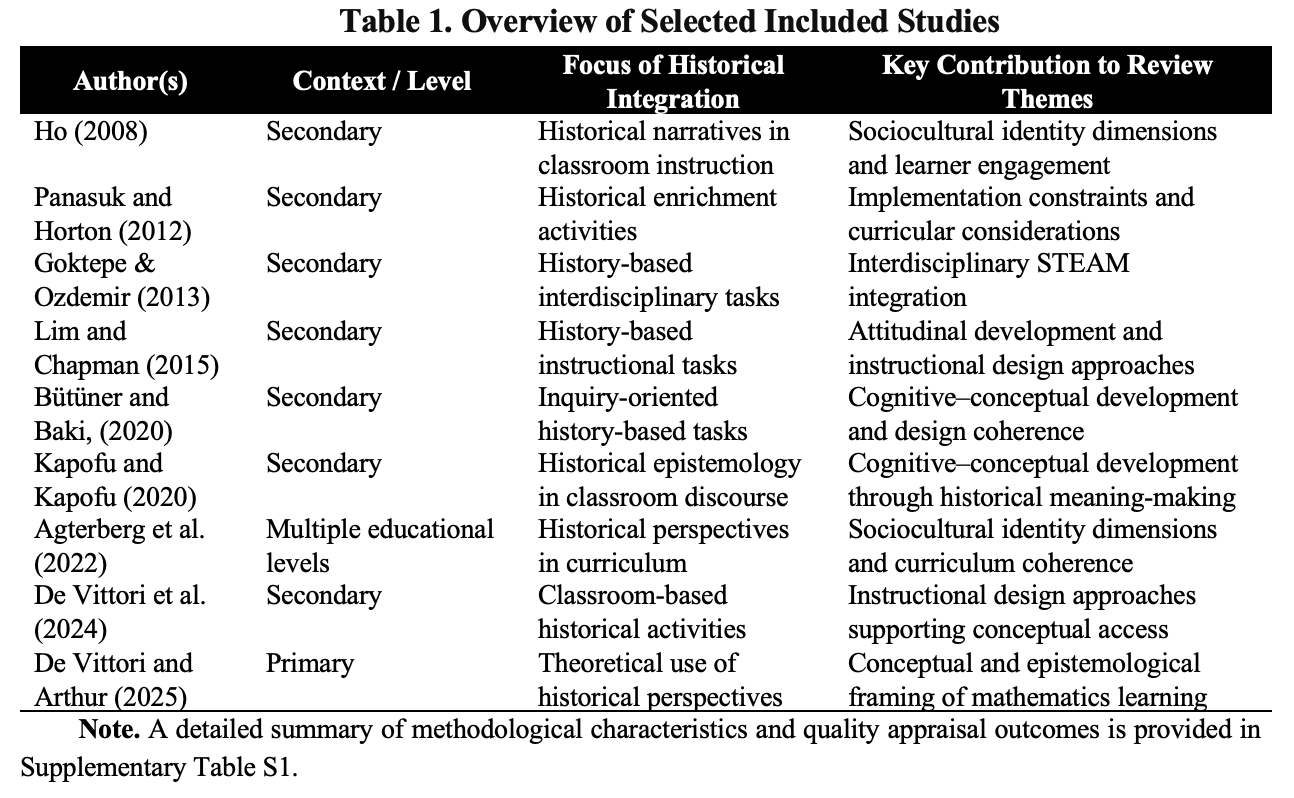
The integration of the history of mathematics (HOM) into mathematics instruction has gained increasing scholarly attention as educators seek approaches that deepen conceptual understanding, foster epistemological awareness, and situate mathematics within broader cultural and historical contexts. Despite this growing interest, findings regarding its pedagogical value, instructional design principles, and implementation challenges remain dispersed across diverse empirical studies. This study presents a descriptive systematic review of research published between 2000 and 2025 examining the integration of historical perspectives in mathematics education. Following PRISMA-style procedures, 18 empirical studies were identified through a multi-stage screening process based on predefined Thematic synthesis revealed that HOM integration contributes to cognitive–conceptual development, sociocultural identity formation, engagement and affective dimensions, and interdisciplinary connections, including evidence that historically structured tasks can support students’ understanding of foundational mathematical concepts by situating them within meaningful problem contexts. However, these benefits are mediated by instructional design coherence and are constrained by factors such as teacher preparation, curriculum pressures, and assessment alignment. The review suggests that HOM functions not merely as enrichment content but as a pedagogical lens capable of reshaping how mathematical knowledge and learning are conceptualised. Effective implementation therefore requires principled instructional design and systemic support across curriculum, teacher education, and assessment structures.
Keywords
Article Details
Copyright (c) 2026 Yijing Chen, Associate Professor Dr Masitah Shahrill, Dr Nor Azura Abdullah

This work is licensed under a Creative Commons Attribution 4.0 International License.
References
- Abdullah, N. A., & Leung, F. K. S. (2019). Exploring teachers’ values and valuing process in school-based lesson study: A Brunei Darussalam case study. In P. Clarkson, W. Seah, & J. Pang (Eds.), Values and valuing in mathematics education: Scanning and scoping the territory (pp. 129–141). Springer. https://doi.org/10.1007/978-3-030-16892-6_9
- Agterberg, D. A., Oostdam, R. J. & Janssen, F. J. J. M. (2022). From speck to story: Relating history of mathematics to the cognitive demand level of tasks. Educational Studies in Mathematics, 110, 49–64. https://doi.org/10.1007/s10649-021-10093-6
- Agyei, E., Agbozo, K. K., & Yarhands, A. D. (2024). History of mathematical concepts and students’ cognitive understanding of mathematics: Effect of pedagogical content knowledge. Journal of Mathematics and Science Teacher, 4(3), em065. https://doi.org/10.29333/mathsciteacher/14585
- Aikenhead, G. S. (2017). Enhancing school mathematics culturally: A path of reconciliation. Canadian Journal of Science, Mathematics and Technology Education, 17(2), 73–140. https://doi.org/10.1080/14926156.2017.1308043
- Asare, B., & Boateng, F. O. (2025). The mediating effect of student motivation on enhancing student math interest through history of mathematics. Contemporary Mathematics and Science Education, 6(2), ep25012. https://doi.org/10.30935/conmaths/16448
- Belbase, S., Mainali, B. R., Kasemsukpipat, W., Tairab, H., Gochoo, M., & Jarrah, A. (2022). At the dawn of science, technology, engineering, arts, and mathematics (STEAM) education: prospects, priorities, processes, and problems. International Journal of Mathematical Education in Science and Technology, 53(11), 2919–2955. https://doi.org/10.1080/0020739X.2021.1922943
- Booth, A., Sutton, A., & Papaioannou, D. (2016). Systematic approaches to a successful literature review (2nd ed.). Sage.
- Boyer, C. B., & Merzbach, U. C. (2011). A history of mathematics (3rd ed.). John Wiley & Sons.
- Braun, V., & Clarke, V. (2006). Using thematic analysis in psychology. Qualitative Research in Psychology, 3(2), 77–101. https://doi.org/10.1191/1478088706qp063oa
- Bütüner, S.O. & Baki, A. (2020). The use of history of mathematics in the mathematics classroom: An action study. International Journal of Education in Mathematics, Science and Technology, 8(2), 92–117. https://doi.org/10.46328/ijemst.v8i2.84
- Chorlay, R., Clark, K. M., & Tzanakis, C. (2022). History of mathematics in mathematics education: Recent developments in the field. ZDM–Mathematics Education, 54, 1407–1420. https://doi.org/10.1007/s11858-022-01442-7
- De Vittori, T., & Arthur, Y. D. (2025). Identifying primary school students’ beliefs about mathematics and its history: The development and application of a questionnaire. Asian Journal for Mathematics Education, 5(1). 22–50. https://doi.org/10.1177/27527263251405496
- De Vittori, T., Louaked, G., & Visentin, M.-P. (2024). Assessing the added value of a history-based activity for students with low mathematics skills. European Journal of Science and Mathematics Education, 12(1), 112–127. https://doi.org/10.30935/scimath/13868
- El Bedewy, S., Lavicza, Z., Haas, B., & Lieban, D. (2022). A STEAM practice approach to integrate architecture, culture and history to facilitate mathematical problem-solving. Education Sciences, 12(1), 9. https://doi.org/10.3390/educsci12010009
- Fauvel, J., & van Maanen, J. (Eds.). (2000). History in mathematics education: The ICMI study. Kluwer Academic.
- Ferreira, R. A. T., & Rich, B. S. (2001). Integrating history of mathematics into the mathematics classroom. Quadrante, 10(2), 67–96. https://doi.org/10.48489/quadrante.22735
- Fried, M. N. (2008). History of mathematics in mathematics education: A Saussurean perspective. The Montana Mathematics Enthusiast, 5(2), 185–198. https://doi.org/10.54870/1551-3440.1100
- Fried, M. N. (2018). History of mathematics, mathematics education, and the liberal arts. In: Kaiser, G., Forgasz, H., Graven, M., Kuzniak, A., Simmt, E., Xu, B. (Eds), Invited Lectures from the 13th International Congress on Mathematical Education. (ICME-13 Monographs) (pp. 85–101). Springer. https://doi.org/10.1007/978-3-319-72170-5_6
- Goktepe, S., & Ozdemir, A. S. (2013). An example of using history of mathematics in classes. European Journal of Science and Mathematics Education, 1(3), 125–136. https://doi.org/10.30935/scimath/9392
- Haverhals, N., & Roscoe, M. (2010). The history of mathematics as a pedagogical tool: Teaching the integral of the secant via Mercator’s projection. The Montana Mathematics Enthusiast, 7(2&3), 339–368. https://doi.org/10.54870/1551-3440.1193
- Hong, Q. N., Fàbregues, S., Bartlett, G., Boardman, F. K., Cargo, M., Dagenais, P., Gagnon, M.-P., Griffiths, F., Nicolau, B., O’Cathain, A., Rousseau, M.-C., Vedel, I., & Pluye, P. (2018). The Mixed Methods Appraisal Tool (MMAT) Version 2018 for Information Professionals and Researchers. Education for Information, 34(4), 285–291. https://doi.org/10.3233/EFI-180221
- Ho, W. K. (2008). Using history of mathematics in the teaching and learning of mathematics in Singapore. In Proceedings of the 1st Raffles International Conference on Education. Singapore.
- Jankvist, U. T. (2009). A categorization of the “whys” and “hows” of using history in mathematics education. Educational Studies in Mathematics, 71(3), 235–261. https://doi.org/10.1007/s10649-008-9174-9
- Kapofu, L. K., & Kapofu, W. (2020). “This Maths is better than that Maths” – Exploring learner perceptions on the integration of history of mathematics in teaching the theorem of Pythagoras: A case study. International Electronic Journal of Mathematics Education, 15(3), em0604. https://doi.org/10.29333/iejme/8446
- Lim, S. Y., Chapman, E. (2015). Effects of using history as a tool to teach mathematics on students’ attitudes, anxiety, motivation and achievement in grade 11 classrooms. Educational Studies in Mathematics, 90(2), 189–212. https://doi.org/10.1007/s10649-015-9620-4
- Liu, P. H. (2003). Connecting research to teaching: Do teachers need to incorporate the history of mathematics in their teaching? Mathematics Teacher, 96(6), 416–421. https://doi.org/10.5951/MT.96.6.0416
- Maeda, Y., Caskurlu, S., Kenney, R. H., Kozan, K., & Richardson, J. C. (2022). Moving qualitative synthesis research forward in education: A methodological systematic review. Educational Research Review, 35, 100424. https://doi.org/10.1016/j.edurev.2021.100424
- Marshall, G. L., & Rich, B. S. (2000). The role of history in a mathematics class. Mathematics Teacher, 93(8), 704–706. https://doi.org/10.5951/MT.93.8.0704
- OECD (2025), Future-focused mathematics curricula: Empowering learners for the 21st century, OECD Publishing, https://doi.org/10.1787/18036510-en
- Page, M. J., McKenzie, J. E., Bossuyt, P. M., Boutron, I., Hoffmann, T. C., Mulrow, C. D., Shamseer, L., Tetzlaff, J. M., Akl, E. A., Brennan, S. E., Chou, R., Glanville, J., Grimshaw, J. M., Hróbjartsson, A., Lalu, M. M., Li, T., Loder, E. W., Mayo-Wilson, E., McDonald, S., … Moher, D. (2021). The PRISMA 2020 statement: An updated guideline for reporting systematic reviews. BMJ, 372, n71. https://doi.org/10.1136/bmj.n71
- Panasuk, R. M., & Horton, L. B. (2012). Integrating history of mathematics into curriculum: What are the chances and constraints? International Electronic Journal of Mathematics Education, 7(1), 3–20. https://doi.org/10.29333/iejme/266
- Petticrew, M., & Roberts, H. (2006). Systematic reviews in the social sciences: A practical guide. Blackwell Publishing. https://doi.org/10.1002/9780470754887
- Radford, L. (1997). On psychology, historical epistemology, and the teaching of mathematics: Towards a socio-cultural history of mathematics. For the Learning of Mathematics, 17(1), 26–33.
- Şahin, Ö., & Danaci, D. (2022). Investigating the effect of history-of-mathematics activities on middle-grade students’ mental computation and opinions: An action research. International Journal of Mathematical Education in Science and Technology, 53(9), 2281–2318. https://doi.org/10.1080/0020739X.2020.1857859
- Schmidt, W. H., Houang, R. T., Sullivan, W. F., & Cogan, L. S. (2022). When practice meets policy in mathematics education: A 19 country/jurisdiction case study (OECD Education Working Papers No. 268). OECD Publishing. https://doi.org/10.1787/07d0eb7d-en
- Shahrill, M. (2017). Examining the methodological implications of international classroom research. International Journal of Interdisciplinary Educational Studies, 12(1), 27–46.
- https://doi.org/10.18848/2327-011X/CGP/v12i01/27-46
- Shahrill, M., & Prahmana, R. C. I. (2018). The connection commonalities in the mathematical content of lesson sequences. Journal of Physics: Conference Series, 943, 012053. https://doi.org/10.1088/1742-6596/943/1/012053
- Tzanakis, C., & Thomaidis, Y. (2011). Classifying the arguments and methods to integrate history in mathematics education: An example. In E. Barbin, M. Kronfellner, & C. Tzanakis (Eds.), Proceedings of the 6th European Summer University on the history and epistemology in mathematics education (pp. 127–136). Holzhausen Verlag.
- Vygotsky, L. S. (1978). Mind in society: The development of higher psychological processes. Harvard University Press.
References
Abdullah, N. A., & Leung, F. K. S. (2019). Exploring teachers’ values and valuing process in school-based lesson study: A Brunei Darussalam case study. In P. Clarkson, W. Seah, & J. Pang (Eds.), Values and valuing in mathematics education: Scanning and scoping the territory (pp. 129–141). Springer. https://doi.org/10.1007/978-3-030-16892-6_9
Agterberg, D. A., Oostdam, R. J. & Janssen, F. J. J. M. (2022). From speck to story: Relating history of mathematics to the cognitive demand level of tasks. Educational Studies in Mathematics, 110, 49–64. https://doi.org/10.1007/s10649-021-10093-6
Agyei, E., Agbozo, K. K., & Yarhands, A. D. (2024). History of mathematical concepts and students’ cognitive understanding of mathematics: Effect of pedagogical content knowledge. Journal of Mathematics and Science Teacher, 4(3), em065. https://doi.org/10.29333/mathsciteacher/14585
Aikenhead, G. S. (2017). Enhancing school mathematics culturally: A path of reconciliation. Canadian Journal of Science, Mathematics and Technology Education, 17(2), 73–140. https://doi.org/10.1080/14926156.2017.1308043
Asare, B., & Boateng, F. O. (2025). The mediating effect of student motivation on enhancing student math interest through history of mathematics. Contemporary Mathematics and Science Education, 6(2), ep25012. https://doi.org/10.30935/conmaths/16448
Belbase, S., Mainali, B. R., Kasemsukpipat, W., Tairab, H., Gochoo, M., & Jarrah, A. (2022). At the dawn of science, technology, engineering, arts, and mathematics (STEAM) education: prospects, priorities, processes, and problems. International Journal of Mathematical Education in Science and Technology, 53(11), 2919–2955. https://doi.org/10.1080/0020739X.2021.1922943
Booth, A., Sutton, A., & Papaioannou, D. (2016). Systematic approaches to a successful literature review (2nd ed.). Sage.
Boyer, C. B., & Merzbach, U. C. (2011). A history of mathematics (3rd ed.). John Wiley & Sons.
Braun, V., & Clarke, V. (2006). Using thematic analysis in psychology. Qualitative Research in Psychology, 3(2), 77–101. https://doi.org/10.1191/1478088706qp063oa
Bütüner, S.O. & Baki, A. (2020). The use of history of mathematics in the mathematics classroom: An action study. International Journal of Education in Mathematics, Science and Technology, 8(2), 92–117. https://doi.org/10.46328/ijemst.v8i2.84
Chorlay, R., Clark, K. M., & Tzanakis, C. (2022). History of mathematics in mathematics education: Recent developments in the field. ZDM–Mathematics Education, 54, 1407–1420. https://doi.org/10.1007/s11858-022-01442-7
De Vittori, T., & Arthur, Y. D. (2025). Identifying primary school students’ beliefs about mathematics and its history: The development and application of a questionnaire. Asian Journal for Mathematics Education, 5(1). 22–50. https://doi.org/10.1177/27527263251405496
De Vittori, T., Louaked, G., & Visentin, M.-P. (2024). Assessing the added value of a history-based activity for students with low mathematics skills. European Journal of Science and Mathematics Education, 12(1), 112–127. https://doi.org/10.30935/scimath/13868
El Bedewy, S., Lavicza, Z., Haas, B., & Lieban, D. (2022). A STEAM practice approach to integrate architecture, culture and history to facilitate mathematical problem-solving. Education Sciences, 12(1), 9. https://doi.org/10.3390/educsci12010009
Fauvel, J., & van Maanen, J. (Eds.). (2000). History in mathematics education: The ICMI study. Kluwer Academic.
Ferreira, R. A. T., & Rich, B. S. (2001). Integrating history of mathematics into the mathematics classroom. Quadrante, 10(2), 67–96. https://doi.org/10.48489/quadrante.22735
Fried, M. N. (2008). History of mathematics in mathematics education: A Saussurean perspective. The Montana Mathematics Enthusiast, 5(2), 185–198. https://doi.org/10.54870/1551-3440.1100
Fried, M. N. (2018). History of mathematics, mathematics education, and the liberal arts. In: Kaiser, G., Forgasz, H., Graven, M., Kuzniak, A., Simmt, E., Xu, B. (Eds), Invited Lectures from the 13th International Congress on Mathematical Education. (ICME-13 Monographs) (pp. 85–101). Springer. https://doi.org/10.1007/978-3-319-72170-5_6
Goktepe, S., & Ozdemir, A. S. (2013). An example of using history of mathematics in classes. European Journal of Science and Mathematics Education, 1(3), 125–136. https://doi.org/10.30935/scimath/9392
Haverhals, N., & Roscoe, M. (2010). The history of mathematics as a pedagogical tool: Teaching the integral of the secant via Mercator’s projection. The Montana Mathematics Enthusiast, 7(2&3), 339–368. https://doi.org/10.54870/1551-3440.1193
Hong, Q. N., Fàbregues, S., Bartlett, G., Boardman, F. K., Cargo, M., Dagenais, P., Gagnon, M.-P., Griffiths, F., Nicolau, B., O’Cathain, A., Rousseau, M.-C., Vedel, I., & Pluye, P. (2018). The Mixed Methods Appraisal Tool (MMAT) Version 2018 for Information Professionals and Researchers. Education for Information, 34(4), 285–291. https://doi.org/10.3233/EFI-180221
Ho, W. K. (2008). Using history of mathematics in the teaching and learning of mathematics in Singapore. In Proceedings of the 1st Raffles International Conference on Education. Singapore.
Jankvist, U. T. (2009). A categorization of the “whys” and “hows” of using history in mathematics education. Educational Studies in Mathematics, 71(3), 235–261. https://doi.org/10.1007/s10649-008-9174-9
Kapofu, L. K., & Kapofu, W. (2020). “This Maths is better than that Maths” – Exploring learner perceptions on the integration of history of mathematics in teaching the theorem of Pythagoras: A case study. International Electronic Journal of Mathematics Education, 15(3), em0604. https://doi.org/10.29333/iejme/8446
Lim, S. Y., Chapman, E. (2015). Effects of using history as a tool to teach mathematics on students’ attitudes, anxiety, motivation and achievement in grade 11 classrooms. Educational Studies in Mathematics, 90(2), 189–212. https://doi.org/10.1007/s10649-015-9620-4
Liu, P. H. (2003). Connecting research to teaching: Do teachers need to incorporate the history of mathematics in their teaching? Mathematics Teacher, 96(6), 416–421. https://doi.org/10.5951/MT.96.6.0416
Maeda, Y., Caskurlu, S., Kenney, R. H., Kozan, K., & Richardson, J. C. (2022). Moving qualitative synthesis research forward in education: A methodological systematic review. Educational Research Review, 35, 100424. https://doi.org/10.1016/j.edurev.2021.100424
Marshall, G. L., & Rich, B. S. (2000). The role of history in a mathematics class. Mathematics Teacher, 93(8), 704–706. https://doi.org/10.5951/MT.93.8.0704
OECD (2025), Future-focused mathematics curricula: Empowering learners for the 21st century, OECD Publishing, https://doi.org/10.1787/18036510-en
Page, M. J., McKenzie, J. E., Bossuyt, P. M., Boutron, I., Hoffmann, T. C., Mulrow, C. D., Shamseer, L., Tetzlaff, J. M., Akl, E. A., Brennan, S. E., Chou, R., Glanville, J., Grimshaw, J. M., Hróbjartsson, A., Lalu, M. M., Li, T., Loder, E. W., Mayo-Wilson, E., McDonald, S., … Moher, D. (2021). The PRISMA 2020 statement: An updated guideline for reporting systematic reviews. BMJ, 372, n71. https://doi.org/10.1136/bmj.n71
Panasuk, R. M., & Horton, L. B. (2012). Integrating history of mathematics into curriculum: What are the chances and constraints? International Electronic Journal of Mathematics Education, 7(1), 3–20. https://doi.org/10.29333/iejme/266
Petticrew, M., & Roberts, H. (2006). Systematic reviews in the social sciences: A practical guide. Blackwell Publishing. https://doi.org/10.1002/9780470754887
Radford, L. (1997). On psychology, historical epistemology, and the teaching of mathematics: Towards a socio-cultural history of mathematics. For the Learning of Mathematics, 17(1), 26–33.
Şahin, Ö., & Danaci, D. (2022). Investigating the effect of history-of-mathematics activities on middle-grade students’ mental computation and opinions: An action research. International Journal of Mathematical Education in Science and Technology, 53(9), 2281–2318. https://doi.org/10.1080/0020739X.2020.1857859
Schmidt, W. H., Houang, R. T., Sullivan, W. F., & Cogan, L. S. (2022). When practice meets policy in mathematics education: A 19 country/jurisdiction case study (OECD Education Working Papers No. 268). OECD Publishing. https://doi.org/10.1787/07d0eb7d-en
Shahrill, M. (2017). Examining the methodological implications of international classroom research. International Journal of Interdisciplinary Educational Studies, 12(1), 27–46.
https://doi.org/10.18848/2327-011X/CGP/v12i01/27-46
Shahrill, M., & Prahmana, R. C. I. (2018). The connection commonalities in the mathematical content of lesson sequences. Journal of Physics: Conference Series, 943, 012053. https://doi.org/10.1088/1742-6596/943/1/012053
Tzanakis, C., & Thomaidis, Y. (2011). Classifying the arguments and methods to integrate history in mathematics education: An example. In E. Barbin, M. Kronfellner, & C. Tzanakis (Eds.), Proceedings of the 6th European Summer University on the history and epistemology in mathematics education (pp. 127–136). Holzhausen Verlag.
Vygotsky, L. S. (1978). Mind in society: The development of higher psychological processes. Harvard University Press.