

Article Sidebar
Downloads
Main Article Content
Abstract
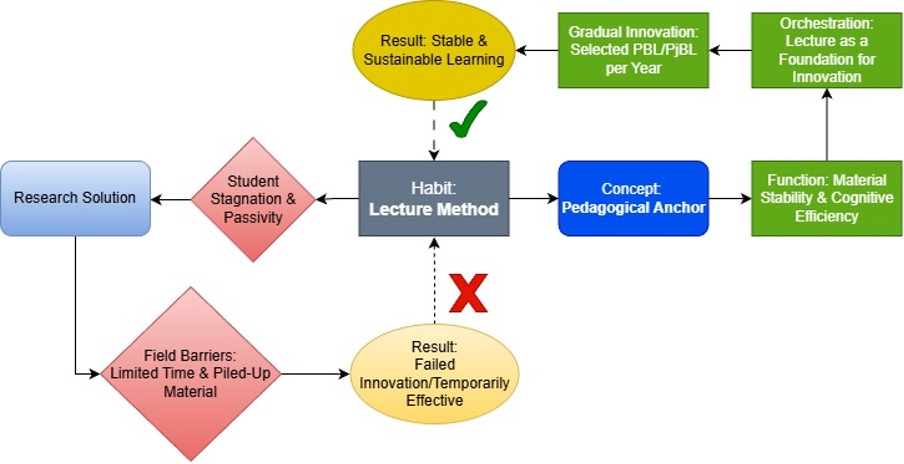
Frequent curriculum changes disrupt instructional rhythms and stigmatize lecture methods, creating "unrealistic" situations within mathematics education research. Current trends demand total innovation, such as PBL or PjBL across all chapters, which is logistically impossible without sacrificing curriculum completion. This study aims to conceptualize the "pedagogical anchor" as a rational and professional response to maintain instructional stability. Employing a critical literature review of previous theses and dissertations, the research compares preparation-to-coverage ratios between experimental settings and real-classroom demands. Findings reveal a significant scale anomaly where "successful" innovations are often limited to single chapters and lack long-term sustainability due to workload mismatches. The study concludes that strategic lecturing serves as a necessary anchor for cognitive stability rather than an anti-innovation stance. It recommends a shift toward an integrated longitudinal research model that supports teachers throughout the academic year. This approach is essential to prevent collective fatigue and ensure meaningful, sustainable educational innovation.
Keywords
Article Details
Copyright (c) 2026 Agus Miftakus Surur, Sri Pujilestari, M. Ubaidillah Ridwanulloh

This work is licensed under a Creative Commons Attribution 4.0 International License.
References
- Afifah, N., Isyati, A. N., & Pratama, L. D. (2025). Implementation of Realistic Mathematics Education and Project-Based Learning to Improve Students’ Mathematical Thinking Ability and Empathy Skills. Jurnal Pendidikan Matematika, 16(2), 197–208. https://doi.org/10.36709/JPM.V16I2.326
- Assyakurrohim, D., Putra, A. M., & Suryana, E. (2023). Implikasi Teori Belajar Kognitivistik Jerome S B runner dalam Pembelajaran PAI. Jurnal Ilmiah Ilmu Pendidikan, 6(September), 7299–7306.
- Ausubel, D. P. (1968). Educational Psychology: A Cognitive View. Holt, Rinehart and Winston.
- Barton, B. (2009). The Language of Mathematics: Telling Mathematical Tales. Springer.
- Creswell, J. W., & Poth, C. (2021). Qualitative inquiry and research design: Choosing among five approaches. SAGE.
- Devlin, K. (2000). The Language of Mathematics: Making the Invisible Visible. W. H. Freeman.
- Effendi, M. (2017). Pembelajaran Kreatif dan Penuh Makna dalam Pendidikan Islam. Jurnal Pendidikan Islam, 5(1), 31-46.
- Faizin, N., & Djayusman, R. R. (2023). The Concept of Sharia Compliance on Islamic Bank Murabaha Financing in the Maqashid Sharia Approach: A Theoretical Study. Al-Iktisab: Journal of Islamic Economic Law, 7(1), 49–74. https://doi.org/10.21111/aliktisab.v7i1.9980
- Fan, A. (2018). Hierarchical neural story generation. In ACL 2018 - 56th Annual Meeting of the Association for Computational Linguistics, Proceedings of the Conference (Long Papers) (Vol. 1, pp. 889–898). https://doi.org/10.18653/v1/p18-1082
- Febiyanti, N. (2024). Pengaruh Model Pembelajaran Problem Based Learning (PBL) Berbantuan Media Papan Bilangan Pemecah Masalah Terhadap Kemampuan Pemecahan Masalah Matematika (Penelitian Pada Siswa Kelas IV SDIT Al Muhajirin). Universitas Muhammadiyah Magelang.
- Fraenkel, J. R., Wallen, N. E., & Hyun, H. H. (2012). How to design and evaluate research in education. McGraw-Hill.
- Hada, K. L., Maulida, F. I., Dewi, A. S., Dewanti, C. K., & Surur, A. M. (2021). Pengembangan Media Pembelajaran Blabak Trarerodi pada Materi Geometri Transformasi: Tahap Expert Review. Jurnal Pendidikan Matematika, 4(2), 155–178. https://doi.org/10.21043/jmtk.v4i2.12047
- Helda. (2025). Pengaruh Model Pembelajaran Inquiry Based Learning (IBL) Terhadap Kemampuan Berpikir Kritis Siswa pada Materi Bilangan Bulat Kelas VII MTs Ar Rahmah Sungai Tabuk - IDR UIN Antasari Banjarmasin [UIN Antasari Banjarmasin]. https://idr.uin-antasari.ac.id/30396/?utm_source=chatgpt.com
- Herlita, H., & Fauzi, F. (2022). Pengaruh Beban Kerja, Stres Dan Disiplin Terhadap Prestasi Kerja Guru Pada SMA Negeri Wilayah Barat Kabupaten Bireuen. IndOmera, 3(6), 38–47. https://doi.org/10.55178/IDM.V3I6.301
- Himmah, K., Asmani, J. M., & Nuraini, L. (2021). Efektivitas Metode Jarimatika dalam Meningkatkan Kemampuan Berhitung Perkalian Siswa [Institut Pesantren Mathali ul Falah]. In Dawuh Guru: Jurnal Pendidikan MI/SD (Vol. 1, Issue 1). https://doi.org/10.35878/GURU.V1I1.270
- Hosnan, M. (2014). Pendekatan Saintifik dan Kontekstual dalam Pembelajaran Abad 21. Ghalia Indonesia.
- Istiqomah, P. (2021). Pengaruh Pembelajaran Berbasis Realistic Mathematics Education (RME) dan Problem Based Learning (PBL) Ditinjau Dari Self-Efficacy Terhadap Kemampuan Literasi Matematika Siswa SMP [Universitas Muhammadiyah Metro]. https://ojs.fkip.ummetro.ac.id/index.php/matematika/issue/view/192
- Jalinus, N. (2018). The instructional media development of welding practice course based on PjBL model: Enhancing student engagement and student competences. In International Journal of Innovation and Learning (Vol. 24, Issue 4, pp. 383–397). https://doi.org/10.1504/IJIL.2018.095365
- Kastaun, M., Meier, M., Küchemann, S., & Kuhn, J. (2021). Validation of Cognitive Load During Inquiry-Based Learning With Multimedia Scaffolds Using Subjective Measurement and Eye Movements. Frontiers in Psychology, 12, 703857. https://doi.org/10.3389/fpsyg.2021.703857
- Komara, E. (2012). Penelitian Tindakan Kelas Dan Profesionalisme Guru. Refika Aditama.
- Manegdeg, J. F. T., & Paglinawan, J. L. (2024). Collaboration Opportunities and Workload on Professional Development Access of Public-School Teachers. International Journal of Research and Innovation in Applied Science, IX(XII), 64–79. https://doi.org/10.51584/IJRIAS.2024.912008
- Mawaddah, S., & Maryanti, R. (2016). Kemampuan Pemahaman Konsep Matematis Siswa SMP dalam Pembelajaran Menggunakan Model Penemuan Terbimbing (Discovery Learning). Edumat, 4(1). https://doi.org/10.20527/edumat.v4i1.2292
- Miles, M. B., & Huberman, A. M. (1994). Qualitative Data Analysis: An Expanded Sourcebook. SAGE Publications.
- Moleong, L. J. (2017). Qualitative Research Methodology. PT. RosdakKarya.
- Mutahri, M. (2025). Pengaruh Model Pembelajaran Inquiry Based Learning Terhadap Minat dan Hasil Belajar Matematika Pada Siswa Kelas VIII SMP Negeri 1 Majene. Universitas Sulawesi Barat.
- Nallaperuma, D., Nawaratne, R., Bandaragoda, T., Adikari, A., Nguyen, S., Kempitiya, T., De Silva, D., Alahakoon, D., & Pothuhera, D. (2019). Online Incremental Machine Learning Platform for Big Data-Driven Smart Traffic Management. IEEE Transactions on Intelligent Transportation Systems, 20(12), 4679–4690. https://doi.org/10.1109/TITS.2019.2924883
- NCTM. (2000). Principles and Standards for School Mathematics.
- Ningsih, E. P., Rismen, S., Haryono, Y., & Matematika, P. (2025). Efektivitas Problem Based Learning (PBL) dalam Meningkatkan Kemampuan Pemecahan Masalah Matematika Siswa. Journal of Education Research, 6(3), 670–676. https://doi.org/10.37985/JER.V6I3.1635
- Nofa, P. A. (2022). Pengaruh Model Focus Explore Reflect Apply (FERA) dengan Pendekatan Science Writing Heuristic (SWH) untuk Meningkatkan Adversity Quotient Peserta Didik dan Literasi Matematis. Diploma thesis. UIN Raden Intan Lampung.
- Oktavia, Ayu Nur, -. (2023). Peningkatan Kemampuan Pemahaman Matematis Siswa SMA Melalui Model Project-Based Learning [Universitas Pendidikan Indonesia]. http://repository.upi.edu
- Pramestika, N. P. D., Wulandari, I. G. A. A., & Sujana, I. W. (2020). Enhancement of Mathematics Critical Thinking Skills through Problem Based Learning Assisted with Concrete Media. Journal of Education Technology, 4(3), 254–263. https://doi.org/10.23887/jet.v4i3.25552
- Prasetyo, A. D., & Abduh, M. (2021). Peningkatan Keaktifan Belajar Siswa melalui Model Discovery Learning di Sekolah Dasar. Jurnal Basicedu, 5(4), 1717–1724. https://doi.org/10.31004/basicedu.v5i4.991
- Qotrunada, A. (2024). Pengembangan Media Interaktif Game-Based Learning Menggunakan Pendekataan Realistik Untuk Meningkatkan Kemampuan Pemecahan Masalah Matematis Siswa Pada Materi Aritmatika Sosial [Universitas Islam Negeri Profesor Kiai Haji Saifuddin Zuhri Purwokerto]. https://repository.uinsaizu.ac.id/25487/1/Alisya Qotrunada_Pengembangan Media Interaktif Game-Based Learning Menggunakan Pendekatan Realistik untuk Meningkatkan Kemampuan Pemecahan Masalah Matematis Siswa pada Materi Aritmatika Sosial.pdf?utm_source=chatg
- Rahmi, Y., Wahyuni, C., Safitri, H., Aqsa, A. N., Nasrullah, A., Isnaniah, & M., I. (2023). Pengaruh Pembelajaran Matematika Terintegrasi Islam terhadap Motivasi Belajar Siswa. Ar-Riyadhiyyat: Journal of Mathematics Education, 4(1), 22–31. https://doi.org/10.47766/arriyadhiyyat.v4i1.1626
- Rusadhi, Y. V. (2020). Perancangan Game Based Learning untuk Mata Pelajaran Matematika Bab Operasi Bilangan (Studi Kasus: Siswa Kelas 4 SD Negeri Gondangtapen Jolosutro).
- Sanjaya, W. (2011). Strategi pembelajaran berbasis kontekstual: Konsep dan penerapannya untuk hasil belajar yang optimal. Kencana.
- Sanjaya, W. (2016). Strategi Pembelajaran Berorientasi Standar Proses Pendidikan. Kencana.
- Santini, Z. I. (2020). Social disconnectedness, perceived isolation, and symptoms of depression and anxiety among older Americans (NSHAP): a longitudinal mediation analysis. The Lancet Public Health, 5(1). https://doi.org/10.1016/S2468-2667(19)30230-0
- Saputra, A. B. (2025). Pengaruh Metode Game Based Learning (GBL) Untuk Meningkatkan Kemampuan Berpikir Kreatif dan Pemecahan Masalah Matematis Ditinjau Dari Minat Belajar Peserta Didik [Universitas Islam Negeri Raden Intan Lampung]. https://repository.radenintan.ac.id/39741/1/SKRIPSI ADI BATIN SAPUTRA Cover-BAB II-Dapus.pdf?utm_source=chatgpt.com
- Sugiyono. (2019). Metode Penelitian dan Pengembangan (Research and Development). Alfabeta.
- Supriatna, Irfan, -. (2024). Pengaruh Implementasi Model Problem-Based Learning (PBL) dan Inquiry-Based Learning (IBL) Terhadap perolehan dan Peningkatan Kemampuan Pemahaman Matematis (KPM) dengan Memperhatikan Tingkat Motivasi Belajar Siswa [Universitas Pendidikan Indonesia]. https://repository.upi.edu
- Surmiyati, S., Patmi, S., & Kristayulita, K. (2014). Analisis Kemampuan Kognitif dan Afektif terhadap Kemampuan Psikomotor Siswa Setelah Penerapan KTSP. Beta: Jurnal Tadris Matematika, 7(1), 25-36.
- Surur, A. M, Fanani, M. Z., Septiana, N. Z., Purnomo, N. H., Ridwanulloh, M. U., & Soimah, Z. (2023). Management of Developing Mathematics Learning Modules to Reduce Students’ Academic Stress. AIP Conference Proceedings. https://doi.org/10.1063/5.0123808
- Surur, Agus Miftakus. (2022). Application of monopoly media to improve readiness for class VI students in facing the national examination of mathematics learning. International Journal of Pedagogical Development and Lifelong Learning, 4(1).
- Surur, Agus Miftakus, Ummayyasari, N., Uswah, A. H. H., Kharimah, A., Putri, Qotrunnada, S., & Nabillah, F. F. (2021). Pengembangan Media Pembelajaran Matematika pada Materi Matriks dengan menggunakan Kotak Matriks (KoMat). Jurnal Pendidikan Sains Dan Komputer, 1(1).
- Suryadi, D. (2019). Mathematics education and low achievement: Challenges and innovations. . Journal of Mathematics Education.
- Susiana, E. (2010). IDEAL Problem Solving dalam Pembelajaran Matematika. Kreano, Jurnal Matematika Kreatif-Inovatif, 1(2), 73-82.
- Suyitno, & Habibi, M. W. (2020). Model Pembelajaran Creative Problem Solving dan Pengaruhnya Terhadap Hasil Belajar dan Berpikir Kreatif Siswa SMPN 1 Yosowilangun. Factor M: Focus ACTion Of Research Mathematic, 2(2), 127–140. https://doi.org/10.30762/factor_m.v2i2.2276
- Tall, D. (2002). Advanced Mathematical Thinking. Springer.
- Tibane, C. C., Mafa-Theledi, O. N., Masebe, T. P., & Mathye, P. (2024). Examining the effect of resource constraints on teaching and learning of grade 12 mathematics in Gauteng community learning centres. International Journal of Learning, Teaching and Educational Research, 23(10), 453–474. https://doi.org/10.26803/ijlter.23.10.22
- Tohari, B., & Rahman, A. (2024). Konstruktivisme Lev Semonovich Vygotsky dan JeromeBruner: Model Pembelajaran Aktif dalam PengembanganKemampuan Kognitif Anak. Nusantara: Jurnal Pendidikan Indonesia, 4(1), 209–228.
- Trianto. (2010). Mendesain model pembelajaran inovatif-progresif: Konsep, landasan, dan implementasinya pada kurikulum tingkat satuan pendidikan (KTSP). Kencana.
- Zan, R., & Di Martino, P. (2007). Attitude towards mathematics: Overcoming the positive/negative dichotomy. The Montana Mathematics Enthusiast, 3(1), 157–168.
References
Afifah, N., Isyati, A. N., & Pratama, L. D. (2025). Implementation of Realistic Mathematics Education and Project-Based Learning to Improve Students’ Mathematical Thinking Ability and Empathy Skills. Jurnal Pendidikan Matematika, 16(2), 197–208. https://doi.org/10.36709/JPM.V16I2.326
Assyakurrohim, D., Putra, A. M., & Suryana, E. (2023). Implikasi Teori Belajar Kognitivistik Jerome S B runner dalam Pembelajaran PAI. Jurnal Ilmiah Ilmu Pendidikan, 6(September), 7299–7306.
Ausubel, D. P. (1968). Educational Psychology: A Cognitive View. Holt, Rinehart and Winston.
Barton, B. (2009). The Language of Mathematics: Telling Mathematical Tales. Springer.
Creswell, J. W., & Poth, C. (2021). Qualitative inquiry and research design: Choosing among five approaches. SAGE.
Devlin, K. (2000). The Language of Mathematics: Making the Invisible Visible. W. H. Freeman.
Effendi, M. (2017). Pembelajaran Kreatif dan Penuh Makna dalam Pendidikan Islam. Jurnal Pendidikan Islam, 5(1), 31-46.
Faizin, N., & Djayusman, R. R. (2023). The Concept of Sharia Compliance on Islamic Bank Murabaha Financing in the Maqashid Sharia Approach: A Theoretical Study. Al-Iktisab: Journal of Islamic Economic Law, 7(1), 49–74. https://doi.org/10.21111/aliktisab.v7i1.9980
Fan, A. (2018). Hierarchical neural story generation. In ACL 2018 - 56th Annual Meeting of the Association for Computational Linguistics, Proceedings of the Conference (Long Papers) (Vol. 1, pp. 889–898). https://doi.org/10.18653/v1/p18-1082
Febiyanti, N. (2024). Pengaruh Model Pembelajaran Problem Based Learning (PBL) Berbantuan Media Papan Bilangan Pemecah Masalah Terhadap Kemampuan Pemecahan Masalah Matematika (Penelitian Pada Siswa Kelas IV SDIT Al Muhajirin). Universitas Muhammadiyah Magelang.
Fraenkel, J. R., Wallen, N. E., & Hyun, H. H. (2012). How to design and evaluate research in education. McGraw-Hill.
Hada, K. L., Maulida, F. I., Dewi, A. S., Dewanti, C. K., & Surur, A. M. (2021). Pengembangan Media Pembelajaran Blabak Trarerodi pada Materi Geometri Transformasi: Tahap Expert Review. Jurnal Pendidikan Matematika, 4(2), 155–178. https://doi.org/10.21043/jmtk.v4i2.12047
Helda. (2025). Pengaruh Model Pembelajaran Inquiry Based Learning (IBL) Terhadap Kemampuan Berpikir Kritis Siswa pada Materi Bilangan Bulat Kelas VII MTs Ar Rahmah Sungai Tabuk - IDR UIN Antasari Banjarmasin [UIN Antasari Banjarmasin]. https://idr.uin-antasari.ac.id/30396/?utm_source=chatgpt.com
Herlita, H., & Fauzi, F. (2022). Pengaruh Beban Kerja, Stres Dan Disiplin Terhadap Prestasi Kerja Guru Pada SMA Negeri Wilayah Barat Kabupaten Bireuen. IndOmera, 3(6), 38–47. https://doi.org/10.55178/IDM.V3I6.301
Himmah, K., Asmani, J. M., & Nuraini, L. (2021). Efektivitas Metode Jarimatika dalam Meningkatkan Kemampuan Berhitung Perkalian Siswa [Institut Pesantren Mathali ul Falah]. In Dawuh Guru: Jurnal Pendidikan MI/SD (Vol. 1, Issue 1). https://doi.org/10.35878/GURU.V1I1.270
Hosnan, M. (2014). Pendekatan Saintifik dan Kontekstual dalam Pembelajaran Abad 21. Ghalia Indonesia.
Istiqomah, P. (2021). Pengaruh Pembelajaran Berbasis Realistic Mathematics Education (RME) dan Problem Based Learning (PBL) Ditinjau Dari Self-Efficacy Terhadap Kemampuan Literasi Matematika Siswa SMP [Universitas Muhammadiyah Metro]. https://ojs.fkip.ummetro.ac.id/index.php/matematika/issue/view/192
Jalinus, N. (2018). The instructional media development of welding practice course based on PjBL model: Enhancing student engagement and student competences. In International Journal of Innovation and Learning (Vol. 24, Issue 4, pp. 383–397). https://doi.org/10.1504/IJIL.2018.095365
Kastaun, M., Meier, M., Küchemann, S., & Kuhn, J. (2021). Validation of Cognitive Load During Inquiry-Based Learning With Multimedia Scaffolds Using Subjective Measurement and Eye Movements. Frontiers in Psychology, 12, 703857. https://doi.org/10.3389/fpsyg.2021.703857
Komara, E. (2012). Penelitian Tindakan Kelas Dan Profesionalisme Guru. Refika Aditama.
Manegdeg, J. F. T., & Paglinawan, J. L. (2024). Collaboration Opportunities and Workload on Professional Development Access of Public-School Teachers. International Journal of Research and Innovation in Applied Science, IX(XII), 64–79. https://doi.org/10.51584/IJRIAS.2024.912008
Mawaddah, S., & Maryanti, R. (2016). Kemampuan Pemahaman Konsep Matematis Siswa SMP dalam Pembelajaran Menggunakan Model Penemuan Terbimbing (Discovery Learning). Edumat, 4(1). https://doi.org/10.20527/edumat.v4i1.2292
Miles, M. B., & Huberman, A. M. (1994). Qualitative Data Analysis: An Expanded Sourcebook. SAGE Publications.
Moleong, L. J. (2017). Qualitative Research Methodology. PT. RosdakKarya.
Mutahri, M. (2025). Pengaruh Model Pembelajaran Inquiry Based Learning Terhadap Minat dan Hasil Belajar Matematika Pada Siswa Kelas VIII SMP Negeri 1 Majene. Universitas Sulawesi Barat.
Nallaperuma, D., Nawaratne, R., Bandaragoda, T., Adikari, A., Nguyen, S., Kempitiya, T., De Silva, D., Alahakoon, D., & Pothuhera, D. (2019). Online Incremental Machine Learning Platform for Big Data-Driven Smart Traffic Management. IEEE Transactions on Intelligent Transportation Systems, 20(12), 4679–4690. https://doi.org/10.1109/TITS.2019.2924883
NCTM. (2000). Principles and Standards for School Mathematics.
Ningsih, E. P., Rismen, S., Haryono, Y., & Matematika, P. (2025). Efektivitas Problem Based Learning (PBL) dalam Meningkatkan Kemampuan Pemecahan Masalah Matematika Siswa. Journal of Education Research, 6(3), 670–676. https://doi.org/10.37985/JER.V6I3.1635
Nofa, P. A. (2022). Pengaruh Model Focus Explore Reflect Apply (FERA) dengan Pendekatan Science Writing Heuristic (SWH) untuk Meningkatkan Adversity Quotient Peserta Didik dan Literasi Matematis. Diploma thesis. UIN Raden Intan Lampung.
Oktavia, Ayu Nur, -. (2023). Peningkatan Kemampuan Pemahaman Matematis Siswa SMA Melalui Model Project-Based Learning [Universitas Pendidikan Indonesia]. http://repository.upi.edu
Pramestika, N. P. D., Wulandari, I. G. A. A., & Sujana, I. W. (2020). Enhancement of Mathematics Critical Thinking Skills through Problem Based Learning Assisted with Concrete Media. Journal of Education Technology, 4(3), 254–263. https://doi.org/10.23887/jet.v4i3.25552
Prasetyo, A. D., & Abduh, M. (2021). Peningkatan Keaktifan Belajar Siswa melalui Model Discovery Learning di Sekolah Dasar. Jurnal Basicedu, 5(4), 1717–1724. https://doi.org/10.31004/basicedu.v5i4.991
Qotrunada, A. (2024). Pengembangan Media Interaktif Game-Based Learning Menggunakan Pendekataan Realistik Untuk Meningkatkan Kemampuan Pemecahan Masalah Matematis Siswa Pada Materi Aritmatika Sosial [Universitas Islam Negeri Profesor Kiai Haji Saifuddin Zuhri Purwokerto]. https://repository.uinsaizu.ac.id/25487/1/Alisya Qotrunada_Pengembangan Media Interaktif Game-Based Learning Menggunakan Pendekatan Realistik untuk Meningkatkan Kemampuan Pemecahan Masalah Matematis Siswa pada Materi Aritmatika Sosial.pdf?utm_source=chatg
Rahmi, Y., Wahyuni, C., Safitri, H., Aqsa, A. N., Nasrullah, A., Isnaniah, & M., I. (2023). Pengaruh Pembelajaran Matematika Terintegrasi Islam terhadap Motivasi Belajar Siswa. Ar-Riyadhiyyat: Journal of Mathematics Education, 4(1), 22–31. https://doi.org/10.47766/arriyadhiyyat.v4i1.1626
Rusadhi, Y. V. (2020). Perancangan Game Based Learning untuk Mata Pelajaran Matematika Bab Operasi Bilangan (Studi Kasus: Siswa Kelas 4 SD Negeri Gondangtapen Jolosutro).
Sanjaya, W. (2011). Strategi pembelajaran berbasis kontekstual: Konsep dan penerapannya untuk hasil belajar yang optimal. Kencana.
Sanjaya, W. (2016). Strategi Pembelajaran Berorientasi Standar Proses Pendidikan. Kencana.
Santini, Z. I. (2020). Social disconnectedness, perceived isolation, and symptoms of depression and anxiety among older Americans (NSHAP): a longitudinal mediation analysis. The Lancet Public Health, 5(1). https://doi.org/10.1016/S2468-2667(19)30230-0
Saputra, A. B. (2025). Pengaruh Metode Game Based Learning (GBL) Untuk Meningkatkan Kemampuan Berpikir Kreatif dan Pemecahan Masalah Matematis Ditinjau Dari Minat Belajar Peserta Didik [Universitas Islam Negeri Raden Intan Lampung]. https://repository.radenintan.ac.id/39741/1/SKRIPSI ADI BATIN SAPUTRA Cover-BAB II-Dapus.pdf?utm_source=chatgpt.com
Sugiyono. (2019). Metode Penelitian dan Pengembangan (Research and Development). Alfabeta.
Supriatna, Irfan, -. (2024). Pengaruh Implementasi Model Problem-Based Learning (PBL) dan Inquiry-Based Learning (IBL) Terhadap perolehan dan Peningkatan Kemampuan Pemahaman Matematis (KPM) dengan Memperhatikan Tingkat Motivasi Belajar Siswa [Universitas Pendidikan Indonesia]. https://repository.upi.edu
Surmiyati, S., Patmi, S., & Kristayulita, K. (2014). Analisis Kemampuan Kognitif dan Afektif terhadap Kemampuan Psikomotor Siswa Setelah Penerapan KTSP. Beta: Jurnal Tadris Matematika, 7(1), 25-36.
Surur, A. M, Fanani, M. Z., Septiana, N. Z., Purnomo, N. H., Ridwanulloh, M. U., & Soimah, Z. (2023). Management of Developing Mathematics Learning Modules to Reduce Students’ Academic Stress. AIP Conference Proceedings. https://doi.org/10.1063/5.0123808
Surur, Agus Miftakus. (2022). Application of monopoly media to improve readiness for class VI students in facing the national examination of mathematics learning. International Journal of Pedagogical Development and Lifelong Learning, 4(1).
Surur, Agus Miftakus, Ummayyasari, N., Uswah, A. H. H., Kharimah, A., Putri, Qotrunnada, S., & Nabillah, F. F. (2021). Pengembangan Media Pembelajaran Matematika pada Materi Matriks dengan menggunakan Kotak Matriks (KoMat). Jurnal Pendidikan Sains Dan Komputer, 1(1).
Suryadi, D. (2019). Mathematics education and low achievement: Challenges and innovations. . Journal of Mathematics Education.
Susiana, E. (2010). IDEAL Problem Solving dalam Pembelajaran Matematika. Kreano, Jurnal Matematika Kreatif-Inovatif, 1(2), 73-82.
Suyitno, & Habibi, M. W. (2020). Model Pembelajaran Creative Problem Solving dan Pengaruhnya Terhadap Hasil Belajar dan Berpikir Kreatif Siswa SMPN 1 Yosowilangun. Factor M: Focus ACTion Of Research Mathematic, 2(2), 127–140. https://doi.org/10.30762/factor_m.v2i2.2276
Tall, D. (2002). Advanced Mathematical Thinking. Springer.
Tibane, C. C., Mafa-Theledi, O. N., Masebe, T. P., & Mathye, P. (2024). Examining the effect of resource constraints on teaching and learning of grade 12 mathematics in Gauteng community learning centres. International Journal of Learning, Teaching and Educational Research, 23(10), 453–474. https://doi.org/10.26803/ijlter.23.10.22
Tohari, B., & Rahman, A. (2024). Konstruktivisme Lev Semonovich Vygotsky dan JeromeBruner: Model Pembelajaran Aktif dalam PengembanganKemampuan Kognitif Anak. Nusantara: Jurnal Pendidikan Indonesia, 4(1), 209–228.
Trianto. (2010). Mendesain model pembelajaran inovatif-progresif: Konsep, landasan, dan implementasinya pada kurikulum tingkat satuan pendidikan (KTSP). Kencana.
Zan, R., & Di Martino, P. (2007). Attitude towards mathematics: Overcoming the positive/negative dichotomy. The Montana Mathematics Enthusiast, 3(1), 157–168.