

Article Sidebar
Downloads
Main Article Content
Abstract
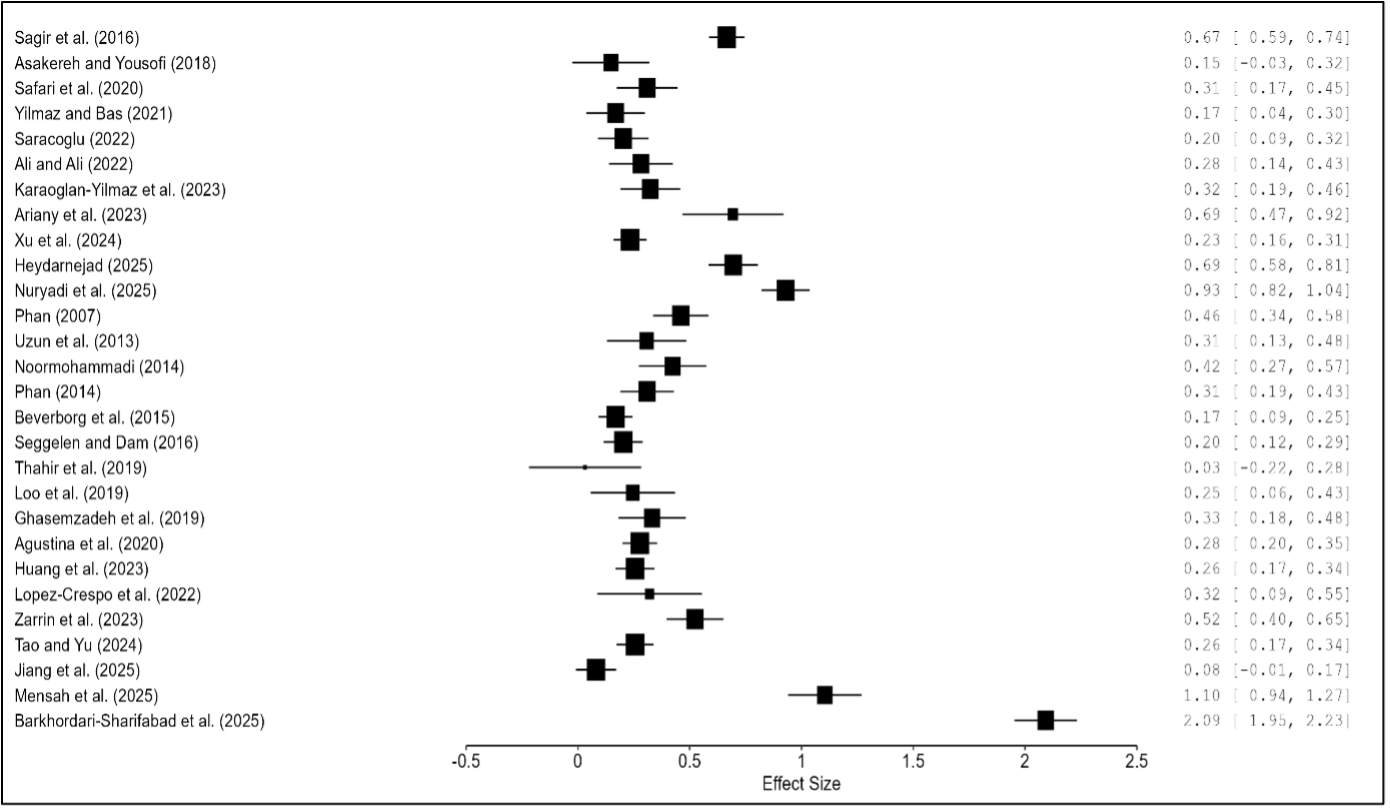
Reflective thinking and self-efficacy are two crucial constructs in education, particularly in mathematics education, and both have been reported to share a positive relationship across various contexts. However, empirical findings regarding the strength of this relationship remain inconsistent. This study presents a meta-analysis to investigate the relationship between reflective thinking and self-efficacy by addressing four research questions: (1) What is the overall strength of the relationship between reflective thinking and self-efficacy? (2) Is there significant heterogeneity among the studies? (3) Do the year of study, country, participants, educational level, and sample size serve as moderators? (4) How can the findings of this meta-analysis be integrated into mathematics learning practices? A total of 28 articles meeting the inclusion criteria were synthesized from the Scopus, ScienceDirect, and ERIC databases, following the PRISMA search protocol. The analysis involved calculating effect sizes, estimating a random-effects model, testing for heterogeneity, analyzing moderator variables, and examining publication bias. The results revealed a positive and statistically significant relationship between reflective thinking and self-efficacy (t(27) = 5.56, p < 0.001). The heterogeneity analysis indicated substantial variation among the included studies. Moderator analysis indicated that participant characteristics were a significant source of this variability, with pre-service mathematics teachers representing one of the key contributing groups. These findings highlight the importance of integrating reflective activities into mathematics learning in ways that are responsive to learner characteristics across educational levels. The results also underscore the need for future research to examine theory-driven pedagogical moderators to further clarify the mechanisms linking reflective thinking and self-efficacy.
Keywords
Article Details
Copyright (c) 2025 Yoga Tegar Santosa, Mutiara Hisda Mahmudah, Devi Yulindra, Akbar Waliyuddin Pakpahan

This work is licensed under a Creative Commons Attribution 4.0 International License.
References
- Agustina, R., Kamdi, W., Hadi, S., Muladi, M., & Nurhadi, D. (2020). Influence of the Principal’s Digital Leadership on the Reflective Practices of Vocational Teachers Mediated by Trust, Self Efficacy, and Work Engagement. International Journal of Learning, Teaching and Educational Research, 19(11), 24–40. https://doi.org/10.26803/ijlter.19.11.2
- Akpur, U. (2020). Critical, reflective, creative thinking and their reflections on academic achievement. Thinking Skills and Creativity, 37(1), 1–8. https://doi.org/10.1016/j.tsc.2020.100683
- Ali, S. I., & Ali, H. I. (2022). Reflective Thinking And Successful Intelligence And Their Relationships To Self-Efficacy Among Kindergarten Teachers. Journal of Positive School Psychology, 6(6), 4164–4179. https://mail.journalppw.com/index.php/jpsp/article/view/8122%0Ahttps://mail.journalppw.com/index.php/jpsp/article/download/8122/5285
- Amal, M. F., & Mahmudi, A. (2020). Enhancing students’ self-efficacy through metacognitive strategies in learning mathematics. Journal of Physics: Conference Series, 1613(1), 1–8. https://doi.org/10.1088/1742-6596/1613/1/012061
- Ariany, R. L., Rosjanuardi, R., & Juandi, D. (2023). Self-Efficacy and Reflective Thinking Skills Attributes of Pre-service Mathematics Teachers. Mosharafa: Jurnal Pendidikan Matematika, 12(1), 81–88. https://doi.org/10.31980/mosharafa.v12i1.754
- Asakereh, A., & Yousofi, N. (2018). Reflective Thinking, Self-Efficacy, Self-Esteem and Academic Achievement of Iranian EFL Students. International Journal of Educational Psychology, 7(1), 68–89. https://doi.org/10.17583/ijep.2018.2896
- Bandura, A. (1997). Self-Efficacy: The Exercise of Control. Worth Publishers.
- Barkhordari-Sharifabad, M., Alipour, Z., & Jahantab, R. (2025). The role of reflective capacity in clinical self-efficacy of nursing students: a cross-sectional study. BMC Medical Education, 25(1), 614–620. https://doi.org/10.1186/s12909-025-07201-y
- Beverborg, A. O. G., Sleegers, P., Endedijk, M., & Van Veen, K. (2015). Towards Sustaining Levels of Reflective Learning: How Do Transformational Leadership, Task Interdependence, and Self-Efficacy Shape Teacher Learning in Schools? Societies, 5(1), 187–219. https://doi.org/10.3390/soc5010187
- Borenstein, M., Hedges, L. V., Higgins, J. P. T., & Rothstein, H. R. (2021). Introduction to Meta-Analysis (2nd ed.). Wiley.
- Calkins, S., Grannan, S., & Siefken, J. (2020). Using Peer-Assisted Reflection in Math to Foster Critical Thinking and Communication Skills. PRIMUS, 30(4), 475–499. https://doi.org/10.1080/10511970.2019.1608608
- Chamdani, M., Yusuf, F. A., Salimi, M., & Fajari, L. E. W. (2022). Meta-Analysis Study: The Relationship Between Reflective Thinking and Learning Achievement. Journal on Efficiency and Responsibility in Education and Science, 15(3), 181–188. https://doi.org/10.7160/eriesj.2022.150305
- Clark, R. M., Kaw, A., & Guldiken, R. (2023). Metacognition instruction and repeated reflection in a fluid mechanics course: Reflective themes and student outcomes. International Journal of Mechanical Engineering Education, 51(4), 243–269. https://doi.org/10.1177/03064190231164719
- Closs, L., Mahat, M., & Imms, W. (2022). Learning environments’ influence on students’ learning experience in an Australian Faculty of Business and Economics. Learning Environments Research, 25(1), 271–285. https://doi.org/10.1007/s10984-021-09361-2
- Cohen, R. D., Woseth, D. M., Thisted, R. A., & Hanauer, S. B. (2000). A Meta-Analysis and Overview of The Literature on Treatment Options for Left-Sided Ulcerative Colitis and Ulcerative Proctitis. American Journal of Gastroenterology, 95(5), 1263–1276. https://doi.org/10.1111/j.1572-0241.2000.01940.x
- Ghasemzadeh, S., Nemati, M., & Fathi, J. (2019). Teacher Self-Efficacy and Reflection as Predictors of Teacher Burnout: An Investigation of Iranian English Language Teachers. Issues in Language Teaching, 8(2), 25–50. https://doi.org/10.22054/ilt.2020.49009.451
- Guo, L. (2022). How should reflection be supported in higher education? — A meta-analysis of reflection interventions. Reflective Practice, 23(1), 118–146. https://doi.org/10.1080/14623943.2021.1995856
- Gürbüztürk, O., & Ünal, H. (2022). The Effect of Reflective Thinking Activities on Academic Achievement, Attitude and Permanence: Meta-Analysis Study. Inonu University Journal of the Faculty of Education (INUJFE), 23(1), 671–702. https://doi.org/10.17679/inuefd.1081203
- Heydarnejad, T. (2025). Disclosing motivation and educational self-efficacy in AI-enhanced EFL learning via a lenz into reflective thinking, academic mindfulness, and teacher support. Discover Psychology, 5(1), 1–23. https://doi.org/10.1007/s44202-025-00502-9
- Hidayat, R., Ayub, A. F. M., Hamid, H., Abd, H. S., & Nasir, N. (2025). Validity and Reliability of Pre-service Teachers and Teachers’ Self-Efficacy: A Scoping Review. Asian Journal of University Education, 21(1), 262–285. https://doi.org/10.24191/ajue.v21i1.5678
- Higgins, J. P. T., Thomas, J., Chandler, J., Cumpston, M., Li, T., Page, M. J., & Welch, V. A. (2019). Cochrane Handbook for Systematic Reviews of Interventions (2nd ed.). John Wiley & Sons.
- Higgins, J. P. T., Thompson, S. G., Deeks, J. J., & Altman, D. G. (2003). Measuring inconsistency in meta-analyses. BMJ, 327(7414), 557–560. https://doi.org/10.1136/bmj.327.7414.557
- Huang, C. (2016). Achievement goals and self-efficacy: A meta-analysis. Educational Research Review, 19(1), 119–137. https://doi.org/10.1016/j.edurev.2016.07.002
- Huang, X., Lai, C., Wang, C., & Xu, G. (2023). The relationship between informal teacher learning and self-efficacy among public school teachers and private school teachers in China. Journal of Education for Teaching, 49(4), 597–615. https://doi.org/10.1080/02607476.2022.2150533
- Izzatunnisa, R., Nindiasari, H., & Fatah, A. (2023). Systematic Literature Review: Students’ Self Efficacy Based on Mathematical Reflective Thinking Ability. JARME: Journal of Authentic Research on Mathematics Education, 5(1), 103–114. https://doi.org/10.37058/jarme.v7i1.13644
- Jiang, P., Lin, W., Ruan, X., Zhang, J., & Xu, R. (2025). Predicting the influencing factors of secondary school students’ behavioral intention of mathematical problem-solving reflection by structural equation model. Humanities and Social Sciences Communications, 12(1), 1900–1910. https://doi.org/10.1057/s41599-025-06174-z
- Jurs, P., Spehte, E., Samusevica, A., & Kulberga, I. (2023). Educational prerequisites to ensure the use of students’ reflection practice in the learning process. Nurture, 17(4), 664–671. https://doi.org/10.55951/nurture.v17i4.458
- Karaoglan-Yilmaz, F. G., Ustun, A. B., Zhang, K., & Yilmaz, R. (2023). Metacognitive Awareness, Reflective Thinking, Problem Solving, and Community of Inquiry As Predictors of Academic Self-Efficacy in Blended Learning: a Correlational Study. Turkish Online Journal of Distance Education, 24(1), 20–36. https://doi.org/10.17718/tojde.989874
- Kholid, M. N., Sa’dijah, C., Hidayanto, E., & Permadi, H. (2020). How are students’ reflective thinking for problem solving? Journal for the Education of Gifted Young Scientists, 8(3), 1135–1146. https://doi.org/10.17478/JEGYS.688210
- Kholid, M. N., Sa’Dijah, C., Hidayanto, E., & Permadi, H. (2022). Students’ reflective thinking pattern changes and characteristics of problem solving. Reflective Practice, 23(3), 319–341. https://doi.org/10.1080/14623943.2021.2025353
- Kirilova, B. (2024). Embedded assessment throughout the problem-based learning – a path to authentic learning experiences. Mathematics and Education in Mathematics, 53(1), 109–116. https://doi.org/10.55630/mem.2024.53.109-116
- Li, J., Xue, E., Li, C., & He, Y. (2023). Investigating Latent Interactions between Students’ Affective Cognition and Learning Performance: Meta-Analysis of Affective and Cognitive Factors. Behavioral Sciences, 13(7), 555–570. https://doi.org/10.3390/bs13070555
- Liao, K. Y.-H., Stead, G. B., & Liao, C.-Y. (2021). A Meta-Analysis of the Relation Between Self-Compassion and Self-Efficacy. Mindfulness, 12(8), 1878–1891. https://doi.org/10.1007/s12671-021-01626-4
- Lipsey, M. W., & Wilson, D. B. (2001). Practical Meta-Analysis. Sage Publications.
- Littlewood, A., & Kloukos, D. (2019). Searching the literature for studies for a systematic review. Part 1: Identifying search concepts in a question. American Journal of Orthodontics and Dentofacial Orthopedics, 155(2), 299–301. https://doi.org/10.1016/j.ajodo.2018.11.005
- Livinƫi, R., Gunnesch-Luca, G., & Iliescu, D. (2021). Research self-efficacy: A meta-analysis. Educational Psychologist, 56(3), 215–242. https://doi.org/10.1080/00461520.2021.1886103
- Loo, J. van der, Krahmer, E., & van Amelsvoort, M. (2019). Reflection in Learning to Write an Academic Text. How Does Reflection Affect Observational Learning and Learning-by-Doing in a Research Synthesis Task? Frontiers in Education, 4(1), 1–14. https://doi.org/10.3389/feduc.2019.00019
- López-Crespo, G., Blanco-Gandía, M. C., Valdivia-Salas, S., Fidalgo, C., & Sánchez-Pérez, N. (2022). The educational e-portfolio: preliminary evidence of its relationship with student’s self-efficacy and engagement. Education and Information Technologies, 27(4), 5233–5248. https://doi.org/10.1007/s10639-021-10827-2
- Maksimović, J., & Osmanović, J. (2019). Perspective of cognitive thinking and reflective teaching practice. International Journal of Cognitive Research in Science, Engineering and Education, 7(2), 1–10. https://doi.org/10.5937/IJCRSEE1902001M
- Mensah, E., Owusu, M., & Nyamekye, E. (2025). Multicultural teaching competence among preservice teachers in Ghana: the role of critical self-reflection, religious inclusivity, and teaching self-efficacy. Discover Education, 4(1), 173–185. https://doi.org/10.1007/s44217-025-00587-3
- Moher, D., Liberati, A., Tetzlaff, J., Altman, D. G., Antes, G., Atkins, D., Barbour, V., Barrowman, N., Berlin, J. A., Clark, J., Clarke, M., Cook, D., D’Amico, R., Deeks, J. J., Devereaux, P. J., Dickersin, K., Egger, M., Ernst, E., Gøtzsche, P. C., … Tugwell, P. (2009). Preferred reporting items for systematic reviews and meta-analyses: The PRISMA statement. PLoS Medicine, 6(7), 1–6. https://doi.org/10.1371/journal.pmed.1000097
- Morgan, R. L., Whaley, P., Thayer, K. A., & Schünemann, H. J. (2018). Identifying the PECO: A framework for formulating good questions to explore the association of environmental and other exposures with health outcomes. Environment International, 121(1), 1027–1031. https://doi.org/10.1016/j.envint.2018.07.015
- Ngololo, E. N., & Kanandjebo, L. N. (2021). Becoming reflective practitioners: Mathematics student teachers’ experiences. JRAMathEdu (Journal of Research and Advances in Mathematics Education), 6(2), 128–141. https://doi.org/10.23917/jramathedu.v6i2.12375
- Noormohammadi, S. (2014). Teacher Reflection and its Relation to Teacher Efficacy and Autonomy. Procedia - Social and Behavioral Sciences, 98(1), 1380–1389. https://doi.org/10.1016/j.sbspro.2014.03.556
- Nuryadi, N., Sukestiyarno, Y. L., & Suyitno, H. (2025). Self-Efficacy, Reflective Thinking, and Critical Thinking: A Structural Equation Modeling Study Among Adolescents. Islamic Guidance and Counseling Journal, 8(2), 1–17. https://doi.org/10.25217/0020258684000
- Peterson, R. A., & Brown, S. P. (2005). On the Use of Beta Coefficients in Meta-Analysis. Journal of Applied Psychology, 90(1), 175–181. https://doi.org/10.1037/0021-9010.90.1.175
- Phan, H. P. (2007). An Examination of Reflective Thinking, Learning Approaches, and Self‐Efficacy Beliefs at the University of the South Pacific: A path analysis approach. Educational Psychology, 27(6), 789–806. https://doi.org/10.1080/01443410701349809
- Phan, H. P. (2014). Self-Efficacy, Reflection, and Achievement: A Short-Term Longitudinal Examination. The Journal of Educational Research, 107(2), 90–102. https://doi.org/10.1080/00220671.2012.753860
- Putri, R. K., & Hariyanti, F. (2022). Problem Solving Profile of Students with High Self-Efficacy Levels in terms of Gender. JME (Journal of Mathematics Education), 7(2), 87–98. https://doi.org/10.31327/jme.v7i2.1835
- Putri, A., Sujadi, I., Nursanti, Y. B., & Nurhasanah, F. (2025). Systematic Literature Review on Mathematical Representation: The Connection between Theories and Implementation. International Journal of Review in Mathematics Education, 1(1), 1–23. Retrieved from https://journals2.ums.ac.id/ijrime/article/view/12780 (Original work published October 31, 2025)
- Quintana, D. S. (2015). From pre-registration to publication: a non-technical primer for conducting a meta-analysis to synthesize correlational data. Frontiers in Psychology, 6(1), 1–9. https://doi.org/10.3389/fpsyg.2015.01549
- Radović, S., Firssova, O., Hummel, H. G., & Vermeulen, M. (2021). Improving academic performance: Strengthening the relation between theory and practice through prompted reflection. Active Learning in Higher Education, 24(2), 139–154. https://doi.org/10.1177/14697874211014411
- Sa’dijah, C., Kholid, M. N., Hidayanto, E., & Permadi, H. (2020). Reflective Thinking Characteristics: a Study in the Proficient Mathematics Prospective Teachers. Infinity Journal, 9(2), 159–172. https://doi.org/10.22460/infinity.v9i2.p159-172
- Safari, I., Davaribina, M., & Khoshnevis, I. (2020). The Influence of EFL Teachers’ and Reflective Thinking on Their Professional Development : a Structural Equation. Journal on Efficiency and Responsibility in Education and Science, 13(1), 27–40. https://doi.org/10.7160/eriesj.2020.130103
- Sagir, S. U., Aslan, O., Bertiz, H., & Oner Armagan, F. (2016). Investigation of the relationship between pre-service science teachers’ perceived self-efficacy in science teaching and disposition toward reflective thinking. European Journal of Science and Mathematics Education, 4(3), 331–345. https://doi.org/10.30935/scimath/9474
- Santosa, Y. T., Antara, S., Ismiyati, & Setyaningsih, N. (2025). The Influence of Metacognitive Awareness, Mathematical Disposition, and Self-Efficacy on Reflective Thinking and Mathematics Achievement. JME (Journal of Mathematics Education), 10(1), 51–63. https://doi.org/10.31327/jme.v10i1.737
- Santosa, Y. T., Antara, S., Sukimin, Setyaningsih, N., & Sutarni, S. (2025). Efektivitas Realistic Mathematics Education Berbasis Hypothetical Learning Trajectories Terhadap Kemampuan Berpikir Reflektif Siswa. JIPMat (Jurnal Ilmiah Pendidikan Matematika), 10(1), 149–161. https://doi.org/10.26877/dwdtj642
- Saracoglu, M. (2022). Reflective Thinking and Inquiry Skills as Predictors of Self-Efficacy in Teaching Mathematics. Problems of Education in the 21st Century, 80(1), 213–231. https://doi.org/10.33225/pec/22.80.213
- Seggelen-Damen, I. van, & Dam, K. van. (2016). Self-reflection as a mediator between self-efficacy and well-being. Journal of Managerial Psychology, 31(1), 18–33. https://doi.org/10.1108/JMP-01-2013-0022
- Şen, H. Ş. (2013). Reflective Thinking Skills of Primary School Students Based on Problem Solving Ability. International Journal of Academic Research, 5(5), 41–48. https://doi.org/10.7813/2075-4124.2013/5-5/B.6
- Simamora, R. E., Saragih, S., & Hasratuddin, H. (2018). Improving Students’ Mathematical Problem Solving Ability and Self-Efficacy through Guided Discovery Learning in Local Culture Context. International Electronic Journal of Mathematics Education, 14(1), 61–72. https://doi.org/10.12973/iejme/3966
- Sutama, S., Fuadi, D., Narimo, S., Hafida, S. H. N., Novitasari, M., Anif, S., Prayitno, H. J., Sunanih, S., & Adnan, M. (2022). Collaborative mathematics learning management: Critical thinking skills in problem solving. International Journal of Evaluation and Research in Education, 11(3), 1015–1027. https://doi.org/10.11591/ijere.v11i3.22193
- Tao, Y., & Yu, J. (2024). Cultural threads in writing mastery: a structural analysis of perfectionism, learning self-efficacy, and motivation as mediated by self-reflection in Chinese EFL learners. BMC Psychology, 12(1), 80–97. https://doi.org/10.1186/s40359-024-01572-5
- Thahir, A., Komarudin, Hasanah, U. N., & Rahmahwaty. (2019). MURDER learning models and self efficacy: Impact on mathematical reflective thinking ability. Journal for the Education of Gifted Young Scientists, 7(4), 1120–1133. https://doi.org/10.17478/jegys.594709
- Thingbak, A., Capobianco, L., Wells, A., & O’Toole, M. S. (2024). Relationships between metacognitive beliefs and anxiety and depression in children and adolescents: A meta-analysis. Journal of Affective Disorders, 361(6), 36–50. https://doi.org/10.1016/j.jad.2024.05.123
- Torres, J. T., Higheagle Strong, Z., & Adesope, O. O. (2020). Reflection through assessment: A systematic narrative review of teacher feedback and student self-perception. Studies in Educational Evaluation, 64(1), 100814. https://doi.org/10.1016/j.stueduc.2019.100814
- Uzun, M. S., Yüksel, N. S., & Dost, Ş. (2013). Investigation of Pre-service Teachers’ Mathematics Teaching Efficacy Beliefs in Terms of their Reflective Thinking Tendencies. Procedia - Social and Behavioral Sciences, 106(1), 1595–1602. https://doi.org/10.1016/j.sbspro.2013.12.180
- Wei, W., Cheong, C. M., Zhu, X., & Lu, Q. (2024). Comparing self-reflection and peer feedback practices in an academic writing task: a student self-efficacy perspective. Teaching in Higher Education, 29(4), 896–912. https://doi.org/10.1080/13562517.2022.2042242
- Wille, E., Opheim, H. M. S., Princeton, D. M., Kisa, S., & Hjerpaasen, K. J. (2025). Building Resilience and Competence in Bachelor Nursing Students: A Narrative Review Based on Social Cognitive Theory. Nursing Reports, 15(7), 253. https://doi.org/10.3390/nursrep15070253
- Wyatt, M. (2021). Research Into Second Language Learners’ and Teachers’ Self‐Efficacy Beliefs: Making the Connections. TESOL Quarterly, 55(1), 296–307. https://doi.org/10.1002/tesq.3010
- Xu, J., Zhang, S., & Chen, H. (2024). The impact of teacher autonomy support on students’ assessment literacy: The chain mediating effects of self-efficacy and critical reflection. Heliyon, 10(14), 1–10. https://doi.org/10.1016/j.heliyon.2024.e34616
- Yanto, B., Sri Hastuti Noer, & Agung Putra Wijaya. (2025). Meta-Analysis: The Effect of The Problem-Based Learning Model on Mathematical Reflective Thinking Ability. Jurnal Ilmiah Pendidikan Profesi Guru, 8(1), 176–184. https://doi.org/10.23887/jippg.v8i1.86267
- Yelbuz, B. E., Madan, E., & Alper, S. (2022). Reflective thinking predicts lower conspiracy beliefs: A meta-analysis. Judgment and Decision Making, 17(4), 720–744. https://doi.org/10.1017/S1930297500008913
- Yilmaz, L., & Baş, F. (2021). An investigation of the variables affecting the problem-solving achievements of pre-service secondary school mathematics teachers. International Journal of Curriculum and Instruction, 13(3), 2332–2359. https://ijci.net/index.php/IJCI/article/view/566
- Zakariya, Y. F. (2022). Improving students’ mathematics self-efficacy: A systematic review of intervention studies. Frontiers in Psychology, 13, 1–13. https://doi.org/10.3389/fpsyg.2022.986622
- Zarrin, L., Ghafourifard, M., & Sheikhalipour, Z. (2023). Relationship between Nurses Reflection, Self-efficacy and Work Engagement: A Multicenter Study. Journal of Caring Sciences, 12(3), 155–162. https://doi.org/10.34172/jcs.2023.31920
References
Agustina, R., Kamdi, W., Hadi, S., Muladi, M., & Nurhadi, D. (2020). Influence of the Principal’s Digital Leadership on the Reflective Practices of Vocational Teachers Mediated by Trust, Self Efficacy, and Work Engagement. International Journal of Learning, Teaching and Educational Research, 19(11), 24–40. https://doi.org/10.26803/ijlter.19.11.2
Akpur, U. (2020). Critical, reflective, creative thinking and their reflections on academic achievement. Thinking Skills and Creativity, 37(1), 1–8. https://doi.org/10.1016/j.tsc.2020.100683
Ali, S. I., & Ali, H. I. (2022). Reflective Thinking And Successful Intelligence And Their Relationships To Self-Efficacy Among Kindergarten Teachers. Journal of Positive School Psychology, 6(6), 4164–4179. https://mail.journalppw.com/index.php/jpsp/article/view/8122%0Ahttps://mail.journalppw.com/index.php/jpsp/article/download/8122/5285
Amal, M. F., & Mahmudi, A. (2020). Enhancing students’ self-efficacy through metacognitive strategies in learning mathematics. Journal of Physics: Conference Series, 1613(1), 1–8. https://doi.org/10.1088/1742-6596/1613/1/012061
Ariany, R. L., Rosjanuardi, R., & Juandi, D. (2023). Self-Efficacy and Reflective Thinking Skills Attributes of Pre-service Mathematics Teachers. Mosharafa: Jurnal Pendidikan Matematika, 12(1), 81–88. https://doi.org/10.31980/mosharafa.v12i1.754
Asakereh, A., & Yousofi, N. (2018). Reflective Thinking, Self-Efficacy, Self-Esteem and Academic Achievement of Iranian EFL Students. International Journal of Educational Psychology, 7(1), 68–89. https://doi.org/10.17583/ijep.2018.2896
Bandura, A. (1997). Self-Efficacy: The Exercise of Control. Worth Publishers.
Barkhordari-Sharifabad, M., Alipour, Z., & Jahantab, R. (2025). The role of reflective capacity in clinical self-efficacy of nursing students: a cross-sectional study. BMC Medical Education, 25(1), 614–620. https://doi.org/10.1186/s12909-025-07201-y
Beverborg, A. O. G., Sleegers, P., Endedijk, M., & Van Veen, K. (2015). Towards Sustaining Levels of Reflective Learning: How Do Transformational Leadership, Task Interdependence, and Self-Efficacy Shape Teacher Learning in Schools? Societies, 5(1), 187–219. https://doi.org/10.3390/soc5010187
Borenstein, M., Hedges, L. V., Higgins, J. P. T., & Rothstein, H. R. (2021). Introduction to Meta-Analysis (2nd ed.). Wiley.
Calkins, S., Grannan, S., & Siefken, J. (2020). Using Peer-Assisted Reflection in Math to Foster Critical Thinking and Communication Skills. PRIMUS, 30(4), 475–499. https://doi.org/10.1080/10511970.2019.1608608
Chamdani, M., Yusuf, F. A., Salimi, M., & Fajari, L. E. W. (2022). Meta-Analysis Study: The Relationship Between Reflective Thinking and Learning Achievement. Journal on Efficiency and Responsibility in Education and Science, 15(3), 181–188. https://doi.org/10.7160/eriesj.2022.150305
Clark, R. M., Kaw, A., & Guldiken, R. (2023). Metacognition instruction and repeated reflection in a fluid mechanics course: Reflective themes and student outcomes. International Journal of Mechanical Engineering Education, 51(4), 243–269. https://doi.org/10.1177/03064190231164719
Closs, L., Mahat, M., & Imms, W. (2022). Learning environments’ influence on students’ learning experience in an Australian Faculty of Business and Economics. Learning Environments Research, 25(1), 271–285. https://doi.org/10.1007/s10984-021-09361-2
Cohen, R. D., Woseth, D. M., Thisted, R. A., & Hanauer, S. B. (2000). A Meta-Analysis and Overview of The Literature on Treatment Options for Left-Sided Ulcerative Colitis and Ulcerative Proctitis. American Journal of Gastroenterology, 95(5), 1263–1276. https://doi.org/10.1111/j.1572-0241.2000.01940.x
Ghasemzadeh, S., Nemati, M., & Fathi, J. (2019). Teacher Self-Efficacy and Reflection as Predictors of Teacher Burnout: An Investigation of Iranian English Language Teachers. Issues in Language Teaching, 8(2), 25–50. https://doi.org/10.22054/ilt.2020.49009.451
Guo, L. (2022). How should reflection be supported in higher education? — A meta-analysis of reflection interventions. Reflective Practice, 23(1), 118–146. https://doi.org/10.1080/14623943.2021.1995856
Gürbüztürk, O., & Ünal, H. (2022). The Effect of Reflective Thinking Activities on Academic Achievement, Attitude and Permanence: Meta-Analysis Study. Inonu University Journal of the Faculty of Education (INUJFE), 23(1), 671–702. https://doi.org/10.17679/inuefd.1081203
Heydarnejad, T. (2025). Disclosing motivation and educational self-efficacy in AI-enhanced EFL learning via a lenz into reflective thinking, academic mindfulness, and teacher support. Discover Psychology, 5(1), 1–23. https://doi.org/10.1007/s44202-025-00502-9
Hidayat, R., Ayub, A. F. M., Hamid, H., Abd, H. S., & Nasir, N. (2025). Validity and Reliability of Pre-service Teachers and Teachers’ Self-Efficacy: A Scoping Review. Asian Journal of University Education, 21(1), 262–285. https://doi.org/10.24191/ajue.v21i1.5678
Higgins, J. P. T., Thomas, J., Chandler, J., Cumpston, M., Li, T., Page, M. J., & Welch, V. A. (2019). Cochrane Handbook for Systematic Reviews of Interventions (2nd ed.). John Wiley & Sons.
Higgins, J. P. T., Thompson, S. G., Deeks, J. J., & Altman, D. G. (2003). Measuring inconsistency in meta-analyses. BMJ, 327(7414), 557–560. https://doi.org/10.1136/bmj.327.7414.557
Huang, C. (2016). Achievement goals and self-efficacy: A meta-analysis. Educational Research Review, 19(1), 119–137. https://doi.org/10.1016/j.edurev.2016.07.002
Huang, X., Lai, C., Wang, C., & Xu, G. (2023). The relationship between informal teacher learning and self-efficacy among public school teachers and private school teachers in China. Journal of Education for Teaching, 49(4), 597–615. https://doi.org/10.1080/02607476.2022.2150533
Izzatunnisa, R., Nindiasari, H., & Fatah, A. (2023). Systematic Literature Review: Students’ Self Efficacy Based on Mathematical Reflective Thinking Ability. JARME: Journal of Authentic Research on Mathematics Education, 5(1), 103–114. https://doi.org/10.37058/jarme.v7i1.13644
Jiang, P., Lin, W., Ruan, X., Zhang, J., & Xu, R. (2025). Predicting the influencing factors of secondary school students’ behavioral intention of mathematical problem-solving reflection by structural equation model. Humanities and Social Sciences Communications, 12(1), 1900–1910. https://doi.org/10.1057/s41599-025-06174-z
Jurs, P., Spehte, E., Samusevica, A., & Kulberga, I. (2023). Educational prerequisites to ensure the use of students’ reflection practice in the learning process. Nurture, 17(4), 664–671. https://doi.org/10.55951/nurture.v17i4.458
Karaoglan-Yilmaz, F. G., Ustun, A. B., Zhang, K., & Yilmaz, R. (2023). Metacognitive Awareness, Reflective Thinking, Problem Solving, and Community of Inquiry As Predictors of Academic Self-Efficacy in Blended Learning: a Correlational Study. Turkish Online Journal of Distance Education, 24(1), 20–36. https://doi.org/10.17718/tojde.989874
Kholid, M. N., Sa’dijah, C., Hidayanto, E., & Permadi, H. (2020). How are students’ reflective thinking for problem solving? Journal for the Education of Gifted Young Scientists, 8(3), 1135–1146. https://doi.org/10.17478/JEGYS.688210
Kholid, M. N., Sa’Dijah, C., Hidayanto, E., & Permadi, H. (2022). Students’ reflective thinking pattern changes and characteristics of problem solving. Reflective Practice, 23(3), 319–341. https://doi.org/10.1080/14623943.2021.2025353
Kirilova, B. (2024). Embedded assessment throughout the problem-based learning – a path to authentic learning experiences. Mathematics and Education in Mathematics, 53(1), 109–116. https://doi.org/10.55630/mem.2024.53.109-116
Li, J., Xue, E., Li, C., & He, Y. (2023). Investigating Latent Interactions between Students’ Affective Cognition and Learning Performance: Meta-Analysis of Affective and Cognitive Factors. Behavioral Sciences, 13(7), 555–570. https://doi.org/10.3390/bs13070555
Liao, K. Y.-H., Stead, G. B., & Liao, C.-Y. (2021). A Meta-Analysis of the Relation Between Self-Compassion and Self-Efficacy. Mindfulness, 12(8), 1878–1891. https://doi.org/10.1007/s12671-021-01626-4
Lipsey, M. W., & Wilson, D. B. (2001). Practical Meta-Analysis. Sage Publications.
Littlewood, A., & Kloukos, D. (2019). Searching the literature for studies for a systematic review. Part 1: Identifying search concepts in a question. American Journal of Orthodontics and Dentofacial Orthopedics, 155(2), 299–301. https://doi.org/10.1016/j.ajodo.2018.11.005
Livinƫi, R., Gunnesch-Luca, G., & Iliescu, D. (2021). Research self-efficacy: A meta-analysis. Educational Psychologist, 56(3), 215–242. https://doi.org/10.1080/00461520.2021.1886103
Loo, J. van der, Krahmer, E., & van Amelsvoort, M. (2019). Reflection in Learning to Write an Academic Text. How Does Reflection Affect Observational Learning and Learning-by-Doing in a Research Synthesis Task? Frontiers in Education, 4(1), 1–14. https://doi.org/10.3389/feduc.2019.00019
López-Crespo, G., Blanco-Gandía, M. C., Valdivia-Salas, S., Fidalgo, C., & Sánchez-Pérez, N. (2022). The educational e-portfolio: preliminary evidence of its relationship with student’s self-efficacy and engagement. Education and Information Technologies, 27(4), 5233–5248. https://doi.org/10.1007/s10639-021-10827-2
Maksimović, J., & Osmanović, J. (2019). Perspective of cognitive thinking and reflective teaching practice. International Journal of Cognitive Research in Science, Engineering and Education, 7(2), 1–10. https://doi.org/10.5937/IJCRSEE1902001M
Mensah, E., Owusu, M., & Nyamekye, E. (2025). Multicultural teaching competence among preservice teachers in Ghana: the role of critical self-reflection, religious inclusivity, and teaching self-efficacy. Discover Education, 4(1), 173–185. https://doi.org/10.1007/s44217-025-00587-3
Moher, D., Liberati, A., Tetzlaff, J., Altman, D. G., Antes, G., Atkins, D., Barbour, V., Barrowman, N., Berlin, J. A., Clark, J., Clarke, M., Cook, D., D’Amico, R., Deeks, J. J., Devereaux, P. J., Dickersin, K., Egger, M., Ernst, E., Gøtzsche, P. C., … Tugwell, P. (2009). Preferred reporting items for systematic reviews and meta-analyses: The PRISMA statement. PLoS Medicine, 6(7), 1–6. https://doi.org/10.1371/journal.pmed.1000097
Morgan, R. L., Whaley, P., Thayer, K. A., & Schünemann, H. J. (2018). Identifying the PECO: A framework for formulating good questions to explore the association of environmental and other exposures with health outcomes. Environment International, 121(1), 1027–1031. https://doi.org/10.1016/j.envint.2018.07.015
Ngololo, E. N., & Kanandjebo, L. N. (2021). Becoming reflective practitioners: Mathematics student teachers’ experiences. JRAMathEdu (Journal of Research and Advances in Mathematics Education), 6(2), 128–141. https://doi.org/10.23917/jramathedu.v6i2.12375
Noormohammadi, S. (2014). Teacher Reflection and its Relation to Teacher Efficacy and Autonomy. Procedia - Social and Behavioral Sciences, 98(1), 1380–1389. https://doi.org/10.1016/j.sbspro.2014.03.556
Nuryadi, N., Sukestiyarno, Y. L., & Suyitno, H. (2025). Self-Efficacy, Reflective Thinking, and Critical Thinking: A Structural Equation Modeling Study Among Adolescents. Islamic Guidance and Counseling Journal, 8(2), 1–17. https://doi.org/10.25217/0020258684000
Peterson, R. A., & Brown, S. P. (2005). On the Use of Beta Coefficients in Meta-Analysis. Journal of Applied Psychology, 90(1), 175–181. https://doi.org/10.1037/0021-9010.90.1.175
Phan, H. P. (2007). An Examination of Reflective Thinking, Learning Approaches, and Self‐Efficacy Beliefs at the University of the South Pacific: A path analysis approach. Educational Psychology, 27(6), 789–806. https://doi.org/10.1080/01443410701349809
Phan, H. P. (2014). Self-Efficacy, Reflection, and Achievement: A Short-Term Longitudinal Examination. The Journal of Educational Research, 107(2), 90–102. https://doi.org/10.1080/00220671.2012.753860
Putri, R. K., & Hariyanti, F. (2022). Problem Solving Profile of Students with High Self-Efficacy Levels in terms of Gender. JME (Journal of Mathematics Education), 7(2), 87–98. https://doi.org/10.31327/jme.v7i2.1835
Putri, A., Sujadi, I., Nursanti, Y. B., & Nurhasanah, F. (2025). Systematic Literature Review on Mathematical Representation: The Connection between Theories and Implementation. International Journal of Review in Mathematics Education, 1(1), 1–23. Retrieved from https://journals2.ums.ac.id/ijrime/article/view/12780 (Original work published October 31, 2025)
Quintana, D. S. (2015). From pre-registration to publication: a non-technical primer for conducting a meta-analysis to synthesize correlational data. Frontiers in Psychology, 6(1), 1–9. https://doi.org/10.3389/fpsyg.2015.01549
Radović, S., Firssova, O., Hummel, H. G., & Vermeulen, M. (2021). Improving academic performance: Strengthening the relation between theory and practice through prompted reflection. Active Learning in Higher Education, 24(2), 139–154. https://doi.org/10.1177/14697874211014411
Sa’dijah, C., Kholid, M. N., Hidayanto, E., & Permadi, H. (2020). Reflective Thinking Characteristics: a Study in the Proficient Mathematics Prospective Teachers. Infinity Journal, 9(2), 159–172. https://doi.org/10.22460/infinity.v9i2.p159-172
Safari, I., Davaribina, M., & Khoshnevis, I. (2020). The Influence of EFL Teachers’ and Reflective Thinking on Their Professional Development : a Structural Equation. Journal on Efficiency and Responsibility in Education and Science, 13(1), 27–40. https://doi.org/10.7160/eriesj.2020.130103
Sagir, S. U., Aslan, O., Bertiz, H., & Oner Armagan, F. (2016). Investigation of the relationship between pre-service science teachers’ perceived self-efficacy in science teaching and disposition toward reflective thinking. European Journal of Science and Mathematics Education, 4(3), 331–345. https://doi.org/10.30935/scimath/9474
Santosa, Y. T., Antara, S., Ismiyati, & Setyaningsih, N. (2025). The Influence of Metacognitive Awareness, Mathematical Disposition, and Self-Efficacy on Reflective Thinking and Mathematics Achievement. JME (Journal of Mathematics Education), 10(1), 51–63. https://doi.org/10.31327/jme.v10i1.737
Santosa, Y. T., Antara, S., Sukimin, Setyaningsih, N., & Sutarni, S. (2025). Efektivitas Realistic Mathematics Education Berbasis Hypothetical Learning Trajectories Terhadap Kemampuan Berpikir Reflektif Siswa. JIPMat (Jurnal Ilmiah Pendidikan Matematika), 10(1), 149–161. https://doi.org/10.26877/dwdtj642
Saracoglu, M. (2022). Reflective Thinking and Inquiry Skills as Predictors of Self-Efficacy in Teaching Mathematics. Problems of Education in the 21st Century, 80(1), 213–231. https://doi.org/10.33225/pec/22.80.213
Seggelen-Damen, I. van, & Dam, K. van. (2016). Self-reflection as a mediator between self-efficacy and well-being. Journal of Managerial Psychology, 31(1), 18–33. https://doi.org/10.1108/JMP-01-2013-0022
Şen, H. Ş. (2013). Reflective Thinking Skills of Primary School Students Based on Problem Solving Ability. International Journal of Academic Research, 5(5), 41–48. https://doi.org/10.7813/2075-4124.2013/5-5/B.6
Simamora, R. E., Saragih, S., & Hasratuddin, H. (2018). Improving Students’ Mathematical Problem Solving Ability and Self-Efficacy through Guided Discovery Learning in Local Culture Context. International Electronic Journal of Mathematics Education, 14(1), 61–72. https://doi.org/10.12973/iejme/3966
Sutama, S., Fuadi, D., Narimo, S., Hafida, S. H. N., Novitasari, M., Anif, S., Prayitno, H. J., Sunanih, S., & Adnan, M. (2022). Collaborative mathematics learning management: Critical thinking skills in problem solving. International Journal of Evaluation and Research in Education, 11(3), 1015–1027. https://doi.org/10.11591/ijere.v11i3.22193
Tao, Y., & Yu, J. (2024). Cultural threads in writing mastery: a structural analysis of perfectionism, learning self-efficacy, and motivation as mediated by self-reflection in Chinese EFL learners. BMC Psychology, 12(1), 80–97. https://doi.org/10.1186/s40359-024-01572-5
Thahir, A., Komarudin, Hasanah, U. N., & Rahmahwaty. (2019). MURDER learning models and self efficacy: Impact on mathematical reflective thinking ability. Journal for the Education of Gifted Young Scientists, 7(4), 1120–1133. https://doi.org/10.17478/jegys.594709
Thingbak, A., Capobianco, L., Wells, A., & O’Toole, M. S. (2024). Relationships between metacognitive beliefs and anxiety and depression in children and adolescents: A meta-analysis. Journal of Affective Disorders, 361(6), 36–50. https://doi.org/10.1016/j.jad.2024.05.123
Torres, J. T., Higheagle Strong, Z., & Adesope, O. O. (2020). Reflection through assessment: A systematic narrative review of teacher feedback and student self-perception. Studies in Educational Evaluation, 64(1), 100814. https://doi.org/10.1016/j.stueduc.2019.100814
Uzun, M. S., Yüksel, N. S., & Dost, Ş. (2013). Investigation of Pre-service Teachers’ Mathematics Teaching Efficacy Beliefs in Terms of their Reflective Thinking Tendencies. Procedia - Social and Behavioral Sciences, 106(1), 1595–1602. https://doi.org/10.1016/j.sbspro.2013.12.180
Wei, W., Cheong, C. M., Zhu, X., & Lu, Q. (2024). Comparing self-reflection and peer feedback practices in an academic writing task: a student self-efficacy perspective. Teaching in Higher Education, 29(4), 896–912. https://doi.org/10.1080/13562517.2022.2042242
Wille, E., Opheim, H. M. S., Princeton, D. M., Kisa, S., & Hjerpaasen, K. J. (2025). Building Resilience and Competence in Bachelor Nursing Students: A Narrative Review Based on Social Cognitive Theory. Nursing Reports, 15(7), 253. https://doi.org/10.3390/nursrep15070253
Wyatt, M. (2021). Research Into Second Language Learners’ and Teachers’ Self‐Efficacy Beliefs: Making the Connections. TESOL Quarterly, 55(1), 296–307. https://doi.org/10.1002/tesq.3010
Xu, J., Zhang, S., & Chen, H. (2024). The impact of teacher autonomy support on students’ assessment literacy: The chain mediating effects of self-efficacy and critical reflection. Heliyon, 10(14), 1–10. https://doi.org/10.1016/j.heliyon.2024.e34616
Yanto, B., Sri Hastuti Noer, & Agung Putra Wijaya. (2025). Meta-Analysis: The Effect of The Problem-Based Learning Model on Mathematical Reflective Thinking Ability. Jurnal Ilmiah Pendidikan Profesi Guru, 8(1), 176–184. https://doi.org/10.23887/jippg.v8i1.86267
Yelbuz, B. E., Madan, E., & Alper, S. (2022). Reflective thinking predicts lower conspiracy beliefs: A meta-analysis. Judgment and Decision Making, 17(4), 720–744. https://doi.org/10.1017/S1930297500008913
Yilmaz, L., & Baş, F. (2021). An investigation of the variables affecting the problem-solving achievements of pre-service secondary school mathematics teachers. International Journal of Curriculum and Instruction, 13(3), 2332–2359. https://ijci.net/index.php/IJCI/article/view/566
Zakariya, Y. F. (2022). Improving students’ mathematics self-efficacy: A systematic review of intervention studies. Frontiers in Psychology, 13, 1–13. https://doi.org/10.3389/fpsyg.2022.986622
Zarrin, L., Ghafourifard, M., & Sheikhalipour, Z. (2023). Relationship between Nurses Reflection, Self-efficacy and Work Engagement: A Multicenter Study. Journal of Caring Sciences, 12(3), 155–162. https://doi.org/10.34172/jcs.2023.31920