Critical Thinking Skills Development across Semesters in Nursing Students: A Cross-Sectional Study
DOI:
https://doi.org/10.23917/bik.v19i1.12711Keywords:
Critical thinking, Nursing education, Nursing studentsAbstract
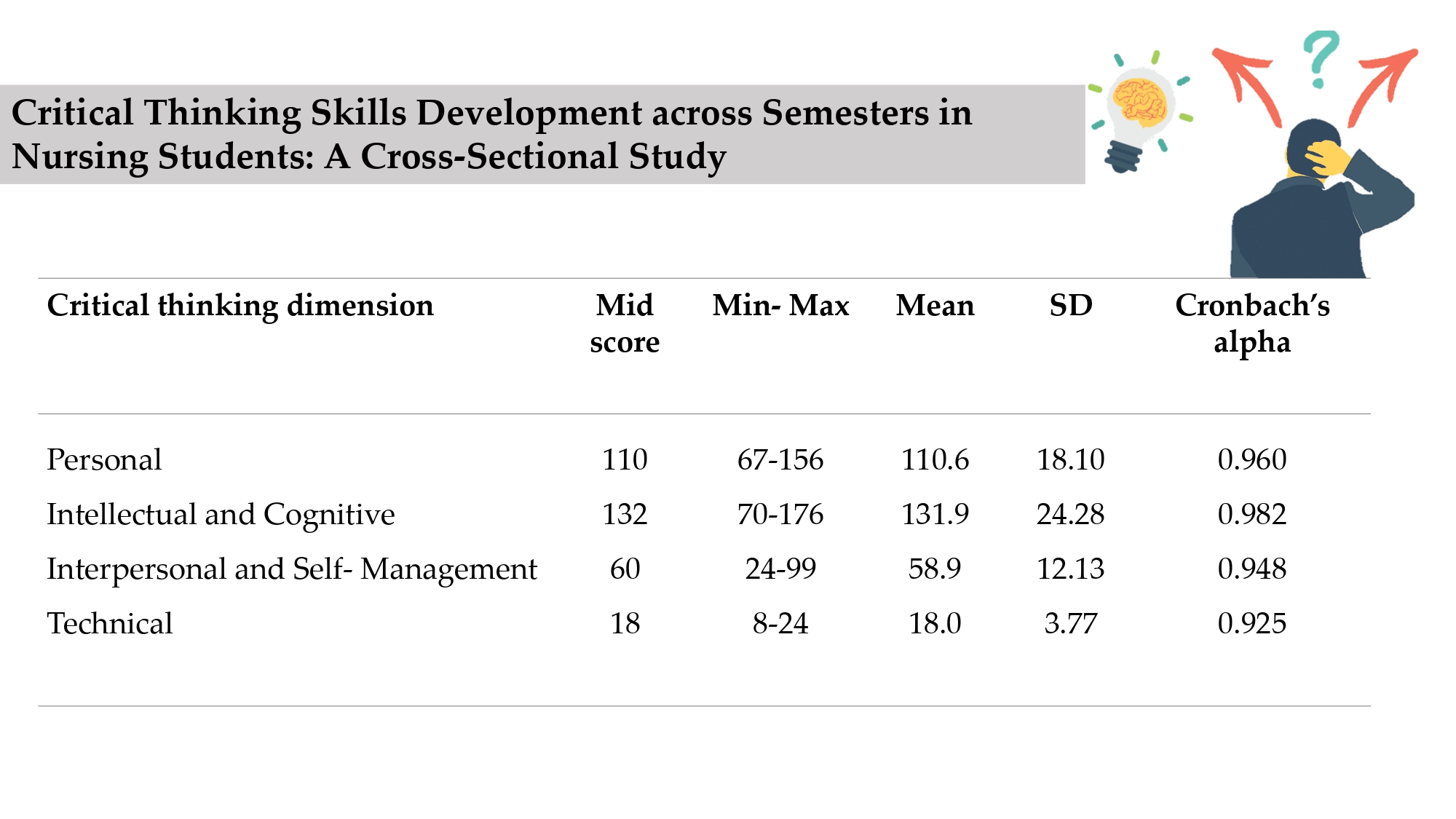
Critical thinking is a fundamental skill in nursing education that plays a crucial role in supporting professional responsibilities, enhancing service quality, and improving nursing performance in the modern era. This study aimed to analyze the dimensions of critical thinking among nursing students and assess the development of critical thinking skills across different academic semesters in the Bachelor of Nursing program at the Faculty of Nursing, IKes Payung Negeri Pekanbaru. A cross-sectional quantitative design was employed, involving 264 nursing students selected through stratified random sampling to ensure proportional representation across academic semesters. Data were collected using the Nursing Critical Thinking in Students Questionnaire (N-CT-4), which measures four dimensions of critical thinking. Descriptive and inferential statistical analyses were conducted using SPSS software, with ANOVA employed to examine differences in mean scores among students from different academic semesters. The Intellectual and Cognitive dimension had the highest mean score (M = 131.99, SD = 24.259, range = 70–176), while the Technical dimension had the lowest (M = 18.09, SD = 3.773, range = 8–24). ANOVA results indicated an upward trend in the Intellectual and Cognitive scores, increasing from 130.2 in the 3rd and 5th semesters to 136.5 in the 7th semester; however, this difference was not statistically significant. Although critical thinking skills, particularly in the cognitive domain, showed improvement across semesters, the progression was not statistically significant. These findings underscore the need for more practical, practice-based learning strategies to enhance critical thinking competencies meaningfully. Further longitudinal studies are recommended to evaluate long-term development and the impact of educational interventions.
Downloads
References
Aein, F., Hosseini, R., Naseh, A., Safdari, F. & Banaian, S. (2020). The effect of problem ‑ solving ‑ based interprofessional learning on critical. Journal of Education and Health Promotion, 9(109), 1–6. https://doi.org/10.4103/jehp.jehp DOI: https://doi.org/10.4103/jehp.jehp_640_19
Aldiabat, K., Alsrayheen, E., Aquino-Russell, C., Al-Qadire, M., Al Rawajfah, O. & Al Sabei, S. D. (2021). Differences in critical thinking skills between nursing students on a fast-track versus traditional 4-year programme. British Journal of Nursing, 30(7), 434–439. https://doi.org/10.12968/bjon.2021.30.7.434 DOI: https://doi.org/10.12968/bjon.2021.30.7.434
Ali-Abadi, T., Babamohamadi, H. & Nobahar, M. (2020). Critical thinking skills in intensive care and medical-surgical nurses and their explaining factors. Nurse Education in Practice, 45(April 2019), 102783. https://doi.org/10.1016/j.nepr.2020.102783 DOI: https://doi.org/10.1016/j.nepr.2020.102783
Arizo-Luque, V., Ramirez-Baena, L., Pujalte-Jesús, M. J., Rodríguez-Herrera, M. Á., Lozano-Molina, A., Arrogante, O. & Díaz-Agea, J. L. (2022). Does Self-Directed Learning with Simulation Improve Critical Thinking and Motivation of Nursing Students? A Pre-Post Intervention Study with the MAES© Methodology. Healthcare (Basel, Switzerland), 10(5). https://doi.org/10.3390/healthcare10050927 DOI: https://doi.org/10.3390/healthcare10050927
Azizi-Fini, I., Hajibagheri, A. & Adib-Hajbaghery, M. (2015). Critical Thinking Skills in Nursing Students: a Comparison Between Freshmen and Senior Students. Nursing and Midwifery Studies, 4(1), 1–5. https://doi.org/10.17795/nmsjournal25721 DOI: https://doi.org/10.17795/nmsjournal25721
Barry, A., Parvan, K., Jabbarzadeh Tabrizi, faranak, Sarbakhsh, P., Safa, B. & Allahbakhshian, A. (2020). Critical thinking in nursing students and its relationship with professional self-concept and relevant factors. Research and Development in Medical Education, 9(1), 7–7. https://doi.org/10.34172/rdme.2020.007 DOI: https://doi.org/10.34172/rdme.2020.007
Basco-Prado, L., Biurrun-Garrido, A., Zuriguel-Pérez, E., Roldán-Merino, J. & Mestres-Soler, O. (2024). Critical thinking level in nursing degree students according to sociodemographic and academic variables: A correlational study. Nurse Education in Practice, 78, 103955. https://doi.org/10.1016/j.nepr.2024.103955 DOI: https://doi.org/10.1016/j.nepr.2024.103955
Canto, V. B. do, Silva, T. G. da, Santos, G. A. Dos, Carvalho, E. C. de, Morais, S. C. R. V. & Frazão, C. M. F. de Q. (2021). Clinical judgment performance of undergraduate Nursing students. Revista Latino-Americana de Enfermagem, 29, e3452. https://doi.org/10.1590/1518-8345.4843.3452 DOI: https://doi.org/10.1590/1518-8345.4843.3452
Cui, C., Li, Y., Geng, D., Zhang, H. & Jin, C. (2018). The effectiveness of evidence-based nursing on development of nursing students’ critical thinking: A meta-analysis. Nurse Education Today, 65(February 2018), 46–53. https://doi.org/10.1016/j.nedt.2018.02.036 DOI: https://doi.org/10.1016/j.nedt.2018.02.036
Dirgar, E., Berşe, S., Ataman Bor, N. & Tosun, B. (2024). The effect of concept mapping in nursing education on critical thinking motivation: A path analysis. Nurse Education Today, 143(March 2024). https://doi.org/10.1016/j.nedt.2024.106386 DOI: https://doi.org/10.1016/j.nedt.2024.106386
Görücü, S., Türk, G. & Karaçam, Z. (2024). The effect of simulation-based learning on nursing students’ clinical decision-making skills: Systematic review and meta-analysis. Nurse Education Today, 140, 106270. https://doi.org/10.1016/j.nedt.2024.106270 DOI: https://doi.org/10.1016/j.nedt.2024.106270
Hashish, A. A., Ebtsam & Bajbeir, E. F. (2018). Emotional Intelligence among Saudi Nursing Students and Its Relationship to Their Critical Thinking Disposition at College of Nursing- Jeddah, Saudi Arabia. American Journal of Nursing Research, 6(6), 350–358. https://doi.org/10.12691/ajnr-6-6-2 DOI: https://doi.org/10.12691/ajnr-6-6-2
Huang, L., Li, X., Meng, Y., Lei, M., Niu, Y., Wang, S. & Li, R. (2023). The mediating effects of self-directed learning ability and critical thinking ability on the relationship between learning engagement and problem-solving ability among nursing students in Southern China: a cross-sectional study. BMC Nursing, 22(1), 1–10. https://doi.org/10.1186/s12912-023-01280-2 DOI: https://doi.org/10.1186/s12912-023-01280-2
Jimenez, J.-M., Lopez, M., Castro, M.-J., Martin-Gil, B., Cao, M. J. & Fernandez-Castro, M. (2021). Development of critical thinking skills of undergraduate students throughout the 4 years of nursing degree at a public university in Spain: A descriptive study. BMJ Open, 11(10). https://doi.org/10.1136/bmjopen-2021-049950 DOI: https://doi.org/10.1136/bmjopen-2021-049950
Kassabry, M., Al-Kalaldeh, M., Ayed, A. & Abu-Shosha, G. (2024). The impact of applying unfolding case-study learning on critical care nursing students’ knowledge, critical thinking, and self-efficacy; a quasi-experimental study. Nurse Education in Practice, 78(February 2024), 104015. https://doi.org/10.1016/j.nepr.2024.104015
Kaya, H., Şenyuva, E. & Bodur, G. (2017). Developing critical thinking disposition and emotional intelligence of nursing students: a longitudinal research. Nurse Education Today, 48, 72–77. https://doi.org/10.1016/j.nedt.2016.09.011 DOI: https://doi.org/10.1016/j.nedt.2016.09.011
Kim, D. H., Moon, S., Kim, E. J., Kim, Y.-J. & Lee, S. (2014). Nursing students’ critical thinking disposition according to academic level and satisfaction with nursing. Nurse Education Today, 34(1), 78–82. https://doi.org/10.1016/j.nedt.2013.03.012 DOI: https://doi.org/10.1016/j.nedt.2013.03.012
Ma, C. & Zhou, W. (2022). Effects of unfolding case-based learning on academic achievement, critical thinking, and self-confidence in undergraduate nursing students learning health assessment skills. Nurse Education in Practice, 60, 103321. https://doi.org/10.1016/j.nepr.2022.103321 DOI: https://doi.org/10.1016/j.nepr.2022.103321
Nemati-Vakilabad, R., Mojebi, M. R., Mostafazadeh, P., Jafari, M. J., Kamblash, A. J., Shafaghat, A., Abbasi, A. S. & Mirzaei, A. (2023a). Factors associated with the critical thinking ability among nursing students: An exploratory study in Iran. Nurse Education in Practice, 73(June), 103814. https://doi.org/10.1016/j.nepr.2023.103814
Nemati-Vakilabad, R., Mojebi, M. R., Mostafazadeh, P., Jafari, M. J., Kamblash, A. J., Shafaghat, A., Abbasi, A. S. & Mirzaei, A. (2023b). Factors associated with the critical thinking ability among nursing students: An exploratory study in Iran. Nurse Education in Practice, 73(October), 103814. https://doi.org/10.1016/j.nepr.2023.103814 DOI: https://doi.org/10.1016/j.nepr.2023.103814
Nes, A. A. G., Riegel, F., Martini, J. G., Zlamal, J., Bresolin, P., Mohallem, A. G. da C. & Steindal, S. A. (2023). Brazilian undergraduate nursing students’ critical thinking need to be increased: a cross-sectional study. Revista Brasileira de Enfermagem, 76(1), 1–8. https://doi.org/10.1590/0034-7167-2022-0315 DOI: https://doi.org/10.1590/0034-7167-2022-0315
Nguyen, T. V., Tang, M. F., Kuo, S. Y., Hu, S. H., Ngoc, T. D. T. & Chuang, Y. H. (2023). Nursing students’ critical thinking and associated factors in Vietnam: A multicenter cross-sectional study. Nurse Education in Practice, 73(October). https://doi.org/10.1016/j.nepr.2023.103823 DOI: https://doi.org/10.1016/j.nepr.2023.103823
Noone, T. & Seery, A. (2018). Critical thinking dispositions in undergraduate nursing students: A case study approach. Nurse Education Today, 68, 203–207. https://doi.org/10.1016/j.nedt.2018.06.014 DOI: https://doi.org/10.1016/j.nedt.2018.06.014
Pour, H. A., Şahin, B., Gökçe, S., Gündoğmuş, E. E., Kunter, D. & Yönem, H. (2017). Assessing Factors Affecting on Critical Thinking Skills of Nursing Students : A Descriptive-Longitudinal Study. Akademik Sosyal Araştırmalar Dergisi, 44(April), 267–278.
Shirazi, F. & Heidari, S. (2019). The relationship between critical thinking skills and learning styles and academic achievement of nursing students. Journal of Nursing Research, 27(4), 1–7. https://doi.org/10.1097/jnr.0000000000000307 DOI: https://doi.org/10.1097/jnr.0000000000000307
Vasli, P., Mortazavi, Y., Aziznejadroshan, P., Esbakian, B., Hemmat Gholinia Ahanga & Hasanali Jafarpoor. (2018). Correlation between critical thinking dispositions and self‑esteem in nursing students. January, 1–6. https://doi.org/10.4103/jehp.jehp
Westerdahl, F., Carlson, E., Wennick, A. & Borglin, G. (2022). Bachelor nursing students´ and their educators´ experiences of teaching strategies targeting critical thinking: A scoping review. Nurse Education in Practice, 63(July), 103409. https://doi.org/10.1016/j.nepr.2022.103409 DOI: https://doi.org/10.1016/j.nepr.2022.103409
Zahro, L. A., Nanda, D., Ramdaniyah, F., Anugrah, F. & Salsabila, N. S. (2025). The Role of N urses ’ Critical Thinking in Developing Effective Nursing Care Peran Pemikiran Kritis Perawat dalam Menyusun Asuhan Keperawatan yang Efektif. Menara Journal of Health Science, 4(2), 95–108.
Zarzycka, D. & Gesek, M. (2022). The factors affecting the critical thinking skills among nursing students - An integrative literature review. Pielegniarstwo XXI Wieku, 174–181. https://doi.org/10.2478/pielxxiw-2022-0021 DOI: https://doi.org/10.2478/pielxxiw-2022-0021
Zeng, Z., Wang, X., Sun, H., Thai, J., Gan, Y., Li, E. & Huang, L. (2025). Association of critical thinking disposition with personality traits and differentiation of self in medical undergraduates, a multicenter cross-sectional study in China. Frontiers in Medicine, 12, 1561786. https://doi.org/10.3389/fmed.2025.1561786 DOI: https://doi.org/10.3389/fmed.2025.1561786
Zhang, J. & Bowen, C. (2021). The effect of cooperative learning on critical thinking of nursing students in clinical practicum: A quasi-experimental study. Journal of Professional Nursing, 37(1), 177–183. https://doi.org/10.1016/j.profnurs.2020.05.008 DOI: https://doi.org/10.1016/j.profnurs.2020.05.008
Zuriguel-Pérez, E., Falcó-Pegueroles, A., Agustino-Rodríguez, S., Gómez-Martín, M. del C., Roldán-Merino, J. & Lluch-Canut, M. T. (2019). Clinical nurses’s critical thinking level according to sociodemographic and professional variables (Phase II): A correlational study. Nurse Education in Practice, 41(July), 102649. https://doi.org/10.1016/j.nepr.2019.102649 DOI: https://doi.org/10.1016/j.nepr.2019.102649
Zuriguel-Pérez, E., Falcó-Pegueroles, A., Roldán-Merino, J., Agustino-Rodriguez, S., Gómez-Martín, M. del C. & Lluch-Canut, M. T. (2017). Development and Psychometric Properties of the Nursing Critical Thinking in Clinical Practice Questionnaire. Worldviews on Evidence-Based Nursing, 14(4), 257–264. https://doi.org/10.1111/wvn.12220 DOI: https://doi.org/10.1111/wvn.12220
Zuriguel-Pérez, E., Lluch-Canut, M. T., Puig-Llobet, M., Basco-Prado, L., Almazor-Sirvent, A., Biurrun-Garrido, A., Aguayo-González, M. P., Mestres-Soler, O. & Roldán-Merino, J. (2022). The nursing critical thinking in clinical practice questionnaire for nursing students: A psychometric evaluation study. Nurse Education in Practice, 65(June), 1–7. https://doi.org/10.1016/j.nepr.2022.103498 DOI: https://doi.org/10.1016/j.nepr.2022.103498
Downloads
Submitted
Accepted
Published
How to Cite
Issue
Section
License
Copyright (c) 2026 Gita Adelia, Fahrizal Alwi, Nur Asyikin, Esperanza Zurigue Pérez , Eka Malfasari, Veni Dayu Putri, Angga Arfina, Rozzano C. Locsin, Linda H. Yoder

This work is licensed under a Creative Commons Attribution 4.0 International License.