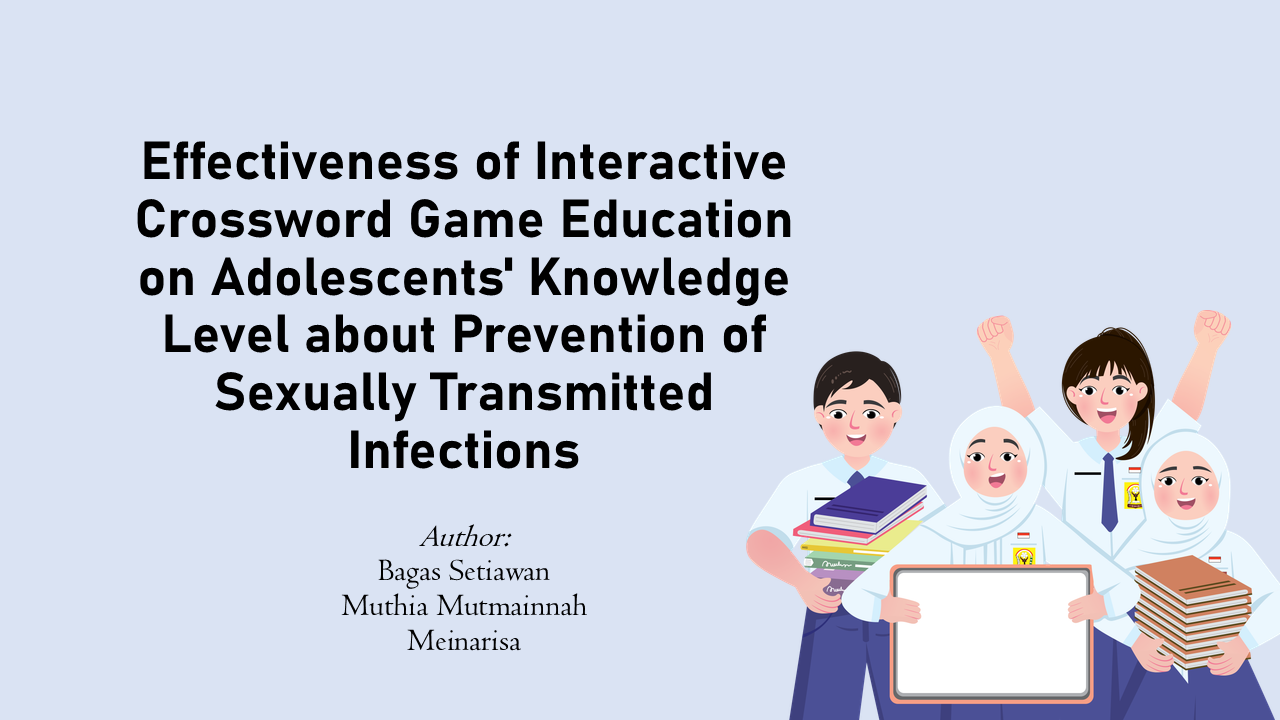
Effectiveness of Interactive Crossword Game Education on Adolescents' Knowledge Level about Prevention of Sexually Transmitted Infections
DOI:
https://doi.org/10.23917/bik.v19i2.11118Keywords:
Adolescent, crossword, knowledge, Sexualy Transmitted InfectionsAbstract
Adolescence (10-24 years) is a critical developmental period with significant physical and psychological changes, placing teens at high risk for sexually transmitted infections (STIs). Interactive crossword puzzle games offer an engaging alternative to traditional health education methods.This quasi-experimental study with a nonequivalent control group design examined the effectiveness of interactive crossword puzzles on adolescents' STI prevention knowledge. Using stratified random sampling, 102 students (grades X–XII) were recruited from SMAN 8 Jambi City (intervention group, n=51) and SMAN 5 Jambi City (control group, n=51). The intervention group received a single 90-minute session combining STI education (30 minutes) and crossword puzzle activities (60 minutes), while the control group received conventional lectures of equal duration. Knowledge was assessed using a validated 25-item questionnaire before and immediately after the intervention. Mann-Whitney test analysis revealed no significant difference between groups pre-intervention (p=0.959), but a statistically significant improvement post-intervention (p=0.001). The intervention group showed a substantial mean score increase from 19.71 to 22.22, while the control group showed minimal change from 20.02 to 20.49. The crossword puzzle method proved significantly more effective than conventional lectures for enhancing adolescents' STI knowledge, with the intervention group achieving 100% knowledge classification as "good" compared to 90.2% in the control group. Interactive crossword game education is a highly effective, innovative, and applicable method to improve adolescents' knowledge of sexually transmitted infections, with superior effectiveness compared to conventional education methods.
Downloads
References
Abdullah, S. M. (2019). Social Cognitive Theory : A Bandura Thought Review published in 1982-2012. Psikodimensia, 18(1), 85. https://doi.org/10.24167/psidim.v18i1.1708
Ajani, A. T. (2023). Pengaruh Pendidikan Kesehatan terhadap Perilaku Pencarian Informasi Kesehatan pada Remaja di Sekolah. Journal on Education, 6(1), 1027–1034. https://doi.org/10.31004/joe.v6i1.3036
Angelique, N. V., Afifur Rafi Hilmi Aziz, Asvarina Al Jannati, Alvin Virya, Salsabela Komalasari, Prima Kartika, Rr Mitsaqon Gholiza Fudryasah, Hisaanti Farayi Yunenda, & Sjahfryza Ahmad Ma’arif. (2023). Reproductive Health Socialization for Adolescents Using a Combination of Crosswords and Lecture Methods. Jurnal Layanan Masyarakat (Journal of Public Services), 7(3), 351–360. https://doi.org/10.20473/jlm.v7i3.2023.351-360
Ariyanti, K. S., Sariyani, M. D., & Utami, L. N. (2019). Penyuluhan Kesehatan Reproduksi Remaja Untuk Meningkatkan Pengetahuan Siswa di SMP Negeri 3 Selemadeg Timur. Indonesian Journal of Community Empowerment (IJCE), 1161, 7–11.
As’ari, A. S. & Raharjo., I. (2019). Pengembangan Media Pembelajaran Biologi Dengan Teka-Teki Silang (TTS) Berbasis Macromedia Flash Materi Sistem Pertahanan Tubuh. Jurnal Bioedu, 8(2).
Badan Pusat Statistik Provinsi Jambi. (2022). PROVINSI JAMBI DALAM ANGKA 2022.
BKKBN. (2018). Indonesia Demographic and Health Survey 2017: Adolescent Reproductive Health. BKKBN, BPS, Kemenkes, ICF, 29–42. https://dhsprogram.com/pubs/pdf/FR343/FR343.pdf
Dewanti, R. A., Yana, Y., Maretha, D. E., Ulfa, K., Riswanda, J., & Nurokhman, A. (2019). Validitas pengembangan media pembelajaran teka-teki silang pada materi plantae di Kelas X SMA. Prosiding Seminar Nasional Pendidikan Biologi 2019, 23–28.
Emilda, S. (2021). Analisis Kesehatan Reproduksi Pada Remaja. Jurnal Kesehatan Dan Pembangunan, 11(21), 93–101. https://doi.org/10.52047/jkp.v11i21.104
Gentry, S. V., Gauthier, A., L’Estrade Ehrstrom, B., Wortley, D., Lilienthal, A., Tudor Car, L., Daules-Okutsu, S., Nikolaou, C. K., Zary, N., Campbell, J., & Car, J. (2019). Serious gaming and gamification education in health professions. Journal of Medical Internet Research, 21(3), `234-247.
Goldfarb, E. S., & Constantine, N. A. (2020). Three decades of research: The case for comprehensive sex education. Journal of Adolescent Health, 68(1), 13–27.
Hairuddin, K., Passe, R., & Sudirman, J. (2022). Penyuluhan Kesehatan Tentang Penyakit Infeksi Menular Seksual (IMS) Pada Remaja. Abdimas Singkerru, 2(1), 12–18. https://doi.org/10.59563/singkerru.v2i1.122
Hidayat, S., Anggraeni, F. D. R., & Mukhlishoh, S. (2020). Pengembangan Buku Bergambar Bertekstur Dilengkapi Teka-Teki Silang Sebagai Media Pembelajaran Biologi Sub Materi Jaringan Epitel Kelas XI SMA. Symbiotic: Journal of Biological Education and Science, 1(1), 15–24. https://doi.org/10.32939/symbiotic.v1i1.2
Inhelder, B., & Piaget, J. (1958). The growth of logical thinking from childhood to adolescence. Kementerian Kesehatan Republik Indonesia. (2024). KELOMPOK USIA Remaja 10-18 Tahun. Ayo Sehat.
Lakoro, S., Eraku, S., & Yusuf, D. (2020). Pengaruh Media Permainan Teka-Teki Silang Terhadap Hasil Belajar Siswa Pada Pembelajaran Geografi Di Sma Negeri 1 Marisa. Jambura Geo Education Journal, 1(1), 32–38. https://doi.org/10.34312/jgej.v1i1.4845
Rahmawati, S., Setyowati, S., Budiati, T., & Rachmawati, I. N. (2023). Faktor-Faktor yang Memengaruhi Kesehatan Reproduksi Remaja. Journal of Telenursing (JOTING), 5(2), 2632–2640. https://doi.org/10.31539/joting.v5i2.7713
Ryan, R. M., & Deci, E. L. (2020). Intrinsic and extrinsic motivation from a self-determination theory perspective: Definitions, theory, practices, and future directions. Psychological Review, 127(1), 1–35.
Susilowati, L., Trisetiyaningsih, Y., Yati, D., Kesehatan, F., Achmad, J., Yogyakarta, Y., Yani, A., Email, Y., & Id, N. C. (2020). Pendampingan Remaja Di Pik-R Sma Negeri 3 Bantul Sebagai Upaya Pencegahan Seks Bebas. Jurnal Pengabdian Masyarakat Karya Husada, 47(1), 2020.
Sweller, J., van Merriënboer, J. J., & Paas, F. (2019). Cognitive architecture and instructional design: 20 years later. Educational Psychology Review, 31(261–292).
Theresia, F., Tjhay, F., Surilena, S., & Widjaja, N. T. (2020). Faktor-Faktor Yang Mempengaruhi Perilaku Seksual Siswa Smp Di Jakarta Barat. Jurnal Kesehatan Reproduksi, 11(2), 101–113. https://doi.org/10.22435/kespro.v11i2.3142.101-113
Utami, I. H. P., & Thohir, M. A. (2022). Pengaruh Pendampingan Orang Tua Terhadap Kesehatan Mental Siswa Sekolah Dasar Dalam Pembelajaran Jarak Jauh. JKPD (Jurnal Kajian Pendidikan Dasar), 7(2), 116–122. https://doi.org/10.26618/jkpd.v7i2.7691
Wahid, W. K., Latif, S., Sinring, A., & Makassar, U. N. (2024). Jurnal Bimbingan dan Konseling Pandohop dalam Mencegah Pelecehan Seksual Child Grooming Needs Analysis of Media Counseling for High School Adolescents in Preventing Child Grooming Sexual Abuse. 4, 45–52.
WHO. (2023.). Sexually Transmitted Infections (STIs).
Downloads
Submitted
Accepted
Published
How to Cite
Issue
Section
License
Copyright (c) 2026 Bagas Setiawan, Muthia Mutmainnah, Meinarisa Meinarisa

This work is licensed under a Creative Commons Attribution 4.0 International License.