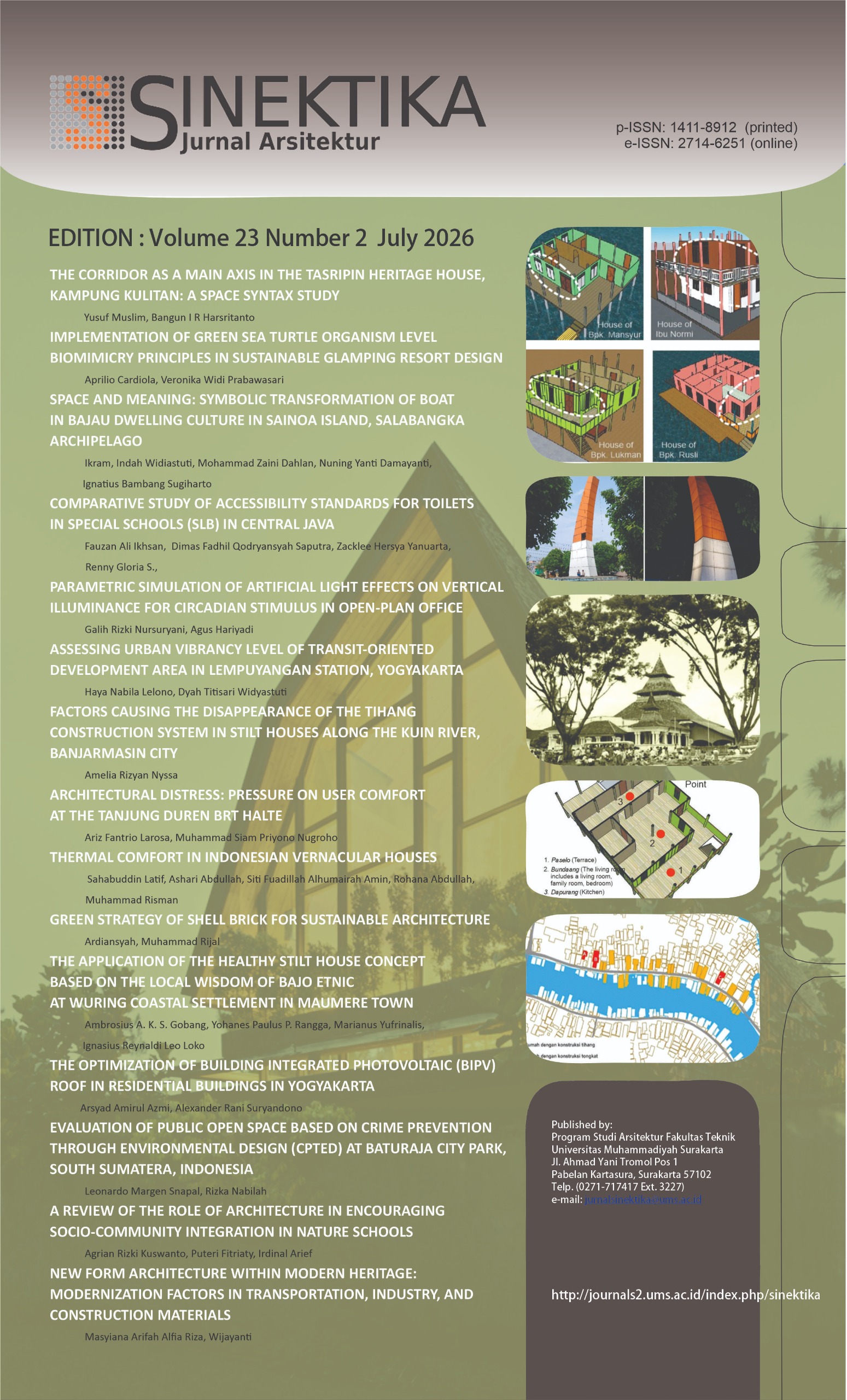
Comparative Study of Accessibility Standards for Toilets in Special Schools (SLB) in Central Java
DOI:
https://doi.org/10.23917/sinektika.v23i2.15406Keywords:
Accessibility, The Americans with Disabilities Act, Special Schools, Indonesian National Standard, ToiletAbstract
This research examines the comparison of toilet accessibility standards in Special Schools (SLB) in Central Java Province against the provisions in the Regulation of the Ministry of Public Works and Housing (Permen PUPR) Number 14 of 2017 and the Americans with Disabilities Act (ADA). The background of this research is based on the importance of providing equal sanitation facilities for students with special needs, considering accessibility is a crucial aspect in supporting inclusivity and independence in the educational environment. The urgency of this research lies in the effort to identify the gap between the existing facility conditions and the applicable national and international standards. The research method used is descriptive-comparative through field observation, documentation, and comparative analysis of standards at several Special Schools (SLB) in the Central Java region. Each facility is evaluated based on spatial planning parameters, circulation, equipment dimensions, and supporting elements for people with disabilities. The research results show that although some special schools have adopted the principles of inclusive design, most toilet facilities have not fully met the minimum standards of Permen PUPR No. 14/2017, and even lag behind the provisions in the ADA, particularly in terms of corridor width, door width, door opening direction, and toilet area. This finding underscores the need for continuous evaluation and improvement of accessible facilities in educational environments to align with the principles of universal design and support equality for all students.
Downloads
References
Bahari, P. I., Musthafa, R. N., Arisanti, S. A., & Harmunisa, Y. R. (2023). Application of inclusive design to school accessibility as a form of equality for people with disabilities. Seminar Nasional Arsitektur Pertahanan.
Blanck, P. (2023). Advanced introduction to U.S. disability law. Edward Elgar Publishing.
Department of Justice. (2010). 2010 ADA standards for accessible design. www.ADA.gov
Dolphin Solutions. (2026). Suitable accessible toilets for disabled persons. https://www.dolphinsolutions.com/en/news/accessible-toilets-for-disabled-persons/
Dwi, D. (2025, March 18). Toilet difabel sebagai wujud inklusivitas dan kepedulian. Archiplan. https://archiplan.ugm.ac.id/id/toilet-difabel-sebagai-wujud-inklusivitas-dan-kepedulian/
Janati, Z. I., Nurhasan, N. (2024). Evaluasi toilet disabilitas pada SLB N Karanganyar fokus pada pengguna kursi roda. Jurnal Seminar Ilmiah Arsitektur V.
Kementerian Pekerjaan Umum dan Perumahan Rakyat. (2017a). Peraturan Menteri Pekerjaan Umum dan Perumahan Rakyat Republik Indonesia Nomor 14/PRT/M/2017 tentang Persyaratan Kemudahan Bangunan Gedung.
Kementerian Pekerjaan Umum dan Perumahan Rakyat. (2017b). Lampiran II Peraturan Menteri Pekerjaan Umum dan Perumahan Rakyat Nomor 14/PRT/M/2017 tentang Persyaratan Kemudahan Bangunan Gedung.
Liritantri, W., Handoyo, A. D., Bazukarno, K. P., & Arnita, L. K. (2021). Accessible Design analysis for Physical Disabilities in Faculty of Creative Industry, Telkom University. Arsitektura, 19(2). https://doi.org/10.20961/arst.v19i2.50841
Maimunah, S., Apsari, N. C., & Rachim, H. A. (2024). Aksesibilitas inklusif: Implementasi infrastruktur publik ramah disabilitas di Indonesia (Sebuah literature review). Focus: Jurnal Pekerjaan Sosial, 7(2), 278–290. https://doi.org/10.24198/focus.v7i2.60851
Mastari, T. K. (2025). Pemenuhan hak aksesibilitas penyandang disabilitas. Muhammadiyah Law Review, 9(1).
Prajalani, Y. N. H., & Himawanto, D. A. (2017). Aksesibilitas bagi anak berkebutuhan khusus di SLB Negeri Sukoharjo. Indonesian Journal of Disability Studies (IJDS), 4(2), 87-95.
Putra, R. P., Buyang, C. G., & Taihuttu, F. (2025). Evaluasi aksesibilitas bagi penyandang disabilitas pada gedung RSUD dr. M. Haulussy Kota Ambon. Jurnal Simetrik, 15(2). https://doi.org/10.31959/js.v15i2.3443
Reach. (2026). The importance of accessibility for people with disabilities. https://www.reachcils.org/announcements/the-importance-of-accessibility-for-people-with-disabilities/
Siregar, V., Rosi, L., Osira, Y., Meliani, T., & Samosir, F. T. (2024). Aksesibilitas anak tunagrahita di SLB Negeri 01 Bengkulu Selatan.
Yahya, G. (2020). Kajian konsep aksesibilitas pada SLB Negeri Bekasi Jaya. Jurnal Linears, 3(2). https://doi.org/10.26618/j-linears.v3i2.4029
Downloads
Submitted
Accepted
Published
How to Cite
Issue
Section
License
Copyright (c) 2026 Sinektika: Jurnal Arsitektur

This work is licensed under a Creative Commons Attribution-NonCommercial 4.0 International License.