Innovation in Islamic Banking Services for Sustainable Development: An Analysis of the Alignment of Islamic Values with SDGs
DOI:
https://doi.org/10.23917/profetika.v27i01.13570Keywords:
islamic banking, service innovation, maqāṣid al-syarī'ah, sdgs, sustainable financeAbstract
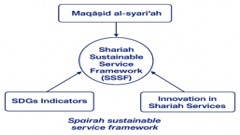
Objective: This study aims to analyse the alignment of Islamic banking service innovations with the Sustainable Development Goals (SDGs) through a maqāṣid al-sharī‘ah–based values approach, positioning Islamic finance as a strategic actor in sustainable development. Theoretical framework: Integrates maqāṣid al-sharī‘ah principles, particularly justice (‘adl), public benefit (maṣlaḥah), and balance (tawāzun), with the multidimensional SDG paradigm encompassing economic growth, social equity, and environmental sustainability. Literature review: Conceptualisation of service innovation in Islamic banking, the relationship between Sharia values and the Sustainable Development Goals, and integration of innovation and sustainability in Islamic banking practices. Method: Employing a qualitative research design based on library research, data were analysed through stages of presentation, conceptual development, and conclusion drawing, using a hermeneutic approach to interpret the substantive relationships between maqāṣid principles and SDG targets. Results: the findings reveal a strong conceptual convergence between Islamic ethical values and key SDG dimensions, particularly poverty alleviation, social equality, and environmental protection, leading to the formulation of the Shariah Sustainable Service Framework (SSSF), which comprises three interconnected pillars: spirituality as a moral foundation, social justice as the orientation of benefit distribution, and economic efficiency as an instrument of productive sustainability. Implications: This framework provides normative and strategic guidance for Islamic financial institutions in designing ethically grounded and sustainability-oriented service innovations, while offering regulators and policymakers a reference for strengthening sharia-based governance aligned with global development agendas. Novelty: This study lies in the development of an original integrative framework that systematically bridges maqāṣid al-sharī‘ah values with SDG indicators, advancing Islamic banking from a compliance-driven model toward a value-based paradigm of sustainable development.
References
[1] M. M. L. Lim, P. S. Jørgensen, and C. A. Wyborn, “Reframing the sustainable development goals to achieve sustainable development in the Anthropocene a systems approach,” Ecol. Soc., vol. 23, no. 3, 2018, https://doi.org/10.5751/ES-10182-230322.
[2] J. Gupta and C. Vegelin, “Sustainable development goals and inclusive development,” Int. Environ. Agreements Polit. Law Econ., vol. 16, no. 3, pp. 433–448, 2016, https://doi.org/10.1007/s10784-016-9323-z.
[3] S. Alhammadi, K. O. Alotaibi, and D. F. Hakam, “Analysing Islamic banking ethical performance from Maqāṣid al-Sharī‘ah perspective: evidence from Indonesia,” J. Sustain. Financ. Invest., vol. 12, no. 4, pp. 1171–1193, 2022, https://doi.org/10.1080/20430795.2020.1848179.
[4] N. A. Abasimel, “Islamic Banking and Economics: Concepts and Instruments, Features, Advantages, Differences from Conventional Banks, and Contributions to Economic Growth,” J. Knowl. Econ., vol. 14, no. 2, pp. 1923–1950, 2023, https://doi.org/10.1007/s13132-022-00940-z.
[5] E. Smolo, I. Saba, N. Ismail, and Z. Mahomed, “Integrating Islamic Finance Into the Sustainable Development Goals (SDGs),” The Future of Islamic Finance: From Shari’ah Law to Fintech. Emerald Publishing Limited, p. 0, Nov. 2024. https://doi.org/10.1108/978-1-83549-906-120241005.
[6] I. Tlemsani, A. Zaman, M. A. Mohamed Hashim, and R. Matthews, “Digitalisation and sustainable development goals in emerging Islamic economies,” J. Islam. Account. Bus. Res., vol. 16, no. 5, pp. 890–914, 2023, https://doi.org/10.1108/JIABR-03-2023-0092.
[7] R. Kamla and H. G. Rammal, “Social reporting by Islamic banks: does social justice matter?” Accounting, Audit. Account. J., vol. 26, no. 6, pp. 911–945, 2013, https://doi.org/10.1108/AAAJ-03-2013-1268.
[8] L. Gelmini, “Islamic banks: Sustainability, integrated reporting and religion,” Corp. Gov. Sustain. Rev., vol. 1, no. 2, pp. 35–42, 2017, https://doi.org/10.22495/cgsrv1i2p5.
[9] I. Saba, A. Khan, and H. Jawed, “Islamic Finance and SDGs: Connecting Dots,” in Islamic Finance and Sustainable Development : A Sustainable Economic Framework for Muslim and Non-Muslim Countries, M. K. Hassan, M. Saraç, and A. Khan, Eds., Cham: Springer International Publishing, 2021, pp. 55–76. https://doi.org/10.1007/978-3-030-76016-8_4.
[10] H. Ahmed and M. Mohieldin, “Sustainable Development Goals and the role of Islamic finance,” Proc. 1st Kedah Int. Zakat Conf. 2019 (KEIZAC 2019), no. May, pp. 698–708, 2015, https://doi.org/10.1596/1813-9450-7266.
[11] M. Asutay and I. Yilmaz, “Constituting an Islamic social welfare function: an exploration through Islamic moral economy,” Int. J. Islam. Middle East. Financ. Manag., vol. 14, no. 3, pp. 524–540, 2021, https://doi.org/10.1108/IMEFM-03-2019-0130.
[12] W. A. Mahyudin and R. Rosman, “Performance of Islamic banks based on maqāṣid al-sharīʿah: a systematic review of current research,” J. Islam. Account. Bus. Res., vol. 13, no. 4, pp. 714–735, 2022, https://doi.org/10.1108/JIABR-10-2020-0337.
[13] A. Elsafty and A. Tahon, “Exploring Impact of Corporate Social Responsibility on Organisational Performance, the Case of Turkish Islamic Banks,” Bus. Manag. Stud., vol. 7, no. 1, pp. 1–21, 2021, https://doi.org/10.11114/bms.v7i1.5087.
[14] A. Y. Ismail, L. B. Musafar Hameed, A. F. Mohamad Suhaimi, N. I. Jamaludin, and S. Shahimi, “Value-Based Intermediation and Interconnection of Sustainable Development Goals in Islamic Banking Framework,” Int. J. Islam. Econ. Financ. Res., vol. 3, no. 1, pp. 45–56, Aug. 2020, https://doi.org/10.53840/ijiefer11.
[15] F. Faizi, A. S. Kusuma, and P. Widodo, “Islamic green finance: mapping the climate funding landscape in Indonesia,” Int. J. Ethics Syst., vol. 40, no. 4, pp. 711–733, 2024, https://doi.org/10.1108/IJOES-08-2023-0189.
[16] A. Arfan, I. A. Arfan, A. Alkoli, and R. Ramadhita, “The implementation of Maqashid Sharia: heterogeneity of scholars’ fatwas towards Islamic banking contracts,” Leg. J. Ilm. Huk., vol. 32, no. 1, pp. 105–128, 2024, https://doi.org/10.22219/ljih.v32i1.32170.
[17] O. Defilania, A. Gunadi, N. Rohaya, and M. Khutub, “Legal Pluralism and Maqāṣid Al-Sharīʿah in Regulating Cooperative Finance under Indonesia’s Financial Services Authority,” Az-Zarqa’ J. Huk. Bisnis Islam, vol. 17, no. 1, pp. 1–21, 2025, https://doi.org/10.14421/az-zarqa.v17.i1.4344.
[18] Ahmad Kholil, Muhammad Zuardi, Amrin, and Juryatina, “Optimising Islamic Financial Instruments in Indonesia to Support SDGs: Maqashid Syariah Perspective,” Profetika J. Stud. Islam, vol. 26, no. 01, pp. 191–210, 2025, https://doi.org/10.23917/profetika.v26i01.9217.
[19] J. Auda, Maqasid Al-shariah as Philosophy of Islamic Law: A Systems Approach. International Institute of Islamic Thought, 2008, https://doi.org/10.2307/j.ctvkc67tg.
[20] M. U. Chapra, The Future of Economics: An Islamic Perspective. United Kingdom: The Islamic Foundation Markfield Conference Centre, 2000.
[21] Muhammad Zuardi, Ahmad Kholil, Amrin, and Ishma Amelia, “Transformation of the Concept of Maslahah in Sustainable Islamic Finance: a Hermeneutic Analysis of al-Ghazali’s Thoughts and ash-Syatibi,” Profetika J. Stud. Islam, vol. 26, no. 01, pp. 211–228, 2025, https://doi.org/10.23917/profetika.v26i01.9616.
[22] Amrin, M. D. Fajri, Ri. Agus, and Sugiyarto, “Strengthening Islamic Law of Financial Literacy Through Integrating Local Wisdom in West Nusa Tenggara Communities,” Addin, vol. 19, no. 2, pp. 291–326, 2025, https://doi.org/10.21043/addin.v19i2.31902.
[23] J. W. Creswell and J. D. Creswell, Research Design: Qualitative, Quantitative, and Mixed Methods Approaches. California: Sage Publications, 2017.
[24] J. M. Lexy, Metodologi Penelitian Kualitatif. In Metodologi Penelitian Kualitatif, no. Maret. Moleong, M.A: PT Remaja Rosdakarya, 2022. [Online]. Available: https://scholar.google.com/citations?user=O-B3eJYAAAAJ&hl=en
[25] M. Miles, M. Huberman, and J. Saldaña, Qualitative data analysis: A methods sourcebook. 3rd. 2014.
[26] M. U. Chapra, Islam and the Economic Challenge. International Institute of Islamic Thought (IIIT), 1992.
[27] N. Hikmah and M. Yazid, “Maqashid Al-Syariah as a Contemporary Economic Solution According to Yusuf Al-Qaradawi,” ITQAN J. Islam. Econ. Manag. Financ., vol. 4, no. 1, pp. 51–63, 2024, https://doi.org/10.57053/itqan.v4i1.62.
[28] M. A. Khan, “Islamic Economics: Nature and Need,” J. Res. Islam. Econ, vol. 1, no. 2, pp. 51–55, 1984.
[29] A. W. Dusuki and N. I. Abdullah, “Maqasid al-Shariah, Maslahah, and corporate social responsibility,” Am. J. Islam. Soc. Sci., vol. 24, no. 1, p. 25, 2007, https://doi.org/10.35632/ajis.v24i1.415.
[30] H. Canton, “Islamic Development Bank—IsDB,” in The Europa Directory of International Organisations, London: Routledge, 2021, https://doi.org/10.4324/9781003179900.
[31] E. Housby, Islamic and Ethical Finance in the United Kingdom. Edinburgh: Edinburgh University Press, 2013, https://doi.org/10.1515/9780748648979.
[32] D. Charles, “Technological Innovation,” Aust. J. Public Adm., vol. 49, no. 3, pp. 332–342, 1990, https://doi.org/10.1111/j.1467-8500.1990.tb01976.x.
[33] S. Cherni and A. Ben Amar, “Does digitalisation affect shariah supervisory board efficiency? Evidence from Islamic banks,” J. Islam. Account. Bus. Res., 2024, https://doi.org/10.1108/JIABR-03-2023-0077.
[34] M. M. Alshater, I. Saba, I. Supriani, and M. R. Rabbani, “Fintech in Islamic finance literature: A review,” Heliyon, vol. 8, no. 9, p. e10385, 2022, https://doi.org/10.1016/j.heliyon.2022.e10385.
[35] A. A. Mahfudz, Rusyda Afifah Ahmad, Daribayeva Meruyert, and Nafi Ilman Husin, “Integrating Islamic finance principles and the digital disruptive age to support global sustainability,” al-Uqud J. Islam. Econ., vol. 8, no. 2, pp. 175–188, 2024, https://doi.org/10.26740/al-uqud.v8n2.p175-188.
[36] F. H. M. Liu and K. P. Y. Lai, “Ecologies of green finance: Green sukuk and development of green Islamic finance in Malaysia,” Environ. Plan. A Econ. Sp., vol. 53, no. 8, pp. 1896–1914, 2021, https://doi.org/10.1177/0308518X211038349.
[37] A. Delle Foglie and J. S. Keshminder, “Challenges and opportunities of SRI sukuk toward financial system sustainability: a bibliometric and systematic literature review,” Int. J. Emerg. Mark, vol. 19, no. 10, pp. 3202–3225, Dec. 2022, https://doi.org/10.1108/IJOEM-04-2022-0601.
[38] F. Faizi, A. N. R. Rohim, M. H. S. Surbakti, M. Munir, and U. Q. Qulsum, “Ensuring Shariah compliance in the Fintech: a comprehensive analysis from Indonesia,” Qual. Res. Financ. Mark, pp. 1–31, Oct. 2025, https://doi.org/10.1108/QRFM-05-2025-0129.
[39] Y. Taufik Syamlan, S. Wahyuni, I. Heruwasto, and M. Hamsal, “Exploring sharia compliance parameters in marketing to foster innovation and collaboration within Islamic finance,” J. Islam. Mark, May 2025, https://doi.org/10.1108/JIMA-04-2024-0172.
[40] J. E. Stiglitz, People, Power, and Profits: Progressive Capitalism for an Age of Discontent. Penguin UK, 2019.
[41] A. Duderija, “Islamic Law Reform and Maqāṣid al-Sharīʿa in the Thought of Mohammad Hashim Kamali,” in Maqāṣid al-Sharīʿa and Contemporary Reformist Muslim Thought: An Examination, A. Duderija, Ed., New York: Palgrave Macmillan US, 2014, pp. 13–37. https://doi.org/10.1057/9781137319418_2.
[42] M. A. K. Hasan and S. Hidayat, “Terjemahan Al-hurûf Al-muqaththa ’ah Versi Inkar Al-sunnah: Telaah Kritis Al-quran dan Terjemah Versi Tadabbur,” Miqot. academia.edu, 2017, https://doi.org/10.30821/miqot.v41i1.367.
[43] M. U. Chapra, The Future of Economics: An Islamic Perspective. Leicester: Kube Publishing, 2016.
[44] K. P. Walsh, “Transforming usury into finance: Financialization and the ethics of debt,” Financ. Soc., vol. 4, no. 1, pp. 41–59, 2018, https://doi.org/10.2218/finsoc.v4i1.2739.
[45] Departemen Agama RI, AL-JUMANATUL ‘ALI Al-Qur’an dan Terjemahannya. Bandung: CV. Penerbit J-ART, 2014.
[46] A. A. Oseni, N. B. Bamiro, S. A. Ashafa, and S. D. Olohunlana, “Sustainable Halal Financing Framework for Blue and Green Economy,” in Green and Blue Economy Frameworks for Halal Industry Sustainability, M. A. Salisu, L. Raimi, N. B. Bamiro, and I. O. Elegbede, Eds., Singapore: Springer Nature Singapore, 2025, pp. 253–273. https://doi.org/10.1007/978-981-96-1729-6_14.
[47] Imam Ghazali, Al-Mustasfa min al-Usul, Jilid II. Cairo: Amiriyah, 1442.
[48] L. da Silva Inácio and I. Delai, “Sustainable banking: a systematic review of concepts and measurements,” Environ. Dev. Sustain., vol. 24, no. 1, pp. 1–39, 2022, https://doi.org/10.1007/s10668-021-01371-7.
[49] F. A. Mohd Zain, W. A. Wan Abdullah, M. N. Muhamad Nasir, and M. F. Hassan, “Development of a comprehensive sustainability performance index for takaful operators: integrating Maqasid Al-Shariah and stakeholder perspectives,” Int. J. Islam. Middle East. Financ. Manag., vol. 18, no. 3, pp. 628–648, Jan. 2025, https://doi.org/10.1108/IMEFM-07-2024-0343.
[50] K. A. Dirie, M. M. Alam, and S. Maamor, “Islamic social finance for achieving sustainable development goals: a systematic literature review and future research agenda,” Int. J. Ethics Syst., vol. 40, no. 4, pp. 676–698, Jan. 2024, https://doi.org/10.1108/IJOES-12-2022-0317.
[51] R. C. Sari, M. Sholihin, F. R. Cahaya, N. Yuniarti, S. Ilyana, and E. Fitriana, “Responding to Islamic finance anomalies in Indonesia: Sharia financial literacy using virtual reality context,” J. Islam. Account. Bus. Res., 2024, https://doi.org/10.1108/JIABR-08-2022-0195.
[52] R. E. Freeman, J. S. Harrison, A. C. Wicks, B. Parmar, and S. de Colle, “Stakeholder theory: The state of the art,” Stakeholder. Theory State Art, pp. 1–343, 2010, https://doi.org/10.1017/CBO9780511815768.
[53] Amrin, “Enhancing Student Engagement with Indonesian Sharia Banking : The Role of Sharia Financial Literacy,” JEKSYAH (Islamic Econ. Journal), vol. 03, no. 01, pp. 36–43, 2023, https://doi.org/10.54045/jeksyah.v3i01.307.
[54] K. Kaharuddin, A. Amrin, M. R. Nurdin, S. Sugiyarto, S. Su’ud, and S. Supriyanto, “The Role of Islamic Financial Literacy and Local Wisdom in Decisions to Use Sharia Banking Products: A Systematic Literature Review,” Mimb. Agama Budaya, vol. 41, no. 1, pp. 61–79, 2024, https://doi.org/10.15408/mimbar.v41i1.38602.
[55] Khalina Mohammed Khalili, “Criticisms On Ontological Relativism Of Modern Science By Syed Muhammad Naquib Al-Attas And Seyyed Hossein Nasr,” Al-Shajarah J. Int. Inst. Islam. Thought Civilis, vol. 29, no. 1, pp. 127–152, 2024, https://doi.org/10.31436/shajarah.v29i1.1832.
[56] M. E. Porter, Cases in Competitive Strategy. New York: Simon and Schuster, 1983.
[57] F. Rahman, Islam & Modernity: Transformation of an Intellectual Tradition. London: University of Chicago Press, 2017.
[58] A. H. Usman, M. Farid, R. Abdullah, M. Najib, and A. Kadir, “The Concept of an Ideal Society : A Review of Fazlur Rahman ’ s Perspective,” International J. Islam. Thought, vol. 21, pp. 1–12, 2022, https://doi.org/10.24035/ijit.21.2022.220.
[59] I. Yilmaz, “Exploring the foundations of Islamic moral economy: a return to substantive morality,” Int. J. Ethics Syst., Oct. 2024, https://doi.org/10.1108/IJOES-03-2024-0085.
[60] M. Muthoifin, A. Nurhayatii, A. Amrin, and ..., “Pembiayaan Syariah di Bank Perkreditan Rakyat Syariah pada Masa Pandemi Covid-19,” Pros. Univ. Res. Colloq., pp. 43–51, 2022.
[61] Z. Hasan, “An Analysis Of The Indonesian Sharia Banking Development Roadmap 2020-2025,” Online J. Islam. Manag. Financ., vol. 3, no. 1, pp. 36–54, 2025, https://doi.org/10.22452/ojimf.v3i1.43382.
[62] E. Sugianto, “Strategy for Accelerating Development of the National Sharia Economic and Financial Committee ( KNEKS ) Efforts to Improve Sharia Financial Institutions in Indonesia,” SYARIKAT J. Rumpun Ekon. Syariah, vol. 7, no. 1, pp. 1–13, 2024, https://doi.org/10.25299/syarikat.2024.vol7(1).16963.
Downloads
Submitted
Accepted
Published
Issue
Section
License
Copyright (c) 2026 Mardelia Desfrida, Amrin, Obydur Rahman

This work is licensed under a Creative Commons Attribution 4.0 International License.