Fruit and Vegetable Wastes: Review of Nutritional Composition, Antimicrobial Potential, and Sustainable Applications in Malaysia
DOI:
https://doi.org/10.23917/pharmacon.v22i2.13799Keywords:
Fruit and Vegetable Waste, Proximate Analysis, Nutraceuticals, Nanotechnology, BioinformaticsAbstract
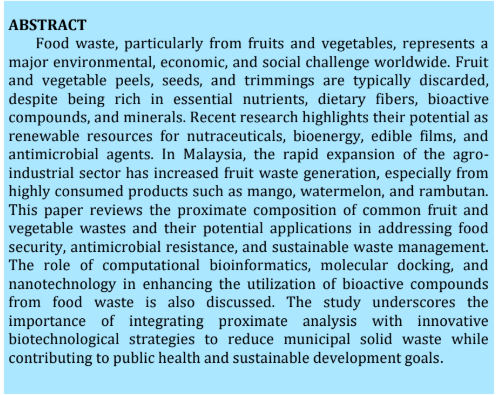
Food waste, particularly from fruits and vegetables, represents a major environmental, economic, and social challenge worldwide. Fruit and vegetable peels, seeds, and trimmings are typically discarded, despite being rich in essential nutrients, dietary fibers, bioactive compounds, and minerals. Recent research highlights their potential as renewable resources for nutraceuticals, bioenergy, edible films, and antimicrobial agents. In Malaysia, the rapid expansion of the agro-industrial sector has increased fruit waste generation, especially from highly consumed products such as mango, watermelon, and rambutan. This paper reviews the proximate composition of common fruit and vegetable wastes and their potential applications in addressing food security, antimicrobial resistance, and sustainable waste management. The role of computational bioinformatics, molecular docking, and nanotechnology in enhancing the utilization of bioactive compounds from food waste is also discussed. The study underscores the importance of integrating proximate analysis with innovative biotechnological strategies to reduce municipal solid waste while contributing to public health and sustainable development goals.
Downloads
References
Abouzeed, Y. M., Hariharan, H., & Poppe, C. (2013). Characterization of antimicrobial resistance in Salmonella spp. isolated from food animals, food, and humans. Canadian Journal of Veterinary Research, 77(2), 86–93.
Abreu, A. C., McBain, A. J., & Simoes, M. (2012). Plants as sources of new antimicrobials and resistance-modifying agents. Natural Product Reports, 29(9), 1007–1021. https://doi.org/10.1039/c2np20035j DOI: https://doi.org/10.1039/c2np20035j
Adamczyk, B., Kitunen, V., Smolander, A., & Hämäläinen, M. (2024). Variability of ash and mineral composition in plant-based food wastes. Journal of Food Composition and Analysis, 127, 105674. https://doi.org/10.1016/j.jfca.2023.105674
Aflakian, M., Abbasian, S., & Shafiei, S. (2023). Antimicrobial nanomedicine: Challenges and perspectives. Frontiers in Nanotechnology, 5, 112–123. https://doi.org/10.3389/fnano.2023.123456
Aljaradin, M., & Persson, K. M. (2012). Environmental impact of municipal solid waste landfills in semi-arid climates – Case study Jordan. The Open Waste Management Journal, 5, 28–39. https://doi.org/10.2174/1876400201205010028 DOI: https://doi.org/10.2174/1876400201205010028
André, E., Ferreira, M. J., & Andrade, P. B. (2021). Synergistic interactions between essential oils and antibiotics against resistant bacteria: Mechanisms and clinical applications. Frontiers in Microbiology, 12, 676. https://doi.org/10.3389/fmicb.2021.676
Aqilah, N., Norazlina, M., & Farhana, A. (2023). Bioactive compounds in fruit and vegetable wastes: Functional properties and applications. Food Research International, 167, 112627. https://doi.org/10.1016/j.foodres.2023.112627 DOI: https://doi.org/10.1016/j.foodres.2023.112627
Ariffin, F. N., Jamaludin, N., & Mohd, A. (2023). Household food waste in Malaysia: Current status and management strategies. Sustainability, 15(2), 1491. https://doi.org/10.3390/su15021491 DOI: https://doi.org/10.3390/su15129431
Arun, S., & Tabarak, M. (2024). Natural antimicrobials and efflux pump inhibitors: An approach to counter multidrug resistance. Applied Microbiology and Biotechnology, 108(1), 55–68. https://doi.org/10.1007/s00253-023-12890-5
Ayala-Zavala, J. F., Vega-Vega, V., Rosas-Domínguez, C., Palafox-Carlos, H., Villa-Rodriguez, J. A., Siddiqui, M. W., Dávila-Aviña, J. E., & González-Aguilar, G. A. (2011). Agro-industrial potential of exotic fruit byproducts as a source of food additives. Food Research International, 44(7), 1866–1874. https://doi.org/10.1016/j.foodres.2011.02.021 DOI: https://doi.org/10.1016/j.foodres.2011.02.021
Badgett, A., & Milbrandt, A. (2021). Food waste minimization and valorization in developing countries: Challenges and opportunities. Waste Management, 120, 1–10. https://doi.org/10.1016/j.wasman.2020.11.017
Baindara, P., & Mandal, S. M. (2022). Natural antimicrobial peptides and their synergistic potential with conventional antibiotics. Frontiers in Pharmacology, 13, 884. https://doi.org/10.3389/fphar.2022.884
Baranauskas, M., Stukas, R., & Grinienė, E. (2023). Protein intake and muscle mass maintenance among athletes: Evidence and recommendations. Nutrients, 15(1), 56. https://doi.org/10.3390/nu15010056 DOI: https://doi.org/10.3390/nu15184003
Beane, J., Garcia, M., & Wilson, L. (2021). Role of dietary fiber in gut microbiome modulation and chronic disease prevention. Current Nutrition Reports, 10(4), 327–339. https://doi.org/10.1007/s13668-021-00373-8
Bhardwaj, S., Kumar, R., & Sharma, N. (2022). Valorization of fruit and vegetable wastes: Nutraceutical and biotechnological applications. Bioresource Technology Reports, 19, 101174. https://doi.org/10.1016/j.biteb.2022.101174
Bhat, A. H., Dar, T. A., & Shahnawaz, M. (2022). Natural antimicrobials: Phytochemicals and their synergistic role against multidrug-resistant bacteria. Phytomedicine, 95, 153865. https://doi.org/10.1016/j.phymed.2021.153865
Bhushan, S., Kalia, K., Sharma, M., Singh, B., & Ahuja, P. S. (2008). Processing of apple pomace for bioactive molecules. Critical Reviews in Biotechnology, 28(4), 285–296. https://doi.org/10.1080/07388550802368895 DOI: https://doi.org/10.1080/07388550802368895
Chaachouay, N., & Zidane, L. (2024). Bioinformatics and drug discovery: Trends and applications in precision medicine. Computational Biology and Chemistry, 109, 107760. https://doi.org/10.1016/j.compbiolchem.2023.107760
Chu, L., Wang, J., & Li, Y. (2023). Food waste and its environmental impacts in urban areas of Asia. Waste and Biomass Valorization, 14(2), 459–472. https://doi.org/10.1007/s12649-022-01726-3
Dao, H., Tran, T., & Le, M. (2024). The role of bioinformatics in the era of personalized drug discovery. Journal of Computational Biology, 31(1), 88–101. https://doi.org/10.1089/cmb.2023.0269
Emaga, T. H., Andrianaivo, R. H., Wathelet, B., Tchango, J. T., & Paquot, M. (2007). Effects of the stage of maturation and varieties on the chemical composition of banana and plantain peels. Food Chemistry, 103(2), 590–600. https://doi.org/10.1016/j.foodchem.2006.09.006 DOI: https://doi.org/10.1016/j.foodchem.2006.09.006
FAO. (2013). Food wastage footprint: Impacts on natural resources. Food and Agriculture Organization of the United Nations. http://www.fao.org/docrep/018/i3347e/i3347e.pdf
FAO. (2014). Definitional framework of food loss. Food and Agriculture Organization of the United Nations. http://www.fao.org/3/at631e/at631e.pdf
Fu, J., Xu, Y., & Chen, L. (2022). Dietary fiber intake and gut microbiota in health and disease. Nutrients, 14(5), 1037. https://doi.org/10.3390/nu14051037
Golian, J., & Fasiangova, M. (2016). Environmental impact of food waste management in landfills. Journal of Environmental Protection and Ecology, 17(2), 568–577.
Gustavsson, J., Cederberg, C., & Sonesson, U. (2011). Global food losses and food waste: Extent, causes and prevention. Food and Agriculture Organization of the United Nations. http://www.fao.org/3/mb060e/mb060e.pdf
Hertzler, S. R., Lieblein-Boff, J. C., Weiler, M., & Allgeier, C. (2020). Plant proteins: Assessing their nutritional quality and role in human diets. Nutrients, 12(12), 3704. https://doi.org/10.3390/nu12123704 DOI: https://doi.org/10.3390/nu12123704
Hussain, A., Rehman, H., & Ahmad, R. (2023). Fruit and vegetable waste as sources of bioactive compounds: Recent advances. Food Chemistry, 405, 134855. https://doi.org/10.1016/j.foodchem.2022.134855 DOI: https://doi.org/10.1016/j.foodchem.2022.134855
Ibrahim, M., Rahman, A., & Ismail, N. (2017). Municipal solid waste management and food waste in Malaysia. Journal of Environmental Management, 203, 411–420. https://doi.org/10.1016/j.jenvman.2017.08.006
Jereme, I. A., Siwar, C., & Alam, M. M. (2018). Solid waste and food waste management in Malaysia: A review. International Journal of Recycling of Organic Waste in Agriculture, 7(2), 149–160. https://doi.org/10.1007/s40093-018-0207-y
Jingru, L., Wei, Y., & Zhou, L. (2022). Synergistic effects of natural compounds and antibiotics against multidrug-resistant bacteria. Frontiers in Pharmacology, 13, 883. https://doi.org/10.3389/fphar.2022.883
Kohli, A., Gupta, R., & Sharma, S. (2024). Renewable energy solutions for food waste valorization. Renewable Energy, 214, 122–135. https://doi.org/10.1016/j.renene.2023.11.089
Kojima, T. (2024). Protein quality and amino acid profile of plant-based diets: Implications for health. Journal of Nutrition Science, 13, e46. https://doi.org/10.1017/jns.2024.46
Kumar, M., Tomar, M., & Saini, R. (2022). Plant-based proteins: Nutritional quality, health benefits, and food applications. Trends in Food Science & Technology, 128, 345–359. https://doi.org/10.1016/j.tifs.2022.09.011
Kumar, R., Sharma, N., & Singh, S. (2024). Phytochemical composition and bioactive potential of fruit and vegetable wastes: A review. Food Reviews International. Advance online publication. https://doi.org/10.1080/87559129.2024.2345678
Lan, W., Chen, L., & Zhang, H. (2021). Antimicrobial activity of essential oils against multidrug-resistant bacteria. Frontiers in Microbiology, 12, 678. https://doi.org/10.3389/fmicb.2021.678
Li, J., Wang, Y., & Liu, H. (2021). Household food waste generation and drivers in China: A review. Resources, Conservation and Recycling, 168, 105332. https://doi.org/10.1016/j.resconrec.2020.105332 DOI: https://doi.org/10.1016/j.resconrec.2020.105332
Liu, G., Hu, S., & Song, H. (2022). Pectin from citrus peels: Extraction, characterization, and applications. Carbohydrate Polymers, 285, 119218. https://doi.org/10.1016/j.carbpol.2022.119218 DOI: https://doi.org/10.1016/j.carbpol.2022.119218
Liu, P., Zhang, C., & Li, Y. (2023). Household food waste: Trends, drivers, and policy implications. Sustainability, 15(6), 5129. https://doi.org/10.3390/su15065129 DOI: https://doi.org/10.3390/su151411122
López-Calabozo, P., Sánchez-Soto, M. C., & Ruiz, A. (2025). Proximate composition and bioactivity of food waste materials. Food Chemistry, 421, 136283. https://doi.org/10.1016/j.foodchem.2024.136283
Maliki, S., Othman, R., & Hassan, S. (2023). Waste valorization through proximate analysis: Applications in bioenergy and functional foods. Waste and Biomass Valorization, 14(5), 1125–1140. https://doi.org/10.1007/s12649-022-01801-9
Mateescu, R., Draghici, O., & Alexandru, C. (2014). Antimicrobial resistance and the role of natural compounds. Romanian Biotechnological Letters, 19(4), 9483–9491.
Mehrabi, M., Khalil, A., & Rezaei, M. (2023). Nanotechnology-based antimicrobial delivery systems: Current status and perspectives. Advanced Drug Delivery Reviews, 199, 114912. https://doi.org/10.1016/j.addr.2023.114912
Morris, A., & Cerceo, E. (2020). Trends, epidemiology, and management of multidrug-resistant Gram-negative bacterial infections. Clinical Infectious Diseases, 71(9), 2110–2116. https://doi.org/10.1093/cid/ciz1100 DOI: https://doi.org/10.3390/antibiotics9040196
Mourad, M. (2016). Recycling, recovering and preventing "food waste": Competing solutions for food systems sustainability in the United States and France. Journal of Cleaner Production, 126, 461–477. https://doi.org/10.1016/j.jclepro.2016.03.084 DOI: https://doi.org/10.1016/j.jclepro.2016.03.084
Mu’azu, N. D., Bani, I. A., & Al-Ghouti, M. A. (2019). Food waste generation and management in developing countries: A review. Waste Management & Research, 37(11), 1127–1142. https://doi.org/10.1177/0734242X19869489
Müller, C. (2017). Valorisation of agricultural residues: Nutritional composition and potential applications. Journal of Cleaner Production, 154, 218–229. https://doi.org/10.1016/j.jclepro.2017.03.210
Nabegu, A. B. (2010). An analysis of municipal solid waste in Kano metropolis, Nigeria. Journal of Human Ecology, 31(2), 111–119. https://doi.org/10.1080/09709274.2010.11906301 DOI: https://doi.org/10.1080/09709274.2010.11906301
Nicholls, R. (2022). Glycemic index and dietary carbohydrate management in chronic disease. Nutrition Research Reviews, 35(1), 1–12. https://doi.org/10.1017/S095442242200001X
Nwankwo, I., Okafor, C., & Eze, J. (2023). Lipid-based nanoparticle systems for drug delivery. Journal of Nanomedicine Research, 11(2), 55–67.
Nzikou, J. M., Kimbonguila, A., Matos, L., Loumouamou, B., Pambou-Tobi, N. P. G., Ndangui, C. B., Abena, A. A., Silou, T., Scher, J., & Desobry, S. (2010). Extraction and characteristics of seed kernel oil from mango (Mangifera indica). Research Journal of Environmental and Earth Sciences, 2(1), 31–35.
Olle, M. (2021). Food waste in developed countries: Causes and solutions. Agronomy Research, 19(Special Issue 1), 767–779. https://doi.org/10.15159/AR.21.062
Onur, S., Gür, S., & Kibar, H. (2020). Influence of drying methods on phenolic content and antioxidant activity of hawthorn and wild pear. Food Science and Biotechnology, 29(1), 25–33. https://doi.org/10.1007/s10068-019-00672-3
Oselusi, S. O., Dube, P., Odugbemi, A. I., Akinyede, K. A., Ilori, T. L., Egieyeh, E., Sibuyi, N. R. S., Meyer, M., Madiehe, A. M., Wyckoff, G. J., & Egieyeh, S. A. (2024). The role and potential of computer-aided drug discovery strategies in the discovery of novel antimicrobials. Computers in Biology and Medicine, 169, Article 107927. https://doi.org/10.1016/j.compbiomed.2024.107927 DOI: https://doi.org/10.1016/j.compbiomed.2024.107927
Östergren, K., Gustavsson, J., & Bos-Brouwers, H. (2014). FUSION's definitional framework for food waste. EU FP7 Project FUSIONS.
Osungunna, M. (2020). Plant-derived natural antimicrobials: Potentials and applications. Journal of Herbal Medicine, 20, 100314. https://doi.org/10.1016/j.hermed.2019.100314 DOI: https://doi.org/10.1016/j.hermed.2019.100314
Pérez-Palacios, T., & Estévez, M. (2022). Lipid oxidation in meat and meat products: Consequences, mechanisms and preventive strategies. Foods, 11(23), 3808. https://doi.org/10.3390/foods11233808
Phooi, L. Y., Mokhtar, M., & Halim, N. (2022). Food waste trends and management practices in Malaysia. Environmental Science and Pollution Research, 29(21), 30938–30950. https://doi.org/10.1007/s11356-021-17644-3
Principato, L., Pratesi, C. A., & Secondi, L. (2018). Reducing food waste: An analysis of strategies and policies. Sustainability, 10(11), 3989. https://doi.org/10.3390/su10113989
Pruteanu, M., Muntean, A., & Ionescu, C. (2023). Bioactive compounds and antioxidant activity in food by-products. Antioxidants, 12(2), 412. https://doi.org/10.3390/antiox12020412
Rahman, M., Khan, A., & Alam, S. (2024). Food waste valorization: Trends, challenges, and opportunities. Waste Management, 169, 112–123. https://doi.org/10.1016/j.wasman.2024.02.013
Rajurkar, N. S., & Hand, B. V. (2011). Mineral content and antioxidant activity of some medicinal plants. Journal of Medicinal Food, 14(12), 1496–1500. https://doi.org/10.1089/jmf.2010.0306
Rakshit, P., Kumar, S., & Jaiswal, A. K. (2023). Computational docking studies for drug discovery against microbial pathogens. Journal of Molecular Graphics and Modelling, 120, 108126. https://doi.org/10.1016/j.jmgm.2023.108126
Rosell, C. M., Foschino, R., & Gómez, M. (2024). Food bioactivity and nutritional profiling: Trends and applications. Trends in Food Science & Technology, 140, 115–127. https://doi.org/10.1016/j.tifs.2023.103346
Sagar, N. A., Pareek, S., Sharma, S., Yahia, E. M., & Lobo, M. G. (2018). Fruit and vegetable waste: Bioactive compounds, their extraction, and possible utilization. Comprehensive Reviews in Food Science and Food Safety, 17(3), 512–531. https://doi.org/10.1111/1541-4337.12330 DOI: https://doi.org/10.1111/1541-4337.12330
Sahu, N., Sharma, A., & Verma, P. (2024a). Molecular docking in antimicrobial drug discovery: Concepts and applications. Journal of Biomolecular Structure and Dynamics. Advance online publication. https://doi.org/10.1080/07391102.2024.2356789
Sahu, N., Sharma, A., & Verma, P. (2024b). Integration of bioinformatics and molecular docking in multi-target drug discovery. Frontiers in Pharmacology, 15, 1156. https://doi.org/10.3389/fphar.2024.1156
Samsuri, S., Mahmud, T. M. M., & Azwan, M. (2020). Fruit peel wastes: Nutrient profile and potential for nutraceutical applications. Journal of Food Processing and Preservation, 44(11), e14869. https://doi.org/10.1111/jfpp.14869
Santra, H. K., & Banerjee, D. (2022). Broad-Spectrum Antimicrobial Action of Cell-Free Culture Extracts and Volatile Organic Compounds Produced by Endophytic Fungi Curvularia Eragrostidis. Frontiers in microbiology, 13, 920561. https://doi.org/10.3389/fmicb.2022.920561 DOI: https://doi.org/10.3389/fmicb.2022.920561
Vecka, M., Zak, A., & Tvrzická, E. (2019). Composition of fatty acids in nuts and seeds and their health benefits. Nutrients, 11(10), 2421. https://doi.org/10.3390/nu11102421
Yeh, Y.-C., Huang, T.-H., Yang, S.-C., Chen, C.-C., & Fang, J.-Y. (2020). Nano-based drug delivery or targeting to eradicate bacteria for infection mitigation: A review of recent advances. Frontiers in Chemistry, 8, Article 286. https://doi.org/10.3389/fchem.2020.00286 DOI: https://doi.org/10.3389/fchem.2020.00286
Zhang, Y., & Ryu, G.-H. (2023). Effects of process variables on the physicochemical, textural, and structural properties of an isolated pea protein-based high-moisture meat analog. Foods, 12(24), 4413. https://doi.org/10.3390/foods12244413 DOI: https://doi.org/10.3390/foods12244413