Chemical profile of Leaves of Magana and NASE3 Varieties of Manihot esculentum Crantz Harvested from Bukedea District, Eastern Uganda
DOI:
https://doi.org/10.23917/pharmacon.v22i2.13791Keywords:
Cassava varieties, Cyanogenic glycoside, Phytochemistry, ToxicityAbstract
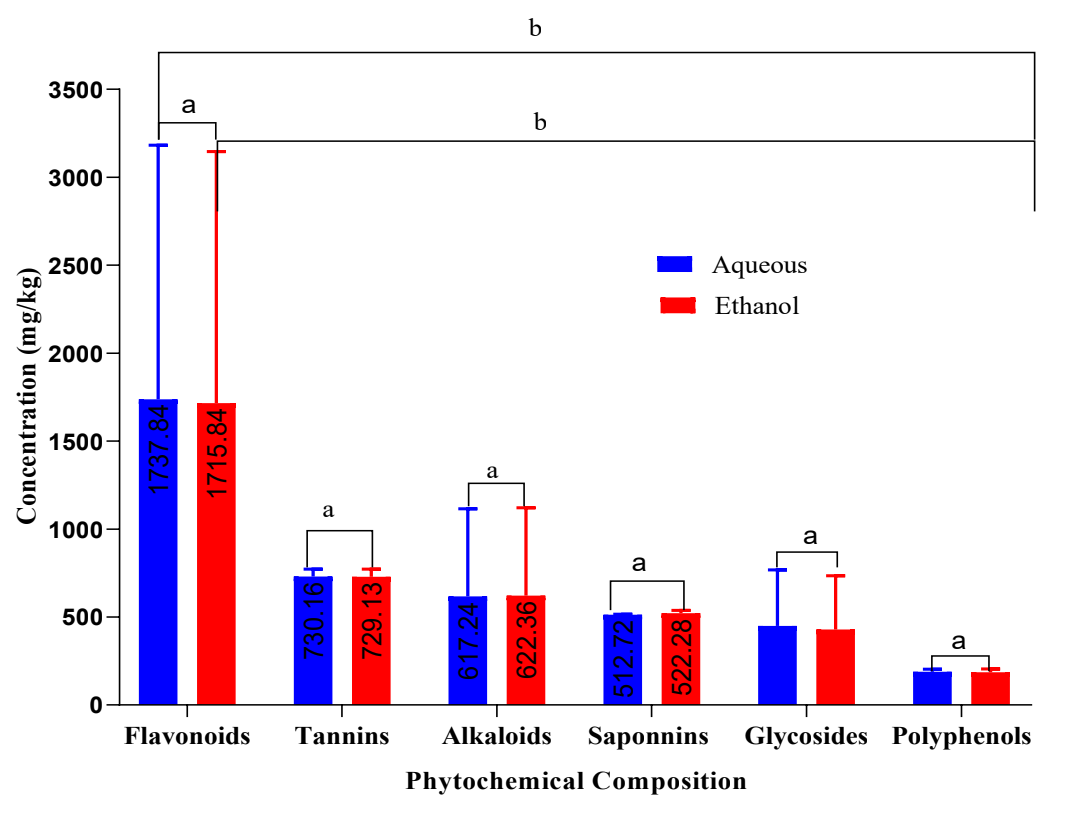
Cassava leaves are widely consumed worldwide, particularly in the Bukedea district of Uganda, for food, medicine, and fodder. The existing correlation between high cassava leaf consumption and organ toxicity and failure remains poorly established within the Bukedea district. This investigation aimed to evaluate the phytochemical composition and toxicity profiles of cassava leaves consumed in the Bukedea District. An ethnobotanical survey was conducted among 60 participants selected from three villages in Bukedea, using a pretested questionnaire and an interview guide. The qualitative and quantitative phytochemical compositions of the ethanolic and aqueous extracts of NASE3 and Magana varieties were determined by High-Performance Liquid Chromatography (HPLC). Results were analyzed using R version 4.3.2 and presented as mean ± SD in tables, Graphical HPLC reports, and figures generated by GraphPad Prism @9.00. An ethno-botanical survey revealed that NASE3 and Magana are the most commonly consumed varieties of cassava leaves, and highlighted their side effects. Qualitatively, Magana had significantly more phytochemicals than NASE3, which mainly consisted of toxic compounds (p < 0.0001). According to quantitative HPLC graphic reports, Magana had higher phytochemical concentrations than NASE3 (p < 0.0001). No significant difference (p = 0.62-1.00, p > 0.0001) in the mean concentration of the same phytochemical ingredient between the two extracts of each cassava leaf variety was exhibited. In conclusion, communities in Bukedea District are vulnerable to toxic phytochemicals from consuming NASE3 and Magana cassava leaves. Further studies on sub-acute and sub-chronic toxicity, the development of non-toxic cassava varieties, and chemical characterization are warranted.
Downloads
References
Amin, M. A., Khaled, K. F., & Fadl-Allah, S. A. (2010). Testing validity of the Tafel extrapolation method for monitoring corrosion of cold rolled steel in HCl solutions–experimental and theoretical studies. Corrosion Science, 52(1), 140–151. DOI: https://doi.org/10.1016/j.corsci.2009.08.055
Anikwe, M. A. N., & Ikenganyia, E. E. (2018). Ecophysiology and production principles of cassava (Manihot species) in Southeastern Nigeria. Cassava. Sidney, Australian College of Business & Technology, 105–122. http://dx.doi.org/10.5772/intechopen.70828 DOI: https://doi.org/10.5772/intechopen.70828
Başaran, N., Paslı, D., & Başaran, A. A. (2022). Unpredictable adverse effects of herbal products. Food and Chemical Toxicology, 159, 112762. https://doi.org/10.1016/j.fct.2021.112762 DOI: https://doi.org/10.1016/j.fct.2021.112762
Byju, G., & Suja, G. (2020). Chapter Five - Mineral nutrition of cassava (D. L. B. T.-A. in A. Sparks (ed.); Vol. 159, pp. 169–235). Academic Press. https://doi.org/10.1016/bs.agron.2019.08.005 DOI: https://doi.org/10.1016/bs.agron.2019.08.005
Da Silva Santos, B. R., Requião Silva, E. F., Minho, L. A. C., Brandão, G. C., Pinto dos Santos, A. M., Carvalho dos Santos, W. P., Lopes Silva, M. V., & Lopes dos Santos, W. N. (2020). Evaluation of the nutritional composition in effect of processing cassava leaves (Manihot esculenta) using multivariate analysis techniques. Microchemical Journal, 152, 104271. https://doi.org/10.1016/j.microc.2019.104271 DOI: https://doi.org/10.1016/j.microc.2019.104271
De Moura, R. F., Ribeiro, C., de Oliveira, J. A., Stevanato, E., & de Mello, M. A. R. (2009). Metabolic syndrome signs in Wistar rats submitted to different high-fructose ingestion protocols. British Journal of Nutrition, 101(8), 1178–1184. https://doi.org/10.1017/S0007114508066774 DOI: https://doi.org/10.1017/S0007114508066774
Fioroni, N., Mouquet-Rivier, C., Meudec, E., Cheynier, V., Boudard, F., Hemery, Y., & Laurent-Babot, C. (2023). Antioxidant Capacity of Polar and Non-Polar Extracts of Four African Green Leafy Vegetables and Correlation with Polyphenol and Carotenoid Contents. In Antioxidants (Vol. 12, Issue 9, p. 1726). https://doi.org/10.3390/antiox12091726 DOI: https://doi.org/10.3390/antiox12091726
Frediansyah, A. (2024). Cassava: Recent Updates on Food, Feed, and Industry. BoD–Books on Demand. DOI: https://doi.org/10.5772/intechopen.105238
Henneh, I. T., Ahlidja, W., Alake, J., Mohammed, H., Boapeah, S. O., Kwabil, A., Malcolm, F., & Armah, F. A. (2022). Acute toxicity profile and gastroprotective potential of ethanolic leaf extract of Manihot esculenta Crantz. Scientific African, 17, e01284. https://doi.org/10.1016/j.sciaf.2022.e01284 DOI: https://doi.org/10.1016/j.sciaf.2022.e01284
Hopmans, E. C., Schouten, S., & Sinninghe Damsté, J. S. (2016). The effect of improved chromatography on GDGT-based palaeoproxies. Organic Geochemistry, 93, 1–6. https://doi.org/10.1016/j.orggeochem.2015.12.006 DOI: https://doi.org/10.1016/j.orggeochem.2015.12.006
Kabasindi, H., Isabirye, M., & Odoi, J. (2021). Drought Stress and Adaptation Strategies in Kumi and Amuria Districts of Uganda. Uganda Journal of Agricultural Sciences, 21(1), 41–56. https://orcid.org/0000-0002-1504-9304 DOI: https://doi.org/10.4314/ujas.v21i1.4
Kasolo, J. N., Bimenya, G. S., Ojok, L., & Ogwal-Okeng, J. W. (2012). Sub-acute toxicity evaluation of Moringa oleifera leaves aqueous and ethanol extracts in Swiss Albino rats. International Journal of Medicinal Plant Research, 1(6), 75–81.
Kudamba, A., Lubowa, M., Kafeero, H. M., Okurut, S. A., Nsubuga, H., Abiti, T., Walusansa, A., Kayendeke, J., Nanyingi, H., & Mubajje, M. S. (2022). Phytochemical Profiles of Albizia coriaria, Azadirachta indica, and Tylosema fassoglensis Used in the Management of Cancers in Elgon Sub-Region. Fortune Journal of Health Sciences, 5(3), 461–471. DOI: https://doi.org/10.26502/fjhs.073
Latif, S., Zimmermann, S., Barati, Z., & Müller, J. (2019). Detoxification of Cassava Leaves by Thermal, Sodium Bicarbonate, Enzymatic, and Ultrasonic Treatments. Journal of Food Science, 84(7), 1986–1991. https://doi.org/10.1111/1750-3841.14658 DOI: https://doi.org/10.1111/1750-3841.14658
Laya, A., & Koubala, B. B. (2020). Polyphenols in cassava leaves (Manihot esculenta Crantz) and their stability in antioxidant potential after in vitro gastrointestinal digestion. Heliyon, 6(3). DOI: https://doi.org/10.1016/j.heliyon.2020.e03567
Mohidin, S. R. N. S. P., Moshawih, S., Hermansyah, A., Asmuni, M. I., Shafqat, N., & Ming, L. C. (2023). Cassava (Manihot esculenta Crantz): A Systematic Review for the Pharmacological Activities, Traditional Uses, Nutritional Values, and Phytochemistry. Journal of Evidence-Based Integrative Medicine, 28, 2515690X231206227. DOI: https://doi.org/10.1177/2515690X231206227
Nakabonge, G., Samukoya, C., & Baguma, Y. (2018). Local varieties of cassava: Conservation, cultivation and use in Uganda. Environment, Development and Sustainability, 20(6), 2427–2445. DOI: https://doi.org/10.1007/s10668-017-9997-6
Okareh, O., Ajayeoba, T. A., Ugbekile, O. F., & Hammed, T. B. (2021). The use of cassava leaves as food and medicinal herbs in rural communities and the perceived health risks. Bionature, 41(1), 19–38.
Okoro, I. O. (2020). Effects of Extraction Solvents on the Antioxidant and Phytochemical Activities of Manihot Esculenta Leaves TT -. IJT, 14(1), 51–58. https://doi.org/10.32598/ijt.14.1.51 DOI: https://doi.org/10.32598/ijt.14.1.51
Okoro, I. O., Kadiri, H. E., & Aganbi, E. (2019). Comparative phytochemical screening, in vivo antioxidant and nephroprotective effects of extracts of cassava leaves on paracetamol-intoxicated rats. Journal of Reports in Pharmaceutical Sciences, 8(2), 188. https://doi.org/10.4103/jrptps.JRPTPS_10_19 DOI: https://doi.org/10.4103/jrptps.JRPTPS_10_19
Oresegun, A., Fagbenro, O. A., Ilona, P., & Bernard, E. (2016). Nutritional and anti-nutritional composition of cassava leaf protein concentrate from six cassava varieties for use in aqua feed. Cogent Food & Agriculture, 2(1), 1147323. https://doi.org/10.1080/23311932.2016.1147323 DOI: https://doi.org/10.1080/23311932.2016.1147323
Taupik, S. A. M., Aani, S. N. A., Chia, P. W., & Chuah, T. S. (2023). Phytotoxic compounds of cassava leaf extracts for weed inhibition in aerobic rice. South African Journal of Botany, 159, 563–570. https://doi.org/10.1016/j.sajb.2023.06.045 DOI: https://doi.org/10.1016/j.sajb.2023.06.045
Zekarias, T., Basa, B., & Herago, T. (2019). Medicinal, nutritional and anti-nutritional properties of Cassava (Manihot esculenta): a review. Acad J Nutr, 8(3), 34–46.