Antioxidant Activity, Total Phenolic Content, and Total Flavonoid Content of Methanol Extract of Vernonia elaeagnifolia Leaves Using ABTS and DPPH Assays
DOI:
https://doi.org/10.23917/pharmacon.v22i2.13498Keywords:
Antioxidant, Vernonia elaeagnifolia, Total phenolic, Total flavonoid, ABTS, DPPHAbstract
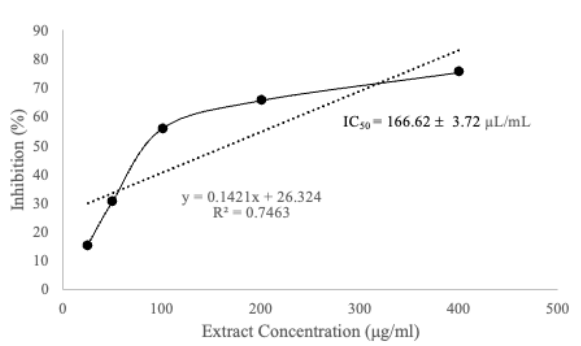
Vernonia elaeagnifolia, also known as Vernonia elliptica, is a member of the Asteraceae family and is known to contain phenol and flavonoid compounds. The study examining the activity of these active compounds in this plant is limited. Therefore, this study aimed to evaluate the phytochemical profile, total phenolic content (TPC), total flavonoid content (TFC), and antioxidant activity of the methanol extract of V. elaeagnifolia leaves. Phytochemical screening was conducted using tube tests, while TPC and TFC were measured using the Folin-Ciocalteu and aluminium chloride colorimetric methods, respectively. Antioxidant activity was assessed using ABTS and DPPH assays. Phytochemical screening revealed the presence of alkaloids, saponins, flavonoids, and polyphenols in the methanolic extract. Quantitative analysis showed that TPC and TFC values were 81.26 ± 0.62 mg GAE/g and 54.02 ± 0.70 mg QE/g, respectively. The extract showed moderate antioxidant activity, with IC50 values of 139.81 ± 0.62 µg/mL (ABTS) and 166.62 ± 3.72 µg/mL (DPPH), which were significantly different. These findings suggest that the ABTS assay is more effective in evaluating the antioxidant activity of V. elaeagnifolia leaf extract compared to the DPPH assay, and V. elaeagnifolia leaves have potential as a source of natural antioxidants. Further isolation and characterization of active compounds are recommended
Downloads
References
Alara, O. R., Abdurahman, N. H., Ukaegbu, C. I., & Kabbashi, N. A. (2019). Extraction and characterization of bioactive compounds in Vernonia amygdalina leaf ethanolic extract comparing Soxhlet and microwave-assisted extraction techniques. Journal of Taibah University for Science, 13(1), 414–422. https://doi.org/10.1080/16583655.2019.1582460 DOI: https://doi.org/10.1080/16583655.2019.1582460
Amarachukwu Uzombah, T. (2022). The Implications of Replacing Synthetic Antioxidants with Natural Ones in the Food Systems. In M. A. Prieto & P. Otero (Eds.), Natural Food Additives. IntechOpen. https://doi.org/10.5772/intechopen.103810 DOI: https://doi.org/10.5772/intechopen.103810
Baliyan, S., Mukherjee, R., Priyadarshini, A., Vibhuti, A., Gupta, A., Pandey, R. P., & Chang, C.-M. (2022). Determination of Antioxidants by DPPH Radical Scavenging Activity and Quantitative Phytochemical Analysis of Ficus religiosa. Molecules (Basel, Switzerland), 27(4), 1326. https://doi.org/10.3390/molecules27041326 DOI: https://doi.org/10.3390/molecules27041326
Hassanpour, S. H., & Doroudi, A. (2023). Review of the antioxidant potential of flavonoids as a subgroup of polyphenols and partial substitute for synthetic antioxidants. Avicenna Journal of Phytomedicine, 13(4), 354–376. https://doi.org/10.22038/AJP.2023.21774
Hatami, T., Emami, S. A., Miraghaee, S. S., & Mojarrab, M. (2014). Total Phenolic Contents and Antioxidant Activities of Different Extracts and Fractions from the Aerial Parts of Artemisia biennis Willd. Iranian Journal of Pharmaceutical Research: IJPR, 13(2), 551–559.
Hikmawanti, N. P. E., Hanani, E., Sapitri, Y., & Ningrum, W. (2020). Total Phenolic Content and Antioxidant Activity of Different Extracts of Cordia sebestena L. Leaves. Pharmacognosy Journal, 12(6), 1311–1316. https://doi.org/10.5530/pj.2020.12.180 DOI: https://doi.org/10.5530/pj.2020.12.180
Hilma, H., Putri, N. A. D., & Lely, N. (2021). Determination Of Total Phenol and Total Flavonoid Content Of Longan (Dimoncarpus longan Lour) Leaf Extract. Jurnal Ilmiah Farmako Bahari, 12(1), 80–87. https://doi.org/10.52434/jfb.v12i1.1037 DOI: https://doi.org/10.52434/jfb.v12i1.1037
Hussen, E. M., & Endalew, S. A. (2023). In vitro antioxidant and free-radical scavenging activities of polar leaf extracts of Vernonia amygdalina. BMC Complementary Medicine and Therapies, 23(1), 146. https://doi.org/10.1186/s12906-023-03923-y DOI: https://doi.org/10.1186/s12906-023-03923-y
Iglesias-Carres, L., Mas-Capdevila, A., Bravo, F. I., Bladé, C., Arola-Arnal, A., & Muguerza, B. (2019). Optimization of extraction methods for characterization of phenolic compounds in apricot fruit ( Prunus armeniaca ). Food & Function, 10(10), 6492–6502. https://doi.org/10.1039/C9FO00353C DOI: https://doi.org/10.1039/C9FO00353C
Ilyasov, I. R., Beloborodov, V. L., Selivanova, I. A., & Terekhov, R. P. (2020). ABTS/PP Decolorization Assay of Antioxidant Capacity Reaction Pathways. International Journal of Molecular Sciences, 21(3), 1131. https://doi.org/10.3390/ijms21031131 DOI: https://doi.org/10.3390/ijms21031131
Jamshidi-kia, F., Wibowo, J. P., Elachouri, M., Masumi, R., Salehifard-Jouneghani, A., Abolhasanzadeh, Z., & Lorigooini, Z. (2020). Battle between plants as antioxidants with free radicals in human body. Journal of Herbmed Pharmacology, 9(3), 191–199. https://doi.org/10.34172/jhp.2020.25 DOI: https://doi.org/10.34172/jhp.2020.25
Karlina, N., Kunaedi, A., Ahidin, D., Jannah, U., & Zahiyah, Y. (2023). ANTIOXIDANT ACTIVITY TEST OF AFRICAN LEAVES PURIFICATION EXTRACT (Vernonia amygdalina Del) WITH DPPH METHOD. Jurnal Farmasi Sains Dan Praktis, 1–10. https://doi.org/10.31603/pharmacy.v9i1.7912 DOI: https://doi.org/10.31603/pharmacy.v9i1.7912
Kumar, R. S., Narasingappa, R. B., Joshi, C. G., Girish, T. K., & Danagoudar, A. (2017). Caesalpinia Crista Linn. Induces Protection against DNA and Membrane Damage. Pharmacognosy Magazine, 13(Suppl 2), S250–S257. https://doi.org/10.4103/pm.pm_557_16 DOI: https://doi.org/10.4103/pm.pm_557_16
Kusumawati, A. H., Farhamzah, Alkandahri, M. Y., Sadino, A., Agustina, L. S., & Apriana, S. D. (2021). Antioxidant Activity and Sun Protection Factor of Black Glutinous Rice (Oryza sativa var. Glutinosa). Tropical Journal of Natural Product Research, 5(11), 1958–1961. https://doi.org/10.26538/tjnpr/v5i11.11 DOI: https://doi.org/10.26538/tjnpr/v5i11.11
Kusumorini, N., Nugroho, A. K., Pramono, S., & Martien, R. (2022). Determination of The Potential Antioxidant Activity of Isolated Piperine from White Pepper Using DPPH, ABTS, and FRAP Methods. Majalah Farmaseutik, 18(4), 454. https://doi.org/10.22146/farmaseutik.v18i4.70246 DOI: https://doi.org/10.22146/farmaseutik.v18i4.70246
Mathews, A., Arbal, A. V., Kaarunya, A., Jha, P. K., Le-Bail, A., & Rawson, A. (2024). Conventional vs modern extraction techniques in the food industry. In Extraction Processes in the Food Industry (pp. 97–146). Elsevier. https://doi.org/10.1016/B978-0-12-819516-1.00013-2 DOI: https://doi.org/10.1016/B978-0-12-819516-1.00013-2
Moazzen, A., Öztinen, N., Ak-Sakalli, E., & Koşar, M. (2022). Structure-antiradical activity relationships of 25 natural antioxidant phenolic compounds from different classes. Heliyon, 8(9), e10467. https://doi.org/10.1016/j.heliyon.2022.e10467 DOI: https://doi.org/10.1016/j.heliyon.2022.e10467
Ngibad, K. (2019). Phytochemical Screening of Sunflower Leaf (Helianthus annuus) and Anting-Anting (Acalypha indica Linn) Plant Ethanol Extract. Borneo Journal of Pharmacy, 2(1), 24–30. https://doi.org/10.33084/bjop.v2i1.689 DOI: https://doi.org/10.33084/bjop.v2i1.689
Panova, I. G., & Tatikolov, A. S. (2023). Endogenous and Exogenous Antioxidants as Agents Preventing the Negative Effects of Contrast Media (Contrast-Induced Nephropathy). Pharmaceuticals, 16(8), 1077. https://doi.org/10.3390/ph16081077 DOI: https://doi.org/10.3390/ph16081077
Platzer, M., Kiese, S., Herfellner, T., Schweiggert-Weisz, U., Miesbauer, O., & Eisner, P. (2021). Common Trends and Differences in Antioxidant Activity Analysis of Phenolic Substances Using Single Electron Transfer Based Assays. Molecules (Basel, Switzerland), 26(5), 1244. https://doi.org/10.3390/molecules26051244 DOI: https://doi.org/10.3390/molecules26051244
Rolnik, A., & Olas, B. (2021). The Plants of the Asteraceae Family as Agents in the Protection of Human Health. International Journal of Molecular Sciences, 22(6), 3009. https://doi.org/10.3390/ijms22063009 DOI: https://doi.org/10.3390/ijms22063009
Schober, P., Boer, C., & Schwarte, L. A. (2018). Correlation Coefficients: Appropriate Use and Interpretation. Anesthesia & Analgesia, 126(5), 1763–1768. https://doi.org/10.1213/ANE.0000000000002864 DOI: https://doi.org/10.1213/ANE.0000000000002864
Selvaraj, N. R., Nandan, D., Nair, B. G., Nair, V. A., Venugopal, P., & Aradhya, R. (2025). Oxidative Stress and Redox Imbalance: Common Mechanisms in Cancer Stem Cells and Neurodegenerative Diseases. Cells, 14(7), 511. https://doi.org/10.3390/cells14070511 DOI: https://doi.org/10.3390/cells14070511
Vollmannová, A., Bojňanská, T., Musilová, J., Lidiková, J., & Cifrová, M. (2024). Quercetin as one of the most abundant represented biological valuable plant components with remarkable chemoprotective effects—A review. Heliyon, 10(12), e33342. https://doi.org/10.1016/j.heliyon.2024.e33342 DOI: https://doi.org/10.1016/j.heliyon.2024.e33342
Wulandari, F., Sari, A. A., Hapsari, P. S., Aji, B. N. C., Adiningsih, M. U., Hidayatullah, M. H., & Umaroh, A. K. (2024). In Vitro Antioxidant Activity and Cytotoxic Effect of Ethanol Extract of Vernonia elaeagnifolia Leaves against Breast Cancer Cell Lines. Tropical Journal of Natural Product Research, 8(7). https://doi.org/10.26538/tjnpr/v8i7.39 DOI: https://doi.org/10.26538/tjnpr/v8i7.39