In Silico Analysis of Momordica charantia L. as Antidiabetic Agents of GSK-3β Receptors and It's Antioxidant Activity
DOI:
https://doi.org/10.23917/pharmacon.v22i2.13447Keywords:
Momordica charantia L.; GSK-3β Receptors; MetforminAbstract
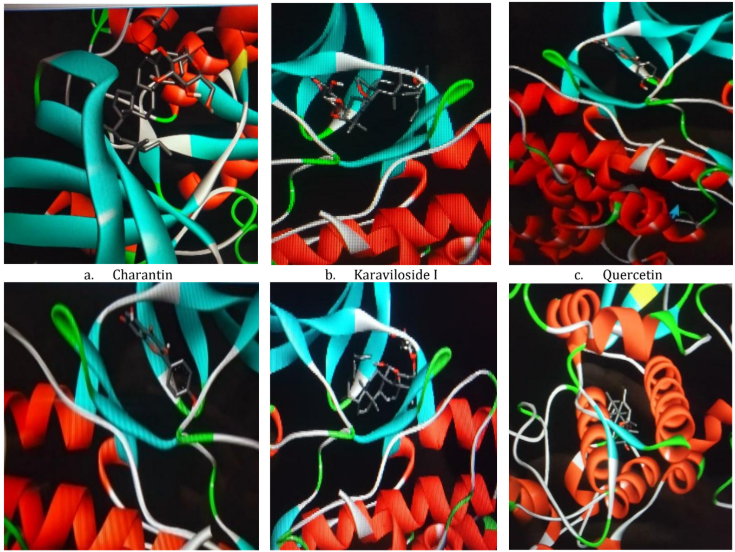
Diabetes mellitus is included in the group of degenerative diseases with the highest incidence rate globally. This study was conducted to evaluate the potential of bioactive compounds contained in bitter melon (Momordica charantia L.) as antidiabetic and antioxidant agents using an in silico approach. The methods used include molecular docking simulations, pharmacokinetic and toxicological analyses were carried out using Absorption, Distribution, Metabolism, Excretion, and Toxicology parameters as well as drug suitability tests based on the Lipinski rule of five. The test results showed that bitter melon juice obtained an IC50 of 63.18 μg/ml while vitamin C as a comparison obtained an IC50 of 7.60 μg/ml. The docking results show that the Kaemferol compound has the highest binding affinity (-6.64 Kcal/mol), Quercetin (-6.28 Kcal/mol) and Charantoside I (6.07 Kcal/mol) have stable binding energy, the interaction of charantin, quercetin, kaemferol and charantoside I residues is similar to native ligands such as Valine 135, Cysteine 199, Valine 70 and Lysine 85. Based on the ADMET profile results, the quercetin and kaemferol compounds have high absorption, Caco-2 permeability which supports oral bioavailability, and do not show the ability to penetrate the blood-brain barrier, which indicates safety for the central nervous system, as well as low AMES toxicity and hepatotoxicity. As the conclusion, kaempferol and quercetin compounds have the potential as GSK-3β inhibitors. Antioxidant activity of bitter melon juice and vitamin C are categorized as strong. Further research regarding the mechanism of action of Momordica charantia L. as an alternative therapeutic agent in the management of type 2 diabetes is needed.
Downloads
References
Afriana. D.. & Dewi. C. (2022). In Silico Study of Compounds from Saffron (Crocus sativus L.) Against Glycogen Synthase Kinase-3 Beta (GSK-3β) Receptors as Antidiabetics. Jurnal Pharmacia Mandala Waluya. 1(5). 188–201. https://doi.org/10.54883/jpmw.v1i5.
Abdullah. S. S.. Antasionasti. I.. Rundengan. G.. & Abdullah. R. P. I. (2022). Antioxidant Activity of Ethanol Extract of Nutmeg Seeds and Fruit Flesh with (Myristica fragrans) DPPH Method. Chemistry Progress. 15(2). 70–75. https://doi.org/10.35799/cp.15.2.2022.4448.
Andriani. D.. & Murtisiwi. L. (2020). Antioxidant Activity Test of 70% Ethanol Extract of Butterfly Pea Flowers (Clitoria ternatea L) from Sleman Region Using the DPPH Method. Pharmacon: Jurnal Farmasi Indonesia. 17(1). 70–76. https://doi.org/10.23917/pharmacon.v17i1.9321.
Achmad. A.. Regar. D. N.. & Harwoko. (2016). The Effectiveness of Bitter Melon (Momordica charantia) and Green Bean (Phaseolus vulgaris) Extracts in Reducing Blood Sugar Levels and AUC (Area Under Curve). Pharmaceutical Journal of Indonesia. 2(1). 25–29. https://doi.org/10.21776/ub.pji.2016.002.01.5
Alkhalidy. H.. Moore. W.. Wang. A.. Luo. J.. McMillan. R. P.. Wang. Y.. Zhen. W.. Hulver. M. W.. & Liu. D. (2018). Kaempferol ameliorates hyperglycemia through suppressing hepatic gluconeogenesis and enhancing hepatic insulin sensitivity in diet-induced obese mice. J Nutr Biochem. 58. 90–101. https://doi.org/10.1002/hep.30150.Ductular
Awaluddin. A.. Aksa. R.. & Septiani. H. R. (2018). Study of the Potential Pharmacodynamic Interaction of Metformin and Ethanol Extract of Cherry Leaves (Muntigia calabura L.) on Changes in Blood Glucose Levels in Rats. Farbal. 6(2). 44–49.
Akmal. T.. & Sasongko. L. (2023). Influence Of Momordica charantia (L.) On The Pharmacokinetics And Pharmacodynamics Of Gliclazide In Alloxan-Induced Diabetic Rats. Medical Sains : Jurnal Ilmiah Kefarmasian. 8(3). 1079–1088. https://doi.org/10.37874/ms.v8i3.854
Bakare. R. I.. Magbagbeola. O. A.. Akinwande. A. I.. & Okunowo. O. W. (2010). Nutritional and chemical evaluation of Momordica charantia. Journal of Medicinal Plants Research. 4(21). 2189–2193.
Bahagia. W.. Kurniawaty. E.. & Mustafa. S. (2018). The Potential of Bitter Melon Extract (Momordhica charantia) to Lower Blood Glucose Levels: The Benefits Behind the Bitter Taste. Majority. 7(2). 177–181.
Bai. C.. Wu. L.. Li. R.. Cao. Y.. He. S.. & Bo. X. (2025). Machine Learning-Enabled Drug-Induced Toxicity Prediction. Advanced Science. 2413405. https://doi.org/10.1002/advs.202413405
Bitew. M.. Desalegn. T.. Demissie. T. B.. Belayneh. A.. Endale. M.. & Eswaramoorthy. R. (2021). Pharmacokinetics and drug-likeness of antidiabetic flavonoids: Molecular docking and DFT study. PLoS ONE. 16(12). https://doi.org/10.1371/journal.pone.0260853
Effendi. N.. Saputri. N. airin. Purnomo. H.. & Aminah. (2023). ADME-T. Media Farmasi. 19(1). 10.
Fauziyyah. R. S.. Huang. S. A.. Sholehah. A. M.. Dewi. T. T.. Wulandari. R. P.. Nurdin. H. A.. & Nuwarda. F. (2025). In Silico Study of Secondary Metabolite Compound from Noni fruit ( Morinda citrifolia ) as Potential Drug Candidates for Type 2 Diabetes Mellitus Targeting PPAR- γ. Indonesian Journal of Chemical Science. 14(1).
IDF. (2021). IDF Diabetes Atlas 10 TH Edision. Internasional Diabetes Federation.
Ino Ischak. N.. Musa. W. J.. Ode Aman. L.. Alio. L.. La Kilo. A.. & Deltalia Saleh. S. (2023). Molecular Docking Study and ADME Prediction of Secondary Metabolite Compounds of Gorontalo Traditional Medicinal Plants on HER-2 Receptors as Breast Anticancer Agents. Jamb.J.Chem. 5(1). 90–103. https://www.rcsb.org/
Kurniadi. A. (2024). Study Of The Formulation Of Bulldang Pea Flower Extract (Clitoria Ternatea) On Antioxidant Activity In Functional Drinks. 3(1). 13–28.
Mahmoud. M. F.. Hassan. N. A.. El Bassossy. H. M.. & Fahmy. A. (2013). Quercetin Protects against Diabetes-Induced Exaggerated Vasoconstriction in Rats: Effect on Low Grade Inflammation. PLoS ONE. 8(5). https://doi.org/10.1371/journal.pone.0063784
Mailandari. M. (2012). Antioxidant Activity Test of Garcinia kydia Roxb. Leaf Extract Using the DPPH Method and Identification of Active Fraction Chemical Compounds. Fakultas Matematika Dan Ilmu Pengetahuan Alam Program Studi Ekstensi Farmasi. Universitas Indonesia. 13.
Nirnadia. N.. Kamilla. L.. & Djohan. H. (2020). The Potential of Bitter Melon (Momordica charantia Linn) as an Antidiabetic. Jurnal Laboratorium Khatulistiwa. 4(1). 34. https://doi.org/10.30602/jlk.v4i1.942
Novianty. R. (2023). Innovation of Areca catechu Compounds Combined with Fluoxetine as Antidepressant by In Silico Method. Photon: Jurnal Sain Dan Kesehatan. 13(2). 70–77. https://doi.org/10.37859/jp.v13i2.5041.
Octariani. S.. Mayasari. D.. & Ramadhan. A. M. (2021). Optimization of Polyvinyl Alcohol (PVA) as a Base for Anti-Acne Gel Preparations. Proceeding of Mulawarman Pharmaceuticals Conferences. 135–138. http://prosiding.farmasi.unmul.ac.id/index.php/mpc/article/view/416/399
Oyelere. S. F.. Ajayi. O. H.. Ayoade. T. E.. Pereira. G. B. S.. Owoyemi. B. C. D.. Ilesanmi. A. O.. & Akinyemi. O. A. (2022). A detailed review on the phytochemical profiles and anti-diabetic mechanisms of Momordica charantia. Heliyon. 8(4). e09253. https://doi.org/10.1016/j.heliyon.2022.e09253
Peng. J.. Li. Q.. Li. K.. Zhu. L.. Lin. X.. Lin. X.. Shen. Q.. Li. G.. & Xie. X. (2017). Quercetin Improves Glucose and Lipid Metabolism of Diabetic Rats: Involvement of Akt Signaling and SIRT1. Journal of Diabetes Research. 2017. https://doi.org/10.1155/2017/3417306
Ramadhani. R.. Baruna. I.. Vedha. G. B.. & Lutfi Chabib. (2023). The Effect of Sambiloto and Ginger Compounds on Covid-19 Target Proteins Using Molecular Docking. Parapemikir : Jurnal Ilmiah Farmasi. Vol. 12(2). 157–171.
Rajagopal. P. lakshmi. (2022). Molecular docking analysis of metformin analogues with GSK-3β. Bioinformation. 18(3). 269–272. https://doi.org/10.6026/97320630018269
Rantung. O.. Korua. A. I.. & Datau. H. (2021). UV Spectrophotometer Method for Vitamin C Testing in Fruits. Prosiding. 61.
Richter. E.. Geetha. T.. Burnett. D.. Broderick. T. L.. & Babu. J. R. (2023). The Effects of Momordica charantia on Type 2 Diabetes Mellitus and Alzheimer’s Disease. International Journal of Molecular Sciences. 24(5). https://doi.org/10.3390/ijms24054643
Seal. S.. Mahale. M.. García-Ortegón. M.. Joshi. C. K.. Hosseini-Gerami. L.. Beatson. A.. Greenig. M.. Shekhar. M.. Patra. A.. Weis. C.. Mehrjou. A.. Badré. A.. Paisley. B.. Lowe. R.. Singh. S.. Shah. F.. Johannesson. B.. Williams. D.. Rouquie. D.. … Bender. A. (2025). Machine Learning for Toxicity Prediction Using Chemical Structures: Pillars for Success in the Real World. Chemical Research in Toxicology. https://doi.org/10.1021/acs.chemrestox.5c00033
Syafitri. A.. & Mardatillah. H. F. (2022). Antidiabetic Effectiveness Test of a Combination of Bitter Melon Fruit Extract (Momordica charantia L.) and Rosella Flower Petals (Hibiscus sabdariffa L.) on White Male Mice as Experimental Animals. Jurnal Farmasi Dan Hernal. 4(2).
Scott. B.. Day. E. A.. O’Brien. K. L.. Scanlan. J.. Cromwell. G.. Scannail. A. N.. McDonnell. M. E.. Finlay. D. K.. & Lynch. L. (2024). Metformin and feeding increase levels of the appetite-suppressing metabolite Lac-Phe in humans. Nature Metabolism. 6(4). 651–658. https://doi.org/10.1038/s42255-024-01018-7
Supringrum. R.. & Jubaidah. S. (2019). Antioxidant Activity Of Ethanol Extract And Fraction Of Tabar Kedayan Roots (Aristolochia foveolata Merr.) Using The Dpph (2.2 Diphenyl-1-Picrilhydrazil) Method. JFL : Jurnal Farmasi Lampung. 8–14. https://doi.org/10.37090/jfl.v8i1.81
Xu. B.. Li. Z.. Zeng. T.. Zhan. J.. Wang. S.. Ho. C. T.. & Li. S. (2022). Bioactives of Momordica charantia as Potential Anti-Diabetic/ Hypoglycemic Agents. Molecules. 27(7). 1–17. https://doi.org/10.3390/molecules27072175