Antibiotic Adjuvants from Natural Resources against Multi-Drug Resistance Bacteria
DOI:
https://doi.org/10.23917/pharmacon.v22i2.13399Keywords:
Adjuvant, Antibiotic, Synergism, Drug Combination, Natural ResourcesAbstract
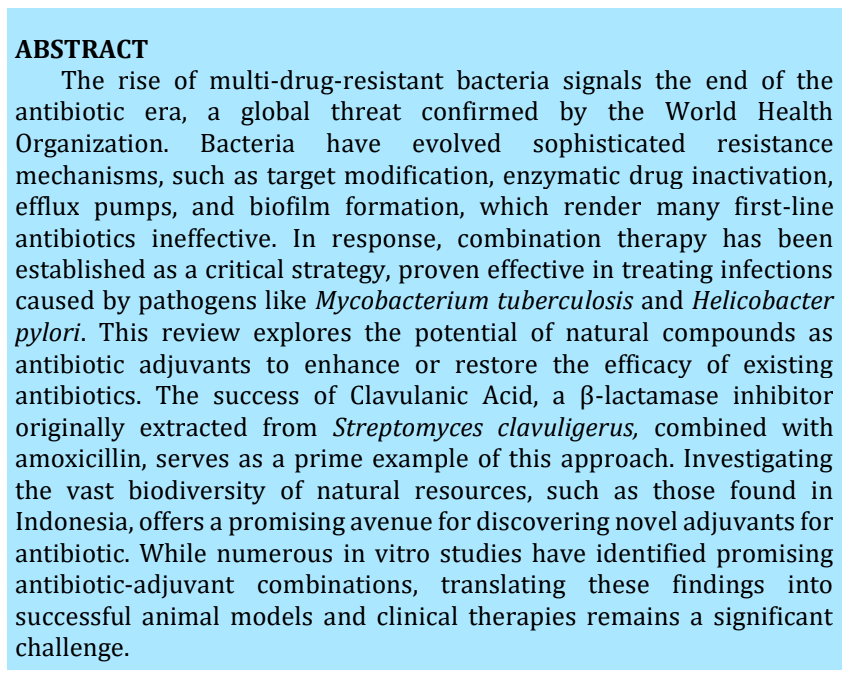
The rise of multi-drug resistant bacteria signals the end of the antibiotic era, a global threat confirmed by the World Health Organization. Bacteria have evolved sophisticated resistance mechanisms, such as target modification, enzymatic drug inactivation, efflux pumps, and biofilm formation, which render many first-line antibiotics ineffective. In response, combination therapy has emerged as a critical strategy, historically proven effective in treating infections caused by pathogens like Mycobacterium tuberculosis and Helicobacter pylori. This paper explores the use of natural compounds as antibiotic adjuvants to enhance or restore the efficacy of existing antibiotics. The success of Clavulanic Acid, a natural product combined with amoxicillin, serves as a prime example of this approach. Investigating the vast biodiversity of natural resources, such as those found in Indonesia, offers a promising avenue for discovering novel adjuvants. While numerous in vitro studies have identified promising combinations, translating these findings into successful animal models and clinical therapies remains a significant challenge.
Downloads
References
Alnour, T. M. S., Ahmed-Abakur, E. H., Elssaig, E. H., Abuduhier, F. M., & Ullah, M. F. (2022). Antimicrobial synergistic effects of dietary flavonoids rutin and quercetin in combination with antibiotics gentamicin and ceftriaxone against E. coli (MDR) and P. mirabilis (XDR) strains isolated from human infections: Implications for food–medicine interactions. Italian Journal of Food Science, 34(2), 34–42. https://doi.org/10.15586/ijfs.v34i2.2196 DOI: https://doi.org/10.15586/ijfs.v34i2.2196
Bellio, P., Fagnani, L., Nazzicone, L., & Celenza, G. (2021). New and simplified method for drug combination studies by checkerboard assay. MethodsX, 8, 101543. https://doi.org/10.1016/j.mex.2021.101543 DOI: https://doi.org/10.1016/j.mex.2021.101543
Bush, K., & Bradford, P. A. (2016). β-Lactams and β-Lactamase Inhibitors: An Overview. Cold Spring Harbor Perspectives in Medicine, 6(8), a025247. https://doi.org/10.1101/cshperspect.a025247 DOI: https://doi.org/10.1101/cshperspect.a025247
Bushby, S. R., & Hitchings, G. H. (1968). Trimethoprim, a sulphonamide potentiator. British Journal of Pharmacology and Chemotherapy, 33(1), 72–90. https://doi.org/10.1111/j.1476-5381.1968.tb00475.x DOI: https://doi.org/10.1111/j.1476-5381.1968.tb00475.x
Cohen, M. L. (1992). Epidemiology of Drug Resistance: Implications for a Post—Antimicrobial Era. Science, 257(5073), 1050–1055. https://doi.org/10.1126/science.257.5073.1050 DOI: https://doi.org/10.1126/science.257.5073.1050
Costerton, J. W., Stewart, P. S., & Greenberg, E. P. (1999). Bacterial Biofilms: A Common Cause of Persistent Infections. Science, 284(5418), 1318–1322. https://doi.org/10.1126/science.284.5418.1318 DOI: https://doi.org/10.1126/science.284.5418.1318
Dellinger, R. P., Levy, M. M., Carlet, J. M., Bion, J., Parker, M. M., Jaeschke, R., Reinhart, K., Angus, D. C., Brun-Buisson, C., Beale, R., Calandra, T., Dhainaut, J.-F., Gerlach, H., Harvey, M., Marini, J. J., Marshall, J.,
Ranieri, M., Ramsay, G., Sevransky, J., … Vincent, J.-L. (2008). Surviving Sepsis Campaign: International guidelines for management of severe sepsis and septic shock: 2008: Critical Care Medicine, 36(1), 296–327. https://doi.org/10.1097/01.CCM.0000298158.12101.41 DOI: https://doi.org/10.1097/01.CCM.0000298158.12101.41
Dhanda, G., Acharya, Y., & Haldar, J. (2023). Antibiotic Adjuvants: A Versatile Approach to Combat Antibiotic Resistance. ACS Omega, 8(12), 10757–10783. https://doi.org/10.1021/acsomega.3c00312 DOI: https://doi.org/10.1021/acsomega.3c00312
Ejim, L., Farha, M. A., Falconer, S. B., Wildenhain, J., Coombes, B. K., Tyers, M., Brown, E. D., & Wright, G. D. (2011). Combinations of antibiotics and nonantibiotic drugs enhance antimicrobial efficacy. Nature Chemical Biology, 7(6), 348–350. https://doi.org/10.1038/nchembio.559 DOI: https://doi.org/10.1038/nchembio.559
Estrada, A., Wright, D. L., & Anderson, A. C. (2016). Antibacterial Antifolates: From Development through Resistance to the Next Generation. Cold Spring Harbor Perspectives in Medicine, 6(8), a028324. https://doi.org/10.1101/cshperspect.a028324 DOI: https://doi.org/10.1101/cshperspect.a028324
Fair, R. J., & Tor, Y. (2014). Antibiotics and Bacterial Resistance in the 21st Century. Perspectives in Medicinal Chemistry, 6, PMC.S14459. https://doi.org/10.4137/PMC.S14459 DOI: https://doi.org/10.4137/PMC.S14459
Fatsis-Kavalopoulos, N., Sánchez-Hevia, D. L., & Andersson, D. I. (2024). Beyond the FIC index: The extended information from fractional inhibitory concentrations (FICs). Journal of Antimicrobial Chemotherapy, 79(9), 2394–2396. https://doi.org/10.1093/jac/dkae233 DOI: https://doi.org/10.1093/jac/dkae233
Gulick, R. M., Mellors, J. W., Havlir, D., Eron, J. J., Gonzalez, C., McMahon, D., Richman, D. D., Valentine, F. T., Jonas, L., Meibohm, A., Emini, E. A., Chodakewitz, J. A., Deutsch, P., Holder, D., Schleif, W. A., & Condra, J. H. (1997). Treatment with Indinavir, Zidovudine, and Lamivudine in Adults with Human Immunodeficiency Virus Infection and Prior Antiretroviral Therapy. New England Journal of Medicine, 337(11), 734–739. https://doi.org/10.1056/NEJM199709113371102 DOI: https://doi.org/10.1056/NEJM199709113371102
Hammer, S. M., Squires, K. E., Hughes, M. D., Grimes, J. M., Demeter, L. M., Currier, J. S., Eron, J. J., Feinberg, J. E., Balfour, H. H., Deyton, L. R., Chodakewitz, J. A., Fischl, M. A., Phair, J. P., Pedneault, L., Nguyen, B.-Y., & Cook, J. C. (1997). A Controlled Trial of Two Nucleoside Analogues plus Indinavir in Persons with Human Immunodeficiency Virus Infection and CD4 Cell Counts of 200 per Cubic Millimeter or Less. New England Journal of Medicine, 337(11), 725–733. https://doi.org/10.1056/NEJM199709113371101 DOI: https://doi.org/10.1056/NEJM199709113371101
Hentschel, E., Brandstatter, G., Dragosics, B., Hirschl, A. M., Nemec, H., Schutze, K., Taufer, M., & Wurzer, H. (1993). Effect of Ranitidine and Amoxicillin plus Metronidazole on the Eradication of Helicobacter pylori and the Recurrence of Duodenal Ulcer. New England Journal of Medicine, 328(5), 308–312. https://doi.org/10.1056/NEJM199302043280503 DOI: https://doi.org/10.1056/NEJM199302043280503
Hossain, Md. A., Park, H.-C., Lee, K.-J., Park, S.-W., Park, S.-C., & Kang, J. (2020). In vitro synergistic potentials of novel antibacterial combination therapies against Salmonella enterica serovar Typhimurium. BMC Microbiology, 20(1), 118. https://doi.org/10.1186/s12866-020-01810-x DOI: https://doi.org/10.1186/s12866-020-01810-x
Huang, R., Pei, L., Liu, Q., Chen, S., Dou, H., Shu, G., Yuan, Z., Lin, J., Peng, G., Zhang, W., & Fu, H. (2019). Isobologram Analysis: A Comprehensive Review of Methodology and Current Research. Frontiers in Pharmacology, 10, 1222. https://doi.org/10.3389/fphar.2019.01222 DOI: https://doi.org/10.3389/fphar.2019.01222
Jawetz, E., Gunnison, J. B., & Coleman, V. R. (1950). The Combined Action of Penicillin with Streptomycin or Chloromycetin on Enterococci in Vitro. Science, 111(2880), 254–256. https://doi.org/10.1126/science.111.2880.254 DOI: https://doi.org/10.1126/science.111.2880.254
Kerantzas, C. A., & Jacobs, W. R. (2017). Origins of Combination Therapy for Tuberculosis: Lessons for Future Antimicrobial Development and Application. mBio, 8(2), e01586-16. https://doi.org/10.1128/mBio.01586-16 DOI: https://doi.org/10.1128/mBio.01586-16
Kluge, R. M., Standiford, H. C., Tatem, B., Young, V. M., Greene, W. H., Schimpff, S. C., Calia, F. M., & Hornick, R. B. (1974). Comparative activity of tobramycin, amikacin, and gentamicin alone and with carbenicillin against Pseudomonas aeruginosa. Antimicrobial Agents and Chemotherapy, 6(4), 442–446. https://doi.org/10.1128/AAC.6.4.442 DOI: https://doi.org/10.1128/AAC.6.4.442
Lady, J., Nurcahyanti, A. D. R., & Tjoa, E. (2023). Synergistic Effect and Time-Kill Evaluation of Eugenol Combined with Cefotaxime Against Staphylococcus aureus. Current Microbiology, 80(8), 244. https://doi.org/10.1007/s00284-023-03364-3 DOI: https://doi.org/10.1007/s00284-023-03364-3
Li, X., Song, Y., Wang, L., Kang, G., Wang, P., Yin, H., & Huang, H. (2021). A Potential Combination Therapy of Berberine Hydrochloride With Antibiotics Against Multidrug-Resistant Acinetobacter baumannii. Frontiers in Cellular and Infection Microbiology, 11, 660431. https://doi.org/10.3389/fcimb.2021.660431 DOI: https://doi.org/10.3389/fcimb.2021.660431
Liebmann, A. J., McQuarrie, E. B., & Perlstein, D. (1944). A Standard Penicillinase Preparation. Science, 100(2606), 527–528. https://doi.org/10.1126/science.100.2606.527 DOI: https://doi.org/10.1126/science.100.2606.527
Lim, T.-P., Cai, Y., Hong, Y., Chan, E. C. Y., Suranthran, S., Teo, J. Q.-M., Lee, W. H., Tan, T.-Y., Hsu, L.-Y., Koh, T.-H., Tan, T.-T., & Kwa, A. L.-H. (2015). In Vitro Pharmacodynamics of Various Antibiotics in Combination against Extensively Drug-Resistant Klebsiella pneumoniae. Antimicrobial Agents and Chemotherapy, 59(5), 2515–2524. https://doi.org/10.1128/AAC.03639-14 DOI: https://doi.org/10.1128/AAC.03639-14
Luo, Y., He, B., Li, Z.-P., Zhong, Q., Liu, Y.-C., Zhang, H.-Y., Li, Y., Yan, H.-L., Hu, Y.-L., Zheng, Z.-J., Ren, H., Liao, X.-P., & Sun, J. (2025). Rutin Synergizes with Colistin to Eradicate Salmonellosis in Mice by Enhancing the Efficacy and Reducing the Toxicity. Journal of Agricultural and Food Chemistry, 73(1), 438–449. https://doi.org/10.1021/acs.jafc.4c06751 DOI: https://doi.org/10.1021/acs.jafc.4c06751
Matsuura, M., Nakazawa, H., Hashimoto, T., & Mitsuhashi, S. (1980). Combined antibacterial activity of amoxicillin with clavulanic acid against ampicillin-resistant strains. Antimicrobial Agents and Chemotherapy, 17(6), 908–911. https://doi.org/10.1128/AAC.17.6.908 DOI: https://doi.org/10.1128/AAC.17.6.908
McDermott, W., & Rogers, D. E. (1982). Social ramifications of control of microbial disease. The Johns Hopkins Medical Journal, 151(6), 302–312.
McMurry, L., Petrucci, R. E., & Levy, S. B. (1980). Active efflux of tetracycline encoded by four genetically different tetracycline resistance determinants in Escherichia coli. Proceedings of the National Academy of Sciences, 77(7), 3974–3977. https://doi.org/10.1073/pnas.77.7.3974 DOI: https://doi.org/10.1073/pnas.77.7.3974
Micek, S. T., Welch, E. C., Khan, J., Pervez, M., Doherty, J. A., Reichley, R. M., & Kollef, M. H. (2010). Empiric Combination Antibiotic Therapy Is Associated with Improved Outcome against Sepsis Due to Gram-Negative Bacteria: A Retrospective Analysis. Antimicrobial Agents and Chemotherapy, 54(5), 1742–1748. https://doi.org/10.1128/AAC.01365-09 DOI: https://doi.org/10.1128/AAC.01365-09
Miert, A. S. J. P. A. M. V. (1994). The sulfonamide‐diaminopyrimidine story*. Journal of Veterinary Pharmacology and Therapeutics, 17(4), 309–316. https://doi.org/10.1111/j.1365-2885.1994.tb00251.x DOI: https://doi.org/10.1111/j.1365-2885.1994.tb00251.x
Nasution, H. M., Yulyana, A., Utama, R. F., Bangar, R. I., Kaban, V. E., Daulay, W., Astyka, R., & Lubis, M. F. (2025). Synergistic mechanism of Phyllanthus emblica extract and tetracycline against multidrug-resistant Acinetobacter baumannii. Narra J, 5(1), e1939. https://doi.org/10.52225/narra.v5i1.1939 DOI: https://doi.org/10.52225/narra.v5i1.1939
Nasution, H. R., Yuandani, Y., Septama, A. W., Nugraha, S. E., Sufitni, S., & Khairunnisa, N. A. (2024). Synergistic Antibacterial Activity of Curcuma domestica Val. Extract with Tetracycline Against Multidrug-resistant Acinetobacter baumannii. Molekul, 19(1), 58. https://doi.org/10.20884/1.jm.2024.19.1.8593 DOI: https://doi.org/10.20884/1.jm.2024.19.1.8593
Neu, H. C., & Fu, K. P. (1978). Clavulanic Acid, a Novel Inhibitor of β-Lactamases. Antimicrobial Agents and Chemotherapy, 14(5), 650–655. https://doi.org/10.1128/AAC.14.5.650 DOI: https://doi.org/10.1128/AAC.14.5.650
Nguyen, T. L. A., & Bhattacharya, D. (2022). Antimicrobial Activity of Quercetin: An Approach to Its Mechanistic Principle. Molecules, 27(8), 2494. https://doi.org/10.3390/molecules27082494 DOI: https://doi.org/10.3390/molecules27082494
Ni, J., Chen, Y., Zhang, L., Wang, R., Wu, X., Khan, N. U., & Xie, F. (2025). Epigallocatechin gallate and vancomycin loaded poly(vinyl)-pyrrolidone-gelatine nanofibers, conceivable curative approach for wound healing. Colloids and Surfaces B: Biointerfaces, 249, 114506. https://doi.org/10.1016/j.colsurfb.2025.114506 DOI: https://doi.org/10.1016/j.colsurfb.2025.114506
NobelPrize.org. (n.d.). The unseen enemy: Navigating antimicrobial resistance. Nobel Prize Outreach 2025. Retrieved 18 October 2025, from https://www.nobelprize.org/the-unseen-enemy-navigating-antimicrobial-resistance/
Noordeen, S. K. (2016). History of chemotherapy of leprosy. Clinics in Dermatology, 34(1), 32–36. https://doi.org/10.1016/j.clindermatol.2015.10.016 DOI: https://doi.org/10.1016/j.clindermatol.2015.10.016
Odabaş Köse, E., Koyuncu Özyurt, Ö., Bilmen, S., Er, H., Kilit, C., & Aydemir, E. (2023). Quercetin: Synergistic Interaction with Antibiotics against Colistin-Resistant Acinetobacter baumannii. Antibiotics, 12(4), 739. https://doi.org/10.3390/antibiotics12040739 DOI: https://doi.org/10.3390/antibiotics12040739
Pal, A., & Tripathi, A. (2020). Demonstration of bactericidal and synergistic activity of quercetin with meropenem among pathogenic carbapenem resistant Escherichia coli and Klebsiella pneumoniae. Microbial Pathogenesis, 143, 104120. https://doi.org/10.1016/j.micpath.2020.104120 DOI: https://doi.org/10.1016/j.micpath.2020.104120
Pato, M. L., & Brown, G. M. (1963). Mechanisms of resistance of Escherichia coli to sulfonamides. Archives of Biochemistry and Biophysics, 103(3), 443–448. https://doi.org/10.1016/0003-9861(63)90435-1 DOI: https://doi.org/10.1016/0003-9861(63)90435-1
Rabodoarivelo, M. S., Hoffmann, E., Gaudin, C., Aguilar-Ayala, D. A., Galizia, J., Sonnenkalb, L., Dal Molin, M., Cioetto-Mazzabò, L., Degiacomi, G., Recchia, D., Rybniker, J., Manganelli, R., Pasca, M. R., Ramón-
García, S., & Lucía, A. (2025). Protocol to quantify bacterial burden in time-kill assays using colony-forming units and most probable number readouts for Mycobacterium tuberculosis. STAR Protocols, 6(1), 103643. https://doi.org/10.1016/j.xpro.2025.103643 DOI: https://doi.org/10.1016/j.xpro.2025.103643
Reardon, S. (2014). WHO warns against ‘post-antibiotic’ era. Nature, nature.2014.15135. https://doi.org/10.1038/nature.2014.15135 DOI: https://doi.org/10.1038/nature.2014.15135
Silver, L. L. (2007). Multi-targeting by monotherapeutic antibacterials. Nature Reviews Drug Discovery, 6(1), 41–55. https://doi.org/10.1038/nrd2202 DOI: https://doi.org/10.1038/nrd2202
Tyers, M., & Wright, G. D. (2019). Drug combinations: A strategy to extend the life of antibiotics in the 21st century. Nature Reviews Microbiology, 17(3), 141–155. https://doi.org/10.1038/s41579-018-0141-x DOI: https://doi.org/10.1038/s41579-018-0141-x
Vazquez-Grande, G., & Kumar, A. (2015). Optimizing Antimicrobial Therapy of Sepsis and Septic Shock: Focus on Antibiotic Combination Therapy. Seminars in Respiratory and Critical Care Medicine, 36(01), 154–166. https://doi.org/10.1055/s-0034-1398742 DOI: https://doi.org/10.1055/s-0034-1398742
Von Rintelen, K., Arida, E., & Häuser, C. (2017). A review of biodiversity-related issues and challenges in megadiverse Indonesia and other Southeast Asian countries. Research Ideas and Outcomes, 3, e20860. https://doi.org/10.3897/rio.3.e20860 DOI: https://doi.org/10.3897/rio.3.e20860
WHO Bacterial Priority Pathogens List 2024: Bacterial Pathogens of Public Health Importance, to Guide Research, Development, and Strategies to Prevent and Control Antimicrobial Resistance (1st ed). (2024). World Health Organization.
Yi, L., Bai, Y., Chen, X., Wang, W., Zhang, C., Shang, Z., Zhang, Z., Li, J., Cao, M., Zhu, Z., & Zhang, J. (2024). Synergistic Effects and Mechanisms of Action of Rutin with Conventional Antibiotics Against Escherichia coli. International Journal of Molecular Sciences, 25(24), 13684. https://doi.org/10.3390/ijms252413684 DOI: https://doi.org/10.3390/ijms252413684
Yi, L., Cao, M., Chen, X., Bai, Y., Wang, W., Wei, X., Shi, Y., Zhang, Y., Ma, T., Zhu, Z., & Zhang, J. (2024). In Vitro Antimicrobial Synergistic Activity and the Mechanism of the Combination of Naringenin and Amikacin Against Antibiotic-Resistant Escherichia coli. Microorganisms, 12(9), 1871. https://doi.org/10.3390/microorganisms12091871 DOI: https://doi.org/10.3390/microorganisms12091871
Yu, H.-H., Kim, K.-J., Cha, J.-D., Kim, H.-K., Lee, Y.-E., Choi, N.-Y., & You, Y.-O. (2005). Antimicrobial Activity of Berberine Alone and in Combination with Ampicillin or Oxacillin Against Methicillin-Resistant Staphylococcus aureus. Journal of Medicinal Food, 8(4), 454–461. https://doi.org/10.1089/jmf.2005.8.454 DOI: https://doi.org/10.1089/jmf.2005.8.454
Zhao, W.-H., Hu, Z.-Q., Okubo, S., Hara, Y., & Shimamura, T. (2001). Mechanism of Synergy between Epigallocatechin Gallate and β-Lactams against Methicillin-Resistant Staphylococcus aureus. Antimicrobial Agents and Chemotherapy, 45(6), 1737–1742. https://doi.org/10.1128/AAC.45.6.1737-1742.2001 DOI: https://doi.org/10.1128/AAC.45.6.1737-1742.2001