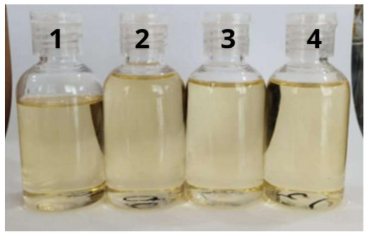
Physical Characteristics of Clove Essential Oil Microemulsions: Comparison of PIC and Spontaneous Techniques with High Energy and Low Energy Methods
DOI:
https://doi.org/10.23917/pharmacon.v22i2.13286Keywords:
clove oil, microemulsion, antiacne, high energy, low energyAbstract
Clove flower essential oil (CFEO), which is useful as an anti-inflammatory, has characteristics that make it easily oxidised and sensitive to heat, so it is formulated in the form of a microemulsion preparation. This study aims to compare the effects of the Phase Inversion Composition (PIC) technique and spontaneous emulsification on the physical characteristics of microemulsions made using high and low-energy methods. The research began with the formulation of clove flower essential oil using the PIC technique and spontaneous emulsification based on the optimal composition from previous studies. The microemulsion was prepared at a stirring speed of 3600 rpm for high-energy and 360 rpm for low-energy. The parameters analysed included globule size, polydispersity index, viscosity, and physical stability against phase separation using centrifugation at 3500 rpm for 30 minutes. The results showed that in the high-energy method, the globule size and viscosity between the two techniques were not significantly different (p > 0.05), but the polydispersity index value in the PIC technique was lower than in spontaneous emulsification (p < 0.05), indicating a more uniform droplet distribution. In the low-energy method, the PIC technique significantly produced smaller droplet size, lower polydispersity index, and higher viscosity (p < 0.05), indicating better kinetic stability. Physical stability testing showed that all formulations remained homogeneous without phase separation. Overall, the PIC technique demonstrated superiority and consistency in producing more homogeneous and stable microemulsions. The low-energy method remains an economical and efficient alternative with proper surfactant composition optimisation.
Downloads
References
Ardiawijianti Iriani, F., Sugihartini, N., & Yuwono, T. (2017). The Profile of Anti-inflammatory Activity of Syzigium Aromaticum Volatile Oil in Lotion with Variation Composition of Oleic Acid and Propylene Glycol as Enhancer. Traditional Medicine Journal, 22(2), 2017. https://doi.org/10.22146/tradmedj.27922 DOI: https://doi.org/10.22146/tradmedj.27922
Aswathanarayan, J. B., & Vittal, R. R. (2019). Nanoemulsions and Their Potential Applications in Food Industry. In Frontiers in Sustainable Food Systems (Vol. 3). Frontiers Media S.A. https://doi.org/10.3389/fsufs.2019.00095 DOI: https://doi.org/10.3389/fsufs.2019.00095
Cui, H., Zhang, C., Li, C., & Lin, L. (2018). Antimicrobial mechanism of clove oil on Listeria monocytogenes. Food Control, 94, 140–146. https://doi.org/10.1016/j.foodcont.2018.07.007 DOI: https://doi.org/10.1016/j.foodcont.2018.07.007
Feng, J., Rodríguez-Abreu, C., Esquena, J., & Solans, C. (2020). A Concise Review on Nano-emulsion Formation by the Phase Inversion
Composition (PIC) Method. In Journal of Surfactants and Detergents (Vol. 23, Issue 4, pp. 677–685). John Wiley and Sons Inc. https://doi.org/10.1002/jsde.12414 DOI: https://doi.org/10.1002/jsde.12414
Gonçalves, A., Nikmaram, N., Roohinejad, S., Estevinho, B. N., Rocha, F., Greiner, R., & McClements, D. J. (2018). Production, properties, and applications of solid self-emulsifying delivery systems (S-SEDS) in the food and pharmaceutical industries. In Colloids and Surfaces A: Physicochemical and Engineering Aspects (Vol. 538, pp. 108–126). Elsevier B.V. https://doi.org/10.1016/j.colsurfa.2017.10.076 DOI: https://doi.org/10.1016/j.colsurfa.2017.10.076
Gumilar, K. N. B., Yuliani, H., & Dwiastuti, R. (2023). Optimization And Physical Characterization Of Quercetin Nanoemulgel Formula As An Antibacterial Agent. International Journal of Applied Pharmaceutics, 15(1), 104–110. https://doi.org/10.22159/ijap.2023v15i1.46737 DOI: https://doi.org/10.22159/ijap.2023v15i1.46737
Haro-González, J. N., Castillo-Herrera, G. A., Martínez-Velázquez, M., & Espinosa-Andrews, H. (2021). Clove essential oil (Syzygium aromaticum l. myrtaceae): Extraction, chemical composition, food applications, and essential bioactivity for human health. In Molecules (Vol. 26, Issue 21). MDPI. https://doi.org/10.3390/molecules26216387 DOI: https://doi.org/10.3390/molecules26216387
Jiang, B., Shi, Y., Lin, G., Kong, D., & Du, J. (2019). Nanoemulsion prepared by homogenizer:The CFD model research. Journal of Food Engineering, 241, 105–115. https://doi.org/10.1016/j.jfoodeng.2018.08.014 DOI: https://doi.org/10.1016/j.jfoodeng.2018.08.014
Julianus Sohilait, H. (2015). Chemical Composition of the Essential Oils in <i>Eugenia caryophylata</i>, Thunb from Amboina Island. Science Journal of Chemistry, 3(6), 95. https://doi.org/10.11648/j.sjc.20150306.13 DOI: https://doi.org/10.11648/j.sjc.20150306.13
Kiromah, N. Z. W., Sugihartini, N., & Nurani, L. H. (2023). Development and characterization of clove oil microemulsion. Pharmacia, 70(1), 233–241. https://doi.org/10.3897/pharmacia.70.e98096 DOI: https://doi.org/10.3897/pharmacia.70.e98096
Kumar, M., Bishnoi, R. S., Shukla, A. K., & Jain, C. P. (2019). Techniques for formulation of nanoemulsion drug delivery system: A review. In Preventive Nutrition and Food Science (Vol. 24, Issue 3, pp. 225–234). Korean Society of Food Science and Nutrition. https://doi.org/10.3746/pnf.2019.24.3.225 DOI: https://doi.org/10.3746/pnf.2019.24.3.225
Liu, C., Li, M., Han, R., Li, J., & Liu, C. (2016). Rheology of Water-in-Oil Emulsions with Different Drop Sizes. Journal of Dispersion Science and Technology, 37(3), 333–344. https://doi.org/10.1080/01932691.2015.1010729 DOI: https://doi.org/10.1080/01932691.2015.1010729
Misra, P., Pandey, G., Pandey, S., Singh, A., Chaurasia, A. K., Lal, E. P., Agnihotry, S., Srivastav, A. K., & Shukla, P. K. (2024). Plant as potential resources for efficacious essential oils: Underpinning aromatherapy evolution. In Aromatherapy: The Science of Essential Oils (pp. 31–63). Bentham Science Publishers. https://doi.org/10.2174/9789815136203124010006 DOI: https://doi.org/10.2174/9789815136203124010006
Safaya, M., & Rotliwala, Y. C. (2020). Nanoemulsions: A review on low energy formulation methods, characterization, applications and optimization technique. Materials Today: Proceedings, 27, 454–459. https://doi.org/10.1016/j.matpr.2019.11.267 DOI: https://doi.org/10.1016/j.matpr.2019.11.267
Silva, T. M., Cerize, N. N. P., & Oliveira, A. M. (2016). The Effect of High Shear Homogenization on Physical Stability of Emulsions. International Journal of Chemistry, 8(4), 52. https://doi.org/10.5539/ijc.v8n4p52 DOI: https://doi.org/10.5539/ijc.v8n4p52
Sohilait, H. J., Kainama, H., & Kaihena, M. (2023). Chemical Composition and Antioxidant Activities of the Essential Oils of Eugenia caryophyllata from Northern Buru Island, Moluccas. https://doi.org/doi10.15376/biores.18.4.7551-7565 DOI: https://doi.org/10.15376/biores.18.4.7551-7565
Sugihartini, N., Haque, A. F., & Yuwono, T. (2018). Anti-Inflammatory Activity of Cream Type O/W with Concentration Variation of Essential Oils of Clove ( Syzigium aromaticum ) . Advanced Science Letters, 23(12), 12514–12517. https://doi.org/10.1166/asl.2017.10805 DOI: https://doi.org/10.1166/asl.2017.10805
Sugihartini, N., Kurniawan, M. F., & Yuwono, T. (2020). Anti-inflammatory Activity of Syzygium Aromaticum Essential Oil in Emulgel. In Jordan Journal of Pharmaceutical Sciences (Vol. 13, Issue 2). http://repository.umy.ac.id/handle/123456789/34541
Suparman, Nurhasanah, & Nurmaya Papuangan. (2017). Mapping of the Population and Types of Local Varieties of Clove Plants (Syzygium aromaticum L.) in the District of Pulau Ternate. Seminar Nasional Penerapan Ilmu Pengetahuan Dan Teknologi; Seminar Nasional Penerapan Ilmu Pengetahuan Dan Teknologi 2017. ISBN : 978-602-8355-53-7
Szumała, P. , & M. A. (2022). Topical delivery of pharmaceutical and cosmetic macromolecules using microemulsion systems. https://doi.org/https://doi.org/10.1016/j.ijpharm.2022.121488 DOI: https://doi.org/10.1016/j.ijpharm.2022.121488
Zulfa E, Danang Novianto, & Dedy Setiawan. (2019). The Effect Of Surfactant Concentration On The Physical Characteristics Of Nanoemulsions And Coenzyme Q10 Gel Nanoemulsions. Jurnal Kimia Riset, Volume 4 No. 2. https://doi.org/doi.org/10.20473/jkr.v4i2.16164