Comparing The Hematological Effects of BPaL/BPaLM Regimens to Those of Standard Regimens in the Treatment of Drug-Resistant Tuberculosis: A Narrative Review
DOI:
https://doi.org/10.23917/pharmacon.v22i2.12071Keywords:
Drug-resistant tuberculosis, BPaL, BPaLM, hematological effectsAbstract
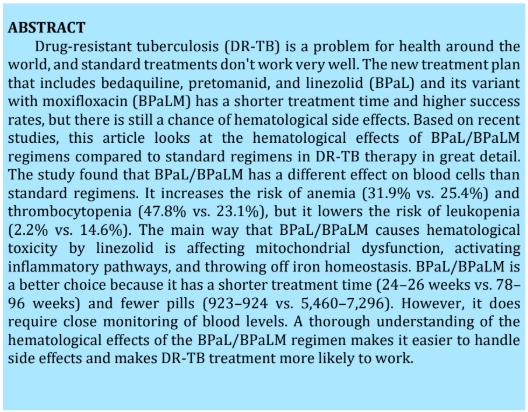
Drug-resistant tuberculosis (DR-TB) is a problem for health around the world, and standard treatments don't work very well. The new treatment plan that includes bedaquiline, pretomanid, and linezolid (BPaL) and its variant with moxifloxacin (BPaLM) has a shorter treatment time and higher success rates, but there is still a chance of hematological side effects. Based on recent studies, this article looks at the hematological effects of BPaL/BPaLM regimens compared to standard regimens in DR-TB therapy in great detail. The study found that BPaL/BPaLM has a different effect on blood cells than standard regimens. It increases the risk of anemia (31.9% vs. 25.4%) and thrombocytopenia (47.8% vs. 23.1%), but it lowers the risk of leukopenia (2.2% vs. 14.6%). The main way that BPaL/BPaLM causes hematological toxicity by linezolid is affecting mitochondrial dysfunction, activating inflammatory pathways, and throwing off iron homeostasis. BPaL/BPaLM is a better choice because it has a shorter treatment time (24–26 weeks vs. 78–96 weeks) and fewer pills (923–924 vs. 5,460–7,296). However, it does require close monitoring of blood levels. A thorough understanding of the hematological effects of the BPaL/BPaLM regimen makes it easier to handle side effects and makes DR-TB treatment more likely to work.
Downloads
References
Adewole, P.D., Ogundipe, T.D., Alabi, O.S. & Nuhu, A., 2024. Haematological parameter among drug resistant tuberculosis patients in Ibadan. African Health Sciences, 24(1), pp.10-15. DOI: https://doi.org/10.4314/ahs.v24i1.3
Bagcchi, S., 2023. WHO's global tuberculosis report 2022. Lancet Microbe, 4(1), p.e20. DOI: https://doi.org/10.1016/S2666-5247(22)00359-7
Balepur, S.S. & Schlossberg, D., 2017. Hematologic complications of tuberculosis. Tuberc Nontuberculous Mycobact Infect, pp.529-539. DOI: https://doi.org/10.1128/9781555819866.ch31
Burhan, E., Sugiharto, J., Soemarno, M., Juan, A., Runtu, Y., Yuvensia, A. et al., 2025. Treatment success rate and time to culture conversion under a prospective BPaL cohort study. IJTLD open, 2(5), pp.284-290. DOI: https://doi.org/10.5588/ijtldopen.24.0524
Conradie, F., Diacon, A., Everitt, D., Mendel, C., Van Niekerk, C. & Howell, P. et al., 2017. The NIX-TB trial of pretomanid, bedaquiline and linezolid to treat XDR-TB. Conf Retroviruses and Opportunistic Infect.
Court, R., Centner, C.M., Chirehwa, M., Wiesner, L., Denti, P. & de Vries, N. et al., 2021. Neuropsychiatric toxicity and cycloserine concentrations during treatment for multidrug-resistant tuberculosis. International Journal of Infectious Diseases, 105, pp.688-694. DOI: https://doi.org/10.1016/j.ijid.2021.03.001
Garrabou, G., Soriano, À., Pinós, T., Casanova-Mollà, J., Pacheu-Grau, D. & Morén, C. et al., 2017. Influence of mitochondrial genetics on the mitochondrial toxicity of linezolid in blood cells and skin nerve fibers. Antimicrobial Agents and Chemotherapy, 61(9), e00542-17. DOI: https://doi.org/10.1128/AAC.00542-17
Haley, C.A., Schechter, M.C., Ashkin, D., Peloquin, C.A., Cegielski, J.P. & Andrino, B.B. et al., 2023. Implementation of bedaquiline, pretomanid, and linezolid in the United States: experience using a novel all-oral treatment regimen for treatment of rifampin-resistant or rifampin-intolerant tuberculosis disease. Clinical Infectious Diseases, 77(7), pp.1053-1062.
Iyer, S.S., He, Q., Janczy, J.R., Elliott, E.I., Zhong, Z. & Olivier, A.K. et al., 2013. Mitochondrial cardiolipin is required for Nlrp3 inflammasome activation. Immunity, 39(2), pp.311-323. DOI: https://doi.org/10.1016/j.immuni.2013.08.001
Khan, M., Ismail, A., Ghafoor, A., Khan, N., Muzaffar, N. & Zafar, F. et al., 2024. Experience of piloting BPaLM/BPaL for DR-TB care at selected sites in Pakistan. IJTLD open, 1(11), pp.508-515. DOI: https://doi.org/10.5588/ijtldopen.24.0369
Massud, A., Syed Sulaiman, S.A., Ahmad, N., Shafqat, M., Chiau Ming, L. & Khan, A.H., 2022. Frequency and management of adverse drug reactions among drug-resistant tuberculosis patients: Analysis from a prospective study. Frontiers in Pharmacology, 13, 883483. DOI: https://doi.org/10.3389/fphar.2022.883483
Minardi, M.L., Fato, I., Di Gennaro, F., Mosti, S., Mastrobattista, A. & Cerva, C. et al., 2021. Common and rare hematological manifestations and adverse drug events during treatment of active TB: a state of art. Microorganisms, 9(7), 1477. DOI: https://doi.org/10.3390/microorganisms9071477
Mo, K., Cao, W., Lu, Y., Li, J., Wei, R. & Meng, M. et al., 2024. Risk factors for linezolid-induced haematological toxicity in patients: a retrospective study. Journal of Infection in Developing Countries, 18(08), pp.1258-1264. DOI: https://doi.org/10.3855/jidc.18366
Mulder, C., Rupert, S., Setiawan, E., Mambetova, E., Edo, P. & Sugiharto, J. et al., 2022. Budgetary impact of using BPaL for treating extensively drug-resistant tuberculosis. BMJ Global Health, 7(1). DOI: https://doi.org/10.1136/bmjgh-2021-007182
Oehadian, A., Santoso, P., Menzies, D. & Ruslami, R., 2022. Concise clinical review of hematologic toxicity of linezolid in multidrug-resistant and extensively drug-resistant tuberculosis: role of mitochondria. Tuberculosis and Respiratory Diseases, 85(2), p.111. DOI: https://doi.org/10.4046/trd.2021.0122
Pradipta, I., Barliana, M.I., Suyatno, D. & Wijasa, W.N., 2023. Efikasi, Keamanan, Efisiensi Biaya Penggunaan Rejimen Bedaquilin, Pretomanid, dan Linezolid (BPaL) dalam Pengobatan Tuberkulosis Resisten Obat Ganda. Majalah Farmasi dan Farmakologi, 27(3), pp.76-81.
Pratama, N.Y.I., Zulkarnain, B.S., Soedarsono & Fatmawati, U., 2021. Hematological side effect analysis of linezolid in MDR-TB patients with individual therapy. Journal of Basic and Clinical Physiology and Pharmacology, 32(4), pp.777-781. DOI: https://doi.org/10.1515/jbcpp-2020-0468
Putra, O.N., Faizah, A.K. & DN, N.K.W., 2023. Safety and Efficacy of Bedaquiline-Pretomanid-Linezolid (BPaL) in Patients with Drug-Resistant Tuberculosis: (Review from Clinical Evidence). Journal of Pharmacy Care Anwar Medika (J-PhAM), 5(2), pp.17-30. DOI: https://doi.org/10.32734/jetromi.v5i2.12373
Sangsayunh, I., Sanchat, T., Chuchottaworn, C., Cheewakul, K. & Rattanawai, S., 2024. The use of BPaL containing regimen in the MDR/PreXDR TB treatments in Thailand. Journal of Clinical Tuberculosis and Other Mycobacterial Diseases, 34, 100408. DOI: https://doi.org/10.1016/j.jctube.2023.100408
Wasserman, S., Brust, J.C.M., Abdelwahab, M.T., Little, F., Denti, P., Wiesner, L., Gandhi, N.R., Meintjes, G. & Maartens, G., 2022. Linezolid toxicity in patients with drug-resistant tuberculosis: a prospective cohort study. Journal of Antimicrobial Chemotherapy, 77(5), pp.1146-1154. DOI: https://doi.org/10.1093/jac/dkac019