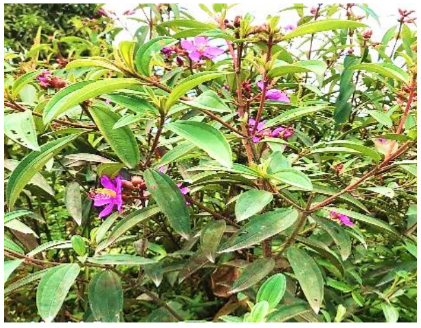
Antifungal Potential of Melastoma malabathricum L. Leaf Extract against Candida albicans: A Phytochemical Approach
DOI:
https://doi.org/10.23917/pharmacon.v22i2.10551Keywords:
Antifungal activity, Candida albicans , Infectious diseases, Melastoma malabathricum, Phytochemical screeningAbstract
Candida species are opportunistic fungi, capable of causing acute and chronic infections in the gastrointestinal tract, vagina, and oral mucosa among which Candida albicans is the most important species. Melastoma malabathricum L. is one of the most important traditional medicinal plants in Sumatera Island, Indonesia used to treat infectious diseases. The main of this work was to evaluate phytochemical screening of ethanol extract of M. malabathricum leaf, qualitative analysis of mixture compounds by TLC analysis and investigation antifungal activity against C. albicans. The antifungal activity of plant extract at concentrations of 20%, 40%, 60% and 80% were assessed using agar-well diffusion method. Flavonoids, saponins and tannins were secondary metabolites found in ethanol extract. The extract of M. malabathricum leaf formed a zone of inhibition of 6.45 ± 0.002, 6.35 ± 0.023, 6.30 ± 0.050 at concentrations of 20%, 40%, 60%, respectively. In conclusion, M. malabathricum leaf had weak antifungal activity. In addition, ethanolic extract had a variety of secondary metabolites that possibly have antifungal activities. Thus, the present findings support the folklore use of M. malabathricum for the treatment of different fungal infections.
Downloads
References
Abubakar, A., & Haque, M. (2020). Preparation of Medicinal Plants: Basic Extraction and Fractionation Procedures for Experimental Purposes. Journal of Pharmacy and Bioallied Sciences, 12(1), 1. https://doi.org/10.4103/jpbs.JPBS_175_19 DOI: https://doi.org/10.4103/jpbs.JPBS_175_19
Aboody, M. S. A., & Mickymaray, S. (2020). Anti-Fungal Efficacy and Mechanisms of Flavonoids. Antibiotics, 9(2), 45. https://doi.org/10.3390/antibiotics9020045 DOI: https://doi.org/10.3390/antibiotics9020045
Asmerom, D., Kalay, T. H., & Tafere, G. G. (2020). Antibacterial and Antifungal Activities of the Leaf Exudate of Aloe megalacantha Baker. International Journal of Microbiology, 2020, 1–6. https://doi.org/10.1155/2020/8840857 DOI: https://doi.org/10.1155/2020/8840857
Astefanei, A., Dapic, I., & Camenzuli, M. (2017). Different Stationary Phase Selectivities and Morphologies for Intact Protein Separations. Chromatographia, 80(5), 665–687. https://doi.org/10.1007/s10337-016-3168-z DOI: https://doi.org/10.1007/s10337-016-3168-z
Balamurugan, K., Nishanthini, A., & Mohan, V. R. (2014). Antidiabetic and Antihyperlipidaemic Activity of Ethanol Extract of Melastoma Malabathricum Linn. Leaf in Alloxan Induced Diabetic Rats. Asian Pacific Journal of Tropical Biomedicine, 4, S442–S448. https://doi.org/10.12980/APJTB.4.2014C122 DOI: https://doi.org/10.12980/APJTB.4.2014C122
Balouiri, M., Sadiki, M., & Ibnsouda, S. K. (2016). Methods for In Vitro Evaluating Antimicrobial Activity: A Review. Journal of Pharmaceutical Analysis, 6(2), 71–79. https://doi.org/10.1016/j.jpha.2015.11.005 DOI: https://doi.org/10.1016/j.jpha.2015.11.005
Bonifácio, B. V., Vila, T. V. M., Masiero, I. F., Da Silva, P. B., Da Silva, I. C., De Oliveira Lopes, É., Dos Santos Ramos, M. A., De Souza, L. P., Vilegas, W., Pavan, F. R., Chorilli, M., Lopez-Ribot, J. L., & Bauab, T. M. (2019). Antifungal Activity of a Hydroethanolic Extract from Astronium urundeuva Leaves Against Candida albicans and Candida glabrata. Frontiers in Microbiology, 10, 2642. https://doi.org/10.3389/fmicb.2019.02642 DOI: https://doi.org/10.3389/fmicb.2019.02642
Carvalho, R. S., Carollo, C. A., De Magalhães, J. C., Palumbo, J. M. C., Boaretto, A. G., Nunes E Sá, I. C., Ferraz, A. C., Lima, W. G., De Siqueira, J. M., & Ferreira, J. M. S. (2018). Antibacterial and Antifungal Activities of Phenolic Compound-Enriched Ethyl Acetate Fraction from Cochlospermum regium (Mart. Et. Schr.) Pilger Roots: Mechanisms of Action and Synergism with Tannin and Gallic Acid. South African Journal of Botany, 114, 181–187. https://doi.org/10.1016/j.sajb.2017.11.010 DOI: https://doi.org/10.1016/j.sajb.2017.11.010
Fernandes, M. M., Carvalho, E. O., Correia, D. M., Esperança, J. M. S. S., Padrão, J., Ivanova, K., Hoyo, J., Tzanov, T., & Lanceros-Mendez, S. (2022). Ionic Liquids as Biocompatible Antibacterial Agents: A Case Study on Structure-Related Bioactivity on Escherichia coli. ACS Applied Bio Materials, 5(11), 5181–5189. https://doi.org/10.1021/acsabm.2c00615 DOI: https://doi.org/10.1021/acsabm.2c00615
Geraldi, A., Wardana, A. P., Aminah, N. S., Kristanti, A. N., Sadila, A. Y., Wijaya, N. H., Wijaya, M. R. A., Diningrum, N. I. D., Hajar, V. R., & Manuhara, Y. S. W. (2022). Tropical Medicinal Plant Extracts from Indonesia as Antifungal Agents against Candida Albicans. Frontiers in Bioscience-Landmark, 27(9), 274. https://doi.org/10.31083/j.fbl2709274 DOI: https://doi.org/10.31083/j.fbl2709274
Harborne, J. B. (1998). Phytochemical Methods A Guide to Modern Techniques of Plant Analysis (3rd ed., Vol. 3). Springer Dordecht.
Hasan, N. binti, & Sudin, N. I. N. binti M. (2019). Diversity and Antifungal Activity of Endophytic Fungi Associated with Melastoma malabathricum L. Journal of Applied Biological Sciences, 3(13), 154–159.
Kamisan, F. H., Yahya, F., Ismail, N. A., Din, S. S., Mamat, S. S., Zabidi, Z., Zainulddin, W. N. W., Mohtarrudin, N., Husain, H., Ahmad, Z., & Zakaria, Z. A. (2013). Hepatoprotective Activity of Methanol Extract of Melastoma malabathricum Leaf in Rats. Journal of Acupuncture and Meridian Studies, 6(1), 52–55. https://doi.org/10.1016/j.jams.2012.08.002 DOI: https://doi.org/10.1016/j.jams.2012.08.002
Maji, S., Dandapat, P., Maity, C., Halder, S. K., Das Mohapatra, P. K., Pathak, T. K., Pati, B. R., Samanta, A., & Mondal, K. C. (2010). In Vitro Antimicrobial Potentialities of Different Solvent Extracts of Ethnomedicinal Plants against Clinically Isolated Human Pathogens. Journal of Phytology, 4(2), 57–64.
Mayasari, D., Murti, Y. B., & Pratiwi, S. U. T., & Sudarsono, S. (2022a). An Ethnomedicinal Study of Plants Used for Healing of Infectious Diseases in Kuantan Singingi District of Riau Province, Indonesia. Studies on Ethno-Medicine, 3–4(16), 147–160.
Mayasari, D., Murti, Y. B., Pratiwi, S. U. T., & Sudarsono, S. (2021a). Metabolic fingerprinting of Melastoma malabathricum L. extracts using high-performance liquid chromatography-diode array detector combined with chemometric data analysis. Journal of Applied Pharmaceutical Science. https://doi.org/10.7324/JAPS.2021.110906 DOI: https://doi.org/10.7324/JAPS.2021.110906
Mayasari, D., Murti, Y. B., Pratiwi, S. U. T., & Sudarsono, S. (2021b). TLC-Contact Bioautography and Disc Diffusion Method for Investigation of the Antibacterial Activity of Melastoma malabathricum L. Leaves. Research Journal of Pharmacy and Technology, 6463–6470. https://doi.org/10.52711/0974-360X.2021.01117 DOI: https://doi.org/10.52711/0974-360X.2021.01117
Mayasari, D., Murti, Y. B., Pratiwi, S. U. T., & Sudarsono, S. (2022b). Antibacterial Activity and TLC-Densitometric Analysis of Secondary Metabolites in the Leaves of the Traditional Herb, Melastoma malabathricum L. Borneo Journal of Pharmacy, 5(4), 334–344. https://doi.org/10.33084/bjop.v5i4.3818 DOI: https://doi.org/10.33084/bjop.v5i4.3818
Mayasari, D., Murti, Y. B., Sudarsono, S., & Pratiwi, S. U. T. (2021). Phytochemical, Antioxidant and Antibacterial Evaluation of Melastoma malabathricum L.: An Indonesian Traditional Medicinal Plant. Tropical Journal of Natural Product Research, 5(5), 819–824. https://doi.org/10.26538/tjnpr/v5i5.5 DOI: https://doi.org/10.26538/tjnpr/v5i5.5
Ouchari, L., Boukeskasse, A., Bouizgarne, B., & Ouhdouch, Y. (2018). Antimicrobial Potential of Actinomycetes Isolated from Unexplored Hot Merzouga Desert and Their Taxonomic Diversity. Biology Open, bio.035410. https://doi.org/10.1242/bio.035410 DOI: https://doi.org/10.1242/bio.035410
Prastiyanto, M. E., Rohmah, N., Efendi, L., Arifin, R., Wardoyo, F. A., Wilson, W., Mukaromah, A. H., Dewi, S. S., & Darmawati, S. (2021). Antifungal Activities of the Rhizome Extract of Five Member Zingiberaceae against Candida albicans and Trichophyton rubrum. Biodiversitas Journal of Biological Diversity, 22(3). https://doi.org/10.13057/biodiv/d220355 DOI: https://doi.org/10.13057/biodiv/d220355
Puxeddu, S., Canton, S., Scano, A., Delogu, I., Pibiri, A., Cabriolu, C., Vascellari, S., Pettinau, F., Pivetta, T., Ennas, G., Manzin, A., & Angius, F. (2025). Beyond One-Size-Fits-All: Addressing Methodological Constraints in Novel Antimicrobials Discovery. Antibiotics, 14(8), 848. https://doi.org/10.3390/antibiotics14080848 DOI: https://doi.org/10.3390/antibiotics14080848
Ramos, M. A. D. S., Calixto, G. M. F., Gaspar De Toledo, L., Vidal Bonifácio, B., Campaner Dos Santos, L., Gottardo De Almeida, M. T., Chorilli, M., & Bauab, T. M. (2015). Liquid Crystal Precursor Mucoadhesive System as a Strategy to Improve the Prophylactic Action of Syngonanthus nitens (Bong.) Ruhland against Infection by Candida Krusei. International Journal of Nanomedicine, 7455. https://doi.org/10.2147/IJN.S92638 DOI: https://doi.org/10.2147/IJN.S92638
Roslen, N. A., Alewi, N. A. M., Ahamada, H., & Rasad, M. S. B. A. (2014). Cytotoxicity Screening of Melastoma malabathricum Extracts on Human Breast Cancer Cell Lines In Vitro. Asian Pacific Journal of Tropical Biomedicine, 4(7), 545–548. https://doi.org/10.12980/APJTB.4.2014C658 DOI: https://doi.org/10.12980/APJTB.4.2014C658
Talapko, J., Juzbašić, M., Matijević, T., Pustijanac, E., Bekić, S., Kotris, I., & Škrlec, I. (2021). Candida albicans—The Virulence Factors and Clinical Manifestations of Infection. Journal of Fungi, 7(2), 79. https://doi.org/10.3390/jof7020079 DOI: https://doi.org/10.3390/jof7020079
Tan, L. F., Yap, V. L., Rajagopal, M., Wiart, C., Selvaraja, M., Leong, M. Y., & Tan, P. L. (2022). Plant as an Alternative Source of Antifungals against Aspergillus Infections: A Review. Plants, 11(22), 3009. https://doi.org/10.3390/plants11223009 DOI: https://doi.org/10.3390/plants11223009
Vanani, A. R., Mahdavinia, M., Kalantari, H., Khoshnood, S., & Shirani, M. (2019). Antifungal Effect of the Effect of Securigera securidaca L. Vaginal Gel on Candida species. Current Medical Mycology. https://doi.org/10.18502/cmm.5.3.1744 DOI: https://doi.org/10.18502/cmm.5.3.1744
Yoshida, T., Nakata, F., Hosotani, K., Nitta, A., & Okuda, T. (1992). Dimeric Hydrolysable Tannins from Melastoma malabathricum. Phtochemistry, 31(8), 2829–2833. DOI: https://doi.org/10.1016/0031-9422(92)83641-B
Zhafira, A. D.,Maulana, I. Topik., & Syafnir, L. (2022). Uji Aktivitas Antifungi Ekstrak Daun Senduduk (Melastoma malabathricum (Linn.)) terhadap Jamur Candida albicans Penyebab Sariawan (Stomatitis Aphtosa Rekuren). Bandung Conference Series: Pharmacy (Vol. 2, No. 2, pp 65-73). https://doi.org/10.52711/0974-360X.2021.01117 DOI: https://doi.org/10.29313/bcsp.v2i2.3357