Analysis Of Tathma'innul Qulub's Interpretation In The Perspective Of Tafsir Fi Zhilalil Qur'an And Its Relevance To Mental Health
Keywords:
Tathma'innul Qulub, Sayyid Quthb, Tafsir, Fi Zhilalil Qur'an, Mental HealthAbstract
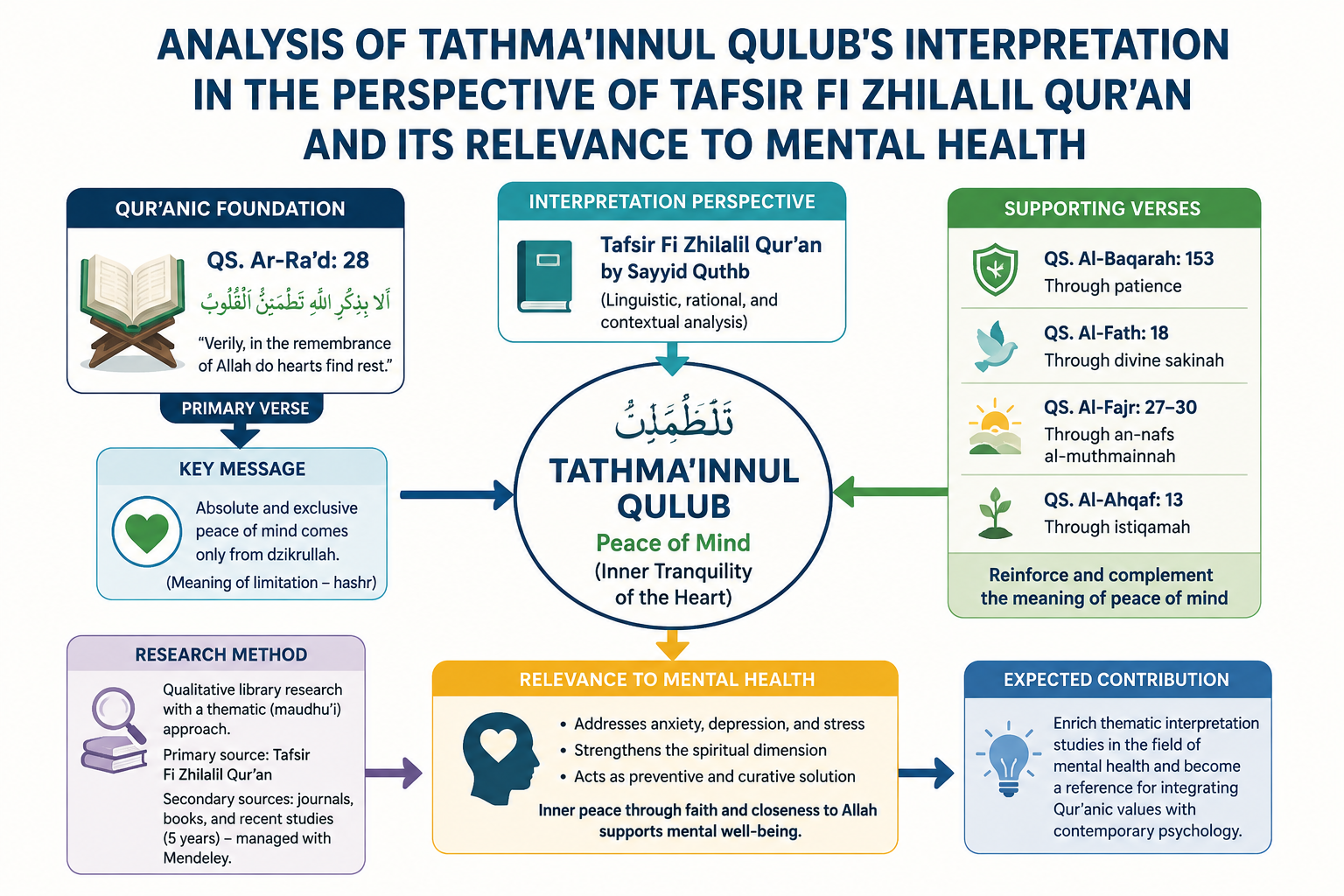
Peace of mind (tathma'innul qulub) is one of the basic psychological needs of humans that is closely related to mental health. In the midst of the increasing number of anxiety disorders, depression, and stress in modern society, the Qur'an offers the concept of peace of mind that comes from faith and closeness to Allah. Among all the verses that talk about peace of mind, QS. Ar-Ra'd: 28 is the only verse that explicitly uses the redaction of the tatma'innul qulub, so this verse is positioned as primary data, while the other verses serve as reinforcements and complements the meaning. This research aims to analyze in depth Sayyid Quthb's interpretation of QS. Ar-Ra'd: 28 in Tafsir Fi Zhilalil Qur'an, both from the linguistic aspects, reasonableness, and content of its meaning, and examines its relevance to contemporary mental health concepts. This study uses a qualitative method of library research with a thematic approach (maudhu'i), namely collecting and analyzing verses related to the theme of peace of mind from primary sources of Tafsir Fi Zhilalil Qur'an, supported by secondary sources in the form of journals, books, and the results of previous research in the last five years which are managed using the Mendeley reference manager application. The results of the study show that Sayyid Quthb interpreted the tatma'innul qulub in QS. Ar-Ra'd: 28 as an absolute and exclusive peace of mind, which is born only from dzikrullah, as shown by the sentence structure of the verse that precedes the phrase bidzikrillah to affirm the meaning of limitation (hashr). This meaning is reinforced by QS. Al-Baqarah: 153, QS. Al-Fath: 18, QS. Al-Fajr: 27-30, and QS. Al-Ahqaf: 13 which shows variations of the form of peace of mind through patience, prayer, sakinah, and istiqamah. This concept is relevant to modern mental health indicators, especially the spiritual dimension, because it can be a preventive and curative solution to psychological disorders such as anxiety and depression. This research is expected to enrich the study of thematic interpretation in the field of mental health and become a reference for the integration of Qur'anic values with contemporary psychology.
Downloads
References
[1] D. Anni and M. Y. Nury, “Ketenangan Hati Perspektif Tafsir Fi Dzilalil Quran (Kajian Mental Health dalam Alquran),” Spirit. Heal. J. Tasawuf dan Psikoterapi, vol. 4, no. 1, pp. 42–51, 2023, doi: 10.19109/sh.v4i1.15883.
[2] S. C. Nawawi, “Rahasia Ketenangan Jiwa dalam Al-Qur’an,” MAGHZA J. Ilmu Al-Qur’an dan Tafsir, vol. 6, no. 1, pp. 30–46, 2021, doi: 10.24090/maghza.v6i1.4476.
[3] Aneu Nandya Indayanti, “Implementasi Sumber, Pendekatan, Corak Dan Kaidah Tafsir Karya Sayyid Quthb Dalam Kitab Tafsir Fi Zhilalil Qur’an Jilid 3,” Al-Tadabbur J. Ilmu Al-Qur’an dan Tafsir, vol. 7, no. 2, pp. 291–304, 2022, doi: 10.30868/at.v7i0.
[4] L. Yuniati and K. Nugroho, “The Concept of Time Management in the Interpretation of Surah Al- ’ Asr and Its Relevance to Work Productivity in the Modern Era Konsep Manajemen Waktu dalam Tafsir Surah Al- ‘ Asr dan Relevansinya terhadap Produktivitas Kerja di Era Modern,” vol. 10, no. 1, pp. 210–224, 2026.
[5] R. H. Nur and I. Zamimah, “Kesehatan Mental Perspektif Tafsir Al-Misbah Karya M. Quraish Shihab”.
[6] Z. Rizqi, N. M. Siregar, F. Adnir, U. Islam, N. Sumatera, and U. Medan, “Konsep Tathmaninnul Qulub dalam QS . Ar- Ra ’ d : 28 sebagai Resolusi Quarter-Life Crisis pada Fase Emerging Adulthood,” vol. 03, pp. 747–758, 2026.
[7] M. L. dan S. Vera, “Metodologi Tafsir Fi Zhilal al-Qur’an Sayyid Qutb,” J. Iman dan Spiritualitas, vol. 1, no. 1, pp. 47–54, 2021.
[8] M. Subki, F. Sugiarto, and M. N. Janhari, “Penafsiran Sayyid Quthb Tentang Wacana Pluralisme Agama Dalam Al-Qur’an Surat Al-An’am Ayat 108 Pada Tafsir Fi Zhilal Al-Qur’an,” Sophist J. Sos. Polit. Kaji. Islam dan Tafsir, vol. 3, no. 1, pp. 66–86, 2021, doi: 10.20414/sophist.v3i1.39.
[9] M. N. Janhari, U. Islam, N. Sunan, S. I. Khumaero, U. Islam, and N. Mataram, “Konsep Wasathiyyah Menurut Sayyid dalam Kitab Tafsir Fi Zhilalil Al-Qur’an (Analisa Sosiologi Pengetahuan Peter Ludwig Berger),” J. Semiot. Kaji. Ilmu Al-Qur’an Tafsir, vol. 3, 2023.
[10] M. Nor and Y. Dahliana, “Epistemologi Tafsir Fii Zhilalil Qur’an Karya Sayyid Qutb,” Hamalatul Qur’an J. Ilmu Ilmu Alqur’an, vol. 6, no. 1, pp. 152–174, 2025, doi: 10.37985/hq.v6i1.502.
[11] Muhammad Jalaludin Rumi Hamid, Ahmad Syihabuddin Albuny, Salman Alfarizi, and Yuminah Yuminah, “Relasi Antara Doa dan Ketenangan Jiwa dalam Perpekstif Psikologi Agama,” Al-Tarbiyah J. Ilmu Pendidik. Islam, vol. 3, no. 2, pp. 192–203, 2025, doi: 10.59059/al-tarbiyah.v3i2.2412.
[12] Burhanuddin, “Zikir Dan Ketenangan Jiwa (Solusi Islam Mengatasi Kegelisahan dan Kegalauan Jiwa),” J. Mimb. Media Intelekt. Muslim dan Bimbing. Rohani, vol. 6, no. 1, pp. 1–25, 2020, doi: 10.47435/mimbar.v6i1.371.
[13] Ema Fitriya, Nur Hani’ah, and Hanifatul Khofifah, “Tasawuf dalam Perspektif Psikologi: Harmoni Spiritual dan Kesehatan Mental,” AJMIE Alhikam J. Multidiscip. Islam. Educ., vol. 5, no. 2, pp. 291–306, 2025, doi: 10.32478/8zv7ag68.
[14] S. P. Nurhuda, N. Nasichcah, and S. S. Ayasha, “Terapi Dzikir Dalam Kesehatan Mental,” J. Ilmu Sos. Hum. dan Seni, vol. 2, no. 2, pp. 92–96, 2023, doi: 10.62379/jishs.v2i2.1324.
[15] P. Ariadi, “Kesehatan Mental dalam Perspektif Islam,” Syifa’ Med. J. Kedokt. dan Kesehat., vol. 3, no. 2, p. 118, 2019, doi: 10.32502/sm.v3i2.1433.
[16] J. Aulia and Bashori., “Menggali Konsep Self Healing dalam Al-Qur’an,” MUSHAF J. J. Self Heal. Al-Qur’an dan Hadis, vol. 5, no. 1, pp. 59–67, 2025.
Downloads
Submitted
Accepted
Published
How to Cite
Issue
Section
License
Copyright (c) 2026 Nadhifa Zahira Auria, Yeti Dahliana

This work is licensed under a Creative Commons Attribution 4.0 International License.