The Meaning of Libasut Taqwa in QS. Al-A'raf Verse 26 Perspective of Al-Qurthubi
Keywords:
libasut taqwa, QS. Al-A'raf verse 26, Al-Qurthubi, a socio-religious phenomenonAbstract
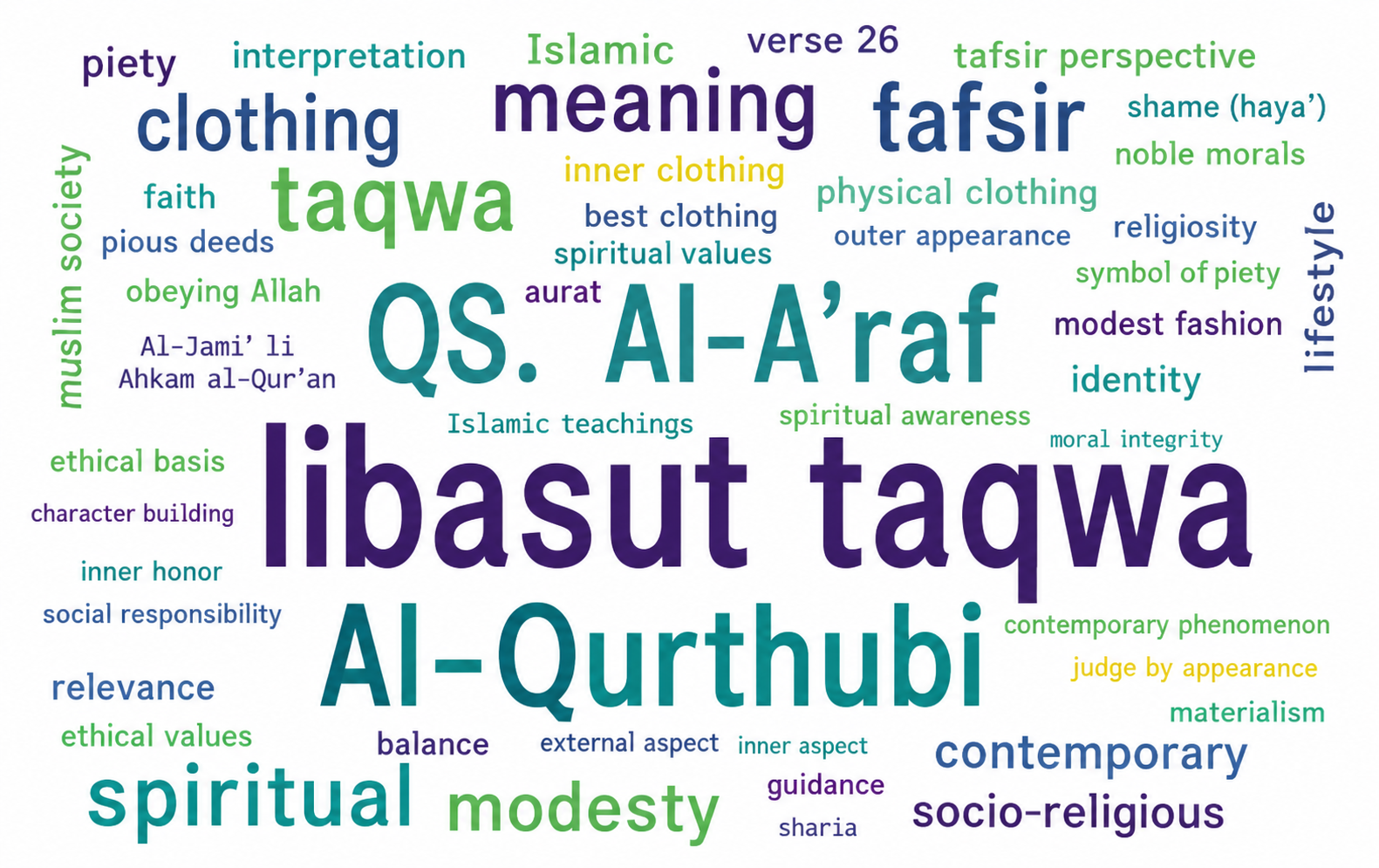
The phenomenon of dressing among contemporary Muslim societies is no longer only understood to fulfill the guidance of the sharia, but has also evolved into a symbol of identity, lifestyle, and expression of religiosity. This situation creates a tendency for people to focus more on the physical aspect than the spiritual values that exist in the concept of libasut taqwa. The purpose of this study is to analyze the meaning of libasut taqwa in QS. Al-A'raf verse 26 from the perspective of Al-Qurthubi and examines its relevance to contemporary socio-religious phenomena. This research applies a qualitative method with the type of library research. Data is obtained from the book Al-Jami' li Ahkam al-Qur'an by Al-Qurthubi as the main source, and is supported by books of tafsir, books, scientific articles, and other literature. The data analysis process is carried out in a descriptive-analytical manner using an interpretation approach. The results of the study show that Al-Qurthubi interprets libasut taqwa as clothing that has a spiritual aspect that is reflected in faith, pious deeds, shame (haya'), noble morals, and obedience to Allah SWT. Al-Qurthubi argues that physical clothing only serves to beautify the appearance as well as a covering for the aurat. Meanwhile, libasut taqwa is the best clothing because it maintains inner honor and forms individual character. In the contemporary socio-religious context, the concept of libasut taqwa still has relevance as an ethical basis in responding to the phenomenon of modest fashion, symbols of piety, and the tendency to judge religiosity based on physical appearance. Therefore, the concept of libasut taqwa is a reference that balances the external and inner aspects, so as to be able to build moral integrity, social responsibility, and spiritual awareness in modern society.
Downloads
References
[1] P. Silviani, N. Nasokah, and S. Rizqi, “ETIKA BERPAKAIAN DAN RELEVANSINYA DENGAN PENDIDIKAN ISLAM KAJIAN AYAT (QS AL-A’RAF AYAT 26-27),” J. Ris. Pendidik. Indones., vol. 5, no. 1, pp. 10–17, 2025.
[2] M. N. Gemilang and Y. Dahliana, “Keistimewaan Sinar Matahari Perspektif Tafsir Kemenag RI Surat Nuh Ayat 16 (Studi Analisis Sinar Matahari dan Pengelolaan Sumber Daya Alam),” 2023, Universitas Muhammadiyah Surakarta.
[3] A. Abdullah, “Kajian Kitab Tafsir ‘al-Jami’li ahkam al-Qur’an’ Karya: Al-Qurthubi,” Al-I’jaz J. Kewahyuan Islam, no. IV, 2018.
[4] S. M. Q. S. An-nur, “PENCEGAHAN PELECEHAN SEKSUAL DALAM AL- QUR ’ AN PERSPEKTIF TAFSIR AL- QURTHUBI Oleh : Izzat Zaini NIM : 171410621 Program Studi Ilmu Al- Qur ’ an dan Tafsir FAKULTAS USHULUDDIN INSTITUT PERGURUAN TINGGI ILMU AL- QUR ’ AN,” pp. 30–31, 2022.
[5] I. Hukum et al., “Muhammad Habib Aris Fauzan Universitas Muhammadiyah Yogyakarta , Yogyakarta , Indonesia Abstrak,” vol. 17, no. 6, pp. 4349–4362, 1907.
[6] A. M. Khasanah and M. F. Fattah, “Pakaian Ideal Seorang Muslimah (Studi Komparatif dalam Pentafsiran Surah Al-A’raf ayat 26 antara Kitab Tafsir Al-Maraghi dan Tafsir Al-Azhar): Al-Maraghi dan Buya Hamka,” Adv. Humanit. Contemp. Stud., vol. 2, no. 1, pp. 21–32, 2021.
[7] G. N. Putri, F. Hayati, and D. N. Inten, “Implikasi Pendidikan QS. Al-Araf Ayat 26 tentang Berbusana Syar’i terhadap Pembentukan Akhlak Berpakaian,” J. Ris. Pendidik. Agama Islam, pp. 23–28, 2024.
[8] M. Sudin, M. A. Fauzi, U. Karimah, and S. Bahri, “Nilai-Nilai Pendidikan Islam Dalam Surat Al-A’raf Ayat 26 Berdasarkan Tafsir Ibnu Katsir,” MISYKAT J. Ilmu-ilmu Al-Quran Hadits Syari’ah dan Tarb., vol. 8, no. 2, pp. 103–110, 2023.
[9] F. Hafidz Abimijoyo, B. Febriyarni, and H. Saputra, “Pesan Moral Al-Qur’an Tentang Pembentukan Akhlaq al-Karimah,” AL-HUDA J. Qur’anic Stud., vol. 1, no. 2, pp. 111–134, 2022.
[10] B. I. N. Abdurahman and B. I. N. Ishaq, “TAFSIR IBNU KATSIR JILID 3,” vol. 3, 2004.
[11] M. A. Muhammad, M. Abdul, L. Khalaf, M. Mursi, and A. Hamid, “Tafsir Ath-Thabari,” vol. 10, 2007.
[12] A. A. M. bin A. A.-A. Al-Qurthubi, “Tafsir Al Qurthubi,” vol. 7, 2008.
[13] F. A. Assegaf, S. Hidayat, A. Nirwana, and M. A. Suharjianto, “Skripsi Toleransi antar umat beragama Menurut Tafsir Al-Mishbah Karya M. Quraish Shihab,” pp. i–15, 2021.
[14] G. S. Pane and J. W. S. Rizki, “Tren JilbabTurban sebagai Fashion Muslimah di Era Kontemporer,” Hikmah, vol. 18, no. Desember, pp. 181–198, 2024.
[15] M. S. I. Ismail et al., “Exploring The True Islamic Brand Attire with Special Reference to The Characteristics of Libas Al-Taqwa,” Int. J. Acad. Res. Bus. Soc. Sci., vol. 13, no. 5, pp. 1553–1564, 2023, doi: 10.6007/ijarbss/v13-i5/16904.
[16] A. Munawwir, “Konsep Libas (Pakaian) dalam Al-Quran,” J. Tafsere, vol. 9, pp. 230–249, 2021, doi: 10.24252/jt.v9i02.37342.
[17] I. I. J. Rifka Alkhilyatul Ma’rifat, I Made Suraharta, “LIBÂS AT-TAQWÂ DALAM PERSPEKTIF AL-QUR`AN (Studi Komparatif Tafsîr al-Mishbâh dan Tafsîr al-Azhar),” vol. 2, pp. 306–312, 2024.
[18] D. Kurniadi, K. Nugroho, and A. Mustofa, “Transformasi Makna Khayra Ummah dalam QS Ali Imran Ayat 110 melalui Analisis Semantik Toshihiko Izutsu sebagai Konstruksi Identitas Kolektif Muslim: Indonesia,” Al Karima J. Stud. Ilmu Al Quran dan Tafsir, vol. 10, no. 1, pp. 130–153, 2026.
Downloads
Submitted
Accepted
Published
How to Cite
Issue
Section
License
Copyright (c) 2026 'Azmah Tsana Pertiwi, Yeti Dahliana

This work is licensed under a Creative Commons Attribution 4.0 International License.