Islamic Ecotheology on the Carbon Footprint of Artificial Intelligence in Contemporary Digital Civilization
Keywords:
Islamic Ecotheology, Carbon Footprint, Artificial Intelligence, Digital Ethics, SustainabilityAbstract
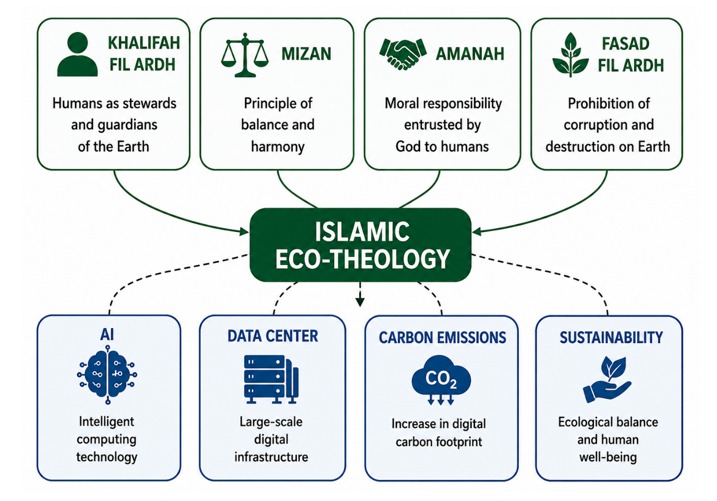
The development of artificial intelligence (AI) in recent years has driven the massive expansion of digital data centers, cloud computing, and algorithmic processing systems on a global scale. Behind the acceleration of these innovations, AI requires high energy consumption and generates a digital carbon footprint that contributes to the contemporary ecological crisis. The discourse on AI has so far focused more on technological, economic, and social ethical aspects, while studies on the ecological impact of AI from an Islamic perspective are still relatively limited. This research aims to analyze the carbon footprint of AI in contemporary digital civilization through an Islamic ecotheological approach and formulate an ethical foundation for sustainable technology development. This study uses a qualitative method based on literature studies with an approach to Islamic ecology and technological ethics. Data was obtained from international scientific articles, global environmental reports, and literature on AI sustainability and Islamic environmental ethics. The results show that AI is not ecologically neutral as it contributes to increased energy consumption, resource exploitation, and digital carbon emissions. From an Islamic perspective, the digital ecological crisis is seen as a form of imbalance in the relationship between humans and nature due to exploitative technological orientation. The principles of sharia maqashid, especially the protection of life and environmental sustainability, can be used as a basis for building a sustainable AI ethics that places ecological responsibility as an integral part of the digital civilization of the future.
Downloads
References
[1] E. Brynjolfsson and A. McAfee, The Second Machine Age: Work, Progress, and Prosperity in a Time of Brilliant Technologies. New York: W.W. Norton & Company, 2016. [Online]. Available: https://wwnorton.com/books/the-second-machine-age/
[2] M. Tegmark, Life 3.0: Being Human in the Age of Artificial Intelligence. New York: Alfred A. Knopf, 2017. [Online]. Available: https://futureoflife.org/book/life-3-0/
[3] I. E. Agency, "Electricity 2024: Analysis and Forecast to 2026," IEA, Paris, 2024. doi: 10.1787/electricity-2024-en.
[4] S. Luccioni, Y. Jernite, and E. Strubell, "Power Hungry Processing: Watts Driving the Cost of AI Deployment?," in Proceedings of the AAAI Conference on Artificial Intelligence, 2024, pp. 23250–23260. doi: 10.1609/aaai.v38i21.30239.
[5] D. Rolnick et al., "Tackling Climate Change with Machine Learning," ACM Comput. Surv., vol. 55, no. 2, pp. 1–96, 2022, doi: 10.1145/3485128.
[6] E. Strubell, A. Ganesh, and A. McCallum, "Energy and Policy Considerations for Deep Learning in NLP," in Proceedings of ACL 2019, 2019, pp. 3645–3650. doi: 10.18653/v1/P19-1355.
[7] U. N. E. Programme, "Sustainability in the Digital Age," UNEP, 2023. [Online]. Available: https://www.unep.org/resources/report/sustainability-digital-age
[8] A. Jobin, M. Ienca, and E. Vayena, "The Global Landscape of AI Ethics Guidelines," Nat. Mach. Intell., vol. 1, pp. 389–399, 2019, doi: 10.1038/s42256-019-0088-2.
[9] M. A. Hosen and A. K. Hasan, "Artificial Intelligence and Islamic Ethics: Contemporary Challenges and Responses," J. Islam. Ethics, vol. 8, no. 2, pp. 145–162, 2023, doi: 10.1163/24685542-12340089.
[10] S. H. Nasr, Man and Nature: The Spiritual Crisis of Modern Man. Chicago: Kazi Publications, 2020. [Online]. Available: https://archive.org/details/manandnature_spiritual_crisis
[11] K. Ardiansyah and A. Nurrohim, "Developing materials of thematic quranic interpretation based on artificial intelligence," Proceeding ISETH (International Summit Sci. Technol. Humanit., pp. 887–894, 2024.
[12] K. Krippendorff, Content Analysis: An Introduction to Its Methodology, 4th ed. California: SAGE Publications, 2018. [Online]. Available: https://us.sagepub.com/en-us/nam/content-analysis/book258450
[13] S. H. Nasr, Religion and the Order of Nature. Oxford University Press, 2019.
[14] IPCC, "Climate Change 2023: Synthesis Report," 2023. [Online]. Available: https://www.ipcc.ch/report/ar6/syr/
[15] J. Saldaña, "The coding manual for qualitative researchers," 2021.
[16] N. Fairclough, Critical Discourse Analysis: The Critical Study of Language, 3rd ed. London: Routledge, 2015. doi: 10.4324/9781315834368.
[17] Suharjianto, "Eco-Theology and Ecological Awareness in Contemporary Islamic Thought," Theosoph. J. Sufism and Thinkers. Islam, vol. 12, no. 1, pp. 88–109, 2023, doi: 10.15642/theosophy.2023.12.1.88-109.
[18] A. Masanet, A. Shehabi, N. Lei, S. Smith, and J. Koomey, "Recalibrating global data center energy-use estimates," Science (80-. )., vol. 367, no. 6481, pp. 984–986, 2020, doi: 10.1126/science.aba3758.
[19] A. Bashir and M. Gill, "Green Computing: Environmental Issues and Challenges in Data Centers," Sustain. Comput., vol. 38, 2023, doi: 10.1016/j.suscom.2023.100857.
[20] P. Li, "Making AI Less Thirsty: Uncovering and Addressing the Secret Water Footprint of AI Models," 2023, arXiv. [Online]. Available: https://arxiv.org/abs/2304.03271
[21] D. Patterson et al., "Carbon Emissions and Large Neural Network Training," 2021, arXiv. [Online]. Available: https://arxiv.org/abs/2104.10350
[22] K. Crawford, Atlas of AI. New Haven: Yale University Press, 2021. [Online]. Available: https://yalebooks.yale.edu/book/9780300209570/atlas-of-ai/
[23] J. D. Peters, "The Marvelous Clouds of Digital Media," Crit. Inq., vol. 44, no. 2, pp. 324–348, 2018, doi: 10.1086/696628.
[24] N. Couldry and U. Mejias, The Costs of Connection: How Data Is Colonizing Human Life and Appropriating It for Capitalism. Stanford: Stanford University Press, 2019. doi: 10.1515/9781503609754.
[25] Mr Berners-Lee, The Carbon Footprint of Everything. London: Profile Books, 2020. [Online]. Available: https://www.penguinrandomhouse.com/books/611415/the-carbon-footprint-of-everything-by-mike-berners-lee/
[26] A. N. An, F. Q. A. Tamami, Z. Daud, N. M. Salleh, M. H. bin Ishak, and M. Muthoifin, "Understanding the Integration of Deep Learning and Artificial Intelligence in Quranic Education and Research through Bibliometric Analysis.," Educ. Process Int. J., vol. 14, p. e2025012, 2025.
[27] J. Koomey, "Does Not Compute: Avoiding Pitfalls Assessing the Internet's Energy and Carbon Impacts," Joule, vol. 6, no. 3, pp. 442–446, 2022, doi: 10.1016/j.joule.2022.02.008.
[28] N. Couldry and U. Mejias, "Data Colonialism: Rethinking Big Data's Relation to the Contemporary Subject," Telev. New Media, vol. 20, no. 4, pp. 336–349, 2019, doi: 10.1177/1527476418796632.
[29] R. Hogan, "Digital Modernity and Environmental Degradation," Approximately. Sociol., vol. 7, no. 1, pp. 65–79, 2021, doi: 10.1080/23251042.2020.1846901.
[30] S. Zuboff, The Age of Surveillance Capitalism. PublicAffairs, 2019.
[31] A. T. Rahmawati, A. Nirwana, and K. Nugroho, "Ecological Analysis of the Qur'an on Wildlife Protection and Biodiversity," Proceeding ISETH (International Summit Sci. Technol. Humanit., pp. 2565–2570, 2023.
[32] I. Bagus, "Islamic Environmental Ethics and Sustainability," J. Islam. Civiliz thought., vol. 11, no. 2, pp. 45–60, 2021, doi: 10.32350/jitc.112.03.
[33] M. Heidegger, The Question Concerning Technology and Other Essays. New York: Harper & Row, 1977.
[34] M. Izzi Dien, "Islamic Environmental Ethics, Law, and Society," Arab Law Q., vol. 34, no. 4, pp. 321–339, 2020, doi: 10.1163/15730255-BJA10009.
[35] F. D. F. A. Nirwana, S. F. Ardiyanto, and A. Azizah, “Burhani’s Reason on Scientific Interpretation Ministry of Religion of the Republic of Indonesia in Scientific Interpretion of the Qur’an Surat. Az-Zumar verse 6," in Proceedings of the International Conference on Islamic and Muhammadiyah Studies (ICIMS 2023), Springer Nature, 2023, p. 166.
[36] O. Leaman, Islamic Philosophy: An Introduction, 2nd ed. Cambridge: Polity Press, 2015. [Online]. Available: https://www.wiley.com/en-us/Islamic+Philosophy
[37] A. Setia, "Islamic Eco-Theology and Environmental Ethics," Worldviews Glob. Religion. Cult. School., vol. 23, no. 3, pp. 215–232, 2019, doi: 10.1163/15685357-02303003.
[38] J. Auda, Maqashid Al-Shariah as Philosophy of Islamic Law: A Systems Approach. London: IIIT, 2008. [Online]. Available: https://iiit.org/en/book/maqasid-al-shariah-as-philosophy-of-islamic-law-a-systems-approach/
[39] H. A. Rasool, "Maqashid Al-Shariah and Environmental Sustainability," Al-Shajarah, vol. 27, no. 1, pp. 77–94, 2022, [Online]. Available: https://journals.iium.edu.my/shajarah/
[40] R. Vinuesa et al., "The Role of Artificial Intelligence in Achieving the Sustainable Development Goals," Nat. Common., vol. 11, p. 233, 2020, doi: 10.1038/s41467-019-14108-y.
[41] A. N. Andri Nirwana, Waston, Mahmudulhassan, Z. Daud, N. M. Salleh, and Muthoifin, "Mapping the Evolution and Trends in Quran Memorization, Cognitive Learning, and Educational Research: A Comprehensive Bibliometric Analysis Utilizing the Scopus Database," Multidisciplinary. Rev., vol. 7, no. 4, pp. 1–18, 2024, doi: 10.31893/multirev.2024SS041.
[42] S. H. Nasr, Religion and the Order of Nature. Oxford: Oxford University Press, 1996.
[43] S. Hidayat, "Islamic Ethics and Sustainable Civilization in Contemporary Society," J. Islam. Civiliz thought., vol. 13, no. 1, pp. 55–72, 2024, [Online]. Available: https://journals.umt.edu.pk/index.php/JITC/article/view/4987
[44] M. H. Kamali, The middle path of moderation in Islam. Oxford University Press, 2015. doi: 10.1093/acprof:oso/9780190226833.001.0001.
[45] K. Crawford and V. Joler, "Anatomy of an AI System," AI Now Institute, 2018. [Online]. Available: https://anatomyof.ai/
[46] Suharjianto and A. Karim, "Islamic Environmentalism and the Future of Sustainable Technology," Stud. Islam., vol. 30, no. 3, pp. 455–478, 2023, doi: 10.36712/sdi.v30i3.34567.
[47] A. N. AN, A. Rifai, M. Ali, T. A. Mustofa, V. N. Vambudi, and M. N. R. Maksum, "SWOT Analysis of AI Integration in Islamic Education: Cognitive, Affective, and Psychomotor Impacts," S. J., vol. 5, no. 1, pp. 476–503, 2025.
[48] L. Winner, The Whale and the Reactor: A Search for Limits in an Age of High Technology. Chicago: University of Chicago Press, 2018. [Online]. Available: https://press.uchicago.edu/
[49] B. C. Stahl, "Ethics of Artificial Intelligence in Sustainability Context," AI Ethics, vol. 2, no. 3, pp. 455–467, 2022, doi: 10.1007/s43681-021-00104-4.
[50] S. Hidayat and A. Fauzi, "Religious Moderation and Digital Civilization in the Era of Artificial Intelligence," Al-Jami'ah J. Islam. Stud., vol. 62, no. 1, pp. 121–146, 2024, doi: 10.14421/ajis.2024.621.121-146.
Downloads
Submitted
Accepted
Published
How to Cite
Issue
Section
License
Copyright (c) 2026 Zulfikar Zulfikar

This work is licensed under a Creative Commons Attribution 4.0 International License.