Reception of Civilization Islamic Boarding School Students to the Routine of Reading Surah Al-Kahfi Every Friday
Keywords:
Living Qur'an, Reception, Kahfi SurahAbstract
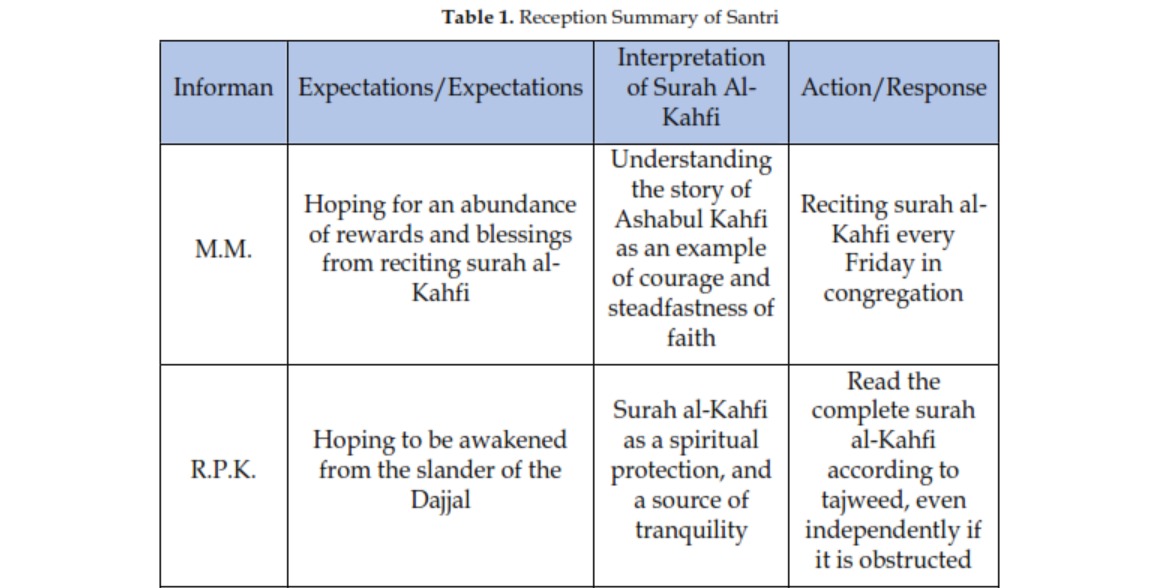
This study discusses the reception of students at Pondok Pesantren Peradaban against the tradition of reciting surah al-Kahfi every Friday as a form of the practice of Living Qur'an. This tradition is not only carried out in congregation and routinely, but also accompanied by an understanding and interpretation of the content of the surah. This research uses a qualitative approach with observation, interview, and documentation methods, and is analyzed using Hans Robert Jauss's Horizon of Expectation theory. The results of the study show that students understand the stories in this surah, such as Ashabul Kahfi and the Prophet Musa with Khidir, through tadabur activities that lead to the internalization of faith values and the manners of seeking knowledge. They also interpret surah al-Kahfi as a surah that has virtues, such as protection from the slander of the Dajjal and blessings between two Fridays. In practice, the recitation of surah al-Kahfi on Friday is carried out in congregation and also uses the correct rules of tajweed. This tradition forms religious discipline, brings inner peace, and increases the motivation and productivity of students in their daily lives.
Downloads
References
[1] M. A. Sayuti, “Cahaya Al-Qur’an Untuk Manusia Modern,” Karimiyah, vol. 3, no. 1, p. 23, 2023, doi: https://doi.org/10.59623/karimiyah.v3i1.28.
[2] A. N. An et al., “Pelatihan metode Tajdied untuk peningkatan membaca Al-Qur’an siswa SD Muhammadiyah Program Khusus Kottabarat,” J. PEMA Tarb., vol. 2, no. 1, pp. 50–68, 2023.
[3] M. Mansyur, Metodologi Penelitian Living Qur’an dan Hadits. Yogyakarta: TH Press, 2007.
[4] M. Q. Shihab, Membumikan Al-Qur’an: Fungsi dan Peran Wahyu Dalam Kehidupan Masyarakat. Bandung: Mizan, 2001.
[5] A. Basir, S. Suri, A. Nirwana AN, R. Sholihin, and H. Hayati, “relevance of national education goals to the guidance of the Al-Quran and Al-Hadith,” Linguist. Cult. Rev., vol. 6, pp. 122–137, Jan. 2022, doi: https://doi.org/10.21744/lingcure.v6nS5.2088.
[6] Bambang Pronogo, Mukjizat Sains Dalam Al-Qur’an: Menggali Insipirasi Ilmiah. Jakarta: Niaga Swadaya, 2005.
[7] A. I. Hartafan, A. Nirwana AN, and C. L. Marheni, “BIBLIOMETRIC ANALYSIS THE ROLE OF ISLAMIC PSYCHOLOGY BASED ON QUR’AN IN OVERCOMING ANXIETY AND IMPROVING MENTAL HEALTH AMONG WOMEN,” QiST J. Quran Tafseer Stud., vol. 3, no. 2, pp. 303–326, Mar. 2024, doi: https://doi.org/10.23917/qist.v3i2.5042.
[8] F. A. Hikmah, Y. Dahliana, A. Nirwana, S. Suharjianto, A. Azizah, and A. Rha’in, “Studi Kitab Tafsir Tanwir Al-Miqbas Min Tafsir Ibni ‘Abbas oleh Al-Fairuzabadi,” Subst. J. Ilmu-Ilmu Ushuluddin, vol. 26, no. 1, pp. 15–25, 2024.
[9] A. Nirwana, A. Fitri, R. Rahmadon, F. Arfan, Z. Zahari, and F. M. Sari, “Sosialisasi Kemukjizatan Al Qur’an Terhadap Komunitas Pendengar Radio Baiturrahman Aceh Melalui Program Interaktif Al Qur’an dan Sains,” PERDIKAN (Journal Community Engag., vol. 1, no. 2, Dec. 2019, doi: https://doi.org/10.19105/pjce.v1i2.2863.
[10] M. U. Abshor, “Tradisi Resepsi Al-Qur’an di Masyarakat Gumawang Sinduadi Mlati Yogyakarta (Kajian Living Qur’an),” Qaf, vol. 3, no. 1, p. 43, 2019, doi: https://doi.org/10.30762/qof.v3i1.1022.
[11] M. Q. Shihab, Lentera Al-Qur’an Kisah dan Hikmah Kehidupan. Bandung: PT Mizan Pustaka, 1994.
[12] A. N. A. Nirwana, F. Arfan, S. Akhyar, and S. Jalil, “Pendampingan Anak Milenial dalam Membaca Al-Qur’an dengan Metode Neuro Nadi Aceh,” Semin. Nas. Multidisiplin Ilmu “Inov. Prod. Penelit. Pengabdi. Masy. Tantangan Era Revolusi, vol. 2, no. 1, p. 10, 2019, [Online]. Available: https://ojs.serambimekkah.ac.id/semnas/article/view/1751
[13] A. N. Andri Nirwana, F. D. Marshal, S. Abdillah, and A. Sahib, “Eksistensi Metode Jibril Dalam Meningkatkan Kefasihan Pelafalan Huruf Al-Qur’an Di Taman Pendidikan Al-Qur’an Al-Hidayah Jorong Paninjauan,” Marsialapari J. Pengabdi. Kpd. Masy., vol. 1, no. 2, pp. 85–98, 2024.
[14] S. Awwalia, “Fadilah Surat Al-Qur’an dalam Pandangan Masyarakat Desa Bandar Setia,” UIN Sumatera Utara Medan, UIN Sumatera, 2019.
[15] P. Peradaban, “Profil dan Sejarah Pesantren Peradaban Bandung,” Youtube.
[16] W. Ayuni, A. Nirwana, and A. Nurrohim, “Bibliometric Analysis of the Development Map and Research Trends in Qur’anic Studies and Tafseer: A Scopus Database Exploration (1974-2023). JOURNAL OF QUR’ᾹN AND HADῙTH STUDIES, 12 (2), 95–116,” J. Qur’an Hadith Stud., pp. 95–116, 2023, doi: https://doi.org/10.15408/quhas.v12i2.36191.
[17] . M., Q. Q. Yusran, . M., . N., . W., and A. Nirwana, “The Practice of Changing the Status of Change of Waqf Property in the Islamic Social Economic View,” J. Ecohumanism, vol. 3, no. 6, pp. 229–238, Sep. 2024, doi: https://doi.org/10.62754/joe.v3i6.3996.
[18] A. N. Andri Nirwana et al., “A historical review on mapping the evolution and direction of leadership in Islam: Challenges and development opportunities. Multidisciplinary Reviews, 7 (6),” Multidiscip. Rev., vol. 7, no. 6, pp. 1–10, 2024, doi: https://doi.org/10.31893/multirev.2024124.
[19] S. Nuranisa, “Living Qur’an: Resepsi Terhadap Tradisi Sima’an Al-Qur’an Di Ma’had Tahfidz Al-Qur’an UIN Sunan Gunung Djati Bandung,” UIN Sunan Gunung Djati, 2024.
[20] A. Rhain, A. Nirwana AN, and B. A. Setiawan, “Reformulasi Metode Penafsiran Al-Qur’an Melalui Metode Tajdidi,” AL QUDS J. Stud. Alquran dan Hadis, vol. 6, no. 3, Dec. 2022, doi: https://doi.org/10.29240/alquds.v6i3.5299.
[21] Q. Aina, “Pembacaan Surat Alkahfi di Kalangan Muslim Indonesia,” Tafsir J. Qur’anic Stud., vol. 5, no. 2, p. 120, 2020, doi: http://dx.doi.org/10.22373/tafse.v5i2.9171.
[22] M.M., “Wawancara Peneliti Bersama M.M. Sebagai Santri Pondok Pesantren Peradaban.” Wawancara langsung Pukul 13.30-15.00, Pondok pesantren Peradaban, 30 Mei 2025.
[23] R.P.K., “Wawancara Peneliti Bersama R.P.K. Sebagai Santri Pondok Pesantren Peradaban.” Wawancara langsung Pukul 13.30-15.00, Pondok pesantren Peradaban, 30 Mei 2025.
[24] A. A. Astuti, S. A. Aryani, S. Hidayat, . W., A. N, Andri Nirwana, and . M., “Parent Practices of SMPIT Insan Mulia Surakarta in Implementing Sexual Education from An Islamic Perspective to Children in The Digital Era,” Int. J. Relig., vol. 5, no. 10, pp. 2092–2109, Jun. 2024, doi: https://doi.org/10.61707/6msvvh24.
[25] A. N. AN, D. Mustofa, and S. Akhyar, “Contextualization Review of the Interpretation of the Verses of the Fathul Qulub Book at the IMM Sukoharjo Regeneration Program,” J. Ilm. Al-Mu’ashirah Media Kaji. Al-Qur’an dan Al-Hadits Multi Perspekt., vol. 20, no. 1, pp. 146–159, 2023.
[26] Sukatin, “HIKMAH: Jurnal Pendidikan Islam Vol. 7, No. 2, Juli – Desember 2018,” vol. 7, no. 2, p. 322, 2018.
[27] I. Septianti, D. Habibi Muhammad, and A. Susandi, “Nilai-Nilai Pendidikan Islam dalam Al-Qur’an dan Hadist,” FALASIFA J. Stud. Keislam., vol. 12, no. 02, pp. 23–32, 2021, doi: 10.36835/falasifa.v12i02.551.
[28] Bangun Pristiwati Zahro and S. N. Adha, “Aspek Keindonesiaan Tafsir Nusantara (Analisis Penafsiran Muhammad Quraish Shihab dalam Tafsir al-Misbah),” Hermeneut. J. Ilmu Al-Qur’an dan Tafsir, vol. 16, no. 01, pp. 47–55, 2022.
[29] A. N. AN et al., “Serving to parents perspective azhar’s quranic interpretation: Study of Birrul Walidain’s terms with the thematic method,” Linguist. Cult. Rev., pp. 254–263, 2022.
[30] N.A.A., “Wawancara Peneliti Bersama N.A.A. Santri Pondok Pesantren Peradaban.” Wawancara langsung Pukul 13.30-15.00, Pondok pesantren Peradaban, 30 Mei 2025.
[31] M.J., “Wawancara Peneliti Bersama M.J. Sebagai Santri Pondok Pesantren Peradaban.” Wawancara langsung Pukul 13.30-15.00, Pondok pesantren Peradaban, 30 Mei 2025.
[32] Ahmad Nasrun, “Praktik Pembacaan Surah Al-Kahfi Di Pondok Pesantren Musthafawiyah Purba Baru Mandaling Natal,” UIN Syarif Hidayatullah, 2021.
[33] S. R. Pratama, A. N. An, A. Yahya, and A. Wahid, “Genealogy Magic in the Perspective of Mufassir Indonesia (QS. Al Baqarah (2): 102 Analysis Study),” al-Afkar, J. Islam. Stud., vol. 7, no. 2, pp. 512–530, 2024.
[34] M.A.P.P., “Wawancara Peneliti Bersama M.A.P.P. Sebagai Santri Pondok Pesantren Peradaban.” Wawancara langsung Pukul 13.30-15.00, Pondok pesantren Peradaban, 30 Mei 2025.
[35] N. Ayni, R. N. Azizah, and R. A. Pribadi, “Pengaruh Kegiatan Pembiasaan Terhadap Pembentukan Karakter Disiplin,” J. Pendidik. dan Kewirausahaan, vol. 10, no. 1, pp. 267–277, 2022, doi: https://doi.org/10.47668/pkwu.v10i1.353.
[36] Muhammad Muslich Al-Jabbar, “Tradisi Pembacaan Delapan Surah Pilihan Oleh Santri Tahfidz (Studi Living Qur’an di Pondok Pesantren Mahasiswa Al-Jihad Surabaya),” UIN Sunan Ampel, 2025.
[37] A. Bin Hambal, Musnad Imam Ahmad, Jilid 5. Jakarta, 2008.
[38] J. Vol and I. Hukum, “Pembiasaan Membaca Surat Al- Kahf pada Malam atau Hari Jum ’ at di komunitas ODOJ DPA Sumedang,” vol. 1, no. 2, p. 66, 2024, doi: https://doi.org/10.61553/abjis.v1i2.150.
[39] S. hamelia Putri and R. R. Kurniawan, “Produktifitas Tauhid dalam Menyikapi Q.S Al-Jumu’ah Ayat 9 beserta Hukumnya,” pp. 13–15, 2022.
[40] U. Abdurrahman, A. N. An, A. Rhain, A. Azizah, Y. Dahliana, and A. Nurrohim, “AL-AFKAR: Journal for Islamic Studies Perdebatan Kategori Ayat Dakwah Qs. Ali Imran Ayat 64 Antara Buya Hamka Dan Mufassir Nusantara,” al-Afkar J. Islam. Stud, vol. 7, no. 1, pp. 189–206, 2024.
[41] Ibnu Rusydi and Fitria Amalin Christia ‘Nisa, “Implementasi Mengaji Al-Qur’an Dengan Tajwid Dan Makhorijul Huruf Bagi Anak–Anak Desa Kedokanbunder Wetan Kecamatan Kedokan Bunder Kabupaten Indramayu,” J. Psychol. Couns. Educ., vol. 1, no. 1, pp. 7–13, 2023, doi: https://doi.org/10.58355/psy.v1i1.4.
[42] A. I. Hartafan and A. N. AN, “A Study Between Tawhid And Pluralism In Buya Hamka And Nurcholish Madjid’s Interpretation Of Kalimatun Sawa In A Comparative Review,” al-Afkar, J. Islam. Stud., vol. 7, no. 1, pp. 159–173, 2024.
[43] N. D. Azari, N. Zulfa, N. Latifa, F. M. Ardana, A. D. Maharani, and F. Mahasiswa, “Manfaat Membaca Al-Quran sebagai Upaya Meningkatkan Konsentrasi dan Fokus Mahasiswa dalam Pembelajaran,” Pros. Semin. Nas. Dan Call Pap. Pengemb. Dakwah , Pondok Al Islam Dan Kemuhammadiyahan, pp. 201–205, 2024.
[44] N. S. Juniar and N. Putri, “Pengaruh Membaca Al- Qur ’ an terhadap Kesehatan Mental,” J. Relig. J. Agama, Sos. dan Budaya, vol. 1, no. 6, pp. 830–839, 2023, doi: https://doi.org/10.55606/agama.v1i6.788.
[45] I. A. Cahyono, A. Azizah, and A. N. An, “Resilience to Calamity in Qur’anic Perspective,” al-Afkar, J. Islam. Stud., vol. 7, no. 2, pp. 975–993, 2024.
[46] A. Akram, S. Suri, W. Faaqih, and A. N. AN, “Damage on Earth in the Qur’an: A Study of Thematic Interpretations in Anwar Al Tanzil’s Interpretation by Al Baidhawi,” al-Afkar, J. Islam. Stud., vol. 7, no. 2, pp. 644–658, 2024.
[47] Z. Dhofier, Tradisi Pesantren: Studi tentang Pandangan Hidup Kyai dan Bimbingannya dalam Pendidikan Agama Islam, 9th ed. Jakarta: LP3ES, 2011.
[48] U. Ni’mah, “The Living Qur ’ an : Self Healing dengan Ayat-ayat al-Qur’an,” AL-MANAR J. Kaji. Al-Quran dan Hadits, vol. 8, no. 2, pp. 65–88, 2022, doi: https://doi.org/10.35719/amn.v8i2.26.
[49] H. R. Jauss, Toward an Aesthetic of Reception. Minneapolis: University of Minnesota Press, 1982.
[50] F. Aliyatul, Y. Dahliana, A. Nirwana, and A. Azizah, “STUDI KITAB TAFSIR TANWIR AL-MIQBAS MIN TAFSIR IBNI ‘ABBAS OLEH AL-FAIRUZABADI,” Subst. J. Ilmu-Ilmu Ushuluddin, vol. 26, no. 1, pp. 15–25, 2024, doi: http://dx.doi.org/10.22373/substantia.v26i1.22695.
[51] A. N. Fadhilah and A. Nirwana, “The Role of Prayer in Seeking Mercy and Guidance: Lessons from the Tafsir of Surah al-Fatihah,” Maʿālim al-Qurʾān wa al-Sunnah, vol. 19, no. 2, pp. 292–298, Dec. 2023, doi: https://doi.org/10.33102/jmqs.v19i2.434.
[52] P. Bourdieu, Outline of a Theory of Practice. Minneapolis: Cambridge University Press, 1977.
Downloads
Submitted
Accepted
Published
How to Cite
Issue
Section
License
Copyright (c) 2025 Davi Abdulloh Haidzam, Eka Galih Rahayu, Elisa, Erma Rahmawati, Ecep Ismail, Asep Abdul Mahyi

This work is licensed under a Creative Commons Attribution 4.0 International License.