A Portable IoT-Based for Non-Invasive Early Stroke Risk Prediction Using Photoplethysmography and Logistic Regression
DOI:
https://doi.org/10.23917/emitor.v26i2.19082Keywords:
Stroke, Non-invasive, MAX30105, Multi-layer Perceptron, Logistic RegressionAbstract
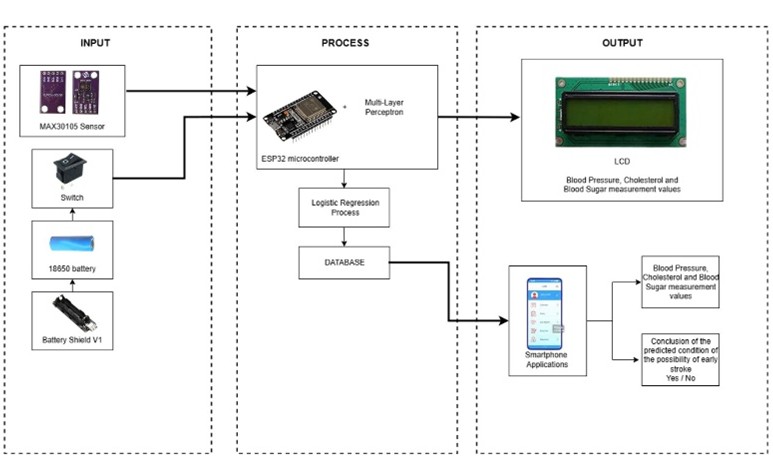
Stroke is a leading cause of death and disability in Indonesia, while early detection is still limited by invasive, expensive, and impractical methods. This study developed a non-invasive stroke detection system based on the MAX30105 sensor, utilizing photoplethysmography (PPG) to measure blood pressure, blood sugar, and cholesterol levels. Data were calibrated using a multi-layer perceptron (MLP) and classified using logistic regression into “Yes/No” stroke risk. The ESP32-based system is integrated with IoT with a real-time display on the LCD and an Android application. Measurement of blood sugar levels using the MAX30105 sensor yielded an accuracy level of 86.79%, while cholesterol measurements achieved 95.07%, systolic blood pressure reached 92.75%, and diastolic blood pressure achieved 97.24%. Additionally, the precision level of the device is indicated by a coefficient of variation value below 2% for all measurement parameters, demonstrating stable and consistent results. The results of the stroke risk classification test obtained an accuracy of 85.71%. The system demonstrated good, consistent performance and has the potential to be a practical solution for non-invasive health monitoring and early stroke detection.
Downloads
Downloads
Submitted
Accepted
Published
How to Cite
Issue
Section
License
Copyright (c) 2026 Emitor: Jurnal Teknik Elektro

This work is licensed under a Creative Commons Attribution 4.0 International License.