Hybrid Bayesian Optimization and Deep Reinforcement Learning for Enhanced MPPT in PV Systems Under Dynamic Conditions
DOI:
https://doi.org/10.23917/emitor.v26i2.18469Keywords:
Maximum Power Point Tracking, Deep Reinforcement Learning, Bayesian Optimization, Photovoltaic Systems, Partial Shading ConditionsAbstract
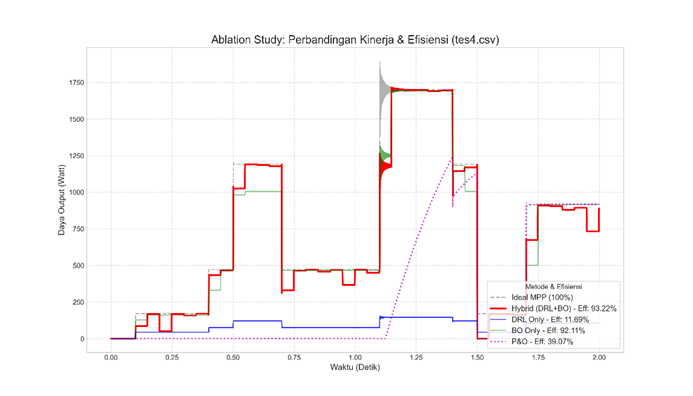
Abstract − Conventional Maximum Power Point Tracking (MPPT) methods in photovoltaic (PV) systems frequently suffer from significant efficiency degradation when subjected to dynamic weather and Partial Shading Conditions (PSC). To address this issue, this study proposes a novel hybrid control algorithm integrating Bayesian Optimization (BO) and Deep Reinforcement Learning (DRL). The primary contribution of this research is the development of an adaptive MPPT system architecture that leverages the global exploration capabilities of BO alongside the high-precision local tuning of DRL to maximize solar energy extraction. The methodology evaluates the proposed BO-DRL agent through an ablation study within a Python simulation environment across four distinctive environmental profiles: uniform irradiance, light partial shading, heavy partial shading, and extreme dynamic conditions. In this framework, the BO component executes a probabilistic global search via Gaussian Processes to prevent the system from getting trapped in local maxima, while the DRL agent performs continuous duty cycle adjustments to minimize steady-state oscillations. Simulation results demonstrate that the hybrid approach significantly outperforms the conventional Perturb and Observe (P&O) method. Under heavy partial shading, the hybrid algorithm achieves a tracking efficiency of 96.08%, whereas the P&O method drops to 62.24% due to local peak entrapment. Under extreme dynamic scenarios, the hybrid efficiency remains robust at 93.22%, while the P&O performance drastically degrades to 39.07%. Furthermore, the ablation validation proves that standalone DRL agents fail to initialize optimally without the global search assistance from the BO unit. In conclusion, the synergistic integration of BO-DRL yields a highly robust, efficient, and adaptive MPPT control solution capable of optimizing PV energy harvesting in highly volatile environments.
Downloads
Downloads
Submitted
Accepted
Published
How to Cite
Issue
Section
License
Copyright (c) 2026 Emitor: Jurnal Teknik Elektro

This work is licensed under a Creative Commons Attribution 4.0 International License.