Implementation of Centralized IoT Safety Latching for Class-D Amplifiers: QoS Analysis and OTA Integration
DOI:
https://doi.org/10.23917/emitor.v26i2.17831Keywords:
Class-D Amplifier, Centralized IoT, Safety Latching, MQTT QoS, OTA UpdateAbstract
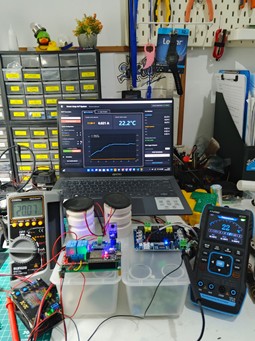
Class-D audio power amplifiers deliver high operational efficiency but remain exceptionally vulnerable to catastrophic failures induced by thermal runaway and output overcurrent. While traditional passive protections and localized active systems isolate faults, they often lack centralized remote monitoring capabilities and seamless software maintainability. This research proposes a Centralized Internet of Things (IoT) protection system using an ESP32 microcontroller as a telemetry node, integrated with INA219 and LM35 precision sensors. Unlike decentralized systems, the core Safety Latching algorithm (OR logic) is processed centrally on a Python-based Graphical User Interface (GUI) server via the MQTT protocol. Furthermore, an Over-The-Air (OTA) firmware update mechanism is integrated for wireless software maintenance. Experimental results demonstrate high measurement accuracy, yielding average errors of less than 1% for temperature and 2% for current. The centralized safety latching algorithm operated robustly, successfully disconnecting the amplifier load at critical thresholds (75.1°C and 3.48 A) and effectively preventing destructive power oscillation by enforcing a manual reset state. The integration of OTA updates proved successful for remote firmware deployment without physical hardware intervention. In conclusion, the proposed centralized IoT framework significantly enhances the diagnostic reliability, safety, and long-term maintainability of high-power audio systems.
Downloads
Downloads
Submitted
Accepted
Published
How to Cite
Issue
Section
License
Copyright (c) 2026 Emitor: Jurnal Teknik Elektro

This work is licensed under a Creative Commons Attribution 4.0 International License.